
Blog
Top 5 Aaronequipment.com Alternatives for 2026
Selling surplus plant equipment and real estate quickly without risking recovery targets or compliance obligations is challenging in industrial asset liquidation. Most auction and brokerage firms lack sector depth, cross-border logistics, or transparent pricing, forcing sellers to juggle multiple vendors. This comparison summarizes service scope and engagement models across five industrial disposition firms so sellers can select a single-vendor model that aligns with their project requirements.
Table of contents
- Maas Companies
- Maynards Asset Disposition
- Loeb Equipment
- Hilco Industrial
- Winternitz Industrial Auctions & Appraisals
- Comparison of alternatives
Maas companies
At a glance
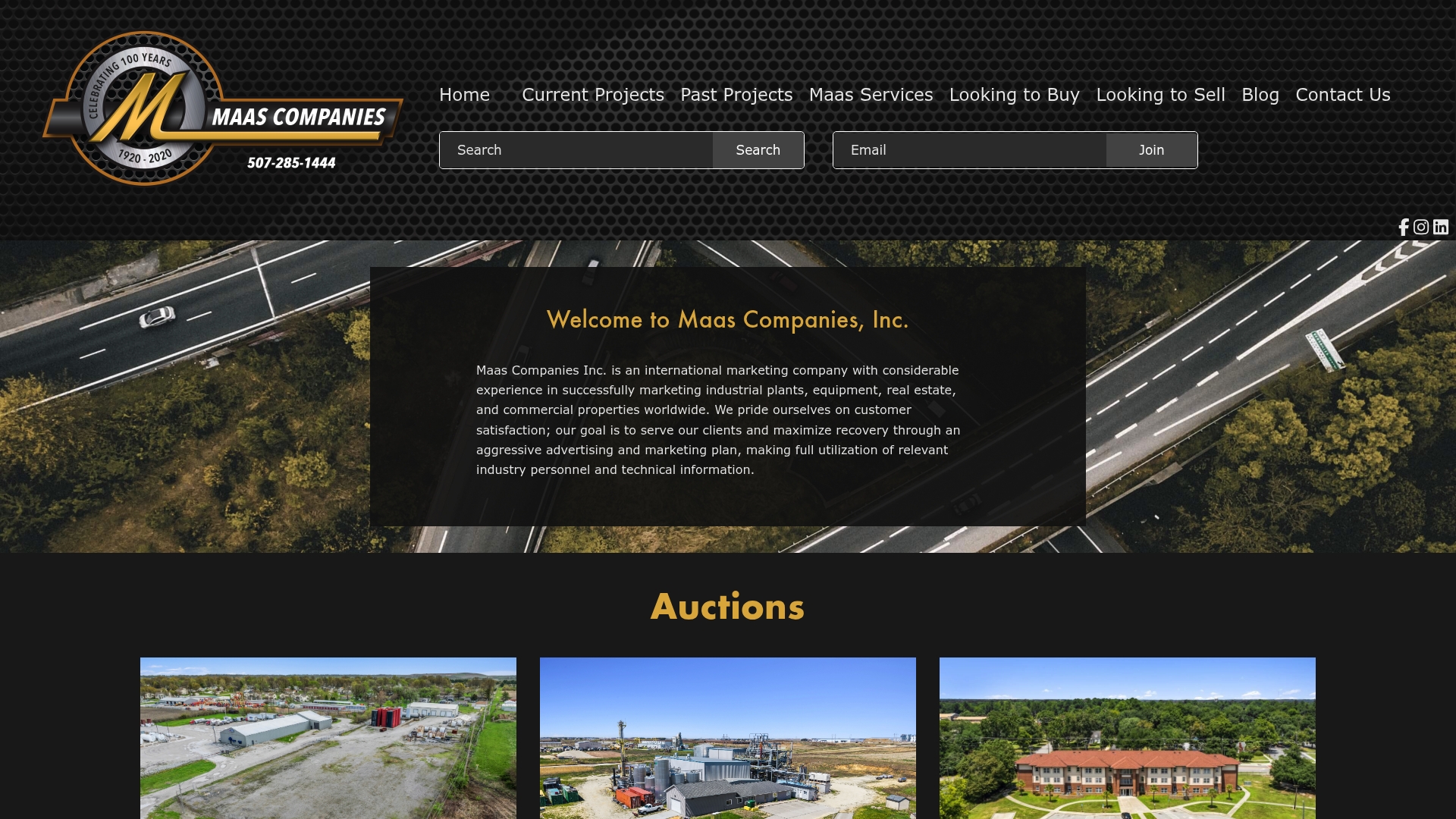
Holds a world record for the largest real estate auction in history and a documented focus on ethanol and biodiesel plant sales. Maascompanies has operated auctions for over 105 years, giving it deep experience in complex asset recoveries. The firm acts as a commission agent and combines marketing, bidding, and logistical coordination for large industrial disposals.
Core features
- Auction and sale of industrial equipment and real estate. Live and online bidding formats target both domestic and international buyers.
- International marketing and liquidation services. Campaigns are designed to reach buyer audiences across multiple geographies and industries.
- Specialization in ethanol and biodiesel plants. The team has repeated experience packaging plant assets for sale to plant operators and investors.
- Full marketing and project coordination. Services include advertising, appraisals, rigging coordination, export logistics, and demolition planning.
Key differentiator
Maascompanies stands out for its long established expertise in selling ethanol and biodiesel plants and for record setting auction experience. That combination matters when a sale involves complex process equipment, regulatory paperwork, and cross border buyers. The firm pairs auction mechanics with project services so sellers do not manage multiple vendors during a liquidation.
Pros
- Extensive tenure and institutional memory. Maascompanies reports more than 105 years of auction activity, which helps with valuation context for large industrial assets.
- Sector depth in renewable fuels. Their repeated work on ethanol and biodiesel plants helps package process systems for operator buyers and component purchasers.
- International reach that broadens the buyer pool. The marketing approach aims to reduce carrying costs by expanding demand beyond local markets.
- Full project support from appraisal to rigging. Coordinating these services reduces scheduling friction and shortens auction timelines.
- Experience with government and large commercial clients. The firm has handled surplus equipment disposals for public agencies and complex real estate auctions.
Cons
- Maascompanies acts only as a commission agent and does not purchase client assets, which may not suit sellers seeking immediate cash offers.
Who it’s for
This firm fits businesses, lenders, and government agencies that need a single vendor to run an industrial asset auction and handle related logistics. It matches sellers with large, complex assets where marketing reach affects recovery. Use Maascompanies when a sale requires auction mechanics, international outreach, and coordinated services.
Unique value proposition
A proven track record of record setting auctions and repeat ethanol plant sales gives clients direct access to buyers who accept plant level asset packages. That capability shortens the path from listing to realized recovery for plant owners and public entities. For estates, lenders, and administrators, this often improves pricing outcomes versus selling piecemeal.
Real world use case
A manufacturer closing a production line hires Maascompanies to liquidate equipment and property. The firm prepares valuations, markets to global buyers, and schedules an online auction with live bidding. Post auction, Maascompanies coordinates appraisals and rigging to clear the site on the agreed timeline.
Pricing
Pricing is not published. Maascompanies operates as a commission agent, so fees and terms are set per engagement and based on the scope of services. Prospective clients should request an engagement letter that lists commission rates and which project services are included.
Website: https://maascompanies.com
Maynards asset disposition
At a glance
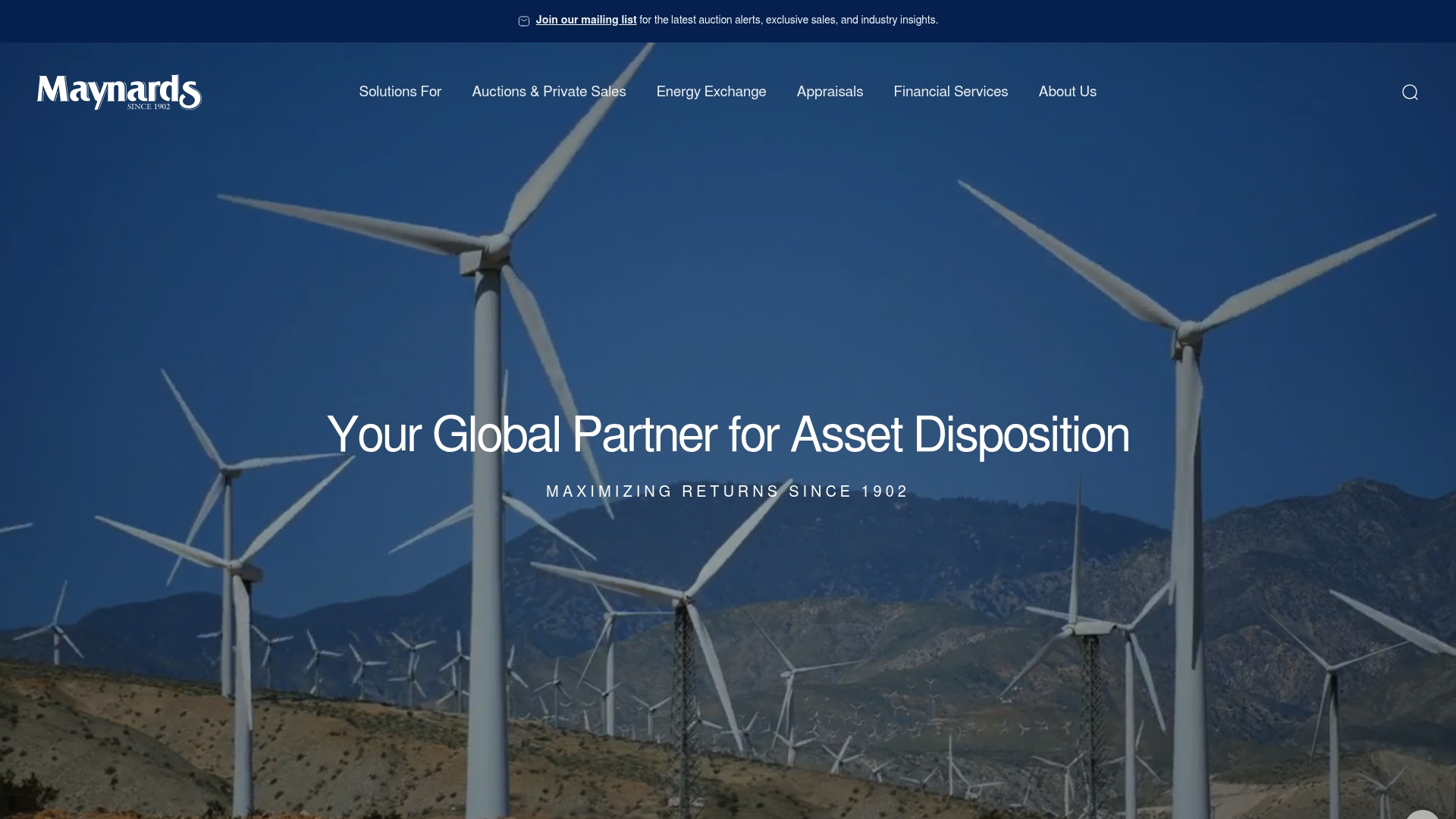
Maynards states it has operated since 1902. That longevity underpins a global network that can move large equipment and entire facilities across borders. The firm combines auctions, private sales, valuations, and financing for industrial and energy clients.
Core features
- Global auction and private sales platform for live and webcast sales to international buyers.
- Energy asset exchange focused on power generation and utility equipment transactions.
- Valuations and appraisals performed by certified experts to support accounting and insurance needs.
- Transaction management services that coordinate logistics, transfer of title, and export documentation.
- Flexible financing solutions to help buyers or sellers with equipment funding and bridge financing.
Key differentiator
The vendor highlights its long operating history and global reach. That history translates into experience handling complex cross-border disposals and regulatory paperwork. Maynards can marshal specialist buyers across industries when a sale requires international exposure.
Pros
- Decades of institutional experience give teams familiarity with complex auction timelines and compliance requirements.
- End-to-end services cover valuation, marketing, sale execution, and settlement, reducing handoffs between vendors.
- Capability to run both confidential private sales and open auctions widens buyer pools for specialized equipment.
- Online and webcast auctions extend geographic reach and can improve recovery for unique or high-value assets.
- Industry coverage includes manufacturing, energy, aerospace, and real estate, which helps match niche buyers to niche assets.
Cons
- Third-party reviews referenced in the product data note inconsistent customer service and unclear reserve disclosure in some sales.
- Large or complex disposals typically require significant lead time for cataloging, transport planning, and regulatory clearances.
- Auction terms can include buyer premiums and fees that affect net recovery for sellers and total cost for buyers.
When it may not fit
Maynards is not the right choice for small, local-only sales where international marketing adds cost without benefit. Sellers with tight timelines for low-value lots may find the lead times and fees disproportionate. Local brokers with yard-level reach can be more practical for small decommissionings.
Who it’s for
Large industrial companies, energy firms, and real estate owners needing professional disposition of high-value equipment or whole facilities will benefit most. Financial officers and asset managers running plant closures or restructurings will find the full-service model useful. Organizations requiring certified appraisals alongside sale execution gain clear benefit.
Real world use case
A manufacturing firm with obsolete machining lines engaged Maynards to perform valuations, market the equipment internationally, and host a webcast auction. The firm received bids from multiple countries and closed sales with logistics and title handled by the firm. Valuation certificates supported the client’s accounting and insurance records.
Pricing
Pricing is not published and is informational only according to the product data. Fees typically depend on sale method, asset complexity, and geography. Sellers should request a detailed fee schedule and sample auction terms before engagement.
Website: https://maynards.com
Loeb equipment
At a glance
Loeb’s marketing materials state the firm has operated since 1880. The firm is family owned and focuses on industrial machinery finance, auctions, appraisals, and sales. Loeb advertises USPAP compliant appraisals and tailored financing for manufacturers and food, pharmaceutical, and processing sectors.
Core features
Loeb combines financing, appraisal, sales, and liquidation services with dedicated client support. The company lists structured credit options and auction management as core offerings. Loeb also maintains a large inventory of used machinery to support buy and sell transactions.
- Equipment financing including term loans, lines of credit, and sale leasebacks tailored to machinery purchases.
- Industrial machinery auctions and liquidation services for surplus or idle assets.
- USPAP compliant machinery appraisals for valuation, reporting, and insurance purposes.
- Used equipment sales supported by inventory management and sourcing assistance.
- Dedicated client support with industry knowledge for transaction execution.
Key differentiator
Loeb emphasizes a long history and industry specialization that the company highlights in its materials. That longevity claim underpins deep institutional knowledge of equipment values and lender expectations. The combination of appraisal services and financing in one provider is the firm’s primary advantage for complex recovery projects.
Pros
- Long operational history and industry focus. That background can shorten appraisal cycles and improve lender confidence.
- Broad service set covering financing, auctions, appraisals, and sales. Clients can centralize multiple phases of an asset recovery project.
- Large inventory and global market access. This helps buyers source used machinery quickly.
- Flexible financing options that include lines of credit and sale leasebacks. These options suit refinancing and acquisition needs.
- Established reputation with financial and industrial clients. That reputation can ease counterpart due diligence.
Cons
- Pricing is not published and is customized. Buyers must request proposals to compare cost effectively.
- Transactions for complex or large portfolios may take longer. Customized processes add steps and approvals.
- Buyer eligibility is often tied to creditworthiness. That constraint can limit bidding participation for some buyers.
When it may not fit
Organizations that need transparent, fixed online pricing will find the model inconvenient because Loeb does not publish standard rates. Sellers who require rapid turnarounds on single machines may find the tailored process too involved. Small buyers with weak credit profiles may struggle to access the full range of financing options.
Who it’s for
Industrial companies, manufacturers, and asset managers that require appraisal quality and financing together will benefit most. Financial institutions arranging asset based lending will find the appraisal and valuation processes relevant. Firms with portfolios large enough to justify a consultative engagement gain the most value.
Real world use case
A manufacturing firm facing a plant closure used Loeb to value equipment, run auctions, and place surplus machinery into sale channels. Loeb provided USPAP compliant appraisals to support insurance and lender reporting. The integrated approach reduced the number of separate vendors the client had to manage.
Pricing
Not applicable for public listing. Pricing is customized and provided after consultation, reflecting asset condition, transaction complexity, and financing structure. Prospective clients must contact Loeb for a written proposal and fee schedule.
Website: https://loebequipment.com
Hilco industrial
At a glance
According to the vendor, Hilco Industrial holds ISO certification for quality, safety, and environmental management and operates across more than 50 countries. The firm manages full factory liquidations and handles large manufacturing assets such as rolling mills and pipe production lines. That scale shows up in projects that require dismantling, logistics, and international sales coordination.
Core features
- Turnkey asset disposition including evaluation, dismantling, packing, and shipping for heavy industrial sites.
- Project management for plant closures with staff experienced in steel mills, rolling mills, and pipe plants.
- Global sales and buyer outreach leveraging Hilco Global relationships to place specialized equipment internationally.
- ISO certified processes for quality, safety, and environmental management as claimed by the vendor.
- Valuation and reporting for insurance, financial reporting, or sale preparation.
Key differentiator
Hilco Industrial combines deep experience in heavy industry with a global network through Hilco Global. That combination makes the company suited to multi component, international liquidations where logistics and buyer outreach are complex. The vendor claim of formal ISO certification adds a documented focus on process standards for large asset projects.
Pros
-
Deep industry expertise. The team understands metallurgy equipment, rolling mills, and pipe plant workflows, which shortens asset appraisal time.
-
Global reach for cross border sales. International buyer access helps find appropriate end users for specialized machinery.
-
Turnkey services that include dismantling and logistics reduce the number of third parties you must manage on a closure.
-
Documentation and valuation capabilities support insurance claims and financial reporting during closures and restructurings.
-
Part of Hilco Global, which offers broader market intelligence and buyer networks for unusual or highly specialized assets.
Cons
-
Focused on large industrial assets, so smaller machinery or single line equipment may get limited attention.
-
Large projects often require longer sale timelines, which can increase carrying costs for owners during disposition.
-
The website is largely informational with limited online catalog or instant purchase options for buyers seeking immediate transactions.
When it may not fit
If your requirement is to sell a handful of shop floor machines or consumer grade equipment, this provider may be a poor match. If you need instant online sales or fixed price listings, Hilco Industrial’s project driven approach will feel slow. Small businesses with limited budgets will likely find the scale and minimum project costs misaligned with their needs.
Who it’s for
Manufacturing firms planning plant closures and asset managers who must remove and monetize heavy industrial lines will find the firm useful. Industrial equipment investors and refurbishers seeking large, specialized machinery for reconditioning will benefit from the global buyer network. Legal and finance teams handling distressed asset recovery will value the valuation and reporting support.
Real world use case
A steel mill scheduled for closure contracted Hilco Industrial to liquidate melting furnaces, rolling mills, and pipe lines. Hilco managed appraisal, dismantling, cross border shipping, and sale to international buyers. The client used the valuation reports for accounting and insurance and avoided hiring multiple contractors.
Pricing
Not applicable, informational only. Hilco Industrial operates on project pricing and bespoke engagement terms rather than published service tiers. Expect quoted fees tied to project scope, asset complexity, and logistics requirements.
Website: https://hilcoindustrial.com
Winternitz industrial auctions & appraisals
At a glance
According to the company, Winternitz was established in 1894 and focuses on complex manufacturing asset sales across the United States, Canada, and Mexico. The firm combines live and webcast auctions with on-site and private negotiated sales. This history and cross-border reach make it a common choice for large plant liquidations and court-ordered dispositions.
Core features
Winternitz runs live and webcast online auctions and supports on-site and hybrid event formats. They offer fixed-price liquidations and private negotiated sales for assets that require a non-auction path. The firm provides market-based equipment appraisals and valuation reports tailored to financial and insurance needs. Their auction platform includes auto-bid and maximum bidding features and automatic bidder notifications. Project managers can combine disposal services with appraisal work for complex, multi-location assignments.
Key differentiator
Winternitz differentiates itself with long institutional experience and what the company calls proprietary market data to inform valuations and pricing strategies. That data supports valuation accuracy and helps position large asset packages for cross-border bidding. The vendor emphasizes tailored recovery plans for complex manufacturing facilities rather than off-the-shelf listings.
Pros
-
Long industry presence. The company reports operations dating back to 1894, which supports deep institutional knowledge of manufacturing asset markets.
-
Specialized focus on manufacturing equipment and plants. This expertise helps when assets require detailed condition assessment and lotting strategies.
-
Multiple sale formats. Clients can choose live auctions, webcast events, sealed bids, or private sales to match legal or operational constraints.
-
Market-based appraisals. The firm provides valuation reports that lenders and insurance teams can use for collateral and claims work.
-
Cross-border capability. Winternitz conducts transactions in the United States, Canada, and Mexico, which matters for multinational plant closures.
Cons
-
Pricing transparency is limited. The public information lists buyer premiums and potential additional fees, but detailed cost schedules are not widely published.
-
Narrow asset focus. The offering centers on industrial and manufacturing assets and does not suit personal property or retail inventory sales.
-
Sparse consumer-facing detail. Online materials emphasize capability and results over step-by-step client guidance or full service menus.
When it may not fit
Organizations selling non-industrial items should look elsewhere because the firm concentrates on manufacturing assets. Small firms with a single machine or low-value lots may find the engagement model and fee structure excessive. Buyers who require a highly interactive online marketplace for ordinary equipment may prefer a different venue with broader retail inventory.
Who it’s for
Winternitz fits manufacturers and owners who must liquidate entire plants or large equipment fleets. It also serves bankruptcy courts, lenders, and turnaround professionals who need appraisals tied to formal recovery processes. Use this firm when complexity, cross-border sales, or formal valuation documentation matter.
Real world use case
A midwestern manufacturer closing a multi-shift plant engaged Winternitz to appraise machinery, design lotting for sale, and run a hybrid auction across three time zones. The team handled on-site staging, online bidder access, and final settlement with the lender. The result simplified disposition and produced a coordinated asset recovery process that matched court and creditor requirements.
Website: https://winternitz.com
Comparison of alternatives
For businesses seeking solutions in industrial asset liquidation, several competitive options exist, each presenting unique advantages. Evaluating these providers based on their strengths and particular services can help determine the best fit for specific project requirements. Below, we examine notable aspects of several top providers.
Expertise in niche liquidation markets
- Maas Companies demonstrates a commanding presence in marketing and selling ethanol and biodiesel plants. Their experience ensures access to a targeted buyer pool seeking such facilities, which can lead to higher recovery values.
- Conversely, companies such as Hilco Industrial bring substantial specialization in heavy industry sectors. With deep expertise in dismantling and logistics, they are uniquely poised to handle large-scale industrial closures, such as steel or pipe rolling mills.
Financial and logistical support
- While Maas Companies integrates project services, Loeb Equipment provides tailored financial solutions and evaluations. This allows clients to secure flexible funding for acquisitions and disposals.
- Maynards Asset Disposition offers a spectrum of asset valuation and transaction support services, excelling in providing solutions for assets requiring global marketing and cross-border documentation.
Best fit
- Maas Companies is intricately equipped for renewable energy plants and facilities, ensuring maximum financial recovery through market strategies.
- Loeb Equipment effectively combines equipment financing and appraisals, ideal for businesses requiring integrated financial solutions during sales processes.
- Hilco Industrial caters to heavy industrial sector clients managing vast and multifaceted operations due to their exceptional project management capabilities.
- Winternitz Industrial Auctions & Appraisals provides tailored solutions for North American manufacturers requiring hybrid auction systems for large-scale liquidations.
Our pick
Among the evaluated alternatives, Maas Companies is an excellent choice for sellers looking to implement international outreach and niche sector marketing strategies, particularly in the renewable energy space. However, for projects involving significant financial integration or focused on other industrial sectors, competitors such as Loeb Equipment or Hilco Industrial might align more closely with the needs of specific sellers.
Using detailed considerations, the table below compares key industrial asset disposition services.
Consider Maascompanies for complex industrial asset liquidation
When evaluating aaronequipment.com alternatives, one critical challenge is managing complicated plant closures with diverse asset types and wide geographic markets. Executives and asset managers prioritizing streamlined coordination, minimizing carrying costs, and expanding buyer reach will find Maascompanies well-suited for this task. Their 105 years of auction expertise focused on large industrial equipment and ethanol plants ensures precise handling of regulatory, logistical, and marketing complexities.
Why Maascompanies stands out:
- Full project management from appraisal through rigging and export
- International marketing efforts to broaden buyer pools and accelerate recovery
- Commission agent model focused on maximizing sale proceeds without inventory risk
Explore Maascompanies’ offerings to optimize your liquidation strategy. Book a consultation to receive a tailored plan for managing your industrial asset disposition and reducing auction timelines.
FAQ
How does Maascompanies support industrial asset recovery?
Maascompanies specializes in the auction and sale of industrial equipment, providing full project coordination services that cover advertising, appraisals, rigging, and more. Their extensive experience in complex asset recoveries allows them to effectively manage the entire liquidation process, ensuring that clients maximize their return on assets.
What is the difference between Maascompanies and maynards asset disposition?
Maynards Asset Disposition has a strong global network for moving large equipment, which can be advantageous for international sales. In contrast, Maascompanies excels in the specialized marketing and liquidation of ethanol and biodiesel plants, making it a better fit for those specific asset categories and project needs.
Which platform offers better support for plant closures: Maascompanies or loeb equipment?
Loeb Equipment offers a comprehensive suite of financing options for machinery purchases, beneficial for clients seeking financial assistance alongside asset recovery. Maascompanies, however, focuses primarily on running auctions and managing logistics, making it the appropriate choice for clients looking for a more hands-on, strategic approach during plant closures.
Can i use Maascompanies if i need quick asset valuations?
Maascompanies provides detailed appraisal services to support various asset dispositions, but their process may involve more engagement compared to competitors that focus solely on quick valuations. If time is critical, initiating a discussion with Maascompanies will help clarify expected timelines.
How does Maascompanies ensure international outreach for asset sales?
Maascompanies employs targeted international marketing campaigns designed to connect with buyers across different geographies, significantly broadening the potential buyer pool and minimizing carrying costs. This strategy is essential for maximizing returns on large industrial disposals.
Recommended
- Sell or Store? How to Decide on Surplus Equipment | Blog | Insights on Asset Liquidation and Auction Trends
- How to Choose the Right Auction for Industrial Equipment | Blog | Insights on Asset Liquidation and Auction Trends
- ONLINE ONLY EQUIPMENT AUCTION: Remy International Tank Manufacturing Jacking System | View Our Current Projects | Maas Companies
- Top 8 Lumbermenonline.com Alternatives 2026 | Blog | Insights on Asset Liquidation and Auction Trends