
Blog
Auction Compliance for Asset Liquidation: What to Know

TL;DR:
- Auction compliance involves adhering to legal, regulatory, and operational requirements that ensure proper notification, documentation, and anti-money laundering controls. Non-compliance risks lawsuits, penalties, and reputational damage, especially when notification failures or improper documentation occur. Effective programs require leadership ownership, continuous enforcement, and robust record-keeping to withstand regulatory and legal scrutiny.
Auction compliance is frequently treated as a formality, something the legal team handles before a sale closes. That assumption carries real financial and reputational risk. What is auction compliance, precisely? It is the full framework of legal, regulatory, and operational requirements that govern how auctions are conducted, from proper pre-sale notification through post-sale documentation and anti-money laundering controls. For CFOs and legal advisers overseeing asset liquidation, understanding these requirements is not optional. Non-compliance creates exposure to lawsuits, regulatory penalties, and transaction failures that can erase the recovery value the auction was designed to generate.
Table of Contents
- Key takeaways
- Core legal and regulatory requirements
- AML and KYC requirements in auction operations
- Documentation, notification, and process transparency
- Leadership and compliance culture
- My perspective on where auction compliance really breaks down
- How Maascompanies supports compliant asset liquidations
- FAQ
Key takeaways
| Point | Details |
|---|---|
| Compliance is a legal framework | Auction compliance covers notification rules, AML programs, documentation, and state-specific statutes, not just sale procedures. |
| Improper notice is the top risk | Over 70% of auction legal disputes involve notification failures, making pre-sale process the most vulnerable phase. |
| AML thresholds are lower than expected | Auction houses with over $100,000 in annual sales must maintain a full AML compliance program under the Bank Secrecy Act. |
| Documentation creates defensibility | Thorough audit trails for notices, bids, and post-sale records protect against wrongful sale claims and regulatory scrutiny. |
| Leadership determines program effectiveness | Compliance programs only reduce legal risk when leadership actively enforces standards, not when they exist on paper alone. |
Core legal and regulatory requirements
Auction compliance regulations in the United States operate across multiple layers. Federal statutes, state-specific lien laws, sector regulations, and international protocols for cross-border transactions all apply simultaneously. Understanding where they overlap, and where they conflict, is the starting point for building a defensible auction process.
At the state level, lien and auction statutes vary considerably, particularly for self-storage facilities and industrial asset disposals. California, Texas, and Florida each prescribe different notice periods, publication requirements, and minimum waiting periods before a lien sale can proceed. Some states require certified mail notice; others require publication in a local newspaper for a set number of weeks. Executing a sale under the wrong state’s standard, or conflating requirements across jurisdictions, is a common source of legal exposure.
The statutory stakes are not abstract. Improper notice is the leading cause of wrongful sale claims, with over 70% of legal disputes from 2020 to 2024 involving notification failures during the lien process. A company that skips a single required publication step or sends notice to an outdated address can face a successful wrongful sale claim regardless of whether the underlying debt was legitimate.
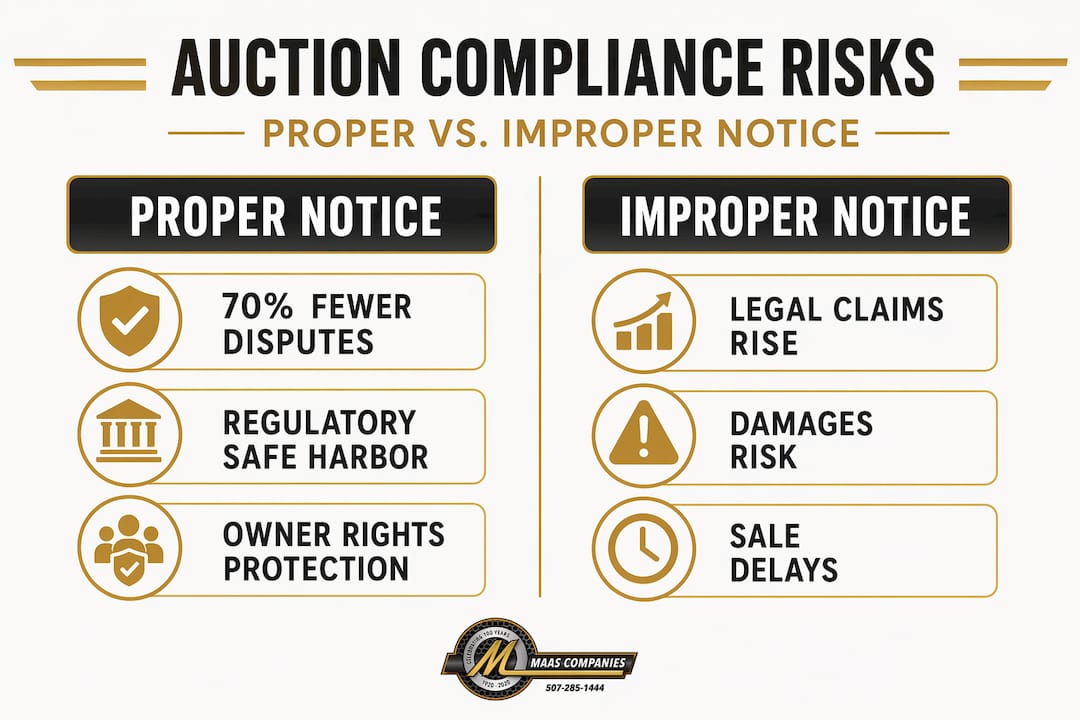
For industrial asset auctions, the requirements extend further. Statutory timelines and notices protect against wrongful sale claims and must be followed precisely to maintain defensibility. Timing matters: a sale conducted one day before the required waiting period expires exposes the seller to the same legal risk as one that skips the notice entirely.
State notice and timing requirements: a comparison
| State | Notice method required | Minimum waiting period | Publication requirement |
|---|---|---|---|
| California | Certified mail | 14 days post-default notice | One-time advertisement |
| Texas | Certified mail + posting | 30 days minimum | Not required for all categories |
| Florida | Certified mail | 14 days after lien notice | One local newspaper advertisement |
| New York | Certified or first-class mail | Varies by asset type | Required in some jurisdictions |
Legal consequences for non-compliance include injunctive relief stopping the sale, damages paid to the asset owner, regulatory fines, and in cases of willful violation, exposure to criminal liability. For organizations conducting multiple liquidations annually, these risks compound quickly.
AML and KYC requirements in auction operations
The auction sector occupies an unusual position in financial regulation. High-value transactions, anonymous bidders, and rapid asset transfer create conditions that regulators treat as money laundering risks. The Bank Secrecy Act requires that auction houses exceeding $100,000 in annual sales implement a formal anti-money laundering program. That threshold covers nearly every professional liquidation operation.
The core components of a compliant AML program for auction operations include:
- A designated compliance officer with authority to implement and enforce the program
- Customer due diligence (CDD) procedures that verify buyer identity before high-value transactions settle
- Suspicious Activity Reports (SARs) filed with FinCEN when transactions exhibit red flags such as structuring, unusual payment methods, or inconsistencies in buyer identity
- Ongoing employee training to recognize and escalate potential violations
- Periodic independent audits to verify program effectiveness and update procedures in response to regulatory changes
Failure to comply with AML requirements can result in heavy fines, imprisonment, and reputational damage that eliminates future business opportunities. These are not theoretical risks. Regulatory enforcement in adjacent financial sectors demonstrates that prosecutors view AML failures as willful when written programs existed but were not enforced.
One complexity that receives insufficient attention is the tension between AML documentation requirements and data privacy law. KYC data collected for AML compliance provides a lawful basis for data collection under GDPR’s data minimization principle. However, auction houses operating across U.S. and European jurisdictions must ensure that bidder data collected for compliance purposes is retained only as long as regulations require and stored with appropriate security controls.
Pro Tip: Treat AML compliance as operational risk management, not regulatory paperwork. The organizations that get into trouble are not those without written AML programs. They are the ones whose programs were never operationalized. Assign responsibility, fund training, and audit the program annually against current FinCEN guidance.
Documentation, notification, and process transparency
How an auction is documented is frequently as legally significant as how it is conducted. Regulators and courts reviewing a disputed sale do not simply ask whether procedures were followed. They ask whether the organization can prove those procedures were followed, with contemporaneous records that were not assembled after a dispute arose.

Effective auction compliance practices in documentation cover three phases: pre-sale, execution, and post-sale.
Pre-sale documentation includes:
- Written lien notices with proof of delivery (certified mail receipts, return receipts, or courier confirmation)
- Accurate auction listings that describe assets without material omissions or misrepresentations
- Published advertisements meeting statutory placement and content requirements
- Documentation of the timeline showing that mandatory waiting periods were observed
Execution documentation covers the auction itself: bidder registration records, bid history, final hammer prices, identification records for winning bidders, and signed buyer’s agreements. For online auctions, system-generated logs and timestamps supplement manual records. Online auction platforms acting as data processors must have formal Data Processing Agreements with the auction house to satisfy applicable compliance requirements.
Post-sale documentation includes payment receipt records, transfer of title or bill of sale, and removal authorization. In lien sales, a written accounting of sale proceeds, fees deducted, and amounts remitted to the lienholder provides the documentation necessary to defend against any subsequent challenge to the distribution.
Pro Tip: Surpassing minimum compliance is the correct standard for organizations managing significant asset portfolios. Build documentation practices that would hold up under adversarial review, not just a routine regulatory check. That means dating every step, retaining delivery confirmations, and archiving auction records for at least the applicable statute of limitations period in each jurisdiction.
The role of technology in supporting auction compliance requirements has expanded considerably. Platforms that automate notice delivery, capture bid logs, and generate compliant post-sale summaries reduce the administrative burden while improving the reliability of the audit trail. Selecting a platform that generates documentation meeting both operational and regulatory standards is a compliance decision, not merely a technology preference. When evaluating auction options for industrial equipment, the documentation capabilities of the platform should factor directly into the decision.
Leadership and compliance culture
The importance of auction compliance extends beyond legal teams and compliance officers. Regulatory enforcement agencies and courts evaluate whether compliance programs reflect genuine organizational commitment or exist only on paper. The distinction has direct consequences for how violations are treated.
The effectiveness of a compliance program depends on practical implementation, not the existence of the program itself. An organization with a 40-page compliance manual that no one enforces receives no more credit with prosecutors than one with no manual at all. By contrast, strong compliance programs that demonstrate continuous training, monitoring, and disciplinary enforcement may reduce fines or sentencing exposure when violations occur.
The following table summarizes the criteria that distinguish effective compliance programs from superficial ones:
| Criteria | Effective program | Ineffective program |
|---|---|---|
| Leadership engagement | Senior management sets tone and monitors outcomes | Compliance delegated entirely to legal staff |
| Employee training | Regular, role-specific training with documented completion | Annual generic training, no verification of understanding |
| Monitoring and auditing | Data analytics, periodic audits, clear corrective action | No systematic monitoring after program launch |
| Disciplinary enforcement | Consistent consequences for violations at all levels | Violations addressed informally or inconsistently |
| Response to incidents | Root cause analysis and program updates after each incident | Incidents handled as isolated events |
A compliance culture also shapes how organizations respond when gaps surface. Organizations with genuine compliance cultures treat a discovered deficiency as a process failure requiring correction. Organizations with superficial compliance treat it as a liability to be managed. That behavioral difference is visible to regulators and, ultimately, to courts.
My perspective on where auction compliance really breaks down
I’ve spent considerable time working alongside organizations managing complex asset liquidations, and the pattern I see consistently is this: compliance failures rarely stem from genuine ignorance of the rules. They stem from an organizational assumption that someone else is handling it.
In practice, the legal team assumes operations understands the notice requirements. Operations assumes the auction house is managing documentation. The auction house assumes the client has obtained necessary consents. The result is a gap that no one owns, which becomes a wrongful sale claim or an AML finding after the fact.
What I’ve observed in auctions where compliance held up under scrutiny is that someone in a leadership position made it their personal responsibility to verify the end-to-end process. Not delegate it. Verify it. They confirmed that notice receipts were in the file before the auction ran. They reviewed bidder registration records before settlement. They treated each auction as a transaction that might one day be reviewed by a regulator or opposing counsel.
The organizations that treat compliance as a baseline and build credible, defensible processes beyond that baseline are the ones that avoid the litigation, the regulatory findings, and the reputational harm that others experience. Moving from reactive compliance to proactive process management is not a major organizational overhaul. It is a decision by leadership to take ownership of the outcome.
— Vector
How Maascompanies supports compliant asset liquidations
Maascompanies brings decades of experience managing complex, high-value asset liquidations for industrial, commercial, and real estate portfolios. That experience is built on a foundation of process rigor that accounts for legal notification requirements, AML obligations, documentation standards, and jurisdiction-specific compliance requirements.

When organizations face plant closures, restructuring events, or surplus equipment disposal, Maascompanies provides the structured process and industry expertise needed to conduct auctions that withstand regulatory and legal scrutiny. From pre-sale lien notice management through post-sale accounting and title transfer, every phase is executed with documentation designed to hold up under adversarial review.
A recent example of this approach in practice is the biodiesel plant auction project, which involved multiple asset categories, multiple jurisdictions, and complex regulatory requirements. For organizations looking to maximize recovery while managing compliance exposure, the right starting point is contacting our team to discuss your specific asset profile and applicable compliance obligations.
FAQ
What is auction compliance in asset liquidation?
Auction compliance is the set of legal, regulatory, and operational requirements that govern how liquidation auctions are conducted, including proper notification, AML programs, documentation, and adherence to state-specific lien statutes.
What triggers AML compliance requirements for auction houses?
Auction houses generating over $100,000 in annual sales must implement a formal AML program under the Bank Secrecy Act, including customer due diligence, suspicious activity reporting, and employee training.
Why is proper notification so critical in lien auctions?
Over 70% of auction legal disputes involve improper notification, making pre-sale notice procedures the highest-risk phase of the lien sale process.
What records should be retained after an auction?
Retain all pre-sale notices with delivery confirmation, bidder registration records, bid logs, buyer agreements, payment receipts, and post-sale accounting summaries for the full statute of limitations period in each applicable jurisdiction.
How does leadership affect auction compliance outcomes?
Practical program effectiveness, not just program existence, determines how compliance is evaluated by regulators. Senior leadership engagement in monitoring and enforcement is the most reliable indicator of a program that will hold up under scrutiny.
Recommended
- How Auctions Help Speed Up Industrial Asset Disposition | Blog | Insights on Asset Liquidation and Auction Trends
- How to Plan Government Asset Sales for Spring 2026 | Blog | Insights on Asset Liquidation and Auction Trends
- How Auctions Help Speed Up Industrial Asset Disposition | Blog | Insights on Asset Liquidation and Auction Trends
- How to Navigate Commercial Property Foreclosure Sales | Blog | Insights on Asset Liquidation and Auction Trends