
Blog
Best Hardened Structures Alternatives for Industrial Shelters
TL;DR:
- Choosing between bespoke and modular protective shelters depends on threat duration and urgency. Vendors’ technical credibility, project timelines, and matching threat profiles are critical for successful selection.
What are the top alternatives to Hardened Structures for industrial protective shelters?
The strongest hardenedstructures.com alternatives span two distinct tiers: ultra-custom bespoke builders and factory-built modular suppliers. Knowing which tier fits your threat profile and timeline is the first decision, not the last.
- Oppidum — Ultra-luxury custom underground fortifications; targets high-net-worth and corporate clients requiring maximum architectural integration and long-term occupancy design.
- Atlas Survival Shelters — US-based manufacturer of prefabricated steel underground bunkers and NBC air filtration systems; over 20 shelter styles available for residential and light industrial use.
- Rising S Company — America’s largest all-steel bunker manufacturer; builds with 1/4-inch plate high-grade steel and ships factory-finished units nationwide.
- Ark Shelter — European modular shelter provider with a focus on above-ground and semi-buried steel systems for rapid deployment.
- Artemis Protection — Specializes in blast-resistant and ballistic-rated enclosures for industrial and government clients.
- Blastcrete Industries — Focuses on shotcrete-based blast-hardened construction for industrial infrastructure protection.
- Ghella — International tunneling and underground civil engineering contractor; handles large-scale underground infrastructure projects.
- Geostock — Underground storage and cavern engineering firm with deep expertise in rock mechanics and subsurface design.
- Herrenknecht AG — German tunneling technology leader; supplies mechanized boring systems used in major underground shelter and infrastructure projects worldwide.
- The Vivos Group — Operates community-scale underground survival networks across the US and Europe; targets corporate and institutional clients seeking shared bunker access.
- Ultimate Bunker — US design-build contractor focused on premium underground bunkers, safe rooms, and gun vaults for residential and commercial clients.
- Modular Security System (MSS) — A patented above-ground shelter system engineered for blast resistance, rapid deployment, and scalable installation on vetted client sites.
These providers collectively cover the full spectrum of protective structural solutions identified in the 2026 global underground bunker construction market report, which tracks over 40 major players worldwide.
Table of Contents
- Key factors to consider when choosing a protective structural system provider
- How do bespoke custom and modular shelter systems compare?
- Notable US and international providers across the protective shelter market
- Industry insights on selecting the right protective shelter provider in 2026
- How pricing models differ across protective shelter providers
- Case studies in protective shelter installations by alternative providers
- What clients report when evaluating alternative providers
- Key Takeaways
Key factors to consider when choosing a protective structural system provider
Selecting the wrong provider is not just a budget problem. A mismatch between your threat model and a vendor’s core capability can result in a shelter that fails its primary mission.
- Threat profile and shelter duration. Distinguish between a safe room designed for short-duration threats such as civil unrest or severe weather, and a bunker engineered for extended occupancy against blast, fallout, or CBRN (Chemical, Biological, Radiological, and Nuclear) threats. These are fundamentally different engineering challenges with different cost structures.
- Lead time alignment. Bespoke custom projects typically require 9–48 months from contract to completion. Modular units generally deliver in 6–16 weeks. If your asset recovery or site protection schedule is fixed, lead time may eliminate entire vendor categories before any other evaluation begins.
- Technical capability verification. Request documented project histories, not marketing summaries. Vendors should demonstrate prior work on blast engineering, EMP/HEMP shielding, or CBRN air filtration, depending on your specification.
- Warranty and post-installation support. Confirm what the vendor covers after delivery: structural warranties, filtration system maintenance, and access to engineering support for modifications.
- Client vetting and confidentiality practices. Top-tier providers operate under strict confidentiality protocols. A vendor that cannot demonstrate a clear chain of control for project information is a liability for sensitive industrial sites.
Pro Tip: Before issuing any RFP, document your threat scenario in writing, including occupancy duration, occupant count, and the specific threat categories you are engineering against. Vendors who cannot respond to a written specification with equal specificity are not equipped for mission-critical work.
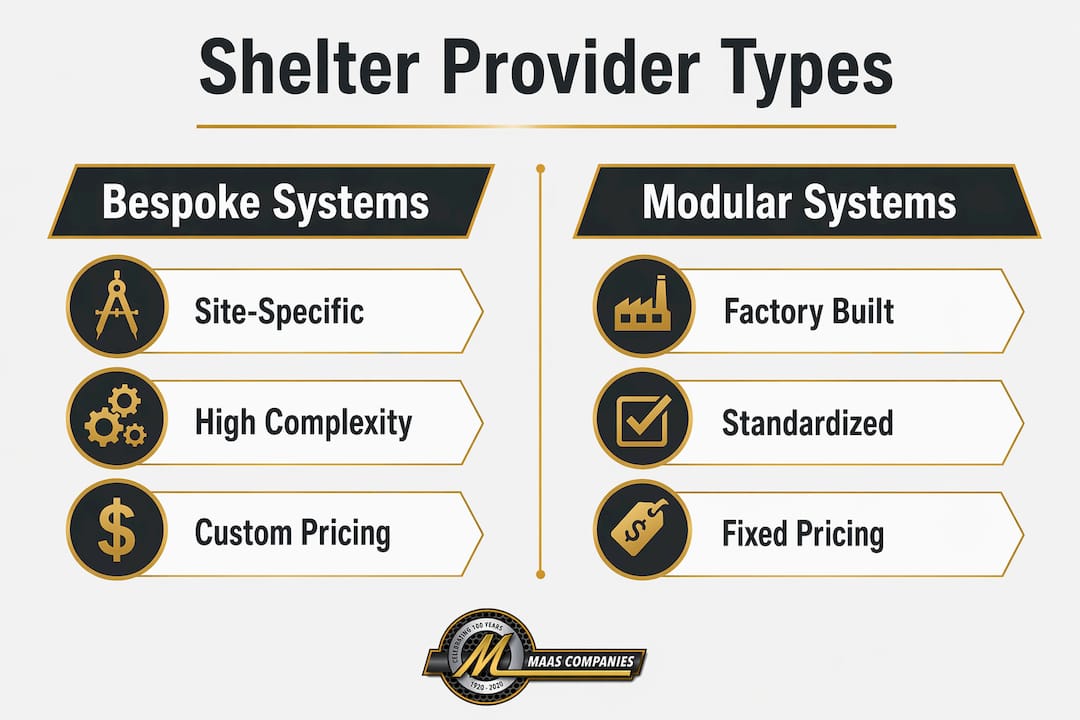
How do bespoke custom and modular shelter systems compare?
The choice between a custom-architected shelter and a factory-built modular system shapes every downstream decision, from budget to timeline to long-term operational flexibility.

| Dimension | Bespoke Custom Systems | Modular Systems |
|---|---|---|
| Design approach | Site-specific architectural and engineering design | Prefabricated catalog-based steel or composite modules |
| Lead time | 9–48 months | 6–16 weeks |
| Cost tier | High; mission-critical and luxury installations | Lower; budget-sensitive or standardized requirements |
| Scalability | Limited post-construction modification | Modules can be added or reconfigured |
| Threat coverage | Full CBRN, blast, EMP, long-term occupancy | Varies; basic to intermediate blast and NBC protection |
| Best fit | Complex, high-stakes, long-duration deployments | Rapid deployment, standardized protection needs |
Bespoke providers like Oppidum and Hardened Structures design from the ground up, integrating security programming, life-safety systems, and site-specific structural engineering across multi-year project timelines. Modular suppliers such as Atlas Survival Shelters, Rising S Company, and MSS deliver factory-finished units with ventilation, filtration, multiple entrances, and emergency exits already integrated. The FORORAK system, for example, uses high-grade steel modules anchored to reinforced concrete slabs, allowing clients to expand a single-family shelter into a multi-room complex by connecting additional segments.
Notable US and international providers across the protective shelter market
The 2026 market includes providers at every scale, from single-unit residential suppliers to multinational tunneling contractors handling government-grade underground infrastructure.
- Hardened Homes — Operating since 1995, this US design-build firm covers fortified residential, corporate, and community structures with full architectural, engineering, and security planning services.
- The Vivos Group — Manages community bunker networks in the US and Europe; suited to organizations seeking shared, pre-built underground capacity without the capital outlay of a private build.
- Ghella — Italian tunneling contractor with global project reach; handles large-scale underground civil works that underpin major shelter and infrastructure installations.
- Herrenknecht AG — Supplies the mechanized tunnel boring systems used in the most technically demanding underground projects; not a shelter builder directly, but a critical supply chain partner for large-scale underground construction.
- Geostock — French underground storage engineering firm with expertise in rock cavern design; relevant for industrial clients requiring subsurface asset protection at scale.
- Blastcrete Industries — US-based; applies shotcrete technology to blast-hardened construction, particularly for industrial and utility infrastructure.
- Artemis Protection — Focuses on ballistic and blast-rated enclosures for government and industrial clients requiring certified protection levels.
| Provider | Geographic Reach | Project Scale | Core Competency |
|---|---|---|---|
| Atlas Survival Shelters | US, UAE, Saudi Arabia | Residential to light commercial | Prefab steel bunkers, NBC filtration |
| Rising S Company | US nationwide | Residential to industrial | All-steel factory-built bunkers |
| Oppidum | Europe, global project-quoted | Ultra-large custom | Luxury underground fortifications |
| Ghella | Global | Large-scale infrastructure | Underground civil engineering |
| Herrenknecht AG | Global | Major infrastructure | Tunnel boring systems |
| MSS | US | Commercial and private | Above-ground blast-resistant modules |
| Ultimate Bunker | US | Residential to commercial | Underground bunkers, safe rooms |
Industry insights on selecting the right protective shelter provider in 2026
Practitioners with direct procurement experience consistently identify two failure points: selecting a vendor tier that does not match the threat scenario, and underestimating the project timeline relative to operational deadlines.
- Start with threat modeling, not vendor shortlisting. Aligning on threat profile and shelter duration before contacting vendors prevents the most common and costly mismatches. A modular steel unit rated for civil unrest is not a substitute for a CBRN-engineered bunker.
- Evaluate bespoke vs. modular on mission criticality, not price alone. Top-tier bespoke builders command higher prices because they engineer for mission-critical installations. Modular suppliers serve standardized or budget-sensitive requirements more efficiently.
- Demand technical documentation. Market experts stress that rigorous vetting and clarity on technical capabilities over marketing claims is the single most reliable differentiator between providers who can deliver and those who cannot.
- Integrate lead times into asset recovery planning. Understanding realistic project timelines is critical to aligning protection infrastructure with broader asset recovery or facility transition schedules.
Pro Tip: Request a written specification review session with any shortlisted vendor before signing a contract. A provider who cannot engage with your written threat scenario and occupancy requirements in technical detail is not ready for your project.
How pricing models differ across protective shelter providers
Pricing in this market does not follow a published rate card. Bespoke providers quote per project after site assessment, threat analysis, and specification review. Modular suppliers offer catalog pricing for standard configurations, with customization costs added separately.
Custom architectural firms like Oppidum and Hardened Structures price based on project complexity, site conditions, occupancy requirements, and the scope of integrated systems such as EMP shielding or CBRN air filtration. These projects are capital-intensive by design, targeting clients where the cost of failure exceeds the cost of the shelter. Modular manufacturers such as Rising S Company and Atlas Survival Shelters publish base unit prices for standard steel configurations, with options for filtration upgrades, entry systems, and extended power capacity priced as add-ons. MSS operates on a vetted-client model, meaning pricing is disclosed only after an initial qualification and consultation process. For industrial asset recovery professionals evaluating protective infrastructure as part of a facility transition, the relevant comparison is not unit price but total cost of ownership across the protection period, including installation, commissioning, and ongoing maintenance.
Case studies in protective shelter installations by alternative providers
Atlas Survival Shelters has delivered prefabricated underground units to clients across the US, with installations ranging from single-family residential shelters to light commercial configurations requiring NBC air filtration. Rising S Company’s all-steel construction approach, using 1/4-inch plate steel throughout, has been applied to both private and small commercial projects where factory-finished quality and predictable delivery timelines were the primary requirements.
The Vivos Group’s community bunker model represents a different deployment pattern entirely. Rather than building for a single client, Vivos develops shared underground facilities and sells access rights to corporate and institutional members, distributing the capital cost across a larger occupant base. This model suits organizations that need verified underground capacity without the overhead of owning and maintaining a private installation. Herrenknecht AG’s tunnel boring technology has underpinned major underground infrastructure projects globally, including facilities that serve dual-use protective and operational functions for government clients. These are not residential or light commercial projects; they are large-scale civil engineering undertakings where the shelter function is integrated into broader infrastructure design.
What clients report when evaluating alternative providers
Published client feedback across the protective shelter market consistently highlights three priorities: technical credibility of the vendor’s team, transparency during the specification and design phase, and confidence in post-installation support.
Clients who have worked with bespoke providers note that the value of a firm like Hardened Structures or Oppidum lies not in the physical structure alone but in the engineering depth behind it, including threat assessment, life-safety programming, and the involvement of personnel with direct military or special operations backgrounds. For modular suppliers, clients frequently cite delivery reliability and the ability to inspect factory-finished units before installation as key advantages over custom builds, where quality control happens on-site over a much longer timeline. Across both segments, the clients who report the most satisfactory outcomes are those who entered the vendor relationship with a written specification rather than a general inquiry. Vendors who responded to a detailed specification with equal technical rigor consistently delivered better results than those who led with marketing materials.
Key Takeaways
The most effective approach to evaluating Hardened Structures alternatives is to match vendor tier to threat profile first, then evaluate lead time, technical capability, and pricing model in that order.
| Point | Details |
|---|---|
| Two distinct tiers exist | Bespoke custom builders and modular suppliers serve fundamentally different threat scenarios and budgets. |
| Lead times vary widely | Bespoke projects require 9–48 months; modular units typically deliver in 6–16 weeks. |
| Threat modeling comes first | Aligning on threat profile and occupancy duration before vendor selection prevents costly mismatches. |
| Pricing is project-specific | Bespoke providers quote per project; modular suppliers offer catalog pricing with customization add-ons. |
| Technical documentation matters | Vendors who respond to written specifications with technical depth consistently outperform those who lead with marketing claims. |
Recommended
- Top 4 Loveexploring.com Alternatives 2026 | Blog | Insights on Asset Liquidation and Auction Trends
- Top 5 biomassmagazine.com Alternatives Agencies 2026 | Blog | Insights on Asset Liquidation and Auction Trends
- Top 4 phxequip.com Alternatives 2026 | Blog | Insights on Asset Liquidation and Auction Trends
- Top 5 Aaronequipment.com Alternatives for 2026 | Blog | Insights on Asset Liquidation and Auction Trends