

Blog
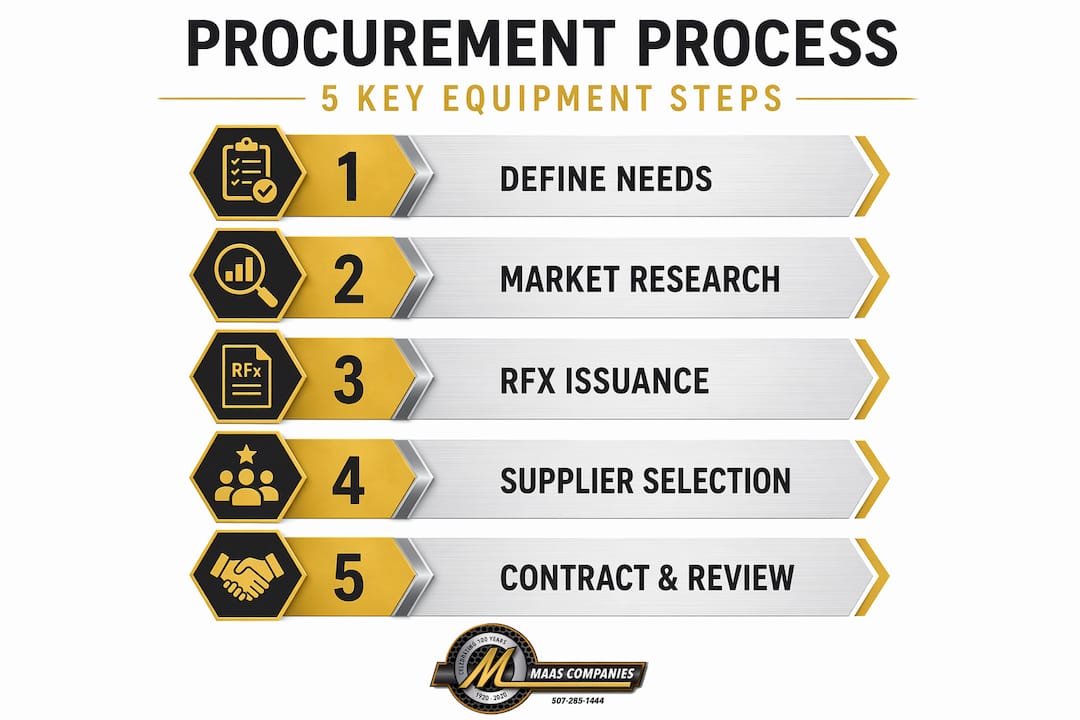
Industrial Equipment Sourcing Process: A Procurement Guide

TL;DR:
- Treating industrial equipment sourcing as a mere purchase leads to delays, quality issues, and audit risks.
- A structured procurement process covers needs definition, market research, RFx management, supplier evaluation, contract enforcement, and asset recovery.
Procurement leaders who treat the industrial equipment sourcing process as a purchasing transaction rather than a structured methodology pay for that assumption in delays, quality failures, and audit exposure. The terminology standard in this field is industrial equipment procurement, and it encompasses far more than placing orders with willing vendors. It spans market intelligence, supplier qualification, request documentation, contract execution, and ultimately asset recovery when equipment reaches end of life. Each phase carries regulatory, operational, and financial consequences. This guide delivers a process-oriented framework covering all stages, from needs definition through compliant asset disposition, designed specifically for procurement specialists and decision-makers who cannot afford gaps.
Table of Contents
- Key takeaways
- The industrial equipment sourcing process: defining needs and market research
- Building a structured RFP and RFQ process
- Supplier evaluation, selection, and ISO 9001 compliance
- Executing contracts and managing post-award performance
- Asset recovery, compliance, and equipment disposition
- My perspective on where sourcing actually fails
- How Maascompanies supports industrial asset disposition
- FAQ
Key takeaways
| Point | Details |
|---|---|
| Define needs before the market | Clarify budget, compliance, and technical constraints before approaching any supplier. |
| Structure every RFx document | Include milestone dates, evaluation criteria, and compliance requirements in all RFP and RFQ documents. |
| Match supplier controls to risk | ISO 9001 Clause 8.4 requires documented evaluation proportional to supplier risk level, not uniform audits. |
| Execute contracts with KPIs | Post-award performance monitoring tied to defined metrics protects delivery outcomes and audit readiness. |
| Integrate asset recovery early | Compliant disposal and resale of retired equipment generates capital recovery and reduces carrying costs. |
The industrial equipment sourcing process: defining needs and market research
Every well-executed industrial equipment procurement effort begins with a clearly documented business need. That sounds obvious, yet weak sourcing processes consistently trace back to procurement efforts that began with a budget figure rather than a precise functional requirement. Before contacting a single vendor, procurement teams must answer three questions: What specific capability does this equipment need to deliver? What operational, regulatory, or environmental constraints apply? And what is the realistic budget and timeline envelope?
Once those answers are documented, the sourcing industrial machinery effort shifts to market research. This phase is not a vendor search. It is an intelligence-gathering exercise. Effective approaches include:
- Supplier capability scans: Review company certifications, production capacity, past project references, and financial stability. A supplier with excellent pricing but questionable liquidity is a delivery risk.
- Plant visits and facility audits: For high-value or technically complex equipment, on-site assessment reveals process maturity that no brochure captures.
- Benchmarking: Compare current market pricing, lead times, and specification norms against your internal baselines to identify where you have leverage.
- Certification verification: Confirm that candidate suppliers hold relevant ISO, CE, ASME, or industry-specific certifications relevant to your equipment category.
Engineering and technical stakeholders must be involved at this stage, not during review of final proposals. Engineering-led sourcing for complex projects prioritizes technical feasibility before price, which improves supplier fit and reduces costly specification changes later in the process.
Pro Tip: Build a short supplier pre-qualification questionnaire and require completion before adding any vendor to your consideration list. This single step eliminates unqualified respondents before they consume your team’s evaluation time.
Building a structured RFP and RFQ process
The RFI, RFQ, and RFP are distinct instruments used at different stages of the equipment purchasing process. A Request for Information (RFI) gathers general market and supplier capability data. A Request for Quotation (RFQ) solicits specific pricing against defined specifications. A Request for Proposal (RFP) invites suppliers to propose solutions, pricing, and terms against a defined set of requirements. Conflating these instruments produces incomplete information and disorganized supplier responses.
For most industrial equipment categories, the RFP is the controlling document. A well-structured RFP contains the following sections in this order:
- Scope of work and technical specifications — Detailed equipment requirements, drawings, revision levels, and performance parameters.
- Supplier instructions — Submission format, contact protocols, evaluation methodology, and disqualification criteria.
- Evaluation criteria — Weighted scoring across technical compliance, price, delivery, quality systems, and references.
- Commercial terms — Payment schedule, warranty, liability, and acceptance testing requirements.
- Compliance requirements — Applicable regulatory standards, environmental requirements, and required certifications.
- Milestone dates — Structured milestone dates covering supplier Q&A windows, proposal submission, presentations, and award notification.
Realistic timelines matter. Complex equipment procurement cycles, such as those involving Manufacturing Execution Systems, typically span 8 to 12 weeks with defined phases that include workshops, paid pilots, and contract finalization. Compressing these timelines without eliminating phases introduces risk rather than efficiency.
The efficiency argument for automation in this phase is well-supported. Automated RFQ systems reduce manual supplier quotation cycles from three to four days down to under four hours. Beyond speed, automated RFQ platforms enforce specification completeness and create structured audit trails, both of which support compliance objectives.
| RFx Type | Primary purpose | Best used when |
|---|---|---|
| RFI | Market intelligence gathering | Early research, new equipment categories |
| RFQ | Price comparison against fixed specs | Specifications are fully defined |
| RFP | Solution and commercial proposals | Complex or high-value equipment sourcing |
Pro Tip: Run at least one formal clarification round between proposal receipt and scoring. Ambiguities resolved before evaluation prevent post-award disputes that inflate project costs.
Supplier evaluation, selection, and ISO 9001 compliance
Establishing documented evaluation criteria before the sourcing process opens is not optional under ISO 9001:2015. Clause 8.4 governs the control of externally provided processes, products, and services, and it imposes specific obligations on how organizations select, approve, monitor, and re-evaluate suppliers.
The practical implication is that your supplier selection criteria must exist in writing before you receive the first proposal. Price is one criterion. Technical fit, delivery reliability, quality management system maturity, and financial health each carry equal or greater weight depending on equipment criticality.
ISO 9001 Clause 8.4 requires that purchase orders communicate quality requirements beyond commercial information alone. A compliant purchase order for industrial equipment should include:
- Material specifications, revision levels, and applicable drawings
- Referenced industry standards (ASME, ASTM, ISO, etc.)
- Required certifications and test reports
- Traceability requirements for materials or components
- Process standards for welding, coating, heat treatment, or other controlled processes
- Quality management system requirements specific to the order
Purchase orders that omit these elements are a documented nonconformity waiting to be discovered. They also leave suppliers with insufficient guidance, which increases the probability of nonconforming deliveries.
On the question of how much evaluation effort each supplier warrants, the standard provides flexibility. ISO 9001 does not require audits for every supplier. It requires documented evaluation scaled proportionally to supplier risk. Low-risk, commodity suppliers can be assessed through desktop reviews and performance history. Critical suppliers providing custom-fabricated components or safety-critical assemblies require on-site audits, performance monitoring, and periodic re-evaluation.
The approved vendor list is not an administrative formality. It is a quality control document. Each entry should carry documented evidence of the evaluation conducted, the risk classification applied, and the monitoring frequency assigned. An undocumented vendor approval is as problematic as no approval at all under a third-party audit.
Maintaining a current approved vendor list with complete audit trails also creates the evidentiary foundation needed for continuous improvement. When a supplier fails, the documentation supports root cause analysis and corrective action rather than reactive re-sourcing.
Executing contracts and managing post-award performance
Contract finalization is where sourcing decisions become operational commitments. The contract must translate the RFP’s evaluation criteria and the supplier’s proposal into binding obligations. Vague performance language in a contract cannot be enforced. Every material requirement should appear as a defined term with associated KPIs, acceptance criteria, and remedies for non-performance.
Effective post-award management includes several distinct activities that procurement teams often underinvest in:
- Kickoff meetings: Align the supplier’s project team with internal stakeholders on scope, schedule, technical requirements, and escalation paths. Assumptions left unaddressed at kickoff become disputes at delivery.
- On-time delivery tracking: Monitor against contractual milestones, not approximate lead times. Early variance signals a larger schedule problem.
- Defect rate monitoring: Track incoming inspection results and supplier-generated nonconformances. Rising defect rates require formal corrective action requests, not informal conversations.
- Change control procedures: Document every scope, specification, or timeline change through a formal process. Undocumented changes expose the organization to liability and create audit gaps.
- Escalation protocols: Define in advance who has authority to escalate disputes, at what threshold, and through what process. Escalation decisions made under pressure without a protocol produce inconsistent outcomes.
Pro Tip: Schedule a formal mid-project performance review at the 50% completion point for any equipment order exceeding 90 days lead time. Problems identified at this stage can still be corrected. Problems discovered at delivery cannot.
Documentation discipline throughout the execution phase protects the organization during audits and supports the continuous improvement cycle that ISO 9001 mandates. Every deviation, nonconformance, corrective action, and change order should be filed against the purchase order record.

Asset recovery, compliance, and equipment disposition
When industrial equipment reaches end of operational life or becomes surplus through restructuring, the same rigor that governs sourcing must govern disposition. Asset recovery in an industrial context encompasses removal, resale, recycling, and regulated disposal. Each path carries distinct compliance obligations.
Used asset recovery services involve refrigerant recovery, certified recycling, proper disposal procedures, and documentation capture for audit readiness and environmental regulations. The documentation requirements parallel those in procurement: chain of custody records, certificates of recycling or destruction, environmental compliance records, and decommissioning sign-offs.
| Disposition method | Best suited for | Compliance considerations |
|---|---|---|
| Resale or auction | Functional equipment with market demand | Title transfer documentation, condition disclosure |
| Certified recycling | Equipment with recoverable materials | Recycling certificates, environmental permits |
| Regulated disposal | Hazardous or end-of-life equipment | Manifests, destruction certificates, chain of custody |
| Parts reclamation | Equipment with serviceable subcomponents | Traceability records, certification of conformance |
Partnering with experienced liquidation specialists at this stage generates measurable value. Expert partners bring established buyer networks, accurate market valuations, structured auction timelines, and the documentation infrastructure required for audit-ready disposition. For procurement teams focused on buying industrial equipment, integrating a disposition strategy for retired assets at the point of capital equipment acquisition reduces future carrying costs and simplifies end-of-life planning. Auction-based disposition accelerates the timeline and maximizes exposure to qualified buyers, directly supporting capital recovery objectives.
My perspective on where sourcing actually fails
I’ve spent considerable time reviewing industrial procurement programs across sectors, and the failures follow predictable patterns. The most expensive one is not selecting the wrong supplier. It’s investing in supplier evaluation theater: running structured RFP processes, building approved vendor lists, and then treating post-award management as an administrative afterthought.
In my experience, the post-award phase is where the real value of a sourcing program is either realized or lost. A well-selected supplier with poor contract management produces exactly the same operational problems as a poorly selected supplier. Delayed deliveries, off-spec components, undocumented changes. The sourcing documentation looks compliant; the outcome is not.
What I’ve observed is that organizations with strong sourcing outcomes do one thing differently. They close the loop. Performance data from the execution phase feeds back into supplier re-evaluation, updates the approved vendor list, and informs the next RFP. The sourcing process is not a linear sequence. It is a continuous control cycle. Teams that treat it as a checklist to be completed before award miss the point entirely.
The second consistent failure is applying uniform evaluation effort regardless of supplier risk. Reviewing a standard catalog supplier with the same rigor as a custom fabricator does not demonstrate compliance. It consumes resources without producing proportional risk reduction. Calibrate your evaluation depth to what the failure mode of a given supplier would actually cost you.
— Vector
How Maascompanies supports industrial asset disposition

When surplus equipment or a plant closure creates a disposition challenge, the industrial equipment procurement cycle is only half the story. Recovering value from retired assets requires the same structured approach as acquiring new ones. Maascompanies brings decades of experience in industrial equipment auctions, brokerage, and liquidation to help procurement teams and asset managers close out equipment with maximum recovery and full documentation support.
The current Zein Extraction Process Plant auction in Galva, IL represents the type of project where Maascompanies delivers value: complex industrial assets requiring qualified buyers, accurate valuation, and audit-ready documentation. For organizations looking to convert surplus equipment into capital, the equipment auction and brokerage services at Maascompanies are structured to support both the commercial and compliance dimensions of asset disposition. Contact Maascompanies to discuss how a tailored recovery strategy can be integrated with your existing procurement program.
FAQ
What are the core stages of industrial equipment procurement?
The process covers needs definition, market research, RFx documentation, supplier evaluation and selection, contract execution, post-award performance management, and asset recovery. Each stage requires documented outputs to support audit readiness and continuous improvement.
What does ISO 9001 Clause 8.4 require for supplier selection?
Clause 8.4 requires organizations to evaluate, approve, monitor, and re-evaluate suppliers using documented criteria scaled to supplier risk. Purchase orders must communicate quality requirements beyond commercial terms, including specifications, certifications, and traceability requirements.
How long does a typical industrial equipment RFP process take?
Complex equipment procurement cycles typically span 8 to 12 weeks, covering RFI, workshops, proposal submission, presentations, and contract finalization. Compressing timelines without removing phases introduces delivery and compliance risk.
How do automated RFQ systems improve procurement compliance?
Automated RFQ platforms enforce specification completeness, structure supplier responses, and generate audit trails automatically. Manual quotation cycles averaging three to four days can be reduced to under four hours while improving documentation quality.
What documentation is required for compliant equipment disposal?
Compliant asset disposition requires chain of custody records, recycling or destruction certificates, environmental compliance documentation, and decommissioning records. These parallel the documentation standards that govern initial equipment procurement and support both regulatory compliance and audit readiness.
Recommended
- How to Choose the Right Auction for Industrial Equipment | Blog | Insights on Asset Liquidation and Auction Trends
- Pre-Auction Selling Checklist for Industrial Equipment | Blog | Insights on Asset Liquidation and Auction Trends
- How Brokerage and Auction Work to Sell Industrial Assets | Blog | Insights on Asset Liquidation and Auction Trends
- Auction absentee bidding: strategies for industrial equipment | Blog | Insights on Asset Liquidation and Auction Trends