
Blog
Auction absentee bidding: strategies for industrial equipment

TL;DR:
- Absentee bidding allows remote participation and multi-site asset acquisition without physical presence.
- Successful absentee bidding relies on thorough research, clear max bid setting, and risk management.
- The method rewards disciplined preparation over reactive bidding in industrial equipment auctions.
Many investors assume that winning industrial equipment at auction requires being physically present, reacting in real time, and outmaneuvering competitors on the floor. That assumption leaves significant opportunity on the table. Absentee bidding, the practice of submitting bids remotely or in advance, has become a disciplined and efficient strategy for asset managers acquiring machinery, forklifts, processing equipment, and surplus industrial assets during liquidation events. This article explains how absentee bidding works, why it appeals to serious buyers, what risks to manage, and which best practices consistently produce results.
Table of Contents
- Understanding auction absentee bidding
- Why absentee bidding appeals to industrial asset buyers
- Risks and limitations: what absentee bidders need to know
- Best practices for absentee bidding success
- The uncomfortable truth experts won’t tell you about absentee bidding
- Unlock more opportunities with industry-leading auction services
- Frequently asked questions
Key Takeaways
| Point | Details |
|---|---|
| Efficient acquisition | Absentee bidding allows investors to buy industrial equipment remotely, streamlining the acquisition process. |
| Risk mitigation strategies | Strategic research and item vetting are essential to minimize risks in absentee auctions. |
| Disciplined bidding | Success depends on setting rational max bids and avoiding emotional decisions in competitive auctions. |
| Platform benefits | Modern auction platforms support absentee bidding for both timed and live webcast equipment sales. |
Understanding auction absentee bidding
Absentee bidding means participating in an auction without being physically present at the sale location. Instead of raising a paddle or calling out bids in real time, you submit your maximum bid ahead of the auction or through a remote digital interface. The auction platform then manages your bids automatically, advancing only as needed to stay competitive up to your stated limit.
This method is widely available across industrial equipment auctions. Remote absentee bidding is supported on major platforms including Proxibid and HiBid, which host liquidation events for manufacturing plants, processing facilities, and surplus equipment portfolios. Absentee bidding is supported across live webcast and timed online formats, giving buyers flexibility regardless of geography.
Understanding a few core terms helps clarify how the process works:
- Proxy bid: An automated bid submitted on your behalf, incrementally increasing only when another bidder challenges your position, up to your maximum.
- Max bid: The highest amount you authorize the system to bid for a given lot. This figure stays confidential from other bidders.
- Timed auction: A format where bidding occurs over a set window, often 24 to 72 hours, with no live auctioneer. Bids are placed at any time before the clock expires.
- Webcast (simulcast) auction: A live auction broadcast online, where remote bidders compete in real time alongside floor participants.
The table below compares absentee bidding with live floor bidding across key factors relevant to industrial asset buyers:
| Factor | Absentee bidding | Live floor bidding |
|---|---|---|
| Geographic flexibility | High, bid from anywhere | Low, requires travel |
| Emotional pressure | Minimal | High |
| Real-time adjustment | Not available | Available |
| Privacy of max bid | Maintained | Partially visible |
| Suitable for multiple lots | Yes, across auctions | Limited by presence |
| Risk of overbidding | Controlled by max bid | Higher under pressure |
For investors choosing auction formats for industrial equipment, absentee bidding is particularly well suited to liquidation events where dozens of lots are sold across a compressed timeline. Asset managers overseeing multiple acquisition targets can monitor several auctions simultaneously, something live attendance simply cannot support.
Why absentee bidding appeals to industrial asset buyers
Having defined absentee bidding, let’s examine why it’s favored by serious industrial asset buyers.
The most immediate benefit is geographic freedom. A buyer in Houston can compete for a CNC machining center being liquidated in Ohio without booking a flight or hotel. This matters significantly when equipment values don’t justify travel costs, or when multiple target assets are spread across different states or countries.

Beyond logistics, absentee bidding offers a structural advantage in decision-making. Absentee bidding provides privacy, anonymity, and protection against emotional overpaying, making it ideal for strategic acquisition during liquidation events. When you’re not in the room, you’re insulated from the competitive energy that pushes live bidders past their rational limits.
For asset managers overseeing portfolio acquisitions, this discipline translates directly into better margins. Consider the following advantages:
- Controlled spending: Max bids enforce budget discipline automatically.
- Strategic anonymity: Competitors cannot read your interest level or body language.
- Parallel participation: You can place absentee bids across multiple auctions running simultaneously.
- Reduced carrying costs: Faster remote acquisition decisions shorten the timeline from identification to purchase.
- Scalability: A single asset manager can cover far more auction events remotely than in person.
The table below illustrates how absentee bidding compares in practical scenarios common to industrial liquidations:
| Scenario | Absentee bidding outcome | Live bidding outcome |
|---|---|---|
| Multi-site liquidation event | Bid on all sites remotely | Must choose one location |
| High-value single asset | Max bid set after research | Risk of emotional escalation |
| Surplus equipment, low value | Efficient, low-cost participation | Travel cost may exceed asset value |
| Time-sensitive acquisition | Bid submitted in advance | Requires scheduling flexibility |
For investors focused on maximizing asset value during liquidation cycles, the combination of privacy, control, and scalability makes absentee bidding a preferred tool. Reviewing proven [auction strategies](https://maascompanies.com/blog/article/auction-strategies-small-businesses-maximize-asset recovery) alongside absentee methods strengthens your overall acquisition framework.
Pro Tip: Before setting your max bid, calculate the total acquisition cost including buyer’s premium, freight, rigging, and reconditioning. This prevents a technically winning bid from becoming a financial loss.
Risks and limitations: what absentee bidders need to know
While absentee bidding has clear advantages, buyers must also account for its unique risks.
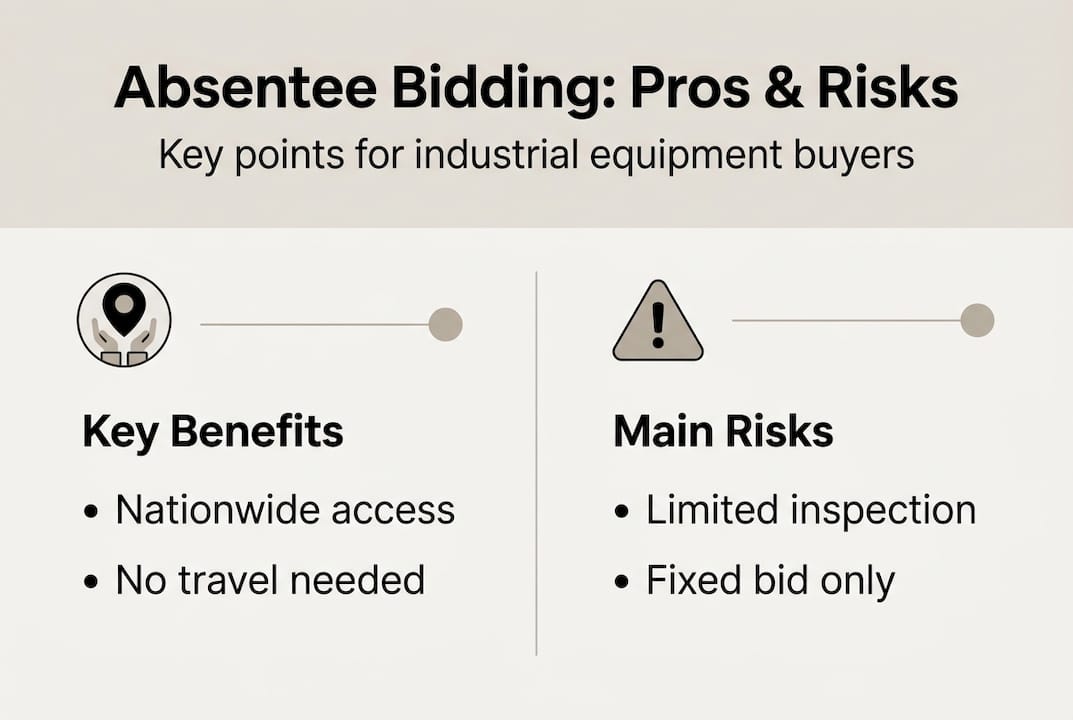
The most significant limitation is reduced inspection capability. In a live auction, experienced buyers walk the floor, check serial numbers, test controls, and assess physical condition firsthand. Absentee bidders rely entirely on photos, written condition reports, and any third-party assessments provided by the auction house. Gaps in that documentation can lead to costly surprises after purchase.
Risks include limited inspection, uncertain competition, potential overbidding if the max bid is set too high, and technology failures that can disrupt remote participation. Each of these deserves a specific mitigation strategy.
Key risks and how to address them:
- Limited physical inspection: Request all available photos, ask the auction house for additional images, and review any maintenance or service records. If the asset value warrants it, hire a local inspector.
- Unknown competition: You cannot know how many absentee or live bidders are targeting the same lot. Set your max bid based on market value research, not on winning at any cost.
- Overbidding risk: A max bid set too aggressively can result in winning at a price that eliminates your margin. Always anchor your max to a realistic resale or deployment value.
- Technology failures: Platform outages, connectivity issues, or registration errors can prevent your bids from registering. Test the platform before auction day and confirm your registration status.
- Missed deadlines: Absentee bids often have submission cutoffs. Missing the window means losing the opportunity entirely.
“Successful absentee bidders treat risk management as a pre-auction discipline, not a post-purchase reaction.”
Reviewing a thorough pre-auction checklist before each event reduces exposure significantly. Pairing that with practical auction buying tips helps you build a repeatable process that accounts for the variables unique to remote participation.
Pro Tip: Always verify the buyer’s premium percentage before placing your max bid. A 15% to 18% premium on a $50,000 lot adds $7,500 to $9,000 to your acquisition cost, a figure that must be factored into your ceiling.
Best practices for absentee bidding success
To make absentee bidding work in your favor, follow these expert-backed best practices.
Consistent success in absentee bidding comes from process, not luck. Success relies on pre-auction due diligence, incremental bid strategies, and setting max values that prevent overbidding. Buyers who skip these steps treat absentee bidding as passive, and that is where losses accumulate.
Follow this numbered framework before and during each auction event:
- Research market value first. Pull comparable sales data from recent auctions, equipment dealers, and industry pricing guides. Your max bid should reflect current market conditions, not optimism.
- Review all available documentation. Study every photo, condition note, and specification sheet. If the auction house offers a preview day, arrange a local representative to attend on your behalf.
- Set your max bid with total cost in mind. Include buyer’s premium, rigging, transport, and any reconditioning expenses before you finalize your ceiling.
- Use incremental bidding tools. Many platforms allow you to set bid increments rather than a single max. This gives you more control and prevents the proxy system from jumping to your maximum prematurely.
- Confirm platform registration and bid submission well in advance. Log in, verify your account status, and submit test bids if the platform allows it. Do not leave registration to the day of the auction.
- Track auction timelines and deadlines. Know when absentee bid submission closes, when the auction goes live, and when results are posted. Missing a deadline on a high-value lot is an avoidable and costly error.
Leveraging platform features such as watchlists, automated outbid notifications, and simulcast access keeps you informed without requiring constant manual monitoring. Understanding how auctions help with speeding up asset disposition also helps you align your acquisition timeline with seller liquidation schedules, which often creates pricing advantages for prepared buyers. For buyers participating in facility closures, reviewing how planning closures affects auction timelines can reveal when motivated sellers are most likely to price assets aggressively.
Pro Tip: Set a calendar reminder 48 hours before each auction’s absentee bid deadline. This buffer gives you time to finalize research and adjust your max bid if new information surfaces.
The uncomfortable truth experts won’t tell you about absentee bidding
Most absentee bidders who lose money share one trait: they treat the method as passive. They submit a bid, step away, and hope the platform does the work. That mindset is the real risk, not the technology.
Veteran asset managers approach absentee bidding as an extension of their due diligence process. Every max bid they submit reflects hours of research, comparable sales analysis, and a clear understanding of the asset’s deployment or resale value. Success relies on pre-auction due diligence, not live presence. The floor is not where acquisitions are won. They are won in the research phase.
The uncomfortable reality is that absentee bidding rewards preparation more than live bidding does. A live bidder can react, adjust, and gather real-time intelligence in the room. An absentee bidder cannot. That asymmetry means your pre-auction work must be thorough enough to substitute for real-time judgment.
At Maas Companies, we have observed that buyers who consistently perform well remotely treat each auction lot as a standalone business case. They know their number before the auction opens, and they do not deviate from it. Understanding the industrial auction benefits of structured events reinforces why disciplined participation, not reactive bidding, produces the best long-term acquisition outcomes.
Unlock more opportunities with industry-leading auction services
Absentee bidding is a powerful tool, but it performs best when applied to well-marketed, professionally managed auction events where asset documentation is thorough and competition is transparent.

Maas Companies hosts industrial equipment auctions with detailed lot documentation, clear auction timelines, and accessible bidding formats designed for remote participants. Whether you are looking to acquire assets from active liquidation events or need support marketing your own equipment portfolio, our team provides tailored solutions. Explore our current industrial auctions to apply your absentee bidding strategy today. If you are on the selling side, visit our selling industrial assets page or connect with our team through our expert auction services to maximize recovery on your assets.
Frequently asked questions
How does absentee bidding work in industrial equipment auctions?
Absentee bidding allows you to submit bids ahead of time or remotely, enabling participation in timed and live webcast auctions for machinery and equipment. Absentee bidding is supported on major auction platforms and during industrial liquidations.
What are the advantages of absentee bidding for investors?
Absentee bidding offers privacy, avoids emotional overpaying, and allows strategic remote asset acquisition, especially during equipment liquidation events. Absentee bidding provides privacy, anonymity, and strategic advantages that live floor participation does not.
How can buyers reduce risks in absentee bidding?
Buyers should rely on detailed photos, condition reports, and thorough research to compensate for limited item inspection and uncertain competition. Mitigate risks by using all available documentation and setting max bids anchored to verified market values.
Can absentee bids be updated during a live auction?
Unlike live bidding, absentee bids are fixed and cannot be altered in real time, so setting a strategic max bid is crucial. Absentee bids lack real-time adjustment capability, which is why pre-auction research is the foundation of every successful remote bid.
What makes absentee bidding effective for asset managers?
It enables efficient participation in multiple auctions without geographic limitation, supporting disciplined acquisition strategies for large portfolios. Absentee bidding is ideal for strategic, non-emotional buying across concurrent liquidation events.
Recommended
- How to Choose the Right Auction for Industrial Equipment | Blog | Insights on Asset Liquidation and Auction Trends
- Auction lots for industrial asset sales: maximize value | Blog | Insights on Asset Liquidation and Auction Trends
- Pre-Auction Selling Checklist for Industrial Equipment | Blog | Insights on Asset Liquidation and Auction Trends
- Auction strategies for small businesses: Maximize asset recovery | Blog | Insights on Asset Liquidation and Auction Trends
- Top 5 LSPs for Industrial Machinery Translation 2026