
Blog
Auction lots for industrial asset sales: maximize value
TL;DR:
- An auction lot is a defined sale unit that can include single or multiple related assets.
- Proper lot structuring influences bidding behavior, recovery rates, and sale speed.
- Strategic grouping and thorough cataloging boost bidder interest and final sale value.
Many business professionals assume that every piece of equipment in an industrial auction is sold individually. That assumption, while understandable, can lead to poorly structured sales, lower recovery rates, and assets that sit unsold long after the auction closes. Understanding how auction lots actually work in industrial contexts is essential for CFOs, operations leaders, and asset managers who want to extract full value from surplus equipment, plant closures, or large-scale liquidations. This article breaks down what an auction lot is, how lots are assembled, how bidding works, and what strategies produce the strongest financial outcomes.
Table of Contents
- Defining an auction lot in industrial sales
- How auction lots are created and organized
- Bidding processes for industrial auction lots
- Maximizing value and recovery in lot-based auctions
- Why strategic lotting matters more than ever in industrial auctions
- Explore expert industrial auction solutions with Maas Companies
- Frequently asked questions
Key Takeaways
| Point | Details |
|---|---|
| Auction lot definition | An auction lot is a bundle of one or more assets grouped for sale under a single bid. |
| Lot grouping strategy | Grouping assets strategically maximizes value and draws targeted buyers. |
| Bidding process clarity | Understanding lot bidding methods helps set expectations and bidding tactics. |
| Maximizing returns | Effective lotting and auction timing boost recovery for industrial asset sales. |
Defining an auction lot in industrial sales
An auction lot is the defined unit of sale in any auction event. It can represent a single piece of equipment, a collection of related items, or an entire facility’s worth of assets grouped for a single bid. In industrial sales, the lot is the fundamental building block of the entire liquidation process.
The distinction between a single asset, a lot, and a grouped lot matters considerably:
- Single asset lot: One machine or piece of equipment offered under one lot number. Common for high-value items like CNC machines or turbines.
- Standard lot: A small grouping of related items, such as a set of conveyors, pumps, or hand tools from the same production line.
- Grouped or bulk lot: A large collection of mixed assets bundled together, often used to clear lower-value inventory quickly.
A common misconception is that industrial auctions always sell items one by one. In practice, what goes into a lot depends heavily on the seller’s liquidation goals, the asset types involved, and the target buyer pool. Auction lots can consist of one or multiple items grouped for bidding depending on strategic liquidation goals.
Strategic reasons for grouping assets include increasing buyer appeal for smaller items that would not attract competitive bids on their own, reducing auction administration costs, and accelerating the overall sale timeline. Separating assets, on the other hand, makes sense when a specific piece carries significant standalone value that would be diluted inside a larger lot.
“The way you structure your lots shapes the entire bidding environment. Lot design is a strategic decision, not an administrative one.”
Pro Tip: Before finalizing lot assignments, consult with your auction firm to review historical bidding data for similar asset categories. Lot structures that worked well in past sales often provide a reliable baseline for current inventory.
Understanding this foundation helps operations leaders and CFOs engage more productively with auction professionals and set realistic recovery expectations from the outset.
How auction lots are created and organized
Now that you understand what an auction lot is, the next step is seeing how lots are assembled in practice. The process is methodical and requires input from both the seller and the auction firm.
Steps in the lot creation process:
- Asset assessment: Every item is inventoried, inspected, and assigned a preliminary value range. Condition, age, operational status, and market demand are all evaluated at this stage.
- Strategic grouping: Assets are sorted based on function, buyer interest, and value. High-value standalone items are typically separated. Complementary items, such as a pump and its associated piping components, may be grouped to attract buyers who need complete systems.
- Cataloging: Each lot receives a unique lot number, a detailed description, and photographs. Accurate cataloging directly influences bidder confidence and participation rates.
- Review and approval: The seller reviews the proposed lot structure and approves or adjusts it before the catalog is published.
Careful planning is essential to grouping assets for optimal sale outcomes. Using a pre-auction checklist ensures no critical steps are skipped during this phase.
| Approach | Advantages | Disadvantages |
|---|---|---|
| Single asset lots | Maximizes individual item value | Slower to clear large inventories |
| Grouped lots | Faster clearance, lower admin cost | May reduce per-item recovery |
| Mixed strategy | Balances recovery and speed | Requires careful planning |
The choice between single and grouped lots is rarely black and white. Most industrial liquidations benefit from a mixed strategy where high-value equipment is lotted individually and lower-value items are grouped. Preparing assets for auction with this structure in mind reduces delays and improves buyer engagement.
Pro Tip: Avoid grouping assets with vastly different values into the same lot. A $50,000 compressor bundled with $500 worth of hand tools can confuse bidders and suppress the final bid price.
The cataloging phase is often underestimated. Lot descriptions that include model numbers, serial numbers, operational condition, and dimensions consistently generate more bidder inquiries and higher final bids than vague or incomplete entries.

Bidding processes for industrial auction lots
With lots assembled, understanding how bidding unfolds sets you up for success in both buying and selling. Industrial auction bidding differs from consumer auctions in several important ways.
Common bidding formats used in industrial auctions:
- Live on-site auctions: Bidders attend in person; fast-paced and effective for high-volume sales where physical inspection is important.
- Online timed auctions: Bidders submit bids over a set period, often several days. This format reaches a global buyer pool and is increasingly the standard for industrial equipment.
- Simultaneous live and online: Combines on-site attendance with real-time online bidding, maximizing participation.
- Sealed bid: Bidders submit one offer without seeing competing bids. Used for unique or high-value assets where confidentiality is preferred.
Bidding strategies vary significantly depending on the type and size of the lots as well as market demand at the time of auction. Reviewing auction bidding details before setting minimums helps sellers calibrate expectations accurately.
Sample bid structure for industrial lots:
| Lot value range | Typical opening bid | Bid increment |
|---|---|---|
| Under $5,000 | 10-20% of estimated value | $100 to $250 |
| $5,000 to $50,000 | 15-25% of estimated value | $500 to $1,000 |
| Over $50,000 | 20-30% of estimated value | $1,000 to $5,000 |
Key metrics that sellers should track include clearance rate (the percentage of lots that sell) and average bid per lot. A clearance rate above 85% is generally considered strong for industrial auctions. When choosing auction channels, the format selected directly affects these metrics.
Factors that drive bidding intensity on specific lots include asset condition, scarcity in the market, buyer demand for that equipment category, and the quality of the lot’s catalog entry. Lots with clear photos, complete specifications, and accurate condition reports consistently attract more competitive bidding than poorly documented entries.
Maximizing value and recovery in lot-based auctions
Having explored the bidding mechanics, let’s move to strategies to boost returns from your auction lots. Recovery optimization begins long before the auction opens.
Best practices for lot structure and recovery:
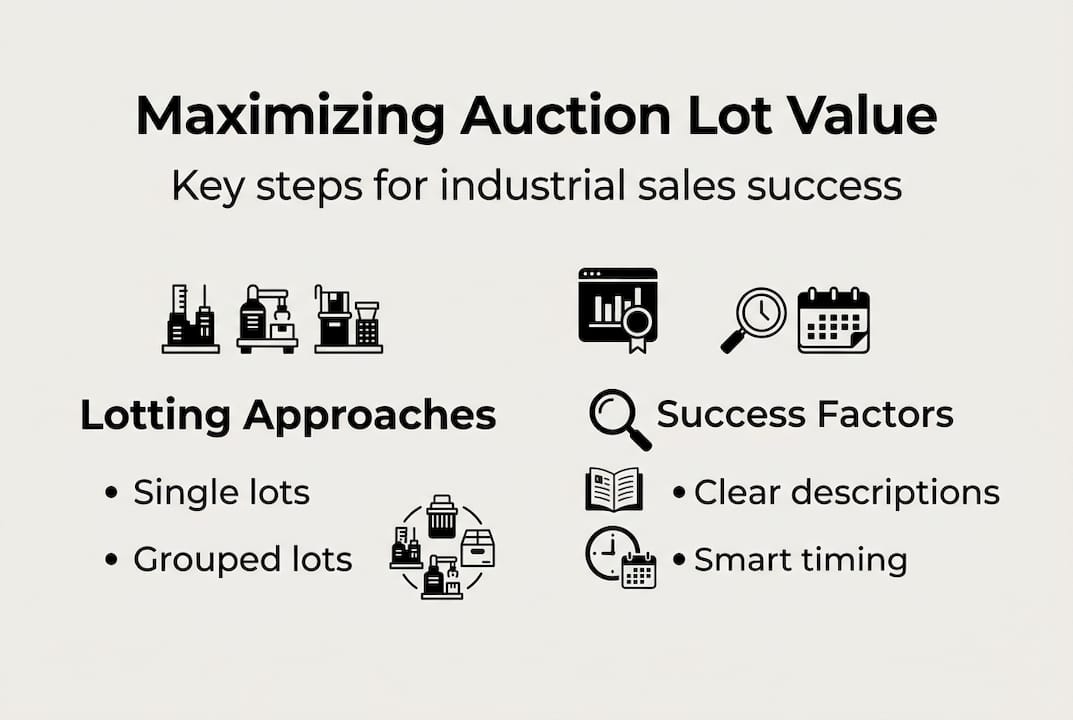
- Separate high-value assets from bulk lots to allow competitive bidding on premium items.
- Group complementary assets that a single buyer would need together, such as a complete processing line or a matched set of generators.
- Set realistic minimum bids based on current market data, not original purchase price or book value.
- Time the auction to align with industry buying cycles. Equipment buyers in certain sectors are more active at specific times of year.
- Invest in professional photography and detailed lot descriptions. Visual quality directly influences bidder confidence.
Following expert guidance on asset preparation and sale timing increases recovery by reducing overlooked value. A structured approach to maximizing asset recovery also addresses the carrying costs associated with delayed sales, which erode net returns over time.
One often overlooked factor is the sell or store decision. Holding assets in storage while waiting for a better market rarely improves outcomes and typically adds costs that reduce the final net recovery.
Pro Tip: Engage your auction firm’s marketing team early. Targeted outreach to qualified industrial buyers in the relevant equipment category, done four to six weeks before the auction, consistently improves participation rates and final bid values.
Common mistakes to avoid include over-grouping assets to reduce lot count, setting reserves too high based on inflated valuations, and neglecting to promote the auction through industry-specific channels. Each of these errors can reduce clearance rates and leave value on the table.
Why strategic lotting matters more than ever in industrial auctions
Most companies focus on the condition and value of individual assets when preparing for an auction. That focus is reasonable, but it misses a critical lever: how lots are structured shapes bidder psychology as much as the assets themselves.
A well-organized lot signals to buyers that the seller is professional and the sale is well-managed. That perception increases trust and encourages more aggressive bidding. Conversely, poorly structured lots, with inconsistent groupings or incomplete descriptions, create hesitation. Buyers discount their bids to compensate for uncertainty.
We have seen industrial liquidations where two nearly identical asset pools produced very different recovery outcomes. The difference was almost entirely in lot structure and marketing execution, not asset quality. Avoiding surprises in auctions requires treating the lot design process with the same rigor applied to financial reporting or compliance documentation.
Experienced sellers treat lotting as both a science and an art. The science involves data: market comps, historical clearance rates, and buyer demand signals. The art involves judgment: knowing when to separate a standout asset, when to bundle items that tell a coherent story for a buyer, and when to adjust the structure based on pre-auction inquiry patterns. Both matter.
Explore expert industrial auction solutions with Maas Companies
Navigating lot structure, bidding formats, and recovery strategy requires more than general knowledge. It requires experience with real industrial transactions at scale.
Maas Companies guides clients through every stage of the auction process, from initial asset assessment and lot design to catalog production, marketing, and final settlement. Whether you are managing a single-facility closure or a multi-site liquidation, our team brings the technical knowledge and buyer network to maximize your recovery. Explore a real-world industrial auction example to see how we structure complex sales. If you are ready to move forward, visit our selling industrial equipment page or review our full Maas services portfolio to find the right solution for your project.
Frequently asked questions
What determines how items are grouped into an auction lot?
Auction lots are grouped based on asset type, value, and strategic considerations for market appeal and sale efficiency. Careful planning during the pre-auction phase ensures groupings align with buyer demand and recovery goals.
Can an auction lot include both equipment and real estate?
Yes, some auctions combine equipment and related real estate into a single lot when it benefits the sale strategy or attracts more bidders. Auction lots can consist of one or multiple items grouped depending on strategic liquidation goals.
What happens if a lot doesn’t receive any bids?
If a lot doesn’t sell, it may be re-offered, regrouped, or withdrawn based on the auction terms and the seller’s decision. Bidding strategies vary significantly depending on lot size and market demand at the time of auction.
How do minimum bids and reserves work for auction lots?
Minimum bids and reserves set baseline prices; if bids fall below these thresholds, the lot may not be sold. Reviewing bid structures before the auction opens helps sellers set realistic minimums based on current market conditions.
Recommended
- How Auctions Help Speed Up Industrial Asset Disposition | Blog | Insights on Asset Liquidation and Auction Trends
- How Auctions Help Speed Up Industrial Asset Disposition | Blog | Insights on Asset Liquidation and Auction Trends
- How to Choose the Right Auction for Industrial Equipment | Blog | Insights on Asset Liquidation and Auction Trends
- How Industrial Plant Liquidation Maximizes Recovery Value for Lenders | Blog | Insights on Asset Liquidation and Auction Trends
- Asset tracking advantages for industrial efficiency in 2026