

Blog
Real Estate Disposal Guide for Business Decision-Makers

TL;DR:
- Effective real estate disposal involves a structured plan, a qualified advisory team, and early tax strategy integration. It typically ranges from one month for bulk sales to over three years for phased individual asset sales. Choosing the right approach depends on liquidity needs, tax implications, and market timing considerations.
Real estate disposal is the structured process of divesting commercial or industrial property assets to maximize financial recovery while minimizing transaction risk and carrying costs. For business owners and financial decision-makers, the difference between a disciplined disposition plan and an ad hoc sale can be measured directly in net proceeds, tax exposure, and time on market. This real estate disposal guide covers the full process: from hold/sell assessment and team assembly through marketing execution, portfolio strategy, and tax planning. The industry term for this process is real estate disposition, and both terms are used throughout this guide.
What prerequisites and team roles are essential for a real estate disposal?
A hold/sell assessment is the first step in any credible disposition plan. This assessment clarifies why a property should be sold, which directly shapes broker selection, buyer targeting, and the marketing timeline. Without it, teams often pursue the wrong buyer pool or price the asset incorrectly from the start.
The core advisory team for a commercial real estate disposition includes three roles:
- Investment sales broker: Manages buyer outreach, qualifies offers, and tracks deal progress. Interviewing 3 to 5 qualified brokers before selecting one reduces the risk of misaligned pricing strategies and weak buyer networks.
- Legal counsel: Handles purchase agreements, title review, and closing documentation. Engaging counsel early prevents delays caused by title defects or contract disputes.
- Tax adviser: Models capital gains exposure and identifies timing strategies before the property goes to market. Bringing in a tax adviser after a deal is signed limits your options significantly.
Asset preparation runs parallel to team assembly. Required documentation typically includes rent rolls, environmental reports, title commitments, zoning certificates, and capital expenditure records. Buyers in commercial transactions conduct thorough due diligence, and gaps in documentation create price renegotiations or deal failures at closing.
Pro Tip: Request broker proposals in writing and ask each candidate to present a comparable sales analysis specific to your asset type and submarket. Generic pitch decks signal a broker who lacks direct experience with your property class.

A best-in-class advisory team is not a luxury for large transactions. Even mid-market disposals benefit from specialized legal and tax counsel who understand the specific risks of commercial real estate exits.
How to execute the disposal process: marketing, buyer engagement, and negotiation
Execution follows a structured sequence. Skipping steps or compressing timelines to close faster typically reduces net proceeds. A three-phase methodology covering pre-sale preparation, execution, and post-closing finalization is the recognized framework for commercial property disposition.
The execution phase breaks down as follows:
- Develop a targeted marketing plan. Identify the most likely buyer pool: owner-users, institutional investors, private equity, or 1031 exchange buyers. Each group responds to different value narratives and pricing structures.
- Launch a controlled marketing process. Distribute offering memoranda to qualified prospects, set a call-for-offers deadline, and manage information requests through a secure data room.
- Qualify buyers before sharing sensitive financials. Require proof of funds or lender pre-qualification letters before granting full data room access. This filters out non-serious parties early.
- Negotiate on price and terms simultaneously. Price is one variable. Earnest money deposit size, due diligence period length, and closing timeline all affect net outcome. A shorter due diligence period with a larger deposit often outperforms a higher headline price with loose terms.
- Track buyer feedback and adjust dynamically. If multiple qualified buyers cite the same concern, such as deferred maintenance or lease rollover risk, address it directly rather than waiting for offers to reflect it.
Choosing quick tenanted sales may involve a 10–15% discount but reduces refinancing risk and ongoing interest expenses. That trade-off is worth modeling explicitly before committing to a longer vacant possession sale.
Pro Tip: Set a best-and-final-offer deadline rather than negotiating bilaterally with each buyer. Competitive tension among multiple qualified buyers consistently produces better terms than one-on-one negotiation.
The broker’s role during execution is active, not passive. A qualified broker tracks every buyer’s position, manages the data room, and keeps the process moving toward a closing date. Brokers who go quiet after the marketing launch are a warning sign.
What are effective property disposal strategies: whole portfolio sale vs. individual asset sales?
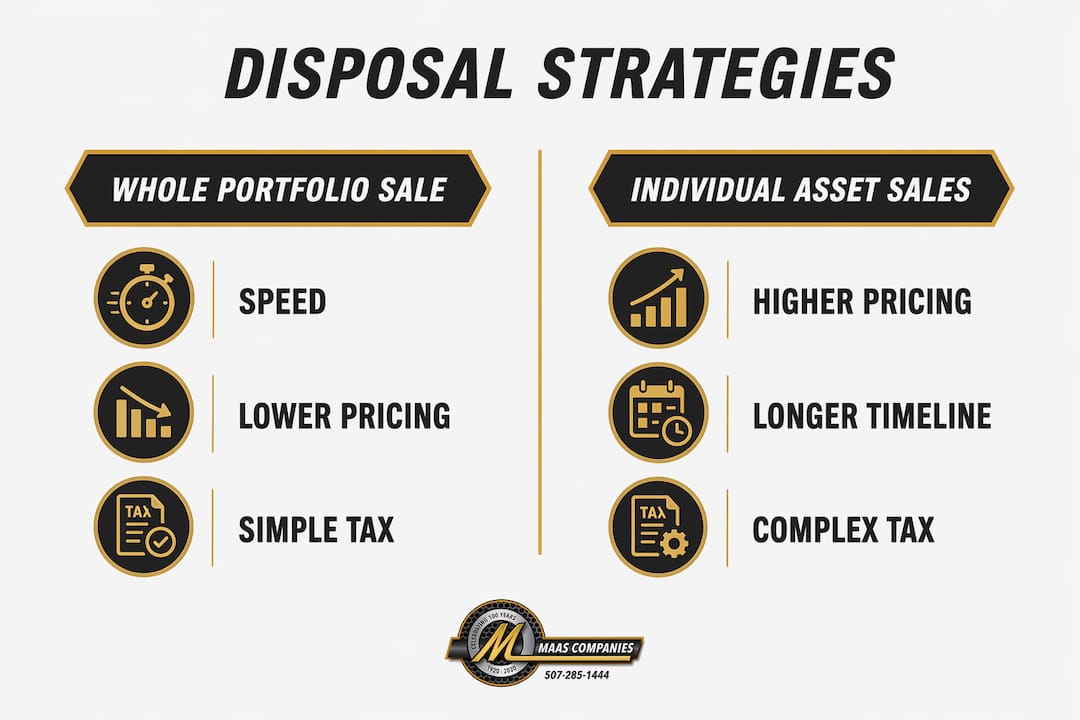
Disposal timelines range from 1–3 months for immediate portfolio sales to over three years for phased individual property sales. That range reflects a fundamental trade-off: speed versus total value recovery.
| Strategy | Speed | Pricing | Tax complexity | Best for |
|---|---|---|---|---|
| Whole portfolio (bulk) sale | Fast (1–3 months) | Discount to individual values | Lower complexity | Immediate liquidity needs |
| Individual asset sales | Slow (12–36+ months) | Full market value per asset | Higher complexity | Maximum value recovery |
| Hybrid approach | Moderate | Mixed | Moderate | Balancing liquidity and value |
A whole portfolio sale transfers all assets to a single buyer in one transaction. The buyer receives a discount for taking on the full portfolio risk. The seller receives speed and certainty. This approach suits businesses facing restructuring deadlines, lender pressure, or operational wind-down timelines.
Individual asset sales target each property’s specific buyer pool, which typically produces higher per-asset pricing. The trade-off is time, carrying costs, and management bandwidth. A portfolio of ten properties sold individually over three years requires sustained advisory team engagement and ongoing property management.
Hybrid disposal strategies combine bulk and individual asset sales to balance transaction efficiency and maximize portfolio value. A business might sell lower-value or operationally burdensome assets in a bulk transaction to generate immediate capital, while holding core assets for individual sales at peak market timing. Institutional investors increasingly blend portfolio sales with individual asset disposals for exactly this reason.
For businesses with social or complex mandates, a rolling sales pipeline combined with targeted individual disposals provides both sustainability and flexibility. The key is defining the financial objective before selecting the strategy, not after.
How to optimize tax efficiency when disposing of real estate assets?
Tax planning is not a post-sale activity. The timing and sequence of disposals directly determines capital gains tax exposure, and decisions made before marketing begins have the most impact.
Core tax efficiency tactics for real estate asset disposal include:
- Spread disposals across multiple tax years. Spreading property disposals over 3 to 5 tax years is a default strategy for portfolios of 3–10 properties. This approach uses annual exempt amounts each year rather than absorbing all gains in a single tax year.
- Prioritize lower-gain properties first. Disposing of lower-gain properties first uses annual exemptions most efficiently and defers higher-gain sales to future years or inheritance planning strategies.
- Use spousal or partner transfers where applicable. Spousal transfers must be completed well before the sale to avoid tax authority scrutiny on intent. Timing is critical. A transfer executed days before a sale closing will not achieve the intended tax benefit.
- Model carrying costs against tax savings. A phased disposal spread over multiple years preserves tax exemptions and keeps gains in lower capital gains tax bands, but incurs carrying costs during the run-off period. Property taxes, insurance, maintenance, and management fees accumulate. The tax savings must exceed those costs for the phased approach to produce a better net outcome.
- Engage a tax adviser before selecting a disposal strategy. The sequence of sales, the choice between bulk and individual disposals, and the timing of transfers all have tax implications. A tax adviser who enters the process after the strategy is set cannot recover those decisions.
The post-closing phase also carries administrative obligations. Final closing involves preparation of closing statements detailing credits, debits, and the transfer of tenant security deposits and utility contracts. These tasks are not optional. Errors in closing statements create post-closing disputes that can offset tax savings achieved earlier in the process.
Key takeaways
Effective real estate disposal requires a structured plan, a qualified advisory team, and tax strategy integrated from the start, not added after the sale is underway.
| Point | Details |
|---|---|
| Start with a hold/sell assessment | Clarify the disposal objective before selecting brokers or setting a price. |
| Assemble the full advisory team early | Engage an investment sales broker, legal counsel, and tax adviser before marketing begins. |
| Match strategy to financial objective | Choose bulk, individual, or hybrid disposal based on liquidity needs and timeline. |
| Spread disposals across tax years | Phased sales over 3–5 years use annual exemptions and reduce capital gains exposure. |
| Model carrying costs against tax savings | Phased disposals incur ongoing costs; confirm the net benefit before committing to a long timeline. |
What I’ve learned about commercial real estate disposal after years in the field
The most consistent mistake I see in commercial real estate disposals is treating the process as a transaction rather than a plan. Owners focus on the closing date and the headline price. They underinvest in the hold/sell assessment, rush broker selection, and bring in the tax adviser too late to change anything meaningful.
The second mistake is confusing speed with efficiency. A bulk portfolio sale closes fast, but the discount can be substantial. An individual asset sale takes longer but often recovers significantly more per property. Neither approach is universally correct. The right answer depends on your liquidity position, your carrying cost exposure, and your tax situation, and those variables require honest modeling before you commit.
Broker selection deserves more discipline than most owners apply. Interviewing multiple qualified brokers and requiring written proposals with comparable sales data is not bureaucratic overhead. It is the single best way to test whether a broker actually knows your asset class and submarket. A broker who cannot produce relevant comparables in the proposal stage will not perform better during execution.
Tax planning integrated with disposal sequencing is where I consistently see the largest recoverable value. Spreading disposals, sequencing lower-gain assets first, and timing transfers correctly can produce material differences in net proceeds. That work happens before the first property goes to market, not after the last one closes.
The firms that execute disposals well share one trait: they treat the advisory team as a core part of the process, not a cost to minimize. Specialized brokers, experienced legal counsel, and proactive tax advisers pay for themselves in better outcomes.
— Vector
How Maascompanies supports commercial real estate asset recovery
Maascompanies brings deep experience in marketing and disposing of industrial plants, commercial properties, and real estate assets across international markets. The firm manages the full disposition process, from pre-sale preparation and targeted marketing to auction execution and negotiated sales, for clients who need maximum recovery on complex assets.

For business owners and financial decision-makers managing plant closures, restructuring, or portfolio wind-downs, Maascompanies provides the advisory depth and buyer network that ad hoc approaches cannot match. Current projects include a biodiesel plant and commercial facility auction that illustrates the firm’s capability across complex multi-asset disposals. Contact Maascompanies directly to discuss your disposal objectives and recovery targets.
FAQ
What is real estate disposal in a business context?
Real estate disposal is the structured process of divesting commercial or industrial property assets through sale, auction, or negotiated transfer. The goal is to maximize financial recovery while managing tax exposure and transaction risk.
How long does a commercial real estate disposal take?
Disposal timelines range from 1–3 months for immediate bulk portfolio sales to over three years for phased individual asset sales. The right timeline depends on your liquidity needs, carrying cost exposure, and target recovery value.
What is the difference between a portfolio sale and individual asset disposal?
A portfolio sale transfers all assets to one buyer quickly, typically at a discount. Individual asset sales target each property’s specific buyer pool and recover higher per-asset pricing but require more time and ongoing management.
When should a tax adviser be engaged in the disposal process?
A tax adviser should be engaged before the disposal strategy is finalized. Decisions about sale sequencing, phasing, and ownership transfers made before marketing begins have the greatest impact on net proceeds.
What is a hybrid disposal strategy?
A hybrid disposal strategy combines a bulk sale of lower-value or operationally burdensome assets with individual sales of core holdings. This approach balances immediate liquidity with maximum value recovery across a portfolio.
Recommended
- Maximize Asset Recovery: Top Real Estate Liquidation Methods | Blog | Insights on Asset Liquidation and Auction Trends
- Facility Liquidation Strategies That Keep Transitions on Track | Blog | Insights on Asset Liquidation and Auction Trends
- How Auctions Help Speed Up Industrial Asset Disposition | Blog | Insights on Asset Liquidation and Auction Trends
- Closing a Facility? Get an Expert Asset Review | Blog | Insights on Asset Liquidation and Auction Trends