

Blog
Sealed bid sales explained: maximize asset returns

Most financial professionals assume sealed bid sales are simply a variation of the standard auction, where the only difference is that bids arrive in envelopes instead of raised hands. That assumption leads to costly strategic errors. A sealed bid sale is a structured process where buyers submit confidential offers without knowledge of competing bids, and all submissions are opened simultaneously. The outcome is not just a sale; it is a controlled, defensible transaction that can significantly affect recovery value for distressed properties, surplus equipment, and complex industrial assets.
Table of Contents
- Understanding sealed bid sales: The fundamentals
- Step-by-step: The sealed bid sale process
- Key advantages and risks of sealed bid sales
- Special considerations: Government, surplus, and electronic sealed bids
- Sealed bid sales in action: Case studies and industry insights
- Best practices for success in sealed bid sales
- Take the next step: Expert help for your next sealed bid sale
- Frequently asked questions
Key Takeaways
| Point | Details |
|---|---|
| Sealed bid structure | All bids remain confidential until simultaneously opened, ensuring impartial selection. |
| Best assets for sealed bids | Distressed, regulated, or high-value corporate assets often achieve better outcomes under sealed bid processes. |
| Risks and rewards | Sealed bid sales balance fairness and efficiency but require clear rules and compliance to avoid legal or financial pitfalls. |
| Digital evolution | Secure digital submissions enhance efficiency but demand rigorous compliance to prevent bid disqualifications. |
| Preparation is key | Advance planning and expert support dramatically increase the success of sealed bid asset sales. |
Understanding sealed bid sales: The fundamentals
Now that we’ve addressed the common misunderstanding, let’s break down what a sealed bid sale really means in practice.
At its core, a sealed bid auction is a method where potential buyers submit confidential bids without knowledge of competitors’ offers. The process follows a clear sequence:
- Public announcement: The seller issues a formal notice with asset details, submission requirements, and a firm deadline.
- Confidential submission: Each bidder submits their offer in a sealed envelope or through a secure digital platform, with no visibility into competing bids.
- Simultaneous opening: All bids are opened at the same time, typically in the presence of witnesses or a neutral third party.
- Evaluation and selection: The highest compliant bid that meets all stated criteria is awarded the contract or sale.
- Execution: The winning bidder is notified, completes payment, and finalizes the transaction.
This format is widely used in asset liquidation, distressed property sales, government surplus disposals, and industrial equipment transactions. The structure enforces impartiality and removes the emotional volatility that can distort open auction outcomes.
Sealed bid sales are valued for their fairness, impartiality, and procedural clarity. They are particularly effective when the seller needs a defensible, auditable process, such as in regulated industries, government disposals, or high-value corporate liquidations.
For organizations weighing their options, choosing the right auction format is a foundational decision that shapes both the bidder pool and the final recovery value.
Step-by-step: The sealed bid sale process
With the fundamentals in mind, let’s walk through the actual execution of a sealed bid sale, step by step.
The sealed bid process follows a defined sequence: a public announcement with full asset details and a submission deadline; bidders submit sealed envelopes or secure digital bids, often accompanied by 5 to 10 percent earnest money; bids are opened publicly at once; each bid is evaluated on price, compliance, and bidder qualifications per stated criteria; and the winner is notified, pays, and executes the contract, with non-compliant bidders forfeiting their deposit.
- Prepare the invitation for bids (IFB): Define asset specifications, minimum acceptable price, submission format, deadline, and evaluation criteria with precision. Ambiguity at this stage creates disputes later.
- Market the sale aggressively: Reach qualified buyers through industry channels, direct outreach, and digital platforms. A limited bidder pool reduces competitive pressure and suppresses final prices.
- Manage submissions securely: Whether paper or digital, all bids must be time-stamped, logged, and stored without access until the official opening. Chain of control matters.
- Conduct a transparent opening: Open all bids simultaneously in front of designated witnesses. Document every submission, including non-compliant ones.
- Evaluate and award: Score each bid against your pre-published criteria. Award to the highest compliant bidder. Notify all participants promptly.
- Complete due diligence and closing: Verify earnest money, confirm buyer qualifications, and execute the purchase agreement within the stated timeline.
Before launching a sealed bid sale, review a detailed selling checklist to confirm all documentation and compliance requirements are in order. Organizations under time pressure should also consider how sealed bid formats can speed up asset disposition compared to negotiated sales.
Pro Tip: For digital submissions, require bidders to use encrypted upload portals with confirmation receipts. This creates an auditable record and eliminates disputes about submission timing or tampering.
Key advantages and risks of sealed bid sales
Understanding the process, it’s vital to weigh the distinctive advantages and risks before deciding if sealed bidding is the right fit.
Core advantages:
- Confidentiality: No bidder knows what competitors are offering, which encourages each party to submit their true maximum value.
- Access to a diverse bidder pool: Sealed formats attract smaller and non-traditional buyers who may be deterred by the competitive pressure of open auctions.
- Clear rules and impartiality: Pre-published criteria remove subjectivity from the award decision, which is critical for regulated or publicly accountable transactions.
- Reduced auction volatility: Without real-time bidding dynamics, the process is less susceptible to emotional overbidding or last-second sniping.
Primary risks:
- Lowballing: Without price signals from competitors, bidders may submit conservative offers, particularly for assets with uncertain market value.
- Collusion: Bidders in concentrated industries may coordinate offers outside the process, suppressing competition.
- Non-compliance: Incomplete or improperly formatted bids must be disqualified, which can reduce the effective bidder pool.
- No price discovery: Unlike open auctions, sealed formats provide no real-time feedback on market value, which can leave sellers uncertain about whether they achieved the best outcome.
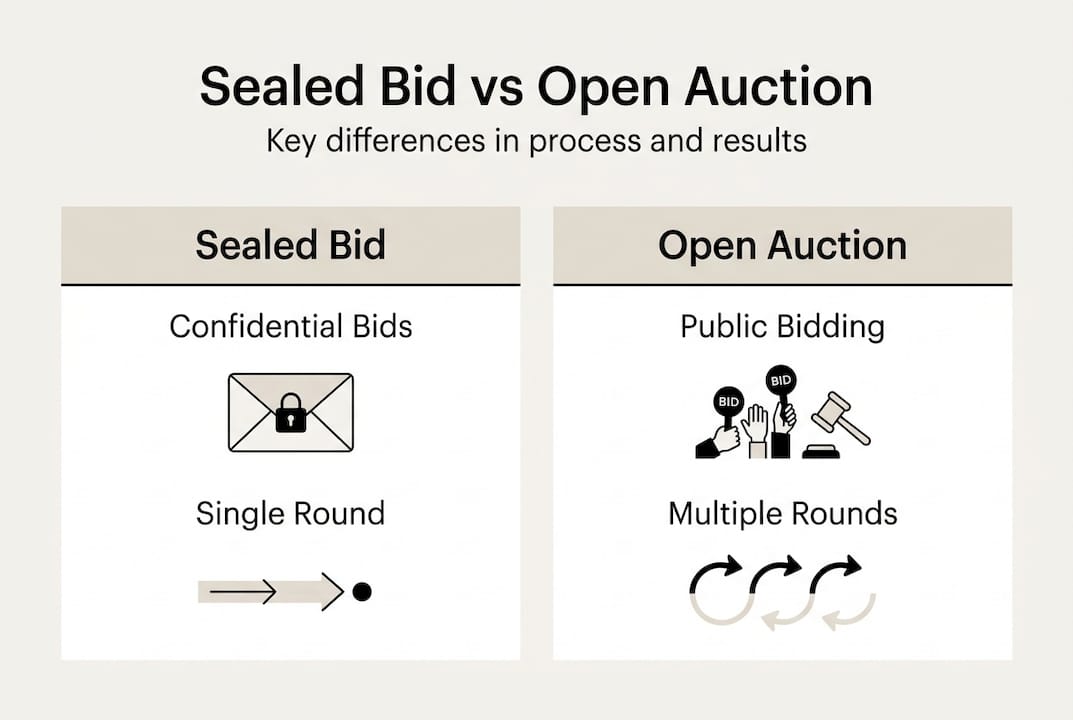
| Factor | Sealed bid sale | Open auction |
|---|---|---|
| Price transparency | Low during bidding | High in real time |
| Bidder confidentiality | Full | None |
| Collusion risk | Moderate | Higher |
| Suitable for complex assets | Yes | Sometimes |
| Speed of process | Structured and predictable | Variable |
| Emotional bidding risk | Low | High |
As auction research confirms, sealed formats promote fairness, confidentiality, and efficiency but carry the risk of over or underbidding, while open formats drive competition but introduce collusion and sniping risks. Sealed bidding is better suited for assets with defined specifications. For a broader view of recovery options, explore asset recovery methods that compare multiple liquidation formats.

Special considerations: Government, surplus, and electronic sealed bids
Beyond basics, complex assets and special sales call for extra diligence, especially with government or electronic transactions.
Government procurement follows the Federal Acquisition Regulation, which mandates invitations for bids with clear specifications, a two-step process for complex needs, and awards to the lowest responsive bid from a responsible bidder. Corporate sellers engaging government buyers must align their process with FAR requirements or risk disqualification.
Surplus asset sales introduce additional nuances. Accelerated timelines, diverse bidder pools, and strict rules around forfeiture of deposits require careful pre-sale planning. Digital submissions have largely replaced paper in most commercial contexts, offering efficiency and a stronger audit trail, but they require secure platforms and clear technical instructions for bidders.
| Consideration | Government sealed bid | Corporate surplus sealed bid |
|---|---|---|
| Governing framework | FAR / agency rules | Internal policy or state law |
| Award basis | Lowest responsive bid | Highest compliant bid |
| Bidder pool | Registered vendors | Open or pre-qualified buyers |
| Deposit requirement | Varies by agency | Typically 5 to 10 percent |
| Digital submission | Increasingly standard | Widely adopted |
For a real-world example of how sealed bid mechanics apply to agricultural and equipment assets, review the Wellman Seeds Inc. sealed bid auction. For industrial power plant equipment, the sealed bid mechanics for government assets case study provides detailed process insight.
Pro Tip: Before accepting digital bids, publish a technical submission guide that specifies file formats, portal access instructions, and deadline enforcement rules. Disqualifying a serious bidder due to a technical error is avoidable and costly.
Sealed bid sales in action: Case studies and industry insights
To clarify the real-world performance and best practices, let’s examine actual case studies and lessons from industry research.
Empirical data from USFS timber auctions shows that sealed bids attract more small bidders, shift allocation toward them, and can generate higher revenue than open auctions under certain market conditions. These findings are directly applicable to corporate asset sales where the goal is to broaden the buyer pool and maximize competitive tension without the volatility of open bidding.
Real-world corporate scenarios where sealed bid sales have delivered measurable outcomes include:
- Industrial equipment liquidations: Manufacturing facilities closing operations have used sealed bids to sell machinery packages, achieving faster timelines and broader geographic reach than negotiated sales.
- Distressed real estate: Lenders managing foreclosed commercial properties have used sealed bid formats to create a fair, auditable process that satisfies regulatory requirements while maximizing recovery.
- Power plant equipment: Sealed bid sales for turbines, generators, and cogeneration systems have attracted specialized buyers who would not participate in open auction formats due to the technical complexity of the assets.
- Agricultural and seed processing facilities: Combined real estate and equipment sealed bid sales have successfully engaged both local and national buyers simultaneously.
Research on timber and industrial asset auctions consistently shows that the revenue advantage of sealed versus open formats is context-dependent. Sealed bids perform best when the bidder pool is large, assets are well-specified, and the seller invests in aggressive pre-sale marketing.
For organizations managing plant liquidation returns, understanding when sealed bids outperform open formats is a critical strategic decision. Additional perspective on format selection is available through resources on industrial auctions for disposition. For context on manufacturing asset outcomes, industry-specific data reinforces the importance of matching sale format to asset type.
Best practices for success in sealed bid sales
With the lessons learned and evidence in mind, here is your practical checklist for successful sealed bid sales.
Empirical data confirms that sealed bids accelerate sales for corporate equipment liquidations compared to negotiated transactions, though the revenue advantage over open formats depends on market context and preparation quality.
- Define asset specifications precisely: Vague descriptions generate non-compliant bids and suppress buyer confidence. Include condition reports, photographs, and technical data sheets.
- Set a realistic reserve price: Base it on independent appraisals and current market data, not book value or replacement cost.
- Market to qualified buyers early: Launch outreach at least four to six weeks before the submission deadline. Target industry-specific databases, trade publications, and direct buyer lists.
- Establish clear compliance criteria: Publish exactly what constitutes a compliant bid, including deposit requirements, submission format, and disqualification conditions.
- Secure the submission process: Use locked physical boxes or encrypted digital portals. Assign a neutral custodian to manage receipt and storage.
- Conduct a witnessed opening: Invite legal counsel or a neutral third party to observe. Document every bid received, including those disqualified.
- Communicate results promptly: Notify all bidders of the outcome within the timeframe stated in your IFB. Return deposits to unsuccessful bidders without delay.
Pro Tip: Avoid the most common failure point: unclear evaluation criteria. If bidders cannot determine how their offer will be scored, they submit conservative bids or withdraw entirely. Publish your scoring methodology in the IFB.
Organizations managing facility closures should also review support for industrial closures to understand how professional auction marketing integrates with sealed bid execution.
Take the next step: Expert help for your next sealed bid sale
If you’re ready to pursue a sealed bid sale or want expert guidance on structuring a high-value asset transaction, Maas Companies Inc. brings decades of international experience to every engagement.
Our team has successfully executed sealed bid sales across industrial equipment, power generation assets, real estate, and commercial properties worldwide. Whether you are managing a distressed portfolio, a plant closure, or a government surplus disposal, we build aggressive marketing programs that attract qualified buyers and maximize recovery. Review a completed example sealed bid auction for a biomass power plant to see our process in action. When you are ready to move forward, visit our sell industrial equipment page or explore the full Maas services portfolio to find the right solution for your assets.
Frequently asked questions
What happens if no bid meets the reserve in a sealed bid sale?
If no bid meets the reserve price, the seller is not obligated to accept any offer, and the sale may be re-advertised or pursued through a negotiated transaction with interested parties.
Are sealed bid sales legal for all asset types?
Yes, sealed bid sales are widely used for real estate, equipment, and government assets, but each transaction must comply with FAR requirements and all applicable industry regulations.
Can a seller negotiate with bidders after a sealed bid sale?
No. Sealed bid formats do not allow post-bid negotiations; once bids are opened, the winner is notified and the transaction proceeds to execution without further price discussion.
How can sellers ensure fairness and prevent collusion in sealed bid sales?
Strict confidentiality protocols, independent bid custodians, and transparent opening procedures reduce collusion risk. As auction analysis confirms, sealed formats inherently promote fairness and efficiency when properly administered.
What types of assets or situations are best suited for sealed bid sales?
Distressed, high-value, or technically complex assets benefit most, particularly when fairness is mandated by regulation or when the seller needs a defensible, auditable transaction record.
Recommended
- SEALED BID AUCTION: Former Air Force Base | View Our Current Projects | Maas Companies
- Maximize Asset Recovery: Top Real Estate Liquidation Methods | Blog | Insights on Asset Liquidation and Auction Trends
- How Auctions Help Speed Up Industrial Asset Disposition | Blog | Insights on Asset Liquidation and Auction Trends
- SEALED BID AUCTION: Former K. I. Sawyer Air Force Base – Property 2 | View Our Current Projects | Maas Companies
- Residual Stock Lending: Maximising Value Without Reducing Prices | Mortgage Managers