

Blog
Understanding Title Transfer in Auctions: 2026 Legal Guide

TL;DR:
- Title transfer in auctions involves legally passing ownership through proper documentation, payment, and recording processes. For vehicles, this process requires accurate assignment, notarization, and timely DMV submission, while industrial equipment relies mainly on bills of sale and lien clearance, and real estate transfers often involve complex deed recording and quiet title actions. Buyers must conduct thorough pre-bid due diligence, verify lien status, and engage legal counsel to prevent delays, disputes, or unmarketable titles.
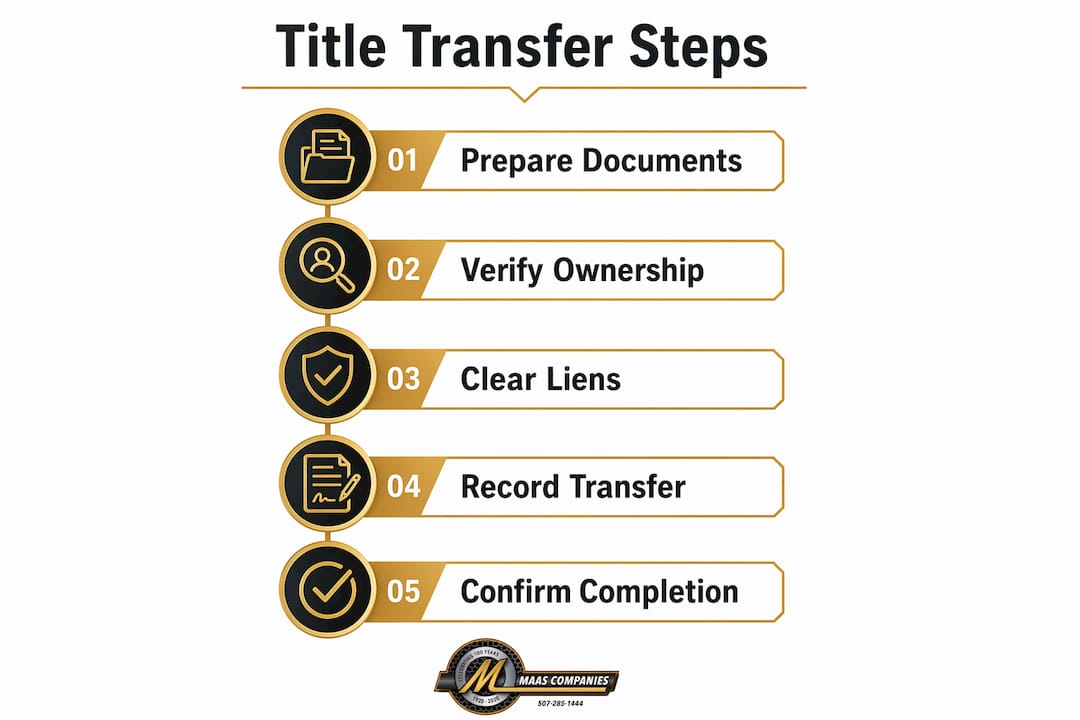
Title transfer in auctions is defined as the legal process by which ownership of an asset passes from seller to buyer upon fulfillment of all required documentation, payment, and recording obligations. For buyers of vehicles, industrial equipment, or real estate acquired at auction, understanding title transfer in auctions is not optional. It is the difference between holding a legally defensible asset and holding a receipt with no enforceable ownership rights. The process varies significantly by asset class, jurisdiction, and auction type, and errors at any stage can delay registration, cloud ownership, or expose buyers to unresolved lien liability.
How does title transfer work for vehicles bought at auction?
Vehicle title transfer at auction follows a defined compliance sequence, and the certificate of title is the foundational document. This certificate serves as legal proof of ownership and must be properly assigned before any registration can occur. Without a correctly completed assignment, the DMV will not recognize the transaction as valid.
The steps for completing a vehicle title transfer post-auction are as follows:
- Obtain the original certificate of title from the seller or auction house immediately after payment is confirmed.
- Complete the assignment section on the back of the title document. Both buyer and seller must sign in the designated fields, and the odometer reading must be recorded accurately for vehicles under a certain age threshold.
- Notarize the assignment where required. North Carolina requires notarized completion of the title back for transfer, and the North Carolina DMV frequently rejects titles with missing notarization or mismatched signature information. Other states have comparable requirements, so confirming state-specific rules before the auction closes is non-negotiable.
- Submit to the DMV with applicable fees, proof of insurance, and any supporting documentation such as a bill of sale or lien release.
- Obtain a temporary tag if the vehicle must be driven before permanent registration is complete. Temporary tags are state-issued and carry expiration dates, so buyers should not delay the DMV submission.
Correct completion of vehicle title assignments is the single most common failure point in vehicle auction transactions. A missing notary stamp or a transposed VIN number sends the entire application back to square one.
Pro Tip: Before bidding on a vehicle at auction, confirm which state issued the existing title. Out-of-state titles often carry different assignment requirements, and some states require a separate odometer disclosure form in addition to the title assignment itself.

What are the title transfer steps for industrial equipment and machinery at auctions?
Industrial equipment and machinery rarely carry a formal title document the way vehicles do. Ownership transfer for these assets relies primarily on a bill of sale, which functions as the legal instrument conveying title from seller to buyer. Understanding this distinction is critical for buyers who may expect a certificate of title and instead receive a bill of sale as the sole ownership record.
The sequence of ownership transfer for industrial assets at auction follows a structured process coordinated by the auction house:
- Payment confirmation triggers document release. The auctioneer holds all title documents and bills of sale until full payment is received and cleared. No documentation changes hands before this point.
- Bill of sale is executed. The auction house prepares a bill of sale identifying the asset by serial number, description, and sale price. This document establishes the chain of ownership and is the primary record for accounting, insurance, and legal purposes.
- Lien searches are conducted prior to sale. Responsible auction firms conduct UCC lien searches on major equipment before listing. If an active lien exists, it must be resolved or disclosed before the asset can transfer free and clear.
- Escrow arrangements apply to high-value transactions. For complex plant sales or multi-asset lots, escrow agents may hold funds and documents simultaneously, releasing both only when all conditions of sale are satisfied.
- Buyer takes physical and legal possession. Once documentation is complete, the buyer assumes full responsibility for the asset, including removal, transport, and any applicable regulatory compliance.
Pro Tip: Request a lien search report from the auction house before the sale date, not after. If a UCC filing surfaces post-sale, resolving it becomes your burden as the new owner, and the process can take weeks.
Maascompanies coordinates industrial asset disposition with attention to documentation accuracy and lien clearance, which reduces post-sale disputes and protects buyer interests throughout the transfer process.
How is real estate title transfer handled in foreclosure and tax deed auctions?
Real estate title transfer at auction is the most legally complex of the three major asset categories. The process differs materially depending on whether the sale is a judicial foreclosure, a non-judicial foreclosure, or a tax deed sale, and each carries distinct implications for lien clearance and title insurability.
| Auction Type | Deed Issued | Lien Treatment | Quiet Title Required? | Typical Timeline |
|---|---|---|---|---|
| Judicial foreclosure | Court-issued deed | Most junior liens extinguished by court order | Rarely, but possible | 30 to 90 days post-confirmation |
| Non-judicial foreclosure | Trustee’s deed | Senior liens survive; junior liens typically extinguished | Occasionally | Weeks after sale |
| Tax deed sale | Tax deed | Varies by state; liens may survive | Often required | 3 to 6 months post-filing |
In a judicial foreclosure, ownership vests when the court issues a deed after sale confirmation and payment. The deed must be recorded promptly at the county recorder’s office to establish the buyer’s position in the public record. Delays in recording create a window during which competing claims could theoretically attach.
Non-judicial foreclosures move faster. The trustee prepares and records a deed at the county office within weeks after the auction, completing the ownership change and removing the prior owner from the title chain. This speed is an advantage, but buyers should not assume the title is clean simply because the deed has been recorded.
Tax deed sales present the greatest post-acquisition risk. In Florida, tax deed purchasers must file a quiet title action to resolve heir claims and prior mortgage interests before obtaining marketable, insurable title. The quiet title judgment typically occurs three to six months after filing. This timeline has direct implications for buyers who intend to finance, sell, or insure the property quickly after acquisition.
A critical point that many buyers overlook: post-sale lien extinguishment does not automatically update public records. Even when a junior lien is legally extinguished by the foreclosure sale, the recorded lien remains visible in the public record until a formal release or court order is filed. Title insurance underwriters will not issue a policy over an unreleased lien, regardless of its legal status. Buyers must obtain and record lien releases or pursue a quiet title action to produce a clean, insurable chain of title.
What are common pitfalls and legal considerations in auction title transfers?
Title transfer errors are more common than most buyers anticipate, and the consequences range from registration delays to complete loss of ownership rights. The following categories represent the most frequent failure points across vehicle, equipment, and real estate auction transactions:
- Incomplete or improperly notarized assignments. Missing notarization or mismatched signature information causes outright rejection by DMV offices and creates gaps in the ownership chain for equipment transactions. Every signature field must be completed exactly as required by the issuing state.
- Unresolved liens and encumbrances. Purchasing an asset without confirming lien status transfers the liability to the buyer. UCC filings on equipment and mortgage liens on real property survive the sale if not properly extinguished or released.
- Failure to record promptly. Recording a deed or title assignment is not a formality. It establishes priority in the public record. A buyer who delays recording after a foreclosure sale risks having a subsequent creditor’s lien attach ahead of their interest.
- State-specific documentation gaps. Title transfer rights and requirements vary by state. What satisfies a DMV in Texas may be insufficient in New York. Buyers acquiring assets across multiple jurisdictions must verify requirements individually rather than assuming uniformity.
- Relying on auction house documentation without independent review. Auction houses prepare bills of sale and coordinate documentation, but they do not provide legal advice. Buyers in high-value transactions should engage legal counsel to review title documents before and after the sale.
Due diligence before bidding is the most effective defense against all of these risks. Reviewing available title records, requesting lien searches, and confirming documentation requirements for the specific asset class and jurisdiction eliminates the majority of post-sale complications before they occur.
Key takeaways
Title transfer in auctions requires asset-specific documentation, prompt recording, and proactive lien clearance to produce legally defensible ownership.
| Point | Details |
|---|---|
| Vehicle title compliance | Complete all assignment fields accurately and confirm state notarization requirements before submitting to the DMV. |
| Industrial equipment documentation | A bill of sale is the primary ownership instrument; confirm lien clearance before the auction closes. |
| Real estate deed recording | Record the deed immediately post-sale; unrecorded deeds leave ownership vulnerable to competing claims. |
| Quiet title for tax deeds | Florida and similar states require a quiet title action after tax deed sales, typically resolved within three to six months. |
| Pre-bid due diligence | Lien searches, title reviews, and documentation verification before bidding prevent the majority of post-sale disputes. |
What experienced practitioners know about title transfer that most buyers learn too late
After working through hundreds of industrial and commercial auction transactions, the pattern I see most often is not fraud or bad faith. It is buyers who treat title transfer as an administrative afterthought rather than a legal process that begins before the bid is placed.
The buyers who encounter the fewest problems are the ones who arrive at the auction having already reviewed available title records, confirmed lien status on major assets, and identified the specific documentation requirements for their state and asset class. They treat the auction legal pack, or its domestic equivalent, the same way a lender treats a loan file: nothing moves forward until the documentation is complete and verified.
The most costly mistakes I have observed involve real estate acquired at tax deed sales where the buyer assumed the deed was sufficient to convey marketable title. It is not, in most cases. The deed conveys whatever interest the taxing authority held, which may be subject to prior claims that survive the sale. Buyers who skip the quiet title process and attempt to sell or finance the property quickly discover that no title insurer will underwrite the transaction. That delay costs money and, in some cases, the deal itself.
For industrial equipment, the risk profile is different but equally real. A buyer who takes possession of a major piece of machinery without confirming that the seller’s lender has released its UCC security interest may find that the lender has a superior claim to the asset. The bill of sale from the auction house does not override a perfected security interest that was never discharged.
The practical answer is straightforward: engage qualified legal counsel for any auction transaction above a threshold your organization defines, conduct lien searches as standard practice, and never assume that speed of possession equals security of ownership. Partnering with an experienced auction firm that coordinates documentation and lien clearance as part of its process reduces this risk materially.
— Vector
How Maascompanies supports title transfer in complex asset auctions
Maascompanies brings decades of experience managing industrial plant, equipment, and real estate auctions where title transfer accuracy directly affects recovery value and transaction speed. Every project involves coordinated documentation management, from bill of sale preparation to lien clearance verification, so buyers receive assets with a clear chain of ownership and sellers achieve maximum recovery without post-sale disputes.

Current active projects include a feed pelletizer system auction and a biodiesel plant liquidation involving multiple asset classes, each requiring precise title transfer management across equipment, real property, and operational facilities. Contact Maascompanies directly to discuss how our auction and asset disposition services can support your next transaction.
FAQ
What is title transfer in an auction?
Title transfer in an auction is the legal process by which ownership of an asset passes from the seller to the buyer after payment is confirmed and required documentation is completed and recorded. The specific steps depend on the asset class and jurisdiction.
How long does the auction title transfer process take?
Vehicle title transfers typically complete within days to weeks after DMV submission. Industrial equipment transfers via bill of sale can close within days of payment. Real estate title transfer in foreclosure auctions takes weeks to months, and tax deed sales requiring quiet title actions can take three to six months.
Do all auction title transfers require notarization?
Notarization requirements vary by state and asset type. Vehicle title assignments in states like North Carolina require notarization, and incomplete notarization causes rejection by the DMV. Real estate deeds typically require notarization for recording. Industrial equipment bills of sale may not require notarization but must be executed correctly to establish a valid chain of ownership.
What happens to liens after a foreclosure auction?
Junior liens are generally extinguished by a judicial foreclosure sale, but recorded liens do not disappear automatically from the public record. Buyers must obtain formal lien releases or pursue a quiet title action to produce a clean, insurable title that satisfies lenders and title insurers.
Can I take possession of an asset before title transfer is complete?
Physical possession and legal title transfer are separate events. A buyer may take physical possession of industrial equipment after payment, but legal ownership is not fully established until the bill of sale is executed and any applicable liens are released. For real estate, possession and title vesting follow the recording of the deed, not the auction date.
Recommended
- Top reasons to buy at auction: maximize value & cut risk | Blog | Insights on Asset Liquidation and Auction Trends
- Common Commercial Foreclosure Auction Questions for Lenders | Blog | Insights on Asset Liquidation and Auction Trends
- How Auctions Help Speed Up Industrial Asset Disposition | Blog | Insights on Asset Liquidation and Auction Trends
- Commercial Real Estate Auctions Speed Up Sales | Blog | Insights on Asset Liquidation and Auction Trends