

Blog
What Is Forced Sale? A Guide for Asset Managers

TL;DR:
- A forced sale is a court-ordered transaction that compels an owner to sell assets against their will. It often occurs in disputes, creditor enforcement, divorce, or probate, and reduces owner control and asset value.
A forced sale is defined as a court-ordered or legally mandated transaction requiring an owner to relinquish property or assets against their will. Unlike a voluntary sale, the owner does not choose the timing, the buyer, or often the price. Asset managers, lenders, and legal professionals encounter forced sales most often in co-ownership disputes, creditor enforcement actions, divorce settlements, and probate proceedings. Understanding the forced sale definition, the legal process it follows, and its financial consequences is not optional for decision-makers managing complex portfolios. The stakes are high: forced sales routinely reduce recoverable value and eliminate owner control over outcomes.
What is forced sale and when does it apply?
A forced sale is a legal compulsion to sell property through a court process, triggered by co-ownership disputes, creditor judgments, or asset divisions in probate and divorce. The industry term most commonly used in legal and financial practice is “involuntary sale” or “compelled sale,” though “forced sale” is the standard shorthand across real estate law and asset management. Both terms describe the same mechanism: a court or legal authority overrides the owner’s preference and mandates a transaction.
The legal frameworks governing forced sales vary by jurisdiction, but the core structure is consistent across most U.S. states. Courts apply statutory partition law for co-ownership disputes, the Uniform Disposition of Community Property Act in some divorce contexts, and creditor enforcement statutes for debt-related sales. Each framework gives courts authority to compel a sale, appoint neutral administrators, and distribute proceeds according to legal priority.
Forced sales differ from distressed voluntary sales in one critical way. A voluntary quick sale, even at a discount, preserves the owner’s right to negotiate terms and select a buyer. A forced sale removes that right entirely. Once a court order is issued, the owner becomes a passive participant in a process governed by judicial timelines and legal procedure.
What triggers a forced sale?
Several distinct legal scenarios lead to a forced sale, and each carries different procedural requirements and timelines.
- Partition actions: Co-owners of inherited property, business real estate, or jointly purchased assets may petition for partition when they cannot agree on use or disposition. Partition actions begin with a petition filed in the jurisdiction where the property is located. Courts then issue an interlocutory order appointing a neutral referee to manage the process.
- Creditor-driven enforcement: After a court judgment, creditors may secure a charging order against the debtor’s property. Creditors initiate forced sales by first obtaining a charging order and then, if the debt remains unpaid, applying for a separate court order compelling the sale.
- Divorce and probate settlements: Courts routinely order the liquidation of jointly held assets when divorcing parties cannot agree on division, or when estate beneficiaries dispute property allocation.
- Tax and HOA liens: Unpaid property taxes or homeowners association assessments can escalate to forced sale proceedings when lien holders pursue judicial enforcement after statutory notice periods expire.
- Voluntary vs. involuntary distinction: A voluntary quick sale, even under financial pressure, is not a forced sale. The legal distinction matters because forced sales carry specific procedural protections and rights that voluntary transactions do not.
The most common trigger in commercial and industrial asset management is the creditor enforcement pathway. A charging order does not immediately compel a sale. It creates a secured claim against the asset, which the creditor can then use as the basis for a subsequent sale application. That two-step structure gives debtors a window to negotiate before losing control of the asset entirely.
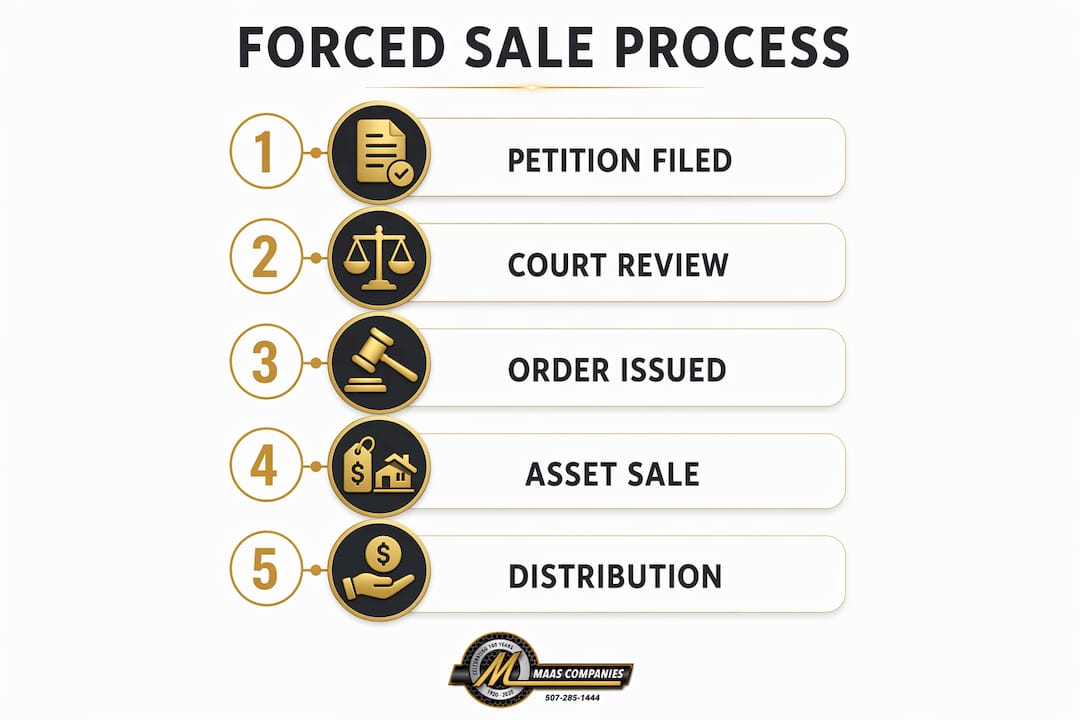
How does the forced sale process work?
The forced sale process follows a defined legal sequence. Understanding each step helps asset managers plan their response and preserve as much value as possible.
- Petition or application filed. A co-owner, creditor, or estate representative files a petition with the court having jurisdiction over the asset. The petition states the legal basis for the sale and the relief requested.
- Court hearing scheduled. The court schedules a hearing where all parties present their positions. Judges evaluate the debt amount, the debtor’s ability to pay, the impact on any family members residing in the property, and whether alternatives to sale exist.
- Interlocutory order issued. If the court finds grounds for a forced sale, it issues an interlocutory order. This order typically appoints a neutral referee or commissioner to manage the sale process. Once a court referee is appointed, owners lose direct control and the sale becomes an active legal project governed by the court’s timeline.
- Partition in kind vs. partition by sale. Courts first consider whether the asset can be physically divided among co-owners without a sale. Real property that cannot be equitably divided, such as a single industrial building or a manufacturing plant, proceeds to partition by sale.
- Sale mechanism selected. Courts favor open-market sales managed by neutral referees rather than rapid auctions. This approach maximizes net value and meets the commercial reasonableness standard courts apply to forced transactions. Court-supervised auctions remain an option when open-market listing fails to produce a qualifying offer within a defined period.
- Proceeds distributed. After the sale closes, the court supervises distribution of proceeds according to legal priority: secured creditors first, then lien holders, then co-owners in proportion to their ownership interests.
Pro Tip: If you are a co-owner facing a partition action, engage legal counsel before the interlocutory order is issued. Once the referee is appointed, your ability to influence the sale process drops significantly. Negotiating a buyout before that stage preserves far more value than contesting the process after the court takes control.
Financial and strategic implications for asset managers
Forced sales are costly and adversarial outcomes that reduce asset value for all parties involved. All parties typically lose value in forced sale proceedings due to legal fees, court costs, commissions, and the compressed or constrained sale conditions that accompany judicial oversight.
The financial consequences extend beyond the direct costs of the sale itself:
- Loss of timing control. Voluntary sales allow owners to list assets when market conditions favor maximum recovery. Forced sales proceed on the court’s schedule, which may coincide with unfavorable market conditions.
- Legal and administrative costs. Fees for attorneys, court-appointed referees, appraisers, and auctioneers reduce net proceeds before distribution. In cases where equity is thin, sale costs can exceed recovery, leaving creditors with less than the cost of pursuing the action.
- Portfolio valuation impact. Assets subject to forced sale proceedings carry legal encumbrances that affect their carrying value on the balance sheet. Lenders and auditors treat assets under active court orders differently from unencumbered holdings.
- Negotiation leverage lost. Once a forced sale order is issued, the owner’s negotiating position collapses. Buyers know the seller is compelled to transact, which suppresses offers.
Forced sales are rarely the preferred outcome for any party. Creditors and courts both treat court-ordered sales as last-resort mechanisms, applied only after alternatives have been exhausted. The threat of a forced sale carries more strategic weight than the sale itself in most negotiated settlements.
The most effective use of forced sale law in asset management is as a negotiation tool. A co-owner or creditor who files a partition petition or sale application signals credible intent to proceed. That signal frequently motivates the opposing party to negotiate a buyout or settlement before the court takes control. Creditors strategically evaluate whether forced sale costs exceed expected recovery, and when costs are high relative to equity, settlements or delays become the preferred path.
What legal rights and protections apply during a forced sale?
Owners facing a forced sale retain specific legal rights, and understanding those rights determines how effectively they can respond.
| Right or protection | How it applies |
|---|---|
| Absolute right to petition | Any co-owner may file for partition; courts cannot deny a valid petition even over strong objections from other co-owners |
| Homestead exemption | Many states protect a defined equity threshold in a primary residence from creditor-forced sales |
| Judicial hardship review | Courts weigh family impact, property use, and debt size before ordering a creditor-driven sale |
| Right to contest sale terms | Owners may challenge the referee’s sale process, pricing, or buyer selection through the court |
| Right to proceeds distribution | Co-owners receive proceeds proportional to their ownership interest after costs and liens are satisfied |
The legal right to petition for partition is generally absolute. Judges cannot deny a valid partition petition, even when co-owners have strong personal or financial objections. This creates a significant risk for owners who hold assets jointly without a co-ownership agreement that addresses disposition rights.
Courts and creditors act as gatekeepers to protect debtors from undue hardship, making forced sales a last resort after alternatives are explored. Judicial discretion plays a meaningful role in creditor-driven cases. A court may delay a forced sale order if the debtor demonstrates a credible repayment plan or if the property serves as a primary family residence.
A common misunderstanding among asset managers is that forced sales always result in rapid, below-market liquidations. Forced sales in partition actions typically result in open-market sales by court-appointed referees rather than fire-sale auctions. The commercial reasonableness standard courts apply means the process often resembles a managed brokerage sale more than a distressed auction.
Pro Tip: If a charging order has been filed against an asset in your portfolio, request a full equity analysis before the creditor applies for a sale order. When sale costs approach or exceed available equity, creditors frequently accept negotiated settlements. That analysis gives you a concrete basis for a settlement offer that avoids court proceedings entirely.
Key Takeaways
Forced sales are court-mandated asset dispositions that eliminate owner control, reduce net recovery, and follow a defined legal process that asset managers must understand to protect portfolio value.
| Point | Details |
|---|---|
| Forced sale definition | A court-ordered involuntary transaction triggered by co-ownership disputes, creditor judgments, or estate proceedings |
| Primary legal triggers | Partition actions, charging orders, divorce settlements, and tax or HOA lien enforcement |
| Process sequence | Petition, court hearing, interlocutory order, referee appointment, open-market sale, and proceeds distribution |
| Financial consequences | Legal fees, court costs, and loss of timing control reduce net recovery for all parties |
| Key owner protection | Courts apply hardship review and commercial reasonableness standards before ordering a creditor-driven sale |
What I’ve learned from watching forced sales unfold
After years of working with asset recovery across industrial, commercial, and real estate sectors, the pattern I see most often is this: forced sales are almost never about the sale itself. They are about leverage.
The professionals who manage forced sale situations most effectively treat the legal process as a negotiating framework, not a final outcome. A partition petition filed in the right jurisdiction, at the right stage of a co-ownership dispute, almost always produces a buyout offer within weeks. The opposing co-owner calculates the cost and loss of control that comes with a court-supervised sale and decides that a negotiated exit is the better option.
What surprises many decision-makers is how rarely forced sales actually reach the open-market stage. Courts prefer settlements. Creditors prefer settlements. Even referees appointed to manage the process will often facilitate negotiation between parties before listing an asset. The legal machinery exists, but it functions primarily as a forcing mechanism for parties who would otherwise remain deadlocked.
The practical lesson for asset managers is to understand the process well enough to use it strategically. That means knowing when to file, what the court will consider, and what a commercially reasonable sale looks like under judicial oversight. It also means knowing when the threat of a forced sale is worth more than the sale itself. In my experience, that is most of the time.
— Vector
Maascompanies and complex asset liquidation
Forced sale proceedings and court-ordered liquidations require a marketing and recovery partner with direct experience in complex, time-sensitive asset transactions. Maascompanies brings that experience to industrial plants, commercial real estate, and specialized equipment portfolios worldwide.


Maascompanies manages industrial asset auctions and orderly negotiated sales across sectors where forced sale conditions create urgent recovery timelines. The firm’s approach prioritizes maximum capital recovery through targeted marketing, qualified buyer networks, and structured sale processes that meet commercial reasonableness standards. For asset managers and legal professionals managing distressed or court-ordered dispositions, Maascompanies offers the operational depth to execute under pressure. Review current projects and sell industrial assets with a team that understands the full forced sale context.
FAQ
What is the forced sale definition in legal terms?
A forced sale is a court-ordered or legally mandated transaction requiring an owner to sell property or assets involuntarily. It is triggered by co-ownership disputes, creditor judgments, divorce settlements, or estate proceedings.
How does a forced sale differ from a voluntary sale?
A voluntary sale preserves the owner’s right to set timing, negotiate terms, and select a buyer. A forced sale removes those rights entirely, placing control with a court-appointed referee and a judicially supervised process.
What triggers a forced sale in a co-ownership dispute?
Any co-owner may file a partition petition to compel the sale of jointly held property. The legal right to petition is generally absolute, meaning courts cannot deny a valid petition even when other co-owners object.
Does a charging order immediately force a sale?
A charging order creates a secured claim against the debtor’s property but does not immediately compel a sale. The creditor must file a separate court application for a sale order, giving the debtor time to negotiate or repay the debt.
Are forced sales always rapid, below-market transactions?
Forced sales in partition actions typically result in open-market sales managed by court-appointed referees, not fire-sale auctions. Courts apply a commercial reasonableness standard designed to maximize net proceeds for all parties.
Recommended
- How to Navigate Commercial Property Foreclosure Sales | Blog | Insights on Asset Liquidation and Auction Trends
- How to Plan Government Asset Sales for Spring 2026 | Blog | Insights on Asset Liquidation and Auction Trends
- Liquidation sales explained: Maximize asset recovery | Blog | Insights on Asset Liquidation and Auction Trends
- How Auctions Help Speed Up Industrial Asset Disposition | Blog | Insights on Asset Liquidation and Auction Trends