

Blog
What Is Portfolio Liquidation: A Recovery Guide

TL;DR:
- Portfolio liquidation involves converting investments into cash through controlled or forced asset sales, with the process significantly impacting recovery value. Scheduled orderly liquidations follow a defined timeline of steps, usually taking 9 to 18 months, and require careful planning and professional execution to optimize outcomes. In contrast, forced liquidations occur rapidly under creditor or court mandates, often resulting in substantial valuation discounts and elevated risks.
Portfolio liquidation is defined as the systematic conversion of investment assets into cash, executed either through a controlled orderly sale or a forced involuntary process triggered by insolvency, fund wind-down, or creditor action. Asset managers and financial professionals distinguish between these two types because the method chosen directly determines how much value is recovered. Forced liquidations often lead to fire sales, while orderly liquidations aim to maximize recovery by managing market impact and timing. Understanding the portfolio liquidation process is not optional for serious capital recovery. It is the foundation of every sound exit strategy.
What is portfolio liquidation and why does it matter?
Portfolio liquidation is the process of converting all or part of an investment portfolio into cash by selling its underlying assets. The industry recognizes two primary categories: voluntary (orderly) liquidation and involuntary (forced) liquidation. Each carries distinct implications for valuation, timing, and stakeholder outcomes.
Voluntary liquidation occurs when fund managers or investors choose to wind down a portfolio in a planned manner. Common reasons include fund maturity, strategic reallocation, or a decision to return capital to investors. Involuntary liquidation is triggered externally, typically by creditor demands, court orders, or regulatory action following insolvency.
Valuation frameworks under IFRS and GAAP both require that liquidation value reflect realistic market conditions rather than book value. This distinction matters because book value often misrepresents liquidation value, and professional valuation must account for forced-sale discounts and realistic conversion timelines to avoid costly surprises. A portfolio that appears healthy on paper can lose 25–45% of its stated value once liquidation conditions are applied.
What is the typical timeline for portfolio liquidation?
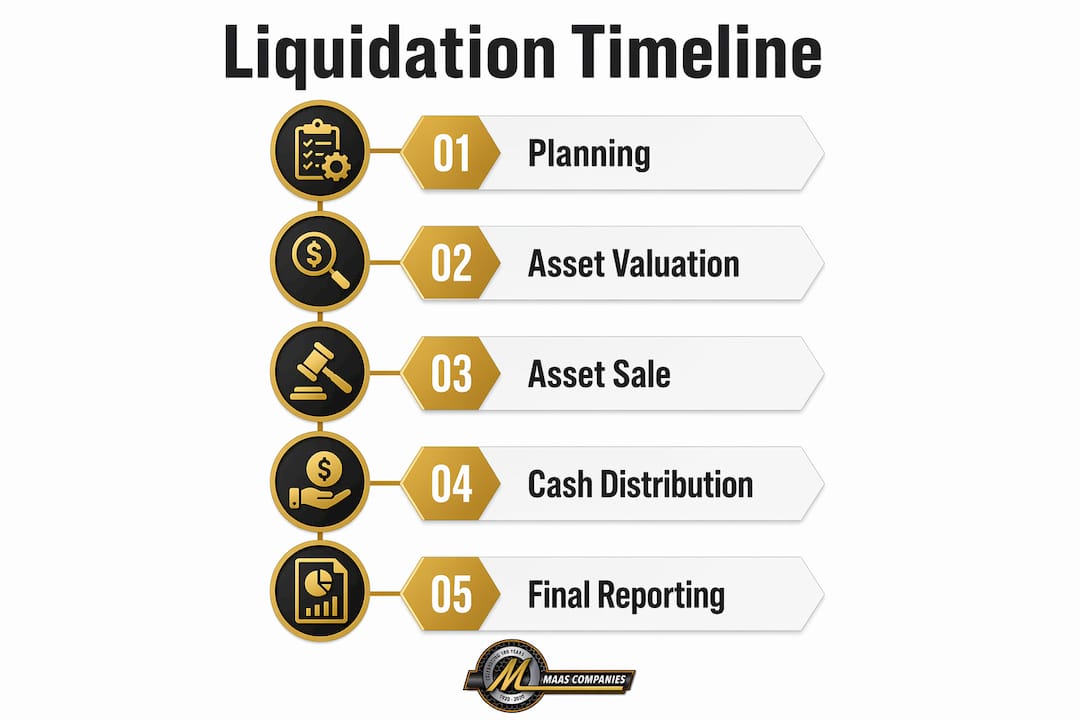
The portfolio liquidation process follows a defined sequence of stages, each with its own regulatory and operational requirements. Skipping or compressing any stage increases the risk of valuation shortfalls and legal exposure.
A standard orderly liquidation for an investment fund proceeds through these steps:
- Board resolution and legal authorization. The fund’s governing body formally approves the wind-down and appoints a liquidator or liquidation committee.
- Asset inventory and valuation. All holdings are cataloged and assigned realistic liquidation values, including stress haircuts for illiquid positions.
- Creditor notification and claims period. Creditors are formally notified, and a claims window is opened to identify all outstanding liabilities.
- Asset sales and interim distributions. Assets are sold in priority order, and interim cash distributions are made to investors as proceeds become available.
- Audit of liquidation accounts. Auditing opening liquidation accounts provides assurance for interim distributions and confirms fund solvency before final payouts.
- Final distribution and dissolution. Remaining cash is distributed, holdbacks are released after all liabilities are settled, and the fund is formally dissolved.
Full liquidation typically takes 9–18 months for orderly closures of investment funds. Cash-only portfolios may complete in 6–9 months, while regulated funds holding illiquid assets or complex liabilities often exceed 18 months. Venture capital funds with private company holdings frequently fall into this extended category because secondary market exits require additional time to locate qualified buyers.
Pro Tip: Retain a holdback of 5–15% of net assets to cover final liabilities. Managers who miscalculate holdbacks may face personal liability or be required to call additional capital from investors after the fund has formally closed.
How do orderly and forced liquidations differ?
The distinction between orderly and forced liquidation is the most consequential decision point in understanding portfolio liquidation. The two approaches differ in control, timing, price realization, and risk profile.
Orderly liquidation is a controlled process where the portfolio manager directs the sale of assets over a planned timeline. The primary objective is to minimize market impact and achieve prices close to fair value. Managers can sequence asset sales to avoid flooding any single market, negotiate directly with buyers, and time transactions around favorable market conditions.
Forced liquidation is creditor-driven or court-mandated. The timeline is compressed, and the seller has little control over pricing or buyer selection. Assets are sold at whatever price the market will bear under time pressure. In forced sale scenarios, vehicles lose approximately 25%, real estate loses 15–20%, and jewelry loses 40–50% of estimated fair value. Secondary market private equity and VC-backed assets often sell at a 10–30% discount to the last round valuation.
The table below summarizes the key differences:
| Factor | Orderly Liquidation | Forced Liquidation |
|---|---|---|
| Timeline | 9–18+ months | Days to weeks |
| Control level | High (manager-directed) | Low (creditor or court-directed) |
| Price realization | Near fair value | 15–50% below fair value |
| Market impact | Managed and minimized | Severe, often self-reinforcing |
| Primary risk | Execution delay | Deep valuation discounts |
| Regulatory oversight | Planned and coordinated | Reactive and compressed |
Key factors that determine which type applies include:
- Solvency status at the time the decision is made
- Creditor agreements and covenant structures in fund documents
- Asset liquidity profile across the portfolio
- Regulatory jurisdiction governing the fund’s domicile
The practical implication is direct: every month of advance planning converts potential forced-sale losses into recoverable value. Asset managers who identify wind-down triggers early retain the ability to execute an orderly process.
What strategies optimize recovery value during liquidation?
Maximizing recovery during the portfolio liquidation process requires deliberate sequencing, professional execution, and realistic valuation from the outset. Generic approaches produce generic results. The following strategies reflect what experienced liquidators apply in practice.

Build a liquidity map before selling anything. A liquidity map assigns conversion time and expected sale discounts, known as stress haircuts, to every holding in the portfolio. This map becomes the operational blueprint for sequencing sales and forecasting cash flows. Correlated asset price drops increase the risk of severe losses if liquidation is rushed without this foundation.
Prioritize assets by liquidity tier. Sell the most liquid assets first to generate operating cash and satisfy near-term creditor obligations. Reserve illiquid holdings for later in the timeline when buyers can be properly sourced. A practical prioritization sequence looks like this:
- Tier 1: Public equities, money market instruments, and exchange-traded funds
- Tier 2: Investment-grade fixed income and listed real estate investment trusts
- Tier 3: Private credit, direct real estate, and infrastructure assets
- Tier 4: Private equity, VC fund interests, and specialty assets
Use algorithmic execution and OTC sales for large positions. Market impact is a primary risk during liquidation of large portfolios. Algorithmic execution breaks large block trades into smaller orders to reduce price disruption. Over-the-counter sales allow direct negotiation with institutional buyers, bypassing public markets entirely for illiquid or specialized assets. Experienced liquidators use both methods depending on asset class and market depth.
Engage specialized professionals early. Valuation agents, audit firms, and experienced liquidation sales professionals each play a distinct role. Valuation agents establish defensible pricing. Auditors confirm solvency and protect against liability. Liquidation agents bring buyer networks and market intelligence that internal teams rarely possess.
Pro Tip: Tax sequencing matters as much as price sequencing. Selling high-gain positions in a tax-advantaged structure before dissolving the fund can preserve meaningful after-tax recovery for investors. Coordinate with tax counsel before executing the first sale.
What are the key risks in portfolio liquidation?
Portfolio liquidation carries risks that compound when not identified and managed in advance. The most damaging scenarios share a common cause: insufficient planning before the liquidation trigger occurs.
“Liquidity cannot be managed as an afterthought. Simulations of forced sales under multiple triggers improve risk readiness far more than single-point stress tests.” — Liquidity Tiering & Designing Portfolios for Forced Sale Scenarios
The primary risks include:
- Market impact risk. Large asset sales move prices against the seller. This effect is most severe in thinly traded markets and can turn a planned orderly sale into a de facto forced sale if not managed through pacing and execution method.
- Valuation gap risk. The gap between book value and liquidation value ranges from 25–45% depending on assets and market conditions. Rapid liquidation incurs larger losses. Managers who rely on book value for distribution planning routinely over-distribute early and face shortfalls at close.
- Correlated drawdown risk. Portfolios with concentrated sector exposure face simultaneous price declines across multiple holdings during market stress. This correlation eliminates the diversification benefit precisely when it is most needed.
- Solvency maintenance risk. Distributing too much capital too early can render a fund technically insolvent before all liabilities are settled. Engaging professional liquidators ensures timely capital return and compliance with solvency requirements throughout the process.
- Holdback miscalculation risk. Underestimating final liabilities exposes managers to personal liability after the fund closes. A reserve of 5–15% of net assets is the accepted standard, but the precise figure requires detailed liability modeling.
Scenario planning and simulation are the most effective tools for managing these risks before they materialize. Running multiple forced-sale scenarios against the actual portfolio, not a theoretical one, reveals which assets create the greatest exposure and where sequencing decisions carry the highest stakes. Firms that conduct this analysis before a wind-down decision is made retain far more options than those who begin planning after the trigger event.
Balancing speed against price realization is the central operational tension in every liquidation. Creditors and investors both want capital returned quickly. The market penalizes urgency with lower prices. The resolution lies in a credible timeline communicated clearly to all stakeholders, supported by a liquidity map that demonstrates how recovery will be maximized within the agreed schedule. For industrial and manufacturing assets, understanding how industrial plant liquidation affects pricing and sale behavior is equally critical for lenders and asset managers overseeing physical asset portfolios.
The lesson most liquidations learn too late
Portfolio liquidation is one of those processes where the decisions made six months before the formal start determine most of the outcome. By the time a fund or portfolio is formally in wind-down, the range of available options has already narrowed significantly.
The most consistent pattern I have observed across liquidation scenarios is that managers underestimate how quickly market conditions can shift against them once a wind-down becomes public knowledge. Buyers reprice immediately when they learn a seller is motivated. That repricing is not irrational. It reflects the reality that the seller’s negotiating position has changed. The practical response is to begin liquidity tiering and scenario planning well before any formal announcement, treating it as routine portfolio management rather than a crisis response.
Stakeholder communication is equally underrated. Investors who receive clear, structured updates throughout the process are far less likely to create legal or regulatory complications. Transparency about timelines, holdback rationale, and interim distribution schedules builds the credibility that keeps a process orderly even when market conditions are not cooperative.
The tools available for managing liquidation have improved considerably. Algorithmic execution platforms, secondary market networks for private assets, and real-time portfolio analytics all reduce the information disadvantage that sellers historically faced. The managers who use these tools systematically, rather than reactively, consistently achieve better recovery outcomes.
The uncomfortable truth is that most forced liquidations were avoidable. They result from delayed recognition of deteriorating conditions, not from unforeseeable events. Continuous liquidity monitoring and tiered portfolio construction are the most reliable defenses against ending up in a forced sale scenario.
— Vector
How Maascompanies supports portfolio liquidation
When a portfolio includes industrial plants, manufacturing equipment, or commercial real estate, the liquidation process requires specialized market knowledge that general financial advisors rarely possess.

Maascompanies brings decades of experience executing orderly negotiated sales and competitive auctions for industrial and commercial assets worldwide. From biodiesel plants and oilseed processing facilities to surplus manufacturing equipment, Maascompanies structures each engagement to maximize recovery through targeted marketing to qualified buyers. If you are managing a portfolio wind-down that includes physical assets, explore Maascompanies’ current liquidation projects to see how specialized expertise translates into measurable recovery value.
Key takeaways
Portfolio liquidation outcomes are determined primarily by preparation quality, asset sequencing, and the choice between orderly and forced sale execution.
| Point | Details |
|---|---|
| Orderly vs. forced liquidation | Orderly sales preserve 15–50% more value than forced sales by controlling timing and buyer selection. |
| Liquidity mapping is foundational | Assign stress haircuts and conversion timelines to every holding before executing any sales. |
| Holdback reserves protect managers | Retain 5–15% of net assets to cover final liabilities and avoid post-close personal liability. |
| Timelines range from 6–18+ months | Cash-heavy funds close faster; illiquid or regulated funds require extended wind-down periods. |
| Professional expertise reduces risk | Valuation agents, auditors, and specialized liquidators consistently improve recovery outcomes. |
FAQ
What is portfolio liquidation in simple terms?
Portfolio liquidation is the process of selling all assets within an investment portfolio to convert them into cash. It can be voluntary, as in a planned fund wind-down, or involuntary, as in a court-ordered or creditor-driven forced sale.
How long does the portfolio liquidation process take?
Orderly fund liquidations typically take 9–18 months, while cash-only portfolios may close in 6–9 months. Funds holding illiquid assets or operating under regulatory oversight often exceed 18 months.
What is the difference between portfolio liquidation and a sell-off?
A sell-off refers to a rapid, often market-driven disposal of specific assets, typically in response to price declines. Portfolio liquidation is a structured process to wind down an entire portfolio, with defined legal, audit, and distribution requirements.
What are the main reasons for portfolio liquidation?
The primary reasons include fund maturity, investor redemption demands, insolvency, regulatory action, and strategic reallocation of capital. Each reason affects the timeline and method of liquidation differently.
How can asset managers maximize recovery during liquidation?
Asset managers maximize recovery by building a liquidity map, sequencing sales from most to least liquid, using algorithmic or OTC execution for large positions, and engaging professional liquidators with specialized buyer networks.
Recommended
- Liquidation sales explained: Maximize asset recovery | Blog | Insights on Asset Liquidation and Auction Trends
- Maximize Asset Recovery: Top Real Estate Liquidation Methods | Blog | Insights on Asset Liquidation and Auction Trends
- Equipment liquidation explained: maximizing asset recovery | Blog | Insights on Asset Liquidation and Auction Trends
- How Industrial Plant Liquidation Maximizes Recovery Value for Lenders | Blog | Insights on Asset Liquidation and Auction Trends