
Blog
Why Auctions Outperform Private Sales for Industrial Asset Recovery

TL;DR:
- Auctions provide transparency, faster closure, and broader market reach compared to private sales.
- They maximize price discovery, reduce carrying costs, and improve regulatory defensibility.
- Private sales often incur delays, limited demand, and higher compliance risks, making auctions the strategic choice.
Many CFOs and COOs assume that a carefully negotiated private sale will always yield a higher net return on industrial equipment and plant assets. In practice, that assumption frequently costs organizations money, time, and regulatory standing. Auctions offer transparency and a competitive environment that private negotiations simply cannot replicate, particularly when timelines are compressed, regulatory scrutiny is elevated, or the asset portfolio is large and varied. This article examines the concrete operational and financial reasons why auction disposition consistently outperforms private sale approaches for industrial organizations.
Table of Contents
- Understanding the core differences: Auction vs. private sale
- Auction advantages: Speed, price discovery, and market reach
- Defensibility, audit trail, and compliance in distressed scenarios
- When to choose auction over private sale: Real-world decision factors
- The practical reality: What most asset sellers miss about auctions
- Explore industrial auction solutions for every scenario
- Frequently asked questions
Key Takeaways
| Point | Details |
|---|---|
| Speed and efficiency | Auctions rapidly complete asset sales, outpacing traditional private deals. |
| Regulatory defensibility | Auction processes create transparent, auditable trails vital for compliance. |
| Maximized market reach | Auctions tap broad buyer pools, enhancing price discovery and competition. |
| Strategic decision factors | Regulatory pressure, time constraints, and value recovery all favor auctions in most industrial scenarios. |
Understanding the core differences: Auction vs. private sale
Having established the high-level value of auctions, let’s examine the basic mechanics and how each method works in practice.
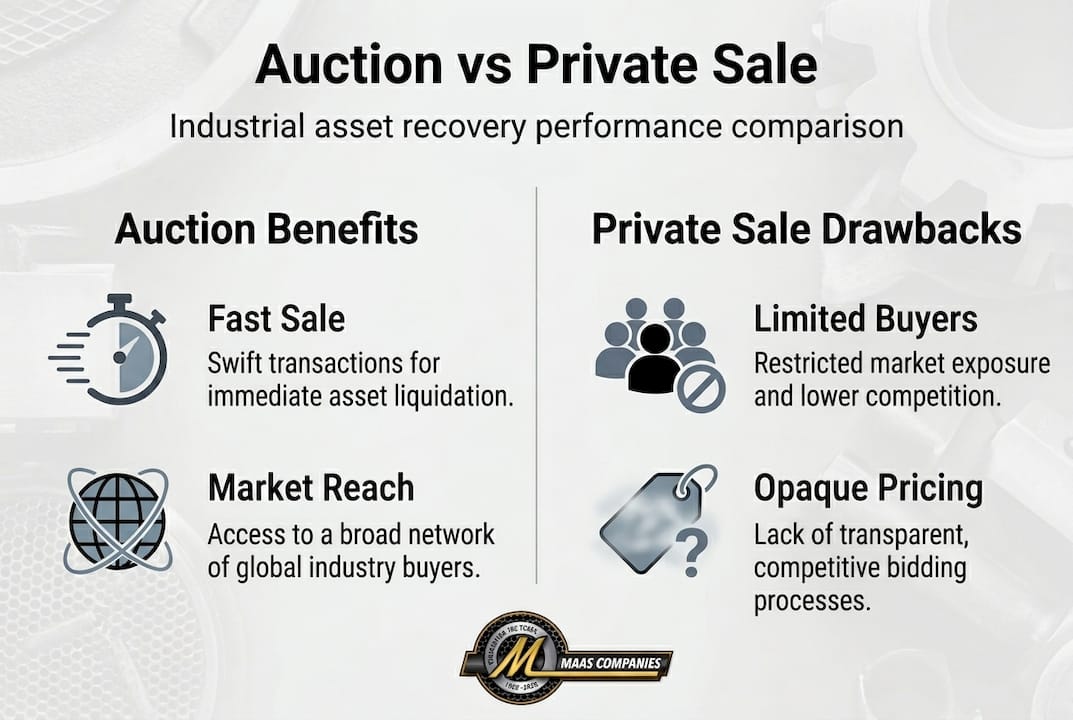
An industrial auction is a structured, time-bound sale event in which qualified buyers compete openly, either in person, online, or through a hybrid format, driving prices upward through competitive bidding. The process is governed by published terms, predetermined timelines, and documented bid records. A private sale, by contrast, involves direct negotiation between the seller and one or more identified buyers, typically without a fixed deadline, open competition, or public transparency.
The distinction matters enormously for CFOs and COOs. In a private sale, the seller bears the full burden of finding buyers, establishing fair market value, and defending the final price to auditors or boards. In an auction, the market itself establishes price through competition, and every step is recorded. Understanding the full range of auction vs. private sale channels helps leadership teams select the right strategy before committing to either path.
The table below contrasts these two approaches across the criteria most relevant to industrial asset disposition:
| Criteria | Auction | Private sale |
|---|---|---|
| Timeline to close | Weeks to 60 days | 3 to 12 months |
| Price discovery | Open, competitive bidding | Negotiated, opaque |
| Buyer pool | Broad, often global | Limited, identified parties |
| Audit trail | Fully documented | Variable, often incomplete |
| Regulatory defensibility | High | Moderate to low |
| Carrying cost exposure | Low | High |
| Management burden | Managed by auction firm | Managed internally |
Several practical impacts follow from these differences:
- Carrying costs (warehousing, insurance, security, and maintenance) accumulate rapidly during prolonged private sale processes, eroding net recovery.
- A limited buyer pool in private negotiations reduces competitive pressure, which typically suppresses final bid values.
- The absence of a structured auction platform makes it difficult for buyers to evaluate assets remotely, cutting off international demand.
- Private sale documentation is rarely sufficient to satisfy lender requirements, court-appointed trustees, or internal audit committees without significant supplemental effort.
Modern auction platform solutions now allow bidders from multiple continents to participate simultaneously, which substantially expands the effective market for specialized industrial equipment that might have only two or three qualified buyers in any single region.
Auction advantages: Speed, price discovery, and market reach
With a clear view of the fundamental differences, it’s time to look closely at the main operational and financial upsides auctions offer.
Speed is one of the most immediately quantifiable auction advantages. When a plant closure decision is made, every week of delay adds carrying costs and increases the risk of asset deterioration. Facility vacates prioritize speed over other concerns, and auctions are structurally designed to deliver exactly that acceleration. A well-organized industrial auction can move from initial inventory to final settlement in 30 to 60 days, a fraction of the typical private sale timeline.
The timeline comparison speaks for itself:
| Disposition method | Typical timeline | Key bottleneck |
|---|---|---|
| Full auction campaign | 30 to 60 days | Asset inventory and marketing |
| Online-only auction | 14 to 30 days | Digital catalog preparation |
| Private sale, standard | 90 to 180 days | Buyer identification and negotiation |
| Private sale, complex | 6 to 12 months | Due diligence and deal structure |
Price discovery is the second major advantage. In a private sale, the seller often has limited visibility into true market demand. An auction compels buyers to reveal their valuations publicly and competitively, which means the final hammer price reflects real-time market conditions rather than a single negotiated figure that may leave significant value on the table. When you can speed up disposition without sacrificing competitive pricing, the financial case for auctions becomes straightforward.

Market reach amplifies price discovery further. Industrial equipment, especially large-format manufacturing machinery, process equipment, or specialized tooling, may have only a handful of qualified buyers in a given region. An auction marketed aggressively through industry channels, digital platforms, and direct buyer outreach can attract bidders from across North America, Europe, Asia, and beyond. That global reach converts a thin local market into a robust competitive field.
Lot structuring is a critical factor that many sellers overlook. How assets are grouped for bidding significantly influences recovery rates. To learn how to auction value maximization strategies apply to lot design, consider that individual lots for high-demand items often generate stronger per-unit prices than bulk lots, while bulk lots can clear lower-value assets quickly.
Pro Tip: Before finalizing your auction catalog, work with your auction firm to analyze historical sale data for comparable equipment. Items that appear similar may have vastly different buyer pools. Separating a CNC machining center from surrounding shop floor equipment into its own lot, for example, can dramatically increase the final bid by drawing specialized buyers who would otherwise ignore a mixed lot.
Key auction advantages at a glance:
- Competitive bidding environment drives prices closer to true market value.
- Fixed auction dates create urgency that motivates buyer preparation and committed bidding.
- Broad marketing reach attracts buyers who were not part of the seller’s existing network.
- Auction firm expertise in lot structuring optimizes recovery across the entire asset portfolio.
- Defined timelines eliminate the open-ended carrying cost exposure that characterizes private sales.
Defensibility, audit trail, and compliance in distressed scenarios
Beyond financial returns, auctions provide additional benefits in documentation and governance that private sales simply can’t match.
For CFOs managing asset sales in distressed or insolvency situations, the ability to demonstrate a fair, arm’s-length process is not optional. It is a fiduciary requirement. Distressed insolvency scenarios favor auctions specifically because the auction process generates an inherent audit trail: every bidder is registered, every bid is time-stamped, and the final sale price is determined openly by market competition rather than private agreement.
A CFO who sells a major asset through a private sale and later faces a creditor challenge or regulatory review must reconstruct the rationale for the accepted price. That reconstruction is costly, time-consuming, and often unconvincing. An auction eliminates that risk by design.
“The auction process is inherently self-documenting. Bid records, buyer registration data, and sale terms are produced automatically as part of the event, giving trustees, auditors, and courts a complete chain of evidence without any additional administrative effort.” This is the fundamental reason that courts, lenders, and insolvency practitioners consistently direct asset sales through auction channels rather than private negotiations.
The compliance steps that CFOs and COOs should follow when preparing for an auction in a regulated or distressed context include:
- Engage legal counsel early to confirm that the chosen auction format satisfies any court orders, lender agreements, or regulatory requirements governing the asset sale.
- Select a licensed, bonded auction firm with demonstrated experience in your asset category and regulatory environment, including international experience if assets have global value.
- Document the inventory process meticulously, with photographs, serial numbers, condition reports, and appraisals where applicable, to support buyer due diligence and post-sale audit requirements.
- Establish buyer qualification criteria before the auction opens, ensuring that all registered bidders meet financial and legal eligibility standards.
- Retain all bidder communication records throughout the marketing and bidding period, including email inquiries, inspection logs, and bid confirmations.
- Issue final settlement documentation promptly after the auction close, capturing buyer identity, final price, payment terms, and asset transfer records.
Auctions also support ESG (environmental, social, and governance) reporting goals, which are increasingly relevant for industrial organizations with sustainability commitments. ESG compliance for manufacturers increasingly includes responsible asset disposition as a measurable metric. Auction-based disposition, particularly when paired with buyer screening for responsible end-use, provides the documentation needed to satisfy those reporting obligations. How industrial plant liquidation for lenders and special asset managers is structured also affects how efficiently these compliance requirements are met across complex portfolios.
When to choose auction over private sale: Real-world decision factors
Now that we’ve covered documentation and compliance, here’s how to determine the best-fit sales strategy for your organization’s unique needs.
The most common mistake organizations make is defaulting to private sale because it feels more controlled. In reality, the control is often illusory. Private negotiations require sustained internal management attention, external advisory fees, and ongoing carrying costs that compound week after week. Meanwhile, the buyer pool stays narrow and the price discovery process remains opaque.
Edge cases clarify the choice: distressed or insolvency situations demand auctions for audit trail and defensibility, while fire-sales or facility vacates prioritize speed, a need that auctions also serve better than private sales given their structured, time-bound nature.
Here is a sequential framework for evaluating which method fits your situation:
- Assess the timeline. If assets must be vacated within 90 days or less, auctions are almost always the superior choice. Private sale cycles rarely close that quickly without significant price concessions.
- Evaluate the buyer pool. If your assets could attract bidders from multiple industries or geographies, auction marketing will capture demand that private outreach would miss entirely.
- Review the regulatory environment. If lenders, courts, boards, or regulators have a stake in the outcome, the auction’s built-in audit trail substantially reduces your compliance risk.
- Calculate carrying cost exposure. Multiply your monthly carrying costs (storage, insurance, utilities, security) by the expected months to close under a private sale. That figure often exceeds any theoretical price premium from negotiated deals.
- Consider internal capacity. Managing a private sale requires sustained internal resources. An experienced auction firm handles marketing, buyer qualification, bidding logistics, and settlement, freeing your team to focus on core operations.
Pro Tip: Before finalizing your disposition strategy, ask your advisors these three questions: How many qualified buyers have you already identified for this specific asset type? What is the realistic timeline to close under a private sale? And what is the total carrying cost if the sale takes twice as long as projected? The answers will almost always point toward auction as the more efficient and financially sound option. Resources on choosing the right auction format and structure can also sharpen that decision-making process significantly.
Real-world scenarios where auctions consistently outperform private sales include plant closures with lender oversight, insolvency proceedings requiring court approval, multi-site equipment portfolios with mixed asset categories, and time-sensitive facility exits driven by lease terminations. Understanding why companies auction machinery to maximize asset recovery helps frame the decision as a strategic choice rather than a last resort.
The practical reality: What most asset sellers miss about auctions
Having mapped out concrete decision factors, let’s consider the deeper, often overlooked lessons from seasoned asset disposition experts.
Most organizations that opt for private sales do so because they believe they have more control over the outcome. What they underestimate is the compounding cost of delay. Every additional month of carrying costs, management attention, and deferred capital recovery represents real financial loss that rarely appears in the initial ROI projection. A private sale that closes at a nominally higher price but takes eight months longer than an auction may actually deliver significantly less net value when carrying costs and opportunity costs are properly accounted for.
The audit trail issue is even more consequential in the long run. Organizations that complete private sales without rigorous documentation often discover the exposure years later, during regulatory reviews, lender audits, or dispute resolution proceedings. The cost of reconstructing defensible records, or settling disputes that arise from their absence, can dwarf any price premium initially gained.
Auctions also mitigate reputational risk in ways that are genuinely difficult to quantify but critically important. A transparent, competitive process signals to creditors, shareholders, and regulators that the organization acted responsibly and in good faith. That signal has lasting value. The case for why auctions outperform private sales is strongest precisely in the situations that matter most: high-stakes, time-sensitive, and heavily scrutinized asset dispositions.
Explore industrial auction solutions for every scenario
If you’re considering a strategic asset sale or face urgent liquidation, industry expertise can make the difference between a recoverable situation and a costly, drawn-out process.
Maas Companies Inc. specializes in marketing industrial plants, equipment, real estate, and commercial properties worldwide, applying aggressive advertising strategies and deep industry networks to maximize recovery for every client. Whether you are managing a planned plant exit, an insolvency-driven liquidation, or a time-critical facility vacate, the right auction partner structures the process to protect your financial and regulatory interests. Explore options to sell industrial equipment through a proven international platform, or review the full range of Maas services to find the right fit for your organization’s specific needs and timeline.
Frequently asked questions
How do auctions provide an audit trail for industrial asset sales?
Auctions record all bids, participants, and transaction details in real time, creating a fully transparent competitive environment that satisfies regulators, auditors, and courts without supplemental documentation effort.
When is a private sale a better choice than an auction?
Private sales can work for assets with a single obvious buyer or for highly specialized items with a very limited market, but these scenarios are rare in most industrial liquidation portfolios where broad demand exists.
How fast can an industrial auction process be completed?
Many industrial auctions close in 30 to 60 days because facility vacates prioritize speed and auction structures are designed specifically to compress timelines without sacrificing competitive pricing.
Do auctions guarantee the highest possible price?
Auctions maximize price discovery and competitive pressure, but no single sale method can guarantee the absolute highest price in every market condition, since outcomes depend on buyer demand, asset condition, and marketing reach.
What compliance risks exist with private sales?
Private sales lack the structured bid records and formal documentation that distressed insolvency scenarios require, increasing exposure during audits, creditor challenges, or legal reviews where a defensible process record is essential.
Recommended
- How Auctions Help Speed Up Industrial Asset Disposition | Blog | Insights on Asset Liquidation and Auction Trends
- How Auctions Help Speed Up Industrial Asset Disposition | Blog | Insights on Asset Liquidation and Auction Trends
- How Industrial Plant Liquidation Maximizes Recovery Value for Lenders | Blog | Insights on Asset Liquidation and Auction Trends
- Auction lots for industrial asset sales: maximize value | Blog | Insights on Asset Liquidation and Auction Trends