
Blog
Why companies auction machinery: maximize asset recovery

TL;DR:
- Machinery auctions offer faster, more competitive, and transparent sales than traditional methods.
- Proper asset selection and preparation enhance auction success and recovery value.
- Auctions provide valuable market data that inform strategic asset management and capital reinvestment.
When a plant closes or production lines change, most executives instinctively turn to trade-ins or private negotiations to move surplus machinery. That instinct is understandable but often costly. Machinery auctions consistently generate stronger competitive pressure, broader buyer reach, and faster cash conversion than most conventional disposal methods. For asset managers carrying idle equipment on the balance sheet, every additional month of ownership adds depreciation and carrying costs that erode recovery value. This guide examines why leading manufacturers treat auctions as a core disposition strategy, not a last resort, and how you can structure your approach to maximize what you recover.
Table of Contents
- Why companies choose machinery auctions over other sale methods
- Core drivers: Financial, operational, and strategic reasons for auctioning machinery
- When and what to auction: Criteria and best practices
- Common challenges and how to address them
- The overlooked power of auctions in strategic asset management
- How Maas Companies can help you maximize machinery auction value
- Frequently asked questions
Key Takeaways
| Point | Details |
|---|---|
| Auctions maximize value | Competitive bidding often results in higher asset recovery than direct sales. |
| Faster cash flow | Auctions can convert machinery to cash in weeks instead of months. |
| Strategic asset management | Using auctions regularly boosts agility and business reinvestment. |
| Preparation is critical | Clean, documented, and well-presented machinery sells better at auction. |
| Expert help adds value | Specialized advisors streamline the auction process and improve outcomes. |
Why companies choose machinery auctions over other sale methods
Most asset managers are familiar with the standard options: direct sale to a known buyer, negotiated private sale, trade-in with an equipment dealer, or outright scrap. Each method has its place, but none consistently matches the financial performance of a well-run auction for surplus industrial equipment.
Direct sales are slow. Finding a qualified buyer, negotiating terms, and completing due diligence can take months. Trade-ins are convenient but typically return the lowest percentage of fair market value because the dealer builds in a margin for resale risk. Private negotiations favor the buyer, who has time and information on their side. Auctions invert that dynamic entirely.
Auctions lead to more competitive bidding and fair market prices for surplus machinery because multiple qualified buyers compete simultaneously. That competition is the single most powerful force for price discovery in any asset class.
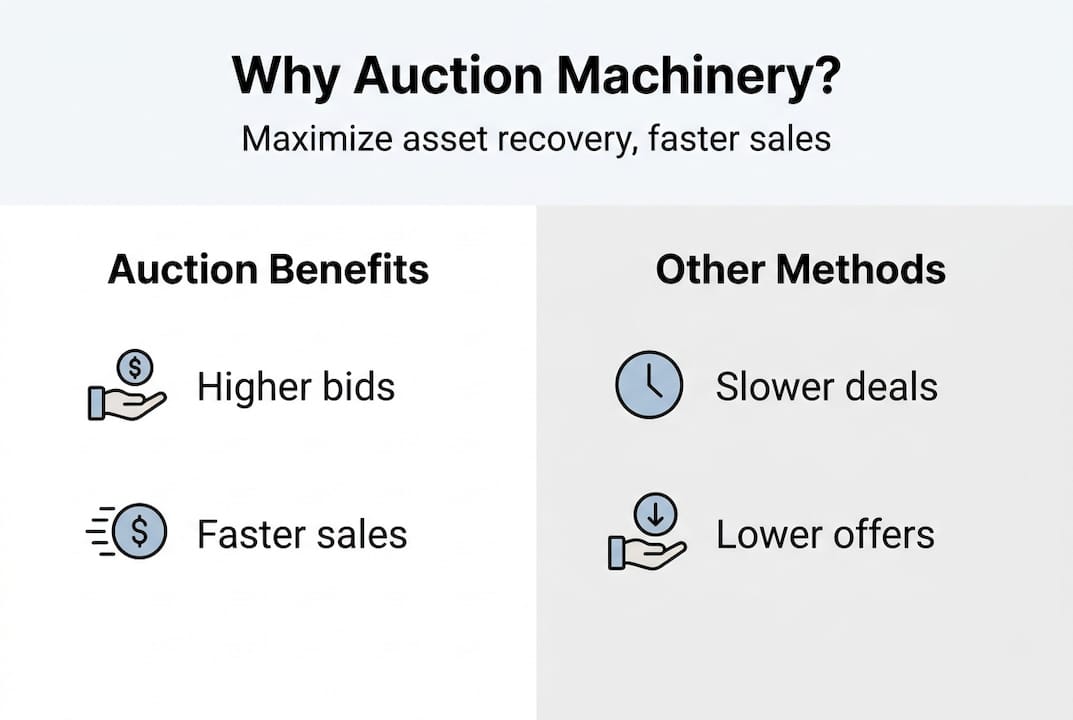
For faster asset disposition, auctions compress the sale timeline dramatically. A professionally marketed auction event can move dozens of assets in a single day, compared to months of individual negotiations.
| Method | Speed | Typical recovery | Buyer reach | Transparency |
|---|---|---|---|---|
| Auction | 30-60 days | High | National/global | High |
| Direct sale | 60-180 days | Moderate | Limited | Low |
| Trade-in | Immediate | Low | Single dealer | Low |
| Private negotiation | 90-180 days | Moderate | Narrow | Moderate |
Key advantages of auctions for machinery disposition include:
- Competitive bidding drives prices above reserve and toward true market value
- Accelerated sale cycle reduces carrying costs and frees capital faster
- Transparent pricing provides defensible documentation for financial reporting
- Broad marketing reach attracts buyers across industries and geographies
- Defined timeline allows operational and financial planning with certainty
Pro Tip: For specialized or complex machinery with limited comparable sales data, auctions are one of the most reliable ways to establish true fair market value because the bidding process reflects real buyer demand rather than appraiser estimates.
That said, choosing the right auction format matters. For highly customized assets with a very narrow potential buyer pool, a targeted negotiated sale may still be the better path. Auctions work best when there is a realistic market of multiple qualified buyers.
Core drivers: Financial, operational, and strategic reasons for auctioning machinery
Understanding why auctions outpace other methods requires a look at their financial and operational impact. The decision to auction surplus machinery is rarely made in isolation. It reflects a convergence of financial pressure, operational change, and strategic intent.
Auctions can convert idle assets to cash faster than most alternatives, which directly addresses one of the most persistent challenges in corporate asset management: the cost of holding equipment that is no longer productive.
| Financial factor | Impact of auctioning |
|---|---|
| Cash conversion speed | 30-60 days vs. months for private sale |
| Carrying costs eliminated | Storage, insurance, maintenance savings |
| Depreciation avoided | Prevents further value erosion on idle assets |
| Balance sheet improvement | Removes non-productive fixed assets |
Operational triggers that commonly drive auction decisions include:
- Plant closures or consolidations where entire production lines must be liquidated on a schedule
- Production upgrades that make existing equipment obsolete but still valuable to other buyers
- Corporate mergers and acquisitions that create duplicate assets across combined operations
- Lease expirations requiring facility clearance within a defined timeframe
- Regulatory or compliance changes that render certain equipment unusable in current operations
Strategically, forward-thinking companies use auctions to maximize asset recovery and redeploy that capital into growth initiatives. Holding surplus equipment is not a neutral act. It consumes space, management attention, and insurance budget while the asset depreciates.
“Cash from auctions fuels business reinvestment and innovation. The companies that treat asset disposition as a strategic function, not an afterthought, consistently outperform those that let surplus equipment sit and lose value.” — Industrial asset management perspective
The strategic case is clear: converting idle machinery to cash at maximum recovery value is almost always preferable to deferring the decision and absorbing ongoing depreciation impact and carrying costs.
When and what to auction: Criteria and best practices
Once you know why auctions are strategic, it is essential to understand which assets benefit most and how to prepare them. Not every piece of equipment belongs in an auction. Asset selection is the first decision that determines your recovery outcome.
Assets best suited for auction share several characteristics:
- They are idle or underutilized, generating no operational value
- They are non-strategic, meaning the business has no foreseeable future need for them
- They are in marketable condition, functional or repairable without excessive investment
- They have broad market appeal across multiple industries or buyer types
- They are tangible fixed assets with verifiable specifications and service history
Systematic asset selection and preparation can significantly increase auction success and recovery values. Preparation is not optional. It is the variable most within your control.
Here is a structured process for preparing machinery for auction:
- Conduct a full asset inventory. Document every item with serial numbers, model numbers, age, condition, and service history.
- Assess condition honestly. Identify what requires cleaning, minor repair, or certification to reach marketable condition.
- Gather all documentation. Manuals, maintenance records, certifications, and compliance documentation increase buyer confidence.
- Resolve legal encumbrances. Confirm clear title and address any liens, leases, or financing agreements before listing.
- Consider grouping items into auction lots. Strategic lot grouping can attract buyers seeking complete production systems rather than individual pieces.
- Set realistic reserve prices. Base reserves on current market data, not original purchase price or book value.
- Coordinate logistics. Plan for buyer inspection access, removal timelines, and rigging requirements in advance.
Pro Tip: Pre-auction inspections, third-party certifications, and thorough cleaning are not cosmetic gestures. They directly increase bidder confidence, which translates to higher final prices. Buyers pay more when uncertainty is removed.
Assets that are generally poor auction candidates include equipment with active legal encumbrances, highly customized machinery with fewer than three or four realistic buyers globally, and items in condition that would require more investment to prepare than they would recover at sale.
Common challenges and how to address them
Maximizing success at auction also means anticipating and avoiding common pitfalls. Even well-intentioned auction efforts can underperform when certain fundamentals are neglected. Understanding these challenges in advance allows asset managers to take corrective action before they affect results.
The most frequent obstacles encountered in industrial machinery auctions include:
- Weak or incomplete documentation: Missing maintenance records, absent certifications, and unclear ownership history create buyer hesitation and suppress bidding
- Insufficient marketing reach: Limiting promotion to a single channel or regional audience reduces competition and final prices
- Poor asset presentation: Equipment that appears neglected, dirty, or poorly maintained signals risk to buyers regardless of actual condition
- Unrealistic reserve prices: Reserves set too high based on book value rather than market data can result in unsold lots and additional carrying costs
- Unclear chain of custody: Buyers need confidence that title is clear and transfer will be straightforward
Sellers often underestimate the need for thorough documentation and marketing, which are the two factors most directly within the seller’s control and most directly correlated with strong results.
“Proactive management of the auction process, from documentation to marketing to logistics, is what separates average recovery from exceptional recovery. The auction itself is just the final step in a well-managed process.” — Asset disposition specialist
Actionable solutions for each challenge are straightforward. Engage an experienced auction firm early, before assets deteriorate further or documentation gaps widen. Invest in professional photography, detailed specifications, and broad digital marketing. Understand the difference between the brokerage vs auction process so you can select the right method for each asset type. Set reserves based on current comparable sales data, not internal accounting values. And treat corporate assets disposition as a project with defined milestones, not an open-ended administrative task.
The overlooked power of auctions in strategic asset management
Looking beyond the mechanics, here is a perspective that most asset disposition guides miss entirely: the most valuable output of a machinery auction is not always the check. It is the market intelligence.
Every auction generates real-time data on what buyers actually pay for specific equipment types, conditions, and configurations. Forward-thinking asset managers use that data to inform future capital expenditure decisions, depreciation schedules, and replacement timing. Companies that treat advanced asset recovery strategies as a continuous function, rather than a reactive one, build a genuine competitive advantage in capital efficiency.
The shift in mindset is from “how do we get rid of this” to “how do we extract maximum value from every asset at every stage of its lifecycle.” Surplus machinery is not a liability to be managed. It is an opportunity to recover capital and fund the next cycle of investment.
Pro Tip: Integrate auction results and market pricing data into your regular asset portfolio reviews. Over time, this creates a feedback loop that improves both acquisition and disposition decisions across your entire equipment base.
The companies that execute this well treat their auction partners as strategic advisors, not just transaction facilitators. That relationship pays dividends well beyond any single sale.
How Maas Companies can help you maximize machinery auction value
Ready to move surplus machinery from a cost center to a capital source? Maas Companies brings decades of international experience in industrial equipment auctions, plant liquidations, and asset recovery marketing to every engagement.
Our team develops tailored auction strategies, manages asset preparation and documentation, and executes aggressive multi-channel marketing programs designed to attract the broadest qualified buyer pool. Whether you are managing a single machine or an entire facility, we provide the expertise to maximize your outcome. Explore your options for selling industrial equipment, review our full range of asset auction services, or contact our auction experts directly to discuss your specific situation and recovery goals.
Frequently asked questions
What types of machinery are best suited for auction?
Idle and depreciating machinery is typically preferred for auctions, along with non-strategic equipment in marketable condition that has broad appeal across multiple buyer segments.
How fast can a company expect to recover cash through an auction?
Auctions enable quick asset-to-cash conversion, typically within 30 to 60 days depending on asset type, preparation quality, and marketing reach.
Is auctioning always better than other disposal methods?
Not always. Certain circumstances favor direct negotiation for highly specialized or custom assets with a very limited buyer pool, where a targeted approach may yield better terms.
What are the main risks in auctioning surplus machinery?
Documentation and marketing are critical for successful auction results; poor preparation, weak promotion, and unrealistic reserve prices are the most common factors that reduce recovery value.
Can smaller businesses benefit from machinery auctions?
Yes. Machinery auctions benefit companies of all sizes, giving smaller operations access to a national or global buyer pool that would be impossible to reach through private sale efforts alone.
Recommended
- Auction strategies for small businesses: Maximize asset recovery | Blog | Insights on Asset Liquidation and Auction Trends
- How Auctions Help Speed Up Industrial Asset Disposition | Blog | Insights on Asset Liquidation and Auction Trends
- How Auctions Help Speed Up Industrial Asset Disposition | Blog | Insights on Asset Liquidation and Auction Trends
- Surplus equipment sale guide: maximize asset recovery fast | Blog | Insights on Asset Liquidation and Auction Trends
- Corporate Assets Meaning I Price & Accountants