

Blog
Bankruptcy Asset Sale Procedures: A 2026 Guide

TL;DR:
- Bankruptcy asset sale procedures allow assets to transfer to a buyer free of liens and liabilities under court supervision. The process, governed by Section 363 of the Bankruptcy Code, involves a sale motion, notice to creditors, an auction, and court approval that ensures a quick, clean transfer. Proper drafting of sale orders and careful bidder engagement are essential to maximize recovery and reduce post-closing disputes.
Bankruptcy asset sale procedures are the court-supervised framework that allows a debtor’s assets to transfer to a buyer free and clear of liens, claims, and successor liabilities. The governing mechanism is Section 363 of the U.S. Bankruptcy Code, which enables free-and-clear asset transfers with court approval. This process is the preferred tool for distressed asset disposition because it resolves competing creditor claims in a single proceeding, produces a clean title, and can close within a defined timeline. Financial professionals and business leaders who understand the full sequence, from the initial sale motion through auction to the final sale order, are positioned to maximize recovery and avoid post-closing litigation.
What are the legal prerequisites for bankruptcy asset sale procedures?
A Section 363 sale begins with the debtor filing a sale motion in bankruptcy court. That motion must include the proposed transaction terms, the identity of any stalking horse bidder, and the full set of proposed bidding procedures. The court does not approve the sale itself at this stage. It approves the rules governing how the sale will be conducted.
Federal Rule of Bankruptcy Procedure 2002(a)(2) requires 21 days’ notice to creditors before the court hearing on sale procedures. That notice period gives secured creditors, unsecured creditor committees, and other parties in interest time to review the proposed terms and file objections. Missing or shortening this window creates procedural grounds to challenge the entire sale.
The stalking horse bidder plays a central role at this stage. This is the buyer who negotiates a purchase agreement with the debtor before the auction, setting a price floor for all competing bids. In exchange for taking on the risk of being outbid, the stalking horse typically negotiates bid protections. Break-up fees range from 2–4% of deal value and are paid to the stalking horse if a competing bidder wins. Courts scrutinize these fees carefully because fees set too high discourage competing bids, while fees set too low reduce the stalking horse’s incentive to invest in due diligence.
Key prerequisites before the auction can proceed:
- File the sale motion with full transaction details and proposed bidding procedures
- Provide 21-day minimum notice to all creditors and parties in interest
- Obtain a bidding procedures order from the court
- Notify counterparties to executory contracts and leases of potential assignment
- Establish the stalking horse bid and court-approved bid protections
Pro Tip: Draft the bidding procedures order with enough flexibility to attract multiple qualified bidders. Courts have rejected procedures that were so restrictive they effectively guaranteed the stalking horse would win unchallenged.
How is the auction conducted in a Section 363 sale?
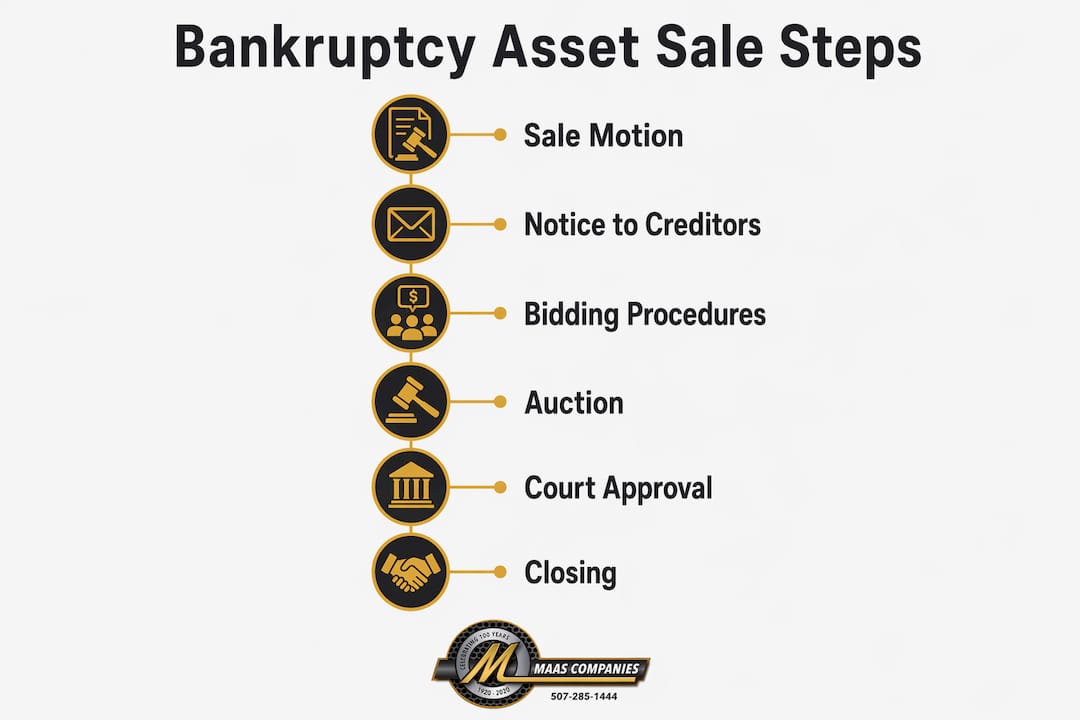
Qualified bidder status is the gateway to participating in a bankruptcy auction. To qualify, a prospective buyer must typically submit a 10% good-faith deposit along with proof of financial capacity and a marked-up version of the stalking horse purchase agreement. These requirements protect the estate from non-serious participants who could disrupt the process.

The auction format itself varies by case. Three primary formats are used in bankruptcy asset sales: live open-cry auctions, sealed-bid processes, and hybrid approaches that combine elements of both. Live auctions work well when multiple qualified bidders are present and competitive tension is high. Sealed-bid formats suit situations where bidder identities must remain confidential or where the asset pool is narrow. Hybrid formats give the debtor flexibility to manage the process dynamically.
The auction follows a structured sequence:
- Confirm qualified bidders. The debtor and its advisors review all submissions and publish the list of qualified participants before the auction opens.
- Open with the stalking horse bid. The stalking horse bid serves as the price floor. No competing bid is accepted below this amount.
- Set minimum overbid increments. Competing bids must exceed the current high bid by a set increment, typically 5–10% of the stalking horse price, to advance.
- Conduct rounds of bidding. Each round is documented. The auctioneer or debtor’s counsel manages the process and resolves any procedural disputes in real time.
- Identify the winning bid and backup bid. Courts routinely require a backup bidder in case the winning bidder fails to close.
- Close the auction record. All bids, terms, and conditions are memorialized before the court hearing.
Pro Tip: Overly restrictive qualification criteria, such as unusually high deposit thresholds or narrow financial proof requirements, risk chilling competitive bids. Set qualification terms that screen out bad actors without discouraging legitimate buyers.
What happens after the auction to close the sale?
The auction result does not finalize the sale. The debtor must return to court for a sale approval hearing, typically held within a few days of the auction. At that hearing, the court reviews the auction record, hears any remaining objections, and determines whether the winning bidder qualifies as a good-faith purchaser under Section 363(m).
The Section 363(m) good-faith finding is the most important protection in the sale order. It insulates the buyer from having the sale unwound on appeal, even if a creditor successfully challenges some aspect of the sale process. Without that finding, a buyer risks losing the asset after closing if an appellate court reverses the sale approval. Buyers should insist that the sale order contains explicit good-faith purchaser language.
Key elements of a properly drafted sale order:
- Free-and-clear title transfer. The order must specify that the buyer takes assets free of all liens, claims, encumbrances, and interests, with those interests attaching to sale proceeds instead.
- Successor liability release. The scope of this release varies widely and requires careful negotiation. Broad language protects the buyer from pre-closing liabilities of the debtor.
- Executory contract and lease assignments. The order must identify which contracts transfer to the buyer and confirm that cure amounts for any defaults have been paid.
- Binding effect on all noticed parties. The sale order binds all parties who received proper notice, preventing collateral attacks on the transaction after closing.
A properly executed Section 363 sale transfers a functioning business or asset portfolio from a bankrupt seller to a solvent buyer within 45–90 days post-filing. That timeline is significantly faster than a plan of reorganization and is the primary reason distressed sellers and their creditors prefer this route.
| Closing milestone | Typical timeline |
|---|---|
| Sale motion filed | Day 1–5 post-filing |
| Bidding procedures order entered | Day 21–30 |
| Auction held | Day 45–60 |
| Sale approval hearing | Day 48–65 |
| Closing | Day 60–90 |
What risks arise in bankruptcy asset sales, and how can they be mitigated?
The period between the stalking horse announcement and the auction is the most operationally sensitive phase of the entire process. Practitioners call it the “death zone.” During this window, the debtor must actively market the assets to attract competing bidders. If marketing is passive or bidder qualification terms are too tight, the stalking horse wins unchallenged and the estate receives no competitive uplift in price.
The successor liability exclusion in the sale order is a frequent source of post-closing disputes. Courts have issued sale orders with narrow exclusions that left buyers exposed to environmental claims, WARN Act liabilities, and pension obligations. Buyers must negotiate broad, explicit successor liability language before the sale order is entered. Attempting to expand that language after closing is rarely successful.
Common risks and mitigation strategies:
- Chilled bidding. Avoid deposit thresholds above 10% and qualification criteria that exclude financially capable buyers without cause.
- Inadequate free-and-clear language. Require the sale order to list specific categories of excluded liabilities, not just a general reference to “liens and claims.”
- Due diligence limitations. Distressed sellers often provide limited data room access. Buyers should conduct independent site inspections and title searches before the bid deadline.
- Objections at the sale hearing. Creditor committees and secured lenders may object to the winning bid. Engage these stakeholders early in the process to resolve concerns before the hearing.
- Appeal risk. The Section 363(m) good-faith finding reduces but does not eliminate appeal risk. Buyers should not release escrow funds until the appeal period has run or been waived.
“The most overlooked risk in a Section 363 sale is not the auction itself. It is the sale order language that governs what the buyer actually owns after closing.”
Experienced bankruptcy counsel is not optional in this process. The bidding procedures order, the sale order, and the notice requirements each carry legal consequences that directly affect recovery value and post-closing liability exposure.
Key Takeaways
A properly structured Section 363 sale transfers assets free and clear of liens within 45–90 days, but only when the bidding procedures, notice requirements, and sale order language are executed without error.
| Point | Details |
|---|---|
| Notice is mandatory | Creditors must receive 21 days’ notice before the bidding procedures hearing under Rule 2002(a)(2). |
| Stalking horse sets the floor | Break-up fees of 2–4% of deal value balance stalking horse incentives against competitive bidding. |
| Auction qualification matters | A 10% good-faith deposit and proof of financial capacity are standard requirements for qualified bidders. |
| Sale order language is critical | Successor liability exclusions and Section 363(m) good-faith findings must be explicit to protect buyers post-closing. |
| Speed is a core advantage | Section 363 sales close in 45–90 days post-filing, far faster than a reorganization plan. |
What I have learned from watching Section 363 sales succeed and fail
The cases that produce the best recovery outcomes share one characteristic: the debtor and its advisors treat the marketing period between the stalking horse announcement and the auction as a genuine sales campaign, not a formality. That means direct outreach to industry buyers, clear data room access, and bidder qualification criteria calibrated to attract competition rather than limit it.
The cases that underperform almost always trace back to one of two failures. Either the bidding procedures were drafted to favor the stalking horse so heavily that no competing bidder could justify the effort, or the sale order was approved with vague successor liability language that created years of post-closing litigation. Both failures are avoidable with careful drafting and early creditor engagement.
Financial professionals often underestimate how much the creditor committee’s posture affects the auction outcome. A committee that is engaged, informed, and aligned with the debtor’s marketing strategy will support the process at the sale hearing. A committee that feels excluded will object, delay the hearing, and sometimes kill a deal that would have served creditors well.
The practical lesson is this: procedural compliance is necessary but not sufficient. The goal is a competitive auction that produces a price above the stalking horse floor. Everything in the process, from notice periods to qualification criteria to sale order language, should be designed with that outcome in mind.
— Vector
How Maascompanies supports complex asset sales and auctions
Maascompanies brings decades of experience to the asset liquidation process, managing court-supervised auctions and negotiated sales for industrial plants, equipment, real estate, and commercial properties across the United States and internationally.

For financial professionals and legal teams managing distressed portfolios, Maascompanies provides the marketing reach and industry expertise needed to attract qualified buyers and generate competitive bidding. From a 3-MGY biodiesel plant auction involving multiple facility types to orderly negotiated sales of specialized manufacturing equipment, the firm’s project portfolio reflects the full range of bankruptcy asset disposition scenarios. Review the full Maascompanies services portfolio to see how the firm’s auction and brokerage capabilities align with your recovery objectives.
FAQ
What is a Section 363 sale in bankruptcy?
A Section 363 sale is a court-approved process that transfers a debtor’s assets to a buyer free and clear of liens, claims, and successor liabilities. It is the primary mechanism for asset disposition in Chapter 11 bankruptcy cases.
How long does a bankruptcy asset sale take to close?
A properly executed Section 363 sale typically closes within 45–90 days of the bankruptcy filing. That timeline depends on court scheduling, creditor notice periods, and the complexity of the asset portfolio.
What is a stalking horse bidder?
A stalking horse bidder is a buyer who negotiates a purchase agreement with the debtor before the auction, establishing a minimum price floor. In exchange, the stalking horse receives bid protections such as a break-up fee, typically 2–4% of deal value.
What qualifies a bidder to participate in a bankruptcy auction?
Qualified bidders must typically submit a 10% good-faith deposit, demonstrate financial capacity, and provide a marked-up version of the purchase agreement before the bid deadline.
What does “free and clear” mean in a bankruptcy sale?
Free and clear means the buyer acquires the assets without inheriting the debtor’s prior liens, encumbrances, or specified liabilities. Those interests attach to the sale proceeds instead, which are then distributed to creditors through the bankruptcy process.
Recommended
- How to Plan Government Asset Sales for Spring 2026 | Blog | Insights on Asset Liquidation and Auction Trends
- Liquidation sales explained: Maximize asset recovery | Blog | Insights on Asset Liquidation and Auction Trends
- Auction strategies for small businesses: Maximize asset recovery | Blog | Insights on Asset Liquidation and Auction Trends
- How Auctions Help Speed Up Industrial Asset Disposition | Blog | Insights on Asset Liquidation and Auction Trends