
Blog
How to Attract Industrial Buyers: Strategies That Work

TL;DR:
- Effective industrial buyer engagement relies on role-specific messaging, multi-channel outreach, and peer validation. Building detailed data-driven personas and implementing sequenced outreach significantly increase deal closure speed and success rates. Regularly measuring and refining outreach efforts based on engagement data ensures continuous improvement in attracting qualified buyers.
Attracting industrial buyers is defined as the targeted engagement of multi-stakeholder buying committees across plant operations, procurement, supply chain, and EHS functions, using data-driven outreach and operationally relevant content. Asset managers and industrial leaders who treat this process as a single-audience, single-channel effort consistently underperform. The most effective approaches segment buyers by role, deploy personalized multi-channel sequences, and support every conversation with peer validation and field-ready proof points. For organizations managing surplus or distressed assets, getting this right determines how quickly capital is recovered and at what margin.
How to attract industrial buyers: understanding who makes the decision
Industrial buying committees are not monolithic. A single purchase decision for surplus processing equipment or a plant closure sale can involve plant operations managers, corporate procurement officers, IT and systems integration teams, supply chain leads, and EHS compliance personnel. Each group evaluates the same asset through a different lens.
The divide is sharp and well documented. Buying committees in manufacturing are polarized: plant operations teams focus on throughput, downtime risk, and line balance, while corporate procurement focuses on total cost of ownership and integration timelines. Generic messaging that addresses neither group specifically causes deal stalls. That finding alone should reshape how asset managers structure their outreach.
Understanding each stakeholder’s priorities allows you to tailor your pitch at every stage:
- Plant operations managers prioritize equipment reliability, installation speed, and minimal disruption to production schedules.
- Corporate procurement officers evaluate total cost of ownership, vendor compliance, and contract terms.
- Supply chain leads focus on lead times, parts availability, and logistics coordination.
- EHS teams require documentation on safety certifications, environmental compliance, and decommissioning records.
- IT and systems teams assess integration compatibility with existing control systems and data infrastructure.
Manufacturing analysts confirm that addressing plant-floor and corporate buyer needs separately prevents deal delays. Sending one brochure to all five stakeholders is not a strategy. It is a missed opportunity.
What tools and data-driven approaches help identify industrial buyers?
The foundation of any effective buyer attraction program is a detailed, data-driven customer persona. Data-driven customer personas can increase lead flow to sales divisions by 10% and reduce the total sales cycle duration by 36%. That reduction in cycle time is particularly valuable when carrying costs on surplus assets accumulate daily.

Personas are built from firmographic data (company size, industry classification, revenue, geography) and technographic data (existing equipment brands, control systems, production capacity). Together, these data points identify which companies are most likely to need what you are selling, before you spend a single dollar on outreach.
The table below outlines the core tools and data sources that support industrial buyer identification and engagement:
| Tool or Data Source | Primary Function | Best Used For |
|---|---|---|
| Firmographic databases | Company size, industry, revenue filtering | Building initial target account lists |
| Technographic data providers | Equipment and systems profiling | Matching assets to likely buyers |
| CRM platforms | Lead routing, pipeline tracking | Managing multi-stakeholder deal flow |
| LinkedIn Sales Navigator | Decision-maker identification | Reaching procurement and operations contacts |
| AI-assisted lead scoring | Prioritizing high-intent accounts | Focusing sales effort on best-fit buyers |
| Analytics and tracking tools | Engagement measurement | Refining outreach based on response data |
AI-assisted lead scoring deserves particular attention. It ranks accounts by behavioral signals such as content downloads, page visits, and email engagement, so your team focuses time on buyers who are already showing interest. Paired with CRM integration, it routes the right leads to the right sales contact without manual triage.
Pro Tip: Build your ideal customer profile (ICP) before running any outreach. Define the company size, industry vertical, geographic range, and asset type that matches your current inventory. Every outreach dollar spent outside that ICP is wasted.
Which outreach channels produce the best results with industrial buyers?
Cold email remains the highest-return outreach channel for industrial B2B sales when targeting identifiable buyers with relevant messaging. Sequenced outreach combining email, LinkedIn, and phone increases engagement chances significantly compared to single-channel approaches. The sequence matters as much as the channel itself.
A proven outreach sequence for industrial asset sales follows this structure:
- Day 1: Initial cold email. Keep it 100–150 words. Lead with a specific operational pain point or asset description. End with a single, low-commitment ask such as a 15-minute call or a link to asset specifications.
- Day 4: LinkedIn connection request. Reference the email briefly. Connect with the plant manager or procurement lead directly. Personalize the note with one detail specific to their operation.
- Day 9: Follow-up email. Add new information, such as updated asset inventory, pricing guidance, or a relevant case study. Do not simply resend the first email.
- Day 15: Phone call. Call only engaged prospects. Reference prior touchpoints. Keep the call under five minutes unless the buyer extends it.
- Day 21: Final email. Acknowledge the outreach cadence. Offer a clear next step or a graceful exit. Leave the door open for future contact.
Multi-channel outreach combining email, LinkedIn, and phone yields 20% higher close rates and 20% lower customer acquisition costs than single-channel approaches. Lower acquisition costs matter directly to asset managers working within fixed liquidation budgets.
Messaging discipline is equally critical. Industrial buyers receive dozens of vendor emails weekly. A 100-word email focused on one operational pain point outperforms a 400-word capabilities overview every time. Specificity signals that you understand their operation. Generality signals that you do not.
Pro Tip: Schedule outreach emails for tuesday through thursday mornings. Procurement and operations managers are most responsive mid-week. Avoid monday mornings and friday afternoons, when inboxes are either clearing the weekend backlog or winding down.
How does content and peer validation accelerate industrial buying decisions?
Content supports outreach but does not replace it. The right content, delivered to the right stakeholder at the right stage, removes objections before they are raised. The wrong content, delivered to everyone at once, creates confusion and slows decisions.
Effective content strategies for industrial buyer engagement include:
- White papers and technical briefs for plant operations managers who need equipment specifications, performance data, and installation requirements.
- Total cost of ownership calculators for procurement officers who must justify capital expenditure to finance teams.
- Case studies with named operations leaders for buyers who want proof that comparable facilities have succeeded with similar assets.
- Field-validation playbooks that include test protocols, success criteria, and executive readout templates for buyers who require internal sign-off before committing.
Pre-built field-validation playbooks reduce trial periods from six months to 90 days by providing test protocols and success criteria up front. That compression of the trial period directly accelerates deal closure and reduces carrying costs on the seller’s side.
Peer validation carries more weight than any content asset. Industrial buyers trust peer references more than vendor claims, and operations leaders prefer direct peer-to-peer discussions over static website logos or testimonial quotes. A structured peer reference program, where past buyers agree to speak directly with prospective buyers, closes more deals than any brochure. Building that program requires maintaining relationships with satisfied buyers after the sale, not just during it.
Targeted LinkedIn advertising and analytics tracking significantly boost visibility to key decision-makers when content is distributed through paid channels. Organic reach alone rarely penetrates the procurement and operations functions at mid-to-large manufacturers.
What mistakes undermine industrial buyer attraction strategies?
Generic outreach is the most common and most costly mistake in industrial sales. Sending the same email to a plant manager and a corporate procurement officer, with no adjustment for their different priorities, signals a lack of preparation. Generic content causes deal stalls in manufacturing buying committees. Stalled deals extend carrying costs and reduce final recovery values.
The second major mistake is underutilizing automation. Manual non-selling activities drain sales teams, and shifting from feature-pitch conversations to quantifiable business impact discussions accelerates deal closure. Sales experts confirm that automating route planning and data entry frees reps for consultative conversations grounded in business impact. Every hour a sales rep spends on data entry is an hour not spent building buyer relationships.
The table below contrasts generic and tailored engagement approaches:
| Approach | Generic Outreach | Tailored Engagement |
|---|---|---|
| Messaging | One message for all stakeholders | Role-specific content per buyer function |
| Channel | Single email blast | Sequenced email, LinkedIn, and phone |
| Content | Capabilities overview | TCO calculators, case studies, playbooks |
| Validation | Logo wall on website | Peer reference calls with named contacts |
| Measurement | Open rate tracking only | Engagement scoring across all touchpoints |
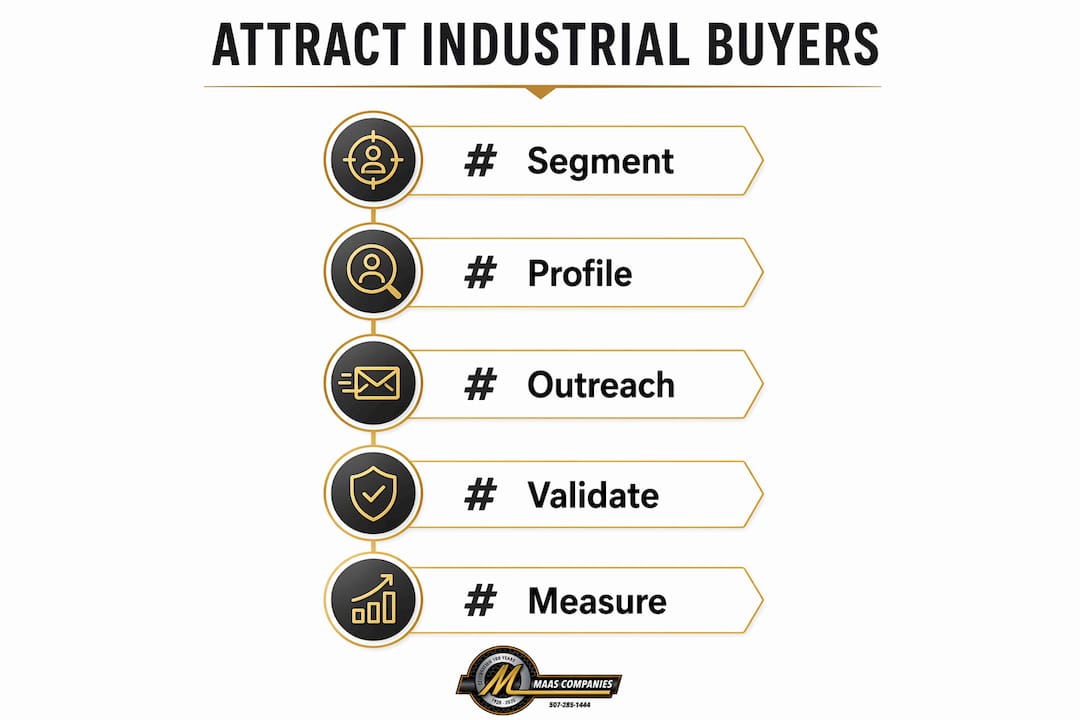
Continuous measurement closes the loop. Track email open rates, LinkedIn response rates, call connection rates, and content download activity. Use that data to refine messaging, adjust timing, and reallocate outreach effort toward the channels and content types that produce the most engagement. Asset managers who treat outreach as a one-time campaign consistently recover less than those who treat it as an iterative process.
Pro Tip: Review your outreach metrics every two weeks during an active asset sale. If email open rates drop below 20%, test a new subject line. If LinkedIn response rates stall, adjust your connection note. Small adjustments compounded over a 60-day sale period produce measurable improvements in buyer engagement.
Key Takeaways
Attracting industrial buyers requires role-specific messaging, sequenced multi-channel outreach, and peer validation to move complex buying committees from interest to commitment.
| Point | Details |
|---|---|
| Segment your buying committee | Address plant operations, procurement, EHS, and IT separately with role-specific content. |
| Build data-driven personas | Use firmographic and technographic data to identify high-potential accounts before outreach begins. |
| Sequence your outreach | Combine email, LinkedIn, and phone across a 21-day cadence for 20% higher close rates. |
| Deploy peer validation | Structured reference programs with named operations leaders close deals faster than any content asset. |
| Measure and refine continuously | Track engagement across all channels every two weeks and adjust messaging based on response data. |
What I’ve learned about reaching industrial buyers that most playbooks miss
Most industrial sales playbooks focus on channels and sequences. Few address the underlying problem: asset managers often do not know which stakeholder is actually blocking the deal. In my experience working with surplus and distressed asset sales, the procurement officer is rarely the final obstacle. The plant operations manager, who was never formally included in the buying process, is the one raising objections at the last moment.
The fix is front-loading stakeholder mapping. Before the first email goes out, identify every person who will touch the decision. Then build content and outreach paths for each of them, even the ones who are not officially part of the buying committee. A pre-auction preparation checklist that accounts for all stakeholder concerns prevents late-stage surprises.
The shift from feature-pitch to value-based conversations is real and measurable. When I stopped leading with equipment specifications and started leading with operational outcomes, such as reduced downtime, faster installation, and documented recovery timelines, buyer engagement improved noticeably. Procurement officers responded to total cost of ownership framing. Plant managers responded to uptime guarantees and installation support.
Field-validation readiness is the most underused accelerator in industrial asset sales. Sellers who arrive with test protocols, success criteria, and executive readout templates already prepared signal competence and reduce perceived risk. That preparation collapses the evaluation period and moves deals to contract faster. Build the validation kit before the first buyer conversation, not after.
— Vector
Maascompanies: connecting industrial assets with qualified buyers
Asset managers who apply the strategies outlined here still need one critical resource: access to a qualified buyer network. Maascompanies brings decades of experience marketing industrial plants, surplus equipment, and commercial properties to buyers worldwide through auction, orderly negotiated sale, and equipment brokerage.
Maascompanies builds aggressive, targeted marketing plans that reach the right buyers at the right time, whether the asset is a biodiesel processing facility, a steam generator, or a full plant closure inventory. Current projects include a 3-MGY biodiesel plant auction and an orderly negotiated sale of industrial steam generation equipment. Asset managers ready to maximize recovery can review the full services portfolio to find the right disposition path for their inventory.
FAQ
Who are the key stakeholders in an industrial buying committee?
Industrial buying committees typically include plant operations managers, corporate procurement officers, supply chain leads, EHS compliance teams, and IT or systems integration personnel. Each stakeholder evaluates assets based on different criteria, so outreach must address each group separately.
What is the most effective outreach channel for industrial buyers?
Cold email delivers the highest return on investment for industrial B2B sales when messages are personalized and operationally relevant. Sequencing email with LinkedIn follow-ups and phone calls across a 21-day cadence produces 20% higher close rates than single-channel outreach.
How do peer references accelerate industrial sales?
Industrial buyers trust peer references more than vendor claims, and operations leaders prefer direct conversations with comparable plant contacts over static testimonials. A structured peer reference program is one of the most effective closing tools available to industrial sellers.
How does content support industrial buyer engagement?
Role-specific content, including total cost of ownership calculators for procurement and field-validation playbooks for operations teams, removes objections before they are raised. Pre-built validation playbooks can reduce trial periods from six months to 90 days.
How should asset managers measure outreach effectiveness?
Track email open rates, LinkedIn response rates, call connection rates, and content download activity across every active campaign. Review metrics every two weeks and adjust messaging, timing, or channel mix based on what the data shows.
Recommended
- How Brokerage and Auction Work to Sell Industrial Assets | Blog | Insights on Asset Liquidation and Auction Trends
- How to Choose the Right Auction for Industrial Equipment | Blog | Insights on Asset Liquidation and Auction Trends
- Auction lots for industrial asset sales: maximize value | Blog | Insights on Asset Liquidation and Auction Trends
- Auction absentee bidding: strategies for industrial equipment | Blog | Insights on Asset Liquidation and Auction Trends