

Blog
Liquidation Fees for Sellers: What You’ll Actually Net

The channel you pick matters more than the commission rate you negotiate within it.
Four channels dominate the market, and each charges differently:
- Platform liquidation programs (Amazon FBA Liquidation): referral fee plus per-unit processing charges
- Auction houses and estate liquidators: commission on hammer price plus buyer’s premium
- Brokers and consignment services: commission tied to negotiated sale price
- Pallet and bulk buyers: flat wholesale pricing, no line-item fees
If you need a fast, defensible number before a board meeting or lender call, model your net recovery by channel before committing. Sellers weighing large or complex asset pools should get a modeled recovery estimate from a professional asset-recovery partner before choosing a route.
Key Takeaways
Net recovery after liquidation fees for sellers depends far more on channel choice and contract terms than on the headline commission percentage alone.
| Point | Details |
|---|---|
| Channel choice drives outcome | Auctions often net 40% to 70% of fair market value versus 5% to 10% for platform liquidation. |
| Amazon FBA fees are fixed | A 15% referral fee plus per-unit processing fees apply regardless of negotiation. |
| Contract terms matter as much as rate | Cap expense pass-throughs and negotiate unsold-lot charges before signing. |
| Condition and lotting move recovery | Basic prep and smart lotting often add more value than a lower commission. |
| Complex or lender-directed sales need a partner | Maascompanies models recovery and structures contracts for plant closures and institutional liquidations. |
Table of Contents
- Liquidation Fees for Sellers: Fee Ranges by Channel
- Amazon FBA Liquidation Fees: The Exact Formula
- Auction Houses and Estate Liquidators: How Commissions Work
- Marketplaces, Pallet Buyers, and Brokers: A Different Fee Logic
- What Actually Moves Your Recovery Rate
- The Costs Sellers Forget to Budget
- Worked Example: Amazon Liquidation vs. Auction House
- How to Negotiate Fees and Contract Terms
- When a Strategic Asset-Recovery Partner Outperforms DIY Routes
- Get a Modeled Recovery Estimate Before You Choose a Channel
- Primary Sources and References
- Frequently Asked Questions
- Sources
Liquidation Fees for Sellers: Fee Ranges by Channel
Fee structures vary enough by channel that comparing headline percentages alone is misleading. What matters is net recovery after every fee layers on top.
- Platform liquidation (Amazon FBA): roughly 15% referral fee plus per-unit processing; net seller recovery typically lands at 5% to 10% of retail. Fast, often 30 days or less.
- Auction houses and estate liquidators: commissions of 10% to 20% for industrial and general estate categories, sometimes higher for specialty or collectible assets, plus a buyer’s premium. Recovery often reaches 40% to 70% of fair market value on well-marketed sales, but the process runs 30 to 90 days.
- Brokers and consignment: commission-based, usually 10% to 25%, with a longer sales cycle in exchange for a targeted buyer match.
- Pallet and bulk buyers: no visible commission structure at all. They quote a flat wholesale price, often 10% to 20% of retail, and pay in days, not weeks.
The pattern holds across every channel: speed and recovery move in opposite directions.
Amazon FBA Liquidation Fees: The Exact Formula
Amazon’s FBA liquidation fee structure has two components, and both are fixed by policy rather than negotiable. The first is a 15% Liquidations Referral Fee charged against the gross recovery value of the liquidated inventory. The second is a per-unit Liquidations Processing Fee that scales with the item’s weight and size tier.
Bulky and oversize items carry higher tiers still. Because the fee structure has stayed consistent even as Amazon has revised removal and disposal fee schedules elsewhere, sellers can model liquidation math with reasonable confidence.
Typical seller recovery through Amazon FBA Liquidation runs 5% to 10% of an item’s regular retail price once the referral fee and per-unit processing charges are deducted. On a $50 retail item, that often nets a seller $2.50 to $5.00 per unit before accounting for any remaining fulfillment charges.
Sellers evaluating FBA liquidation against removal should check current Seller Central policy directly, since aged-inventory surcharge timing changes the math frequently.
Auction Houses and Estate Liquidators: How Commissions Work
Auctioneers and estate liquidators most commonly charge a percentage of the hammer price, layered with a buyer’s premium the winning bidder pays separately.
You’ll typically encounter one of four commission models:
- Flat percentage on total hammer proceeds
- Tiered or sliding scale, where the rate drops as total sale value rises
- Per-lot fee, common for smaller, high-volume inventories
- Hybrid retainer plus commission, used for complex or multi-location sales
The contract terms matter as much as the rate itself. Watch for unsold-lot charges, often 5% to 10% of the reserve price, withdrawal fees if you pull items before sale, and expense pass-throughs for marketing or cataloging.
Pro Tip: Ask every auctioneer to quote unsold-lot and withdrawal fees in the initial proposal, not after signing. A lower headline commission paired with steep unsold-lot penalties can cost more than a higher commission with no penalty clause at all.

Marketplaces, Pallet Buyers, and Brokers: A Different Fee Logic
Pallet and bulk buyers don’t charge fees in the traditional sense. They quote a flat price per pallet or truckload, usually a percentage of wholesale value, and take on all handling, storage, and resale risk from that point forward.
That trade-off cuts both ways:
- Speed: payment in days, sometimes same-day for standard pallets
- Simplicity: no commission math, no unsold-lot risk, no marketing spend
- Yield: the lowest recovery percentage of any channel, often 10% to 20% of retail
- Fit: best for commodity SKUs, damaged or overstock goods, and situations demanding rapid cash conversion
Brokers sit closer to the auction model, earning commission on a negotiated sale price rather than a flat quote, which usually means slower timelines but meaningfully better recovery on assets with identifiable buyers.
What Actually Moves Your Recovery Rate
Fee percentage is only part of the equation. Four variables shift net recovery far more than a point or two of negotiated commission:
- Condition: functional, clean equipment routinely outperforms “as-is” lots by a wide margin.
- Lotting strategy: grouping complementary assets, or breaking oversized lots into smaller ones, changes buyer participation.
- Market demand: timing a sale against sector demand cycles affects bidder turnout more than marketing spend does.
- Speed and geography: rushed timelines and remote locations both suppress bidder pools.
Pro Tip: Spending a modest amount on cleaning, basic repair, and professional photography before listing often lifts realized recovery more than shaving a point or two off the commission rate. Buyers pay for confidence, not just function.
The Costs Sellers Forget to Budget
Commission percentage is rarely the full bill. Sellers typically also cover transportation to a sale site or buyer’s dock, insurance during transit and storage, cataloging and photography, and any disposal or refurbishment prep needed before listing.
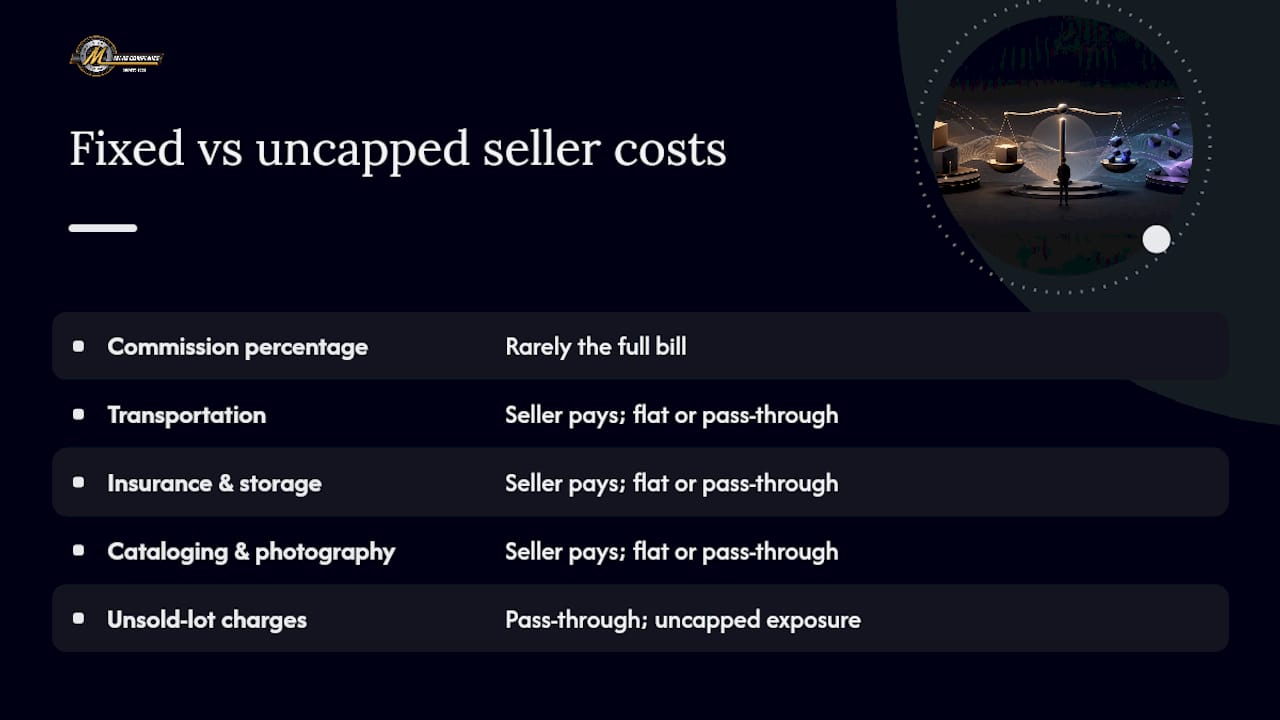
Some of these run as flat per-lot charges; others pass through at actual cost, which is where uncapped exposure creates risk. Unsold-lot charges, discussed earlier, fall in the same category. Sellers generally bear these costs directly, while buyers cover only the buyer’s premium. The contractual red flag is an uncapped pass-through clause with no ceiling. Cap it in writing before you sign.
Worked Example: Amazon Liquidation vs. Auction House
On a 500-unit lot with a $40,000 total retail value, the auction route nets roughly $17,000 more cash than platform liquidation, despite a higher headline commission.
- Amazon FBA Liquidation: Expected recovery at 8% of retail ($40,000 x 0.08) equals $3,200 gross. Subtract the 15% referral fee ($480) and estimated processing fees across 500 units at an average $0.30 per unit ($150). Net proceeds: roughly $2,570.
- Auction house: Expected recovery at 45% of fair market value ($40,000 x 0.45) equals $18,000 hammer total. Subtract an 11% commission ($1,980) and estimated pass-through costs for transport and cataloging ($800). Net proceeds: roughly $15,220.
The gap narrows fast if auction recovery drops. Given that Amazon’s own guidance puts typical liquidation recovery at 5% to 10% of retail, sellers should run both ends of that range before deciding.
How to Negotiate Fees and Contract Terms
Every liquidation contract has five negotiable levers, even when the liquidator presents the commission rate as fixed: reserve price, commission tiering above a threshold, expense caps, unsold-lot terms, and minimum hammer guarantees.
- Ask for a written expense cap before signing, not a verbal assurance.
- Push for tiered commission that drops once proceeds exceed an agreed threshold.
- Negotiate unsold-lot charges down or eliminate them in exchange for a firmer reserve.
- Request a fixed marketing budget line item instead of an open-ended pass-through.
- Confirm withdrawal fees in writing if your timeline might shift mid-process.
Industry guidance from restructuring professionals consistently favors capped expenses and tiered schedules over open-ended arrangements, particularly for court-ordered or lender-directed sales where accountability matters to every stakeholder.
Pro Tip: If a liquidator resists putting an expense cap in writing, treat that resistance itself as information. Reputable partners typically have no problem committing numbers to paper.

When a Strategic Asset-Recovery Partner Outperforms DIY Routes
Three situations consistently favor a professional partner over platform liquidation or a generic auction listing: complex industrial asset pools spanning multiple categories, court-ordered or lender-directed sales requiring documented chain of control, and multi-location plant closures where timing and logistics compound quickly.
Maascompanies structures engagements around transparent commission terms, controlled expense pass-throughs, and an aggressive marketing plan built to reach qualified industrial buyers directly, rather than relying on a generic online listing to find them.
A closure or restructuring event rarely fails because of the commission rate. It fails because nobody modeled the real net recovery before the clock started running, and by the time someone did, the best buyers had already moved on.
Sellers managing plant closures or lender-directed liquidations can request a modeled recovery estimate before choosing between auction, brokerage, or negotiated sale structures.
Author perspective: brief note from the asset-recovery team
Every seller wants speed, transparency, and maximum recoverable value, and no channel delivers all three at once. The sellers who do best are the ones who model the trade-off honestly before they sign anything. Maascompanies has spent decades helping industrial and institutional sellers make that call with real numbers, not guesses.
Get a Modeled Recovery Estimate Before You Choose a Channel
If you’re weighing platform liquidation against an auction or negotiated sale, the fastest way to stop guessing is to get the numbers modeled by people who structure these sales for a living. Maascompanies works directly with corporate, lender, and government clients to build a recovery strategy around the actual asset pool, not a generic listing template.

Contacting Maascompanies typically gets you:
- A modeled net-recovery estimate specific to your asset category and timeline
- A sale strategy built around buyer reach, not just a commission quote
- Contract negotiation support on reserve terms, expense caps, and unsold-lot clauses
If a plant closure, restructuring event, or excess inventory position is on your calendar, reach out about selling your industrial assets and request a recovery estimate before you commit to a channel.
Primary Sources and References
- Amazon Seller Central: Removal, Disposal and Liquidation Fees for exact per-unit FBA tiers
- Amazon’s FBA storage fee overhaul for timeline pressure on liquidation decisions
- Auctioneer commission and fee structures for contract-clause benchmarks
- Negotiating liquidator fees for expense-cap and tiering guidance
Start with Seller Central for Amazon-specific per-unit numbers, then cross-check commission models against the auctioneering and ABI guidance before finalizing any contract.
Frequently Asked Questions
What are typical liquidation fees for sellers on Amazon FBA?
How much of an item’s value do sellers actually recover through liquidation? Platform liquidation typically nets 5% to 10% of retail.
What auction commission rate should I expect? Rates depend heavily on asset category and services included.
What contract terms most affect net recovery besides commission? Unsold-lot charges, withdrawal fees, and uncapped expense pass-throughs can erode recovery as much as the commission rate itself. Negotiate caps before signing.
When does it make sense to use a professional asset-recovery partner instead of a platform or generic auction listing? Complex industrial asset pools, court-ordered or lender-directed sales, and multi-location plant closures typically benefit most from a strategic partner managing marketing reach and contract structure.
Sources
- Amazon Seller Central: Removal, Disposal and Liquidation fees information
- How do auctioneers get paid: commissions, premiums, and more — LegalClarity
- Choosing a liquidator and negotiating the fees — ABI Journal
Recommended
- Liquidation sales explained: Maximize asset recovery | Blog | Insights on Asset Liquidation and Auction Trends
- Demystifying the bidding process for industrial asset liquidation | Blog | Insights on Asset Liquidation and Auction Trends
- Maximize Asset Recovery: Top Real Estate Liquidation Methods | Blog | Insights on Asset Liquidation and Auction Trends
- Auction Compliance for Asset Liquidation: What to Know | Blog | Insights on Asset Liquidation and Auction Trends