
Blog
Demystifying the bidding process for industrial asset liquidation
TL;DR:
- A structured bidding process maximizes asset recovery and reduces risks of lower prices.
- Combining auctions with private sales tailored to asset types improves overall outcomes.
- Expert guidance and thorough documentation enhance buyer confidence and final sale prices.
Many executives assume that running an asset auction means collecting bids and accepting the highest number. That assumption costs money. The real value in industrial asset liquidation comes from understanding the structured process behind the bid: who participates, when each phase occurs, how fees stack up, and which method fits your specific portfolio. Whether you are managing a plant closure, a bankruptcy proceeding, or a strategic divestiture, the difference between a rushed sale and an orderly process can mean tens of thousands of dollars in recovered value. This guide walks through every stage of the industrial asset bidding process so you can approach your next liquidation with clarity and confidence.
Table of Contents
- Why the bidding process matters in asset liquidation
- Step-by-step breakdown: How industrial asset bidding works
- Key financials: Fees, premiums, and bankruptcy nuances
- Choosing the right process: Auction vs. private sale vs. hybrid
- A smarter way to think about industrial asset bidding
- Partner with experts to maximize asset recovery
- Frequently asked questions
Key Takeaways
| Point | Details |
|---|---|
| Order drives value | A structured, well-marketed bidding process delivers higher recovery than rushed sales. |
| Know your costs | Factor in buyer premiums, commissions, and marketing fees to project net recovery accurately. |
| Choose the right method | Auctions guarantee speed; hybrids and private sales can maximize returns for specialty assets. |
| Leverage expert help | Asset recovery partners can tailor process and marketing to your exact situation for best results. |
Why the bidding process matters in asset liquidation
When a manufacturing facility needs to dispose of equipment or property quickly, the instinct is often to move fast. Speed matters, but speed without structure is where recovery rates collapse. The bidding process is not just a formality. It is the mechanism that determines how many qualified buyers see your assets, how competitive the final price becomes, and how cleanly the transaction closes.
Auctions are frequently chosen for urgent asset disposition because they create a defined timeline and a transparent competitive environment. That transparency builds buyer confidence, which drives participation, which drives price. However, auctions guarantee liquidation but often bring discounted returns compared to methods like M&A or private sale. That trade-off is worth understanding before committing to any single approach.
Executives managing industrial asset sales typically have three core goals:
- Speed: Converting assets to cash before carrying costs erode value
- Transparency: Maintaining a defensible, auditable process for stakeholders and creditors
- Maximum recovery: Extracting the highest possible percentage of fair market value
The most common pitfall is the forced or fire sale. When assets are listed without adequate marketing time, buyer outreach, or proper documentation, the pool of qualified bidders shrinks. Fewer bidders mean less competition. Less competition means lower final prices. A compressed timeline that saves two weeks on the calendar can cost 20 to 30 percent of recoverable value.
“An orderly, well-marketed process consistently outperforms a rushed approach, even when the rushed approach feels faster on paper.”
To maximize asset recovery fast, the process must be designed before the first listing goes live. That means asset valuation, marketing strategy, buyer outreach, and documentation are all in place before bidding opens.
Pro Tip: If you are unsure whether to auction or negotiate privately, consider your timeline first. Auctions work best when you have 4 to 8 weeks and a broad buyer market. Private sales work better for high-value specialty equipment with a narrow buyer pool. Understanding why companies auction machinery helps clarify which path fits your situation.
Step-by-step breakdown: How industrial asset bidding works
With an understanding of the importance of structure, let’s break down the industrial asset bidding process step by step. The typical auction lifecycle involves sellers partnering with auctioneers for valuation, marketing, online bidding, inspection, closure, and payment or removal. Each phase has specific roles and timing requirements.
- Asset evaluation and documentation — Catalog all equipment with condition reports, photos, serial numbers, and estimated values. This phase typically takes 3 to 7 days.
- Marketing and buyer outreach — Distribute listings through industry databases, direct outreach to qualified buyers, and online platforms. Allow 2 to 4 weeks for maximum exposure.
- Inspection period — Provide registered bidders access to inspect assets in person or through detailed virtual walkthroughs. This builds confidence and reduces post-sale disputes.
- Online bidding window — Timed auctions typically run 48 hours to 30 days. Most industrial platforms use automatic bid extension rules: if a bid is placed in the final 10 minutes, the window extends by 10 minutes to prevent last-second sniping.
- Auction close and payment — Winning bidders receive invoices and are required to pay within a defined window, usually 24 to 72 hours after close.
- Asset removal — Buyers coordinate removal within a specified period, typically 5 to 15 business days post-payment.
| Phase | Typical duration |
|---|---|
| Evaluation and documentation | 3 to 7 days |
| Marketing and outreach | 14 to 28 days |
| Inspection period | 3 to 7 days |
| Bidding window | 2 to 30 days |
| Payment and removal | 5 to 15 business days |
Online platforms have fundamentally changed industrial bidding by opening participation to global buyers. A piece of specialized processing equipment that might attract three local bidders can now reach hundreds of qualified buyers across multiple continents. That expanded reach is one of the most significant drivers of improved recovery rates in recent years.

Pro Tip: Accurate asset documentation is not just administrative work. It directly affects final prices. Bidders pay more when they have confidence in what they are buying. Use the pre-auction checklist to ensure nothing critical is missing before listings go live. Also review guidance on choosing the right auction format for your asset type.
Key financials: Fees, premiums, and bankruptcy nuances
Understanding the sequence is crucial, but knowing the financials can make or break your strategy. Industrial asset auctions involve multiple fee layers, and executives who do not account for all of them often find their net recovery lower than projected.
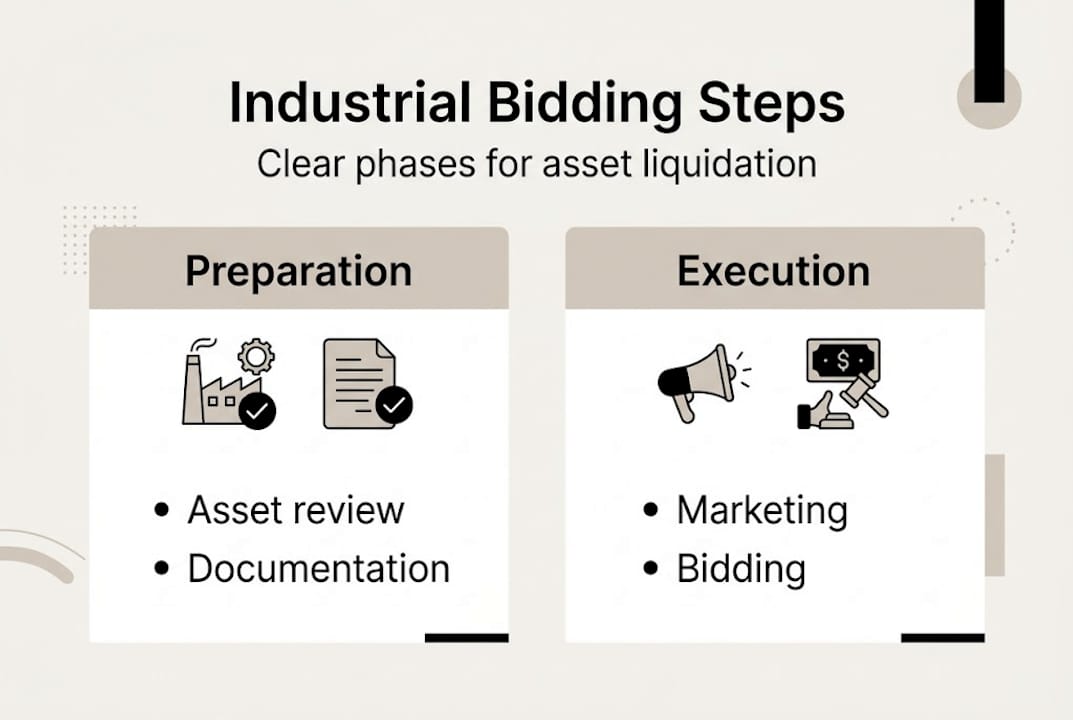
Here is a standard fee breakdown for industrial equipment auctions:
| Fee type | Typical range | Who pays |
|---|---|---|
| Buyer’s premium | 15% to 18% of hammer price | Buyer |
| Seller’s commission | 0% to 10% of gross proceeds | Seller |
| Marketing and setup | $10,000 to $30,000 | Seller |
| Removal coordination | Variable | Buyer |
The buyer’s premium of 15 to 18%, combined with seller commissions and marketing costs, means both parties need to build fees into their financial models from the start. A seller expecting $500,000 in gross proceeds may net $440,000 to $470,000 after commissions and setup costs, depending on the agreement structure.
Some fees are negotiable, particularly when asset volume is high or when the seller brings a well-documented, easily marketable portfolio. Auctioneers may reduce seller commissions in exchange for a guaranteed minimum or a larger buyer’s premium.
Bankruptcy sales add a separate layer of complexity. Under Section 363 of the U.S. Bankruptcy Code, assets can be sold free and clear of liens and encumbrances, which is a significant advantage for buyers and often increases participation. These sales typically begin with a stalking horse bid, which is an initial offer from a pre-selected buyer that sets a price floor for the court-approved auction.
- Stalking horse bidders receive protections including breakup fees (typically around 3% of the bid) and expense reimbursement
- Competing bidders must submit overbids that exceed the stalking horse amount by a defined increment
- The court must approve the final sale, adding time but providing legal certainty
“In bankruptcy scenarios, the stalking horse structure protects the estate from lowball offers while still creating competitive bidding conditions.”
For executives navigating distressed asset scenarios, reviewing auction lots best practices can help structure individual lots to attract the right buyer segments and optimize gross proceeds.
Choosing the right process: Auction vs. private sale vs. hybrid
Now that the bidding mechanics and costs are clear, let’s consider which process fits different disposition needs. Not every asset portfolio benefits from a full public auction, and not every timeline allows for extended private negotiations.
| Method | Recovery potential | Speed | Control | Best for |
|---|---|---|---|---|
| Public auction | Moderate to high | Fast (4 to 8 weeks) | Low | Broad asset portfolios, urgent timelines |
| Private sale | High (46 to 64% FMV) | Slower (6 to 12 weeks) | High | High-value or specialty assets |
| Hybrid approach | High | Moderate | Moderate | Mixed portfolios with varied asset types |
| Outright purchase | Low to moderate | Fastest | Lowest | Highly distressed, time-critical situations |
Private negotiation can yield 46 to 64% of fair market value and typically takes 6 to 12 weeks, making it a strong option when time allows and assets have identifiable buyers. Auctions provide speed and a guaranteed sale but may produce lower per-unit returns for niche equipment.
The hybrid approach is gaining traction among sophisticated asset owners for good reason:
- High-volume, general-purpose equipment goes to auction for broad exposure and speed
- Specialty or high-value items are marketed privately to pre-qualified buyers
- Both tracks run concurrently, preserving the overall timeline
The auction speed advantages are most relevant when carrying costs are high, creditor timelines are tight, or the asset mix is broad enough to attract a wide buyer pool. When assets are highly specialized, a private sale or hybrid model protects against undervaluation in a thin bidding market.
Statistic callout: Orderly private sales consistently recover 46 to 64% of fair market value, while forced auction sales of distressed assets can fall well below that range without proper marketing and buyer outreach.
A smarter way to think about industrial asset bidding
Here is an observation that does not appear in most liquidation guides: the executives who achieve the best recovery outcomes are not necessarily the ones who move fastest. They are the ones who segment their assets strategically before choosing a method.
The default assumption is that auctions solve everything. They are visible, they create urgency, and they produce a clear closing date. But applying a single auction strategy to an entire mixed portfolio often means sacrificing recovery on the items that deserved more targeted attention. A CNC machining center and a fleet of forklifts do not belong in the same bidding strategy. One has a narrow, specialized buyer pool. The other has broad demand.
Executives who maximize recovery efficiently tend to treat asset disposition as a portfolio exercise. They run auctions for volume and use private negotiation for value. They build in adequate marketing time rather than compressing timelines to meet internal deadlines. And they work with advisors who have direct relationships with qualified industrial buyers, not just access to generic listing platforms. That combination of segmentation, timing, and expertise is what separates a strong recovery from a regrettable one.
Partner with experts to maximize asset recovery
If you are ready to put smart bidding strategies into practice, here is how expert help can make the difference.
Maas Companies brings decades of experience managing industrial asset auctions, private sales, and hybrid disposition programs for manufacturers, plant operators, and creditors worldwide. From initial valuation through final removal, our team designs and executes marketing-driven strategies that attract qualified buyers and protect your recovery. Whether you need to sell your industrial equipment quickly or want to explore specialized asset recovery services tailored to your portfolio, we have the tools and the industry relationships to deliver results. You can also view industrial auction projects to see how we have helped clients in complex, multi-asset scenarios achieve strong outcomes.
Frequently asked questions
How long does the industrial asset bidding process typically take?
An industrial auction process usually spans 4 to 8 weeks from listing to payment and removal, with bidding windows ranging from 48 hours to 30 days depending on the platform and asset type.
What are buyer and seller fees at an industrial auction?
Buyers typically pay a 15 to 18% premium on the hammer price, while sellers may face a 0 to 10% commission plus $10,000 to $30,000 in marketing and setup costs.
What is a stalking horse bid and when is it used?
A stalking horse bid is an initial offer in a bankruptcy sale that sets a minimum price floor, typically protected by breakup fees around 3% and expense reimbursement to discourage lowball competition.
Is online or in-person bidding better for industrial assets?
Online bidding opens the buyer pool to global participants and accelerates results, while in-person formats may suit highly localized or unique assets where physical inspection drives buyer confidence.
How can recovery be maximized for specialized or highly distressed assets?
Combining well-marketed auctions for general assets with targeted private sales for niche items yields the best overall recovery, since a hybrid approach avoids undervaluation in thin bidding markets.
Recommended
- How Auctions Help Speed Up Industrial Asset Disposition | Blog | Insights on Asset Liquidation and Auction Trends
- How Auctions Help Speed Up Industrial Asset Disposition | Blog | Insights on Asset Liquidation and Auction Trends
- How Industrial Plant Liquidation Maximizes Recovery Value for Lenders | Blog | Insights on Asset Liquidation and Auction Trends
- Auction absentee bidding: strategies for industrial equipment | Blog | Insights on Asset Liquidation and Auction Trends