
Blog
Online auctions: maximizing distressed asset recovery

TL;DR:
- Online auctions offer faster, more transparent asset liquidation compared to traditional sales.
- Properly structured online auctions can outperform negotiated deals in speed and recovery value.
- Best practices include early marketing, secure bidding protocols, and expert risk mitigation strategies.
Many professionals in private equity and bankruptcy practice still default to traditional negotiated sales when handling distressed industrial assets, assuming that structured deal processes yield better outcomes. That assumption is increasingly difficult to defend. Online auctions have fundamentally reshaped how distressed assets are liquidated, particularly within Section 363 bankruptcy sales, where speed, transparency, and competitive bidding are not just preferred but often court-mandated. This guide covers the critical role online auctions now play in asset recovery, the mechanics driving successful outcomes, the risks professionals must manage, and the best practices that consistently separate strong recoveries from underperforming ones.
Table of Contents
- Why online auctions have become central to asset recovery
- How the online auction process works for distressed assets
- Risks, challenges, and expert mitigation strategies
- Best practices for leveraging online auctions in asset recovery
- Why many professionals underestimate online auctions and what actually works
- Partner with leaders in online asset auctions
- Frequently asked questions
Key Takeaways
| Point | Details |
|---|---|
| Faster recoveries | Online auctions typically resolve distressed asset sales in weeks, not months, accelerating cash flow to stakeholders. |
| Stalking horse advantage | Stalking horse bidders can negotiate special protections, minimizing their risk while setting a floor for competitive bidding. |
| Mitigating auction risks | Professional oversight, clear procedures, and stringent qualification processes are vital for managing online auction pitfalls. |
| More market exposure | Online auctions dramatically widen the potential buyer pool, leading to more competitive prices. |
Why online auctions have become central to asset recovery
The shift toward online auctions in distressed asset recovery is not incidental. It reflects structural changes in how courts, creditors, and capital markets now evaluate liquidation processes. Online auctions in Chapter 11 cases are increasingly standard because they deliver court-mandated transparency while compressing timelines that once stretched into years.
For private equity firms managing distressed portfolio companies and bankruptcy attorneys executing Section 363 sales, the practical advantages are significant:
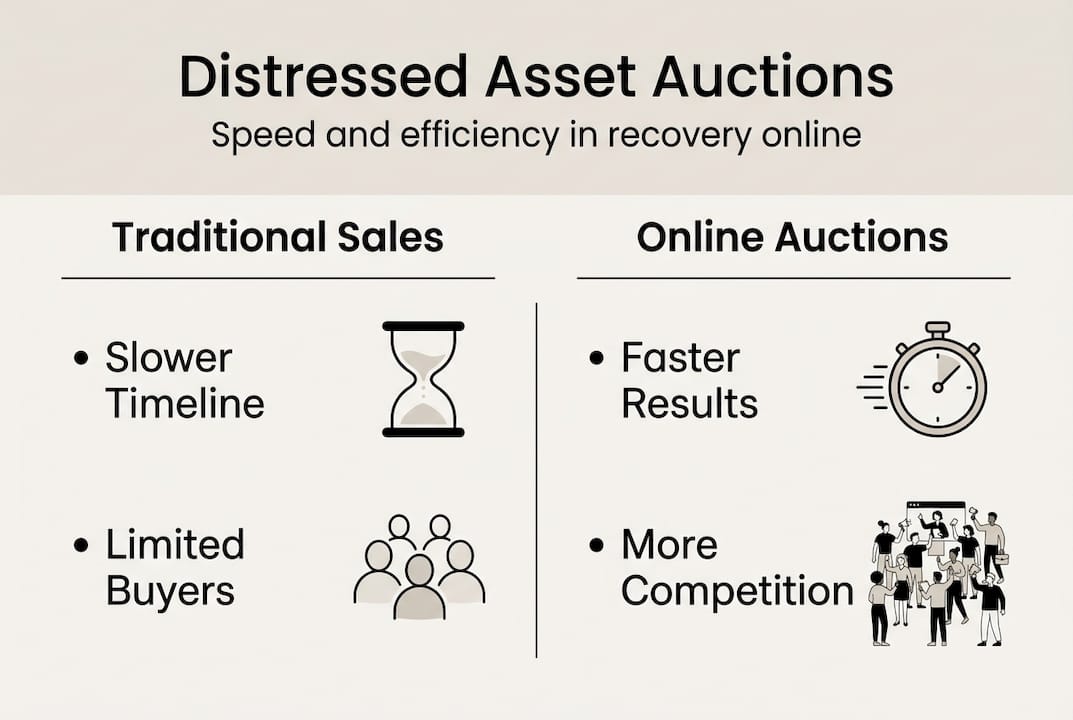
- Compressed timelines: Online auctions typically close within 30 to 90 days, compared to traditional negotiated sales that can take 6 to 18 months.
- Broader buyer reach: Digital platforms attract qualified bidders from international markets, including strategic buyers, PE firms, and industrial operators who would never surface through local broker networks.
- Transparent price discovery: Competitive online bidding creates a real-time record of market value, which courts, creditors, and stakeholders can verify independently.
- Reduced carrying costs: Faster disposition means lower storage, maintenance, insurance, and administrative costs that erode net recovery on distressed industrial assets.
The following table illustrates the key differences between traditional sale processes and online auctions in a distressed context:
| Factor | Traditional sale | Online auction |
|---|---|---|
| Timeline | 6 to 18 months | 30 to 90 days |
| Buyer pool | Limited, local/regional | Global, qualified bidders |
| Transparency | Negotiated, private | Court-approved, public |
| Carrying costs | High | Significantly lower |
| Price certainty | Variable | Competitive floor set |
Beyond cost efficiency, speeding up asset disposition through online platforms directly benefits creditor recoveries by limiting value erosion from operational holding costs during the bankruptcy process. For PE firms, this means capital is freed faster and reinvested more efficiently.
Pro Tip: Engaging in prepetition marketing before a bankruptcy filing is formally concluded can meaningfully expand the qualified bidder pool, increase competitive tension at auction, and ultimately push final sale prices higher than any pre-negotiated deal could achieve.
How the online auction process works for distressed assets
Understanding the mechanics of a Section 363 online auction is essential for any professional seeking to participate effectively, whether as a seller, buyer, or advisor. The process follows a structured sequence that balances legal compliance with competitive market dynamics.
- Prepetition marketing: Before or shortly after filing, the debtor and its advisors begin marketing assets broadly to identify potential stalking horse bidders and generate buyer interest.
- Stalking horse agreement: A lead bidder is selected to negotiate an Asset Purchase Agreement (APA), establishing a floor price and baseline deal terms. This bidder anchors the competitive process.
- Court approval of bidding procedures: The court reviews and approves the auction timeline, minimum overbid increments, qualified bidder requirements, and breakup fee provisions.
- Qualified bidder submissions: Interested parties submit deposits and financial documentation to be approved as qualified bidders, ensuring only serious participants compete.
- Online auction: Approved bidders compete in a structured online process, with bids escalating above the stalking horse floor according to court-approved increments.
- Sale hearing and court confirmation: The winning bid is presented to the court for approval, and upon confirmation, assets transfer free and clear of most liens and claims.
Court-approved procedures in Section 363 sales rely on stalking horse bidders, structured competitive bidding, and free and clear asset transfers, which together protect buyers from pre-existing encumbrances and give sellers a credible price floor.
When choosing the right auction format, consider whether the asset portfolio includes complex industrial equipment, real property, or operating business units, as each may benefit from different platform configurations and marketing timelines. A detailed pre-auction checklist covering documentation, environmental clearances, and title verification can prevent procedural delays that reduce competitive participation.

Pro Tip: If you are positioning a client as a stalking horse bidder, negotiate aggressively for breakup fees in the 2 to 4 percent range and expense reimbursement provisions. These protections compensate for the due diligence investment and the risk of being outbid at auction.
Risks, challenges, and expert mitigation strategies
Online auctions in distressed asset recovery carry specific risks that professionals must evaluate before participating. Recognizing these risks early allows for structured mitigation rather than reactive damage control after a winning bid is confirmed.
Common pitfalls in online auction participation include:
- Compressed due diligence windows: Bankruptcy timelines often allow only days or a few weeks for buyers to review asset condition, environmental status, and operational history.
- Overbidding risk: Competitive auction dynamics can drive prices beyond fundamental asset value, particularly when multiple strategic buyers are present and bidding aggressively.
- Successor liability exposure: Even with free and clear transfer provisions, certain obligations such as environmental remediation, union contracts, and product liability claims may follow assets to new owners.
- Incomplete documentation: Distressed sellers frequently have disorganized records, making it difficult to verify title, equipment condition, or compliance history before the auction closes.
- Procedural noncompliance: Failing to meet qualified bidder deadlines or deposit requirements results in disqualification, forfeiting the ability to participate entirely.
As noted in assessments of successor liability risks in Section 363 contexts, risks include limited due diligence timeframes, overbidding exposure, and the complexity of successor liability, all of which require structured mitigation. The same analysis confirms that qualified bidder processes and court-approved bidding procedures are among the most effective tools for managing these exposures systematically.
“Court-sanctioned bidding procedures are not just administrative formalities. They are the primary safeguard ensuring that competitive auction outcomes hold legal weight and asset transfers are defensible against future challenge.”
Strategically, professionals who engage auction bidding strategies early, set firm bid ceilings based on independent asset valuations, and engage environmental and title counsel before the auction begins consistently outperform those who rely solely on the auction process itself to surface relevant risk information.
Best practices for leveraging online auctions in asset recovery
The professionals who achieve the strongest auction recoveries share a consistent set of behaviors. These are not theoretical recommendations. They are observed patterns from successful distressed asset sales across industrial, manufacturing, and commercial sectors.
- Engage stakeholders and begin marketing early. Creditors, potential buyers, and advisors should be aligned and actively engaged before the court approves bidding procedures. Broad early marketing expands the qualified bidder pool and increases competitive tension at auction.
- Secure stalking horse protections whenever possible. As established guidance confirms, stalking horse bidders negotiate favorable terms and breakup fees that protect their investment and improve the overall auction outcome for all parties.
- Implement strict bidder prequalification. Requiring deposits, financial statements, and proof of funds screens out non-serious participants, reduces the risk of failed closings, and maintains auction integrity.
- Prepare documentation thoroughly before launch. Titles, equipment lists, environmental reports, and survey data must be ready before the virtual data room opens. Buyers who cannot complete due diligence quickly will pass, reducing competitive pressure.
- Monitor bidder engagement during the marketing phase. Platform analytics showing which bidders are actively reviewing data room materials provide early signals of competitive interest that can inform reserve pricing and negotiation posture.
- Coordinate with legal counsel throughout. Given the benefits of auction speed, even small procedural delays during court approval or the sale hearing can erode the timeline advantages that make online auctions attractive in the first place.
Use a structured auction preparation checklist that covers every phase from asset inventory through final court confirmation. Skipping steps to save time upfront typically creates complications that cost far more in delay and reduced recovery.
Pro Tip: Modern auction platforms offer real-time dashboards that track bid activity, data room access, and buyer inquiries. Use this data actively during the marketing period to identify emerging price signals and adjust your reserve or floor bid strategy accordingly.
Why many professionals underestimate online auctions and what actually works
Conventional wisdom in distressed M&A still leans heavily on private negotiated processes, structured marketing periods managed by investment banks, and bilateral deal structures. This is understandable given the institutional familiarity with those tools. But it creates a consistent blind spot.
Online auctions under court-sanctioned procedures regularly outperform negotiated deals on both speed and realized value for distressed industrial assets, yet many experienced professionals still treat them as a last resort rather than a primary strategy. The real-world auction results available from properly structured Section 363 processes challenge the assumption that more time and more bilateral negotiation automatically produce better outcomes.
What actually works is combining the structural advantages of court-approved online auctions with the same creative deal mechanics that sophisticated professionals apply in private transactions: negotiated stalking horse terms, thoughtful breakup fee structures, aggressive prepetition marketing, and tight bidder qualification protocols. Professionals who integrate these tools consistently achieve recoveries that outpace both creditor expectations and comparable private sale benchmarks. The ones who cling to outdated playbooks often leave significant value behind.
Partner with leaders in online asset auctions
For private equity firms and bankruptcy attorneys seeking to put this guide’s insights into action, Maas Companies Inc. offers direct access to structured online auction opportunities across industrial and manufacturing sectors. Our aggressive marketing approach and international reach consistently produce competitive bidder pools and strong recovery outcomes.
Explore current opportunities including a live industrial auction featuring a biodiesel plant, oilseed processing facilities, and related assets. For equipment-focused mandates, review the latest online equipment auction listing for tank manufacturing and jacking systems. To discuss your specific recovery mandate with our team, visit Maas Companies and connect with our asset recovery specialists directly.
Frequently asked questions
What is the main advantage of using online auctions for distressed asset recovery?
Online auctions in Chapter 11 deliver unmatched speed and court-mandated transparency, enabling competitive bidding and higher asset realization within a 30 to 90 day window. This compressed timeline directly reduces carrying costs and prevents further value erosion on distressed assets.
What is a stalking horse bidder in an online asset auction?
A stalking horse bidder agrees to purchase assets under negotiated terms, establishes the minimum bid floor, and may receive breakup fees if ultimately outbid at auction. Stalking horse protections compensate the bidder for due diligence investment and anchor the competitive process.
How can professionals mitigate risks in online asset auctions?
Careful due diligence ahead of the auction, strict qualified bidder requirements, and reliance on court-approved bidding procedures are the most effective tools for managing the common risks professionals face in distressed online auctions.
Are online auctions always the best strategy for asset recovery?
While online auctions are highly effective for maximizing speed and competitive value realization, the specific characteristics of an asset portfolio and prevailing market conditions ultimately determine when they outperform alternative disposition strategies.
Recommended
- Auction strategies for small businesses: Maximize asset recovery | Blog | Insights on Asset Liquidation and Auction Trends
- How Auctions Help Speed Up Industrial Asset Disposition | Blog | Insights on Asset Liquidation and Auction Trends
- Maximize Asset Recovery: Top Real Estate Liquidation Methods | Blog | Insights on Asset Liquidation and Auction Trends
- How Auctions Help Speed Up Industrial Asset Disposition | Blog | Insights on Asset Liquidation and Auction Trends
- Real Estate Cold Calling Practice — AI Roleplay for Every Seller Type | ClosersLeague