
Blog
Plant Decommissioning Workflow: Maximize Recovery
A plant decommissioning workflow that preserves compliance and maximizes recovery is a senior-led, PMO-governed project that sequences inventory and valuation, compliance remediation, targeted marketing and sale, logistics and demobilization, and escrowed closing. BCG’s guidance on industrial asset closures confirms that PMO-led governance, planned from an explicit end state, protects value across financial, operational, and reputational dimensions. Baker McKenzie advises resolving regulatory deficiencies before marketing begins. Maascompanies brings targeted marketing, escrow management, and project coordination to help sellers realize that value.
Start here:
- Appoint an executive sponsor and stand up the PMO within the first week.
- Commission a complete asset inventory with title, lien, and condition data.
- Identify high-risk compliance items and begin remediation before any buyer outreach.
Pro Tip: Assign a single program manager with authority to escalate across legal, operations, and finance. Divided ownership is the leading cause of schedule slippage and value leakage in plant closures.
Key Takeaways
A PMO-led, compliance-first plant decommissioning workflow is the most reliable path to maximum net recovery for executives, lenders, and legal teams managing industrial plant closures in the U.S.
| Point | Details |
|---|---|
| Stand up the PMO first | Appoint an executive sponsor and program manager before any public announcement or buyer contact. |
| Inventory drives every decision | Complete asset records with title, lien, and condition data are required before valuation, marketing, or closing. |
| Remediate compliance gaps pre-marketing | Unresolved cGMP, environmental, or title issues reprice or terminate deals; resolve high-impact items before buyer outreach. |
| Stage the sale format by asset class | Private negotiated sale for premium lots, auction for mid-tier, bulk liquidation for commodity items maximizes blended recovery. |
| Maascompanies as recovery partner | Maascompanies combines targeted marketing, auction execution, and escrow management to maximize net recovery for industrial sellers. |
This article is general information, not a substitute for advice from a qualified lawyer. Consult a qualified legal professional about your own circumstances before acting on anything here.
Table of Contents
- What does a plant decommissioning workflow require from a governance standpoint?
- How do you build a complete asset inventory and valuation matrix?
- What legal and regulatory risks must you resolve before marketing begins?
- Which sale format fits your assets, and how do you build a marketing plan?
- How do you sequence site logistics and manage removal costs?
- What closing mechanics protect sellers, lenders, and fiduciaries?
- How do you evaluate and select a strategic asset-recovery partner?
- What does a 30/60/90-day execution playbook look like?
- What Maascompanies sees in successful plant closures
- Maascompanies: a strategic partner for plant asset recovery
- Sources
What does a plant decommissioning workflow require from a governance standpoint?
A senior-led Program Management Office is the structural control that prevents workstreams from operating in silos. BCG’s end-state-driven closure framework makes the case plainly: without a designated executive sponsor accountable for the full program, financial, operational, and reputational value erodes across every phase.
Core PMO roles:
- Executive Sponsor (COO or equivalent): program authority, escalation point, lender interface
- Program Manager: schedule, budget, risk register, cross-functional coordination
- Commercial Lead: marketing plan, buyer outreach, sale format decisions
- Legal Counsel: title searches, regulatory filings, contract review, closing documents
- Environmental Lead: site liability assessment, hazardous-materials inventory, permit transfers
- Asset Disposition Lead: inventory, valuation, logistics sequencing
- Lender/Credit Representative: lien reconciliation, proceeds distribution, creditor reporting
- Communications Lead: employee notifications, community relations, regulatory agency contact
The governance cadence should include daily operational standups during active removal phases, weekly cross-functional reviews, and a weekly executive summary to the sponsor and lender. A lightweight risk register with fields for risk description, probability, impact, owner, and mitigation status keeps decisions traceable.
Pro Tip: Centralize all title documents, lien searches, condition reports, and correspondence in a single shared repository with version control. A single-source-of-truth system eliminates the conflicting data sets that delay closings.
How do you build a complete asset inventory and valuation matrix?
A credible inventory is the foundation of every downstream decision, from marketing strategy to lender reporting. LegalClarity notes that missing title documentation and incomplete asset records create legal exposure and potential personal liability for officers.
Asset categories to capture:
- Real estate (owned and leased parcels, buildings, easements)
- Production lines and process equipment
- Machinery, motors, and ancillary mechanical systems
- Spare parts, consumables, and tooling
- Vehicles and material-handling equipment
- Office furniture and IT infrastructure
- IP, licenses, permits, and intangible financial instruments
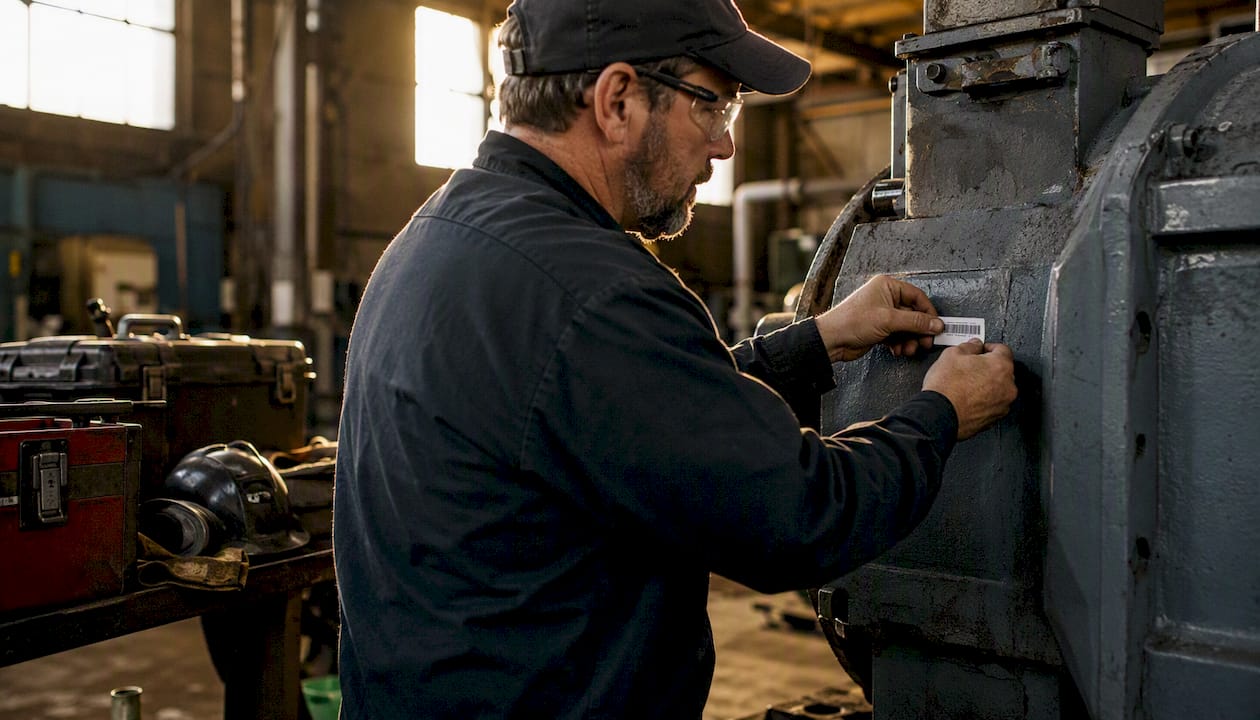
Each record should include serial number or VIN, model and manufacturer, physical location, photographic documentation (minimum four angles, serial plate close-up, calibration stamps where present), maintenance history, OEM documentation, current depreciation basis, and lien or encumbrance status.
Valuation bands by asset condition and market:
| Valuation Basis | Typical Recovery Range | Key Drivers |
|---|---|---|
| Retail / private negotiated | Highest net | Low hours, current model, documented maintenance |
| Auction / competitive bid | Moderate to high | Buyer competition, lot size, marketing reach |
| Wholesale / dealer purchase | Moderate | Speed priority, dealer margin required |
| Relocation value | Condition-dependent | Rigging and transport costs offset recovery |
| Scrap / bulk liquidation | Lowest net | Obsolescence, damage, no market demand |
Triage assets into three buckets immediately: priority lots for private negotiated sale, mid-tier lots for timed or live auction, and bulk items for liquidator purchase. This sequencing balances speed against recovery and directly informs the marketing plan.
Pro Tip: Photograph every asset before any cleaning or repair. Pre-condition photos protect the seller in disputes and give buyers the documentation they need to bid with confidence.
What legal and regulatory risks must you resolve before marketing begins?
Unresolved compliance issues are the most common cause of deal failure and price erosion in industrial plant dispositions. Baker McKenzie’s guidance on manufacturing site divestitures is direct: assess whether regulatory approvals and licenses are site-specific or entity-specific, and address cGMP deficiencies before any sale process begins.
Pre-marketing compliance checklist:
- Title and lien searches on all real property and titled equipment
- Environmental Phase I (and Phase II where indicated) site assessment
- Hazardous-materials inventory: asbestos, PCBs, refrigerants, process chemicals
- Permit and Change of Ownership (CHOW) requirements for regulated operations
- cGMP remediation documentation for pharmaceutical or food-grade manufacturing sites
- WARN Act notification timeline (60-day advance notice for qualifying closures)
- Union contract obligations and collective bargaining agreement review
- Data security and IP protection plan before any third-party site access
Sequence matters. Resolve high-impact items, particularly environmental liabilities and cGMP gaps, before buyer outreach. Buyers who discover compliance deficiencies during due diligence will reprice or withdraw. Document interim operating arrangements and transitional quality responsibilities for any regulated manufacturing that continues during the sale process.
LegalClarity’s liquidation compliance guidance reinforces that adherence to creditor-payment hierarchies and proper documentation protects fiduciaries from clawbacks and personal liability. Establish the creditor priority stack early and confirm it with legal counsel before any proceeds are distributed.
Pro Tip: For pharmaceutical or food-grade sites, engage a regulatory consultant alongside legal counsel since cGMP remediation documentation is a buyer requirement, not an optional disclosure.
Which sale format fits your assets, and how do you build a marketing plan?
Sale format selection is a direct function of asset type, timeline pressure, and buyer pool depth. No single format maximizes recovery across every asset class. Maascompanies’s disposition strategy guide outlines when each route performs best.
Sale format by use case:
- Private negotiated sale: highest net recovery for unique, high-value equipment with a defined buyer pool; requires more time and targeted outreach
- Live or timed online auction: creates competitive bidding for discrete lots with broad market appeal; effective for production lines, CNC machinery, and specialty equipment
- Hybrid staged approach: private marketing for premium lots first, then auction for the remainder; preserves optionality and maximizes blended recovery
- Bulk liquidation: fastest exit for commodity items, spare parts, and obsolete inventory; buyers price in significant discounts to retail
A complete marketing plan for industrial plant liquidation should include a detailed asset list with photos and condition reports, title documentation, buyer outreach to qualified industrial operators, dealers, redeployers, and export buyers, and a defined bidding or offer deadline. Documentation packs that include OEM manuals, maintenance records, and calibration certificates consistently attract stronger bids.
Pro Tip: Stage the marketing: release high-value lots to a targeted private buyer list two to three weeks before any public auction. If a private buyer transacts, you capture the premium. If not, those lots enter the auction with documented market interest, which supports reserve pricing.
How do you sequence site logistics and manage removal costs?
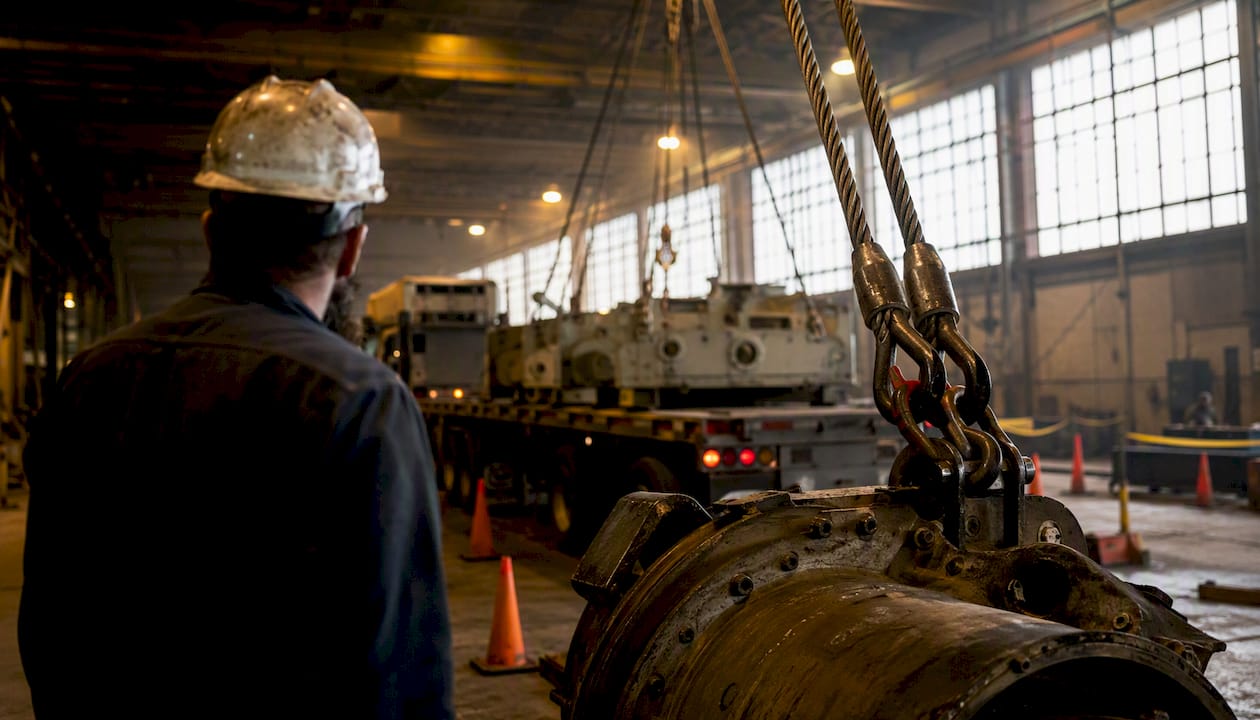
Logistics sequencing determines whether assets leave the site in saleable condition or at scrap value. Beck & Pollitzer’s engineering-led approach to utility isolation, lockout/tagout (LOTO) procedures, and specialist rigging is the industry standard for preserving both safety and asset integrity during removal.
Vendor checklist for removal operations:
- Licensed rigging and heavy-lift contractors with site-specific lift plans
- Specialist dismantling contractors for process equipment and piping
- Qualified hazardous-waste handlers for regulated materials
- Certified transport providers for oversized or sensitive loads
- Insurance certificates and liability confirmation from every contractor on site
Principal cost drivers include rigging and crane time, transport and export packaging, temporary storage, waste disposal and manifesting, and any permitting required for road moves or crane operations. Invest in proper rigging and crating for high-value assets; the cost is recoverable in sale price. Cut costs on commodity items where scrap or bulk sale is the exit.
Parallelize where possible: environmental remediation, utility disconnection, and asset removal can run concurrently on different sections of a large site. Sequencing these workstreams correctly, rather than running them serially, typically compresses the demobilization schedule by several weeks.
What closing mechanics protect sellers, lenders, and fiduciaries?
Transaction closing is where documentation gaps become financial losses. Every asset sale requires a signed purchase agreement, a bill of sale or deed for real property, recorded assignments for any transferred IP or licenses, and a clear escrow workflow that holds funds until title transfer is confirmed.
Closing checklist:
- Executed purchase and sale agreements for all asset lots
- Bills of sale with serial numbers and condition descriptions
- Deed transfers recorded with the appropriate county recorder for real property
- IP and license assignments filed with USPTO or relevant agency
- Lien releases obtained and recorded before funds are disbursed
- Escrow account established with a neutral third-party escrow agent
- Proceeds reconciled against the creditor priority stack before any distribution
Escrow protects both parties: the buyer’s funds are held until title is clear, and the seller’s fiduciaries are protected from distributing proceeds before lien releases are confirmed. LegalClarity’s guidance on creditor hierarchies applies directly here. Lenders with first-priority liens must be paid before any subordinate creditors or equity distributions. Document every disbursement with a written reconciliation statement.
Structured liquidation programs for lenders create predictable timelines and documented recovery records that satisfy reporting requirements and reduce post-closing disputes.
Pro Tip: Retain all closing documents for an appropriate retention period. Title disputes and lien clawbacks can surface well after the sale closes, and complete records are the only reliable defense.
How do you evaluate and select a strategic asset-recovery partner?
The right partner reduces transaction risk, accelerates time to market, and materially improves net recovery. BCG’s closure governance framework and Baker McKenzie’s divestiture best practices both point to integrated legal and PMO oversight as the structural controls that reduce deal failure risk.
Decision criteria:
- Scope of services: does the partner cover marketing, sale execution, logistics coordination, escrow management, and legal support, or only a subset?
- Fee model: commission-based structures align partner incentives with seller recovery; confirm what costs are deducted before the commission base is calculated
- Industry specialization: buyer networks in your specific equipment category (pharmaceutical, food processing, energy, manufacturing) determine realized price
- Track record: request documented case studies with asset types, timelines, and net recovery figures comparable to your situation
- Timeline capability: can the partner mobilize within your required window and manage parallel workstreams?
- Compliance management: does the partner have experience with regulated sites, cGMP documentation, and environmental coordination?
Questions to ask prospective partners:
- What is your buyer database size and geographic reach for this asset category?
- How do you handle lien searches and escrow, and who holds the funds?
- Can you provide references from lender-ordered or court-ordered liquidations?
- What is your process for managing compliance documentation during the sale?
- How do you sequence private marketing versus public auction to maximize blended recovery?
Maascompanies offers auction and negotiated-sale services that combine targeted marketing, escrow handling, and project coordination across industrial equipment, real estate, and commercial properties. Their experience spans manufacturing, energy, healthcare, and government asset dispositions.
Pro Tip: Request a sample marketing plan and buyer outreach list before signing an engagement. A partner who cannot show you their buyer network in your asset category is not the right fit.
What does a 30/60/90-day execution playbook look like?
| Phase | Primary Goals | Key Owners | Measurable Outputs |
|---|---|---|---|
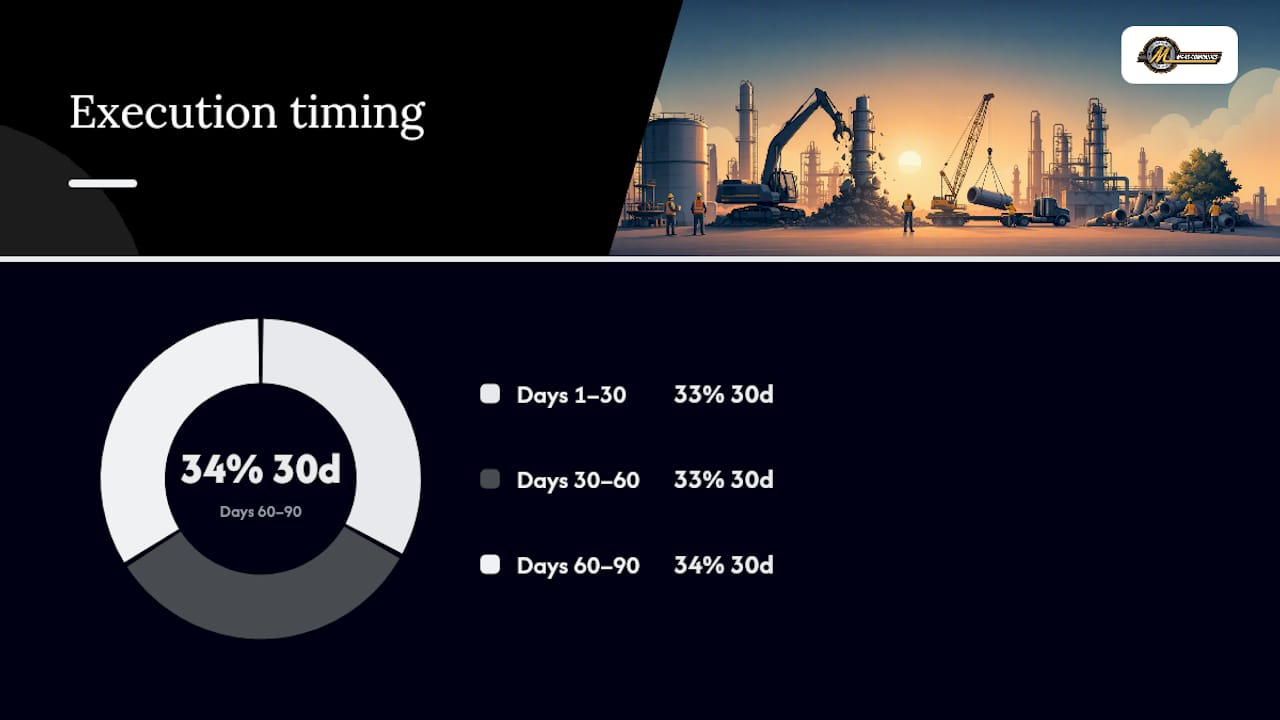
| Days 1–30 | PMO formation, full asset inventory, compliance gap assessment, lender alignment | Executive Sponsor, PMO, Legal, Environmental | Inventory database complete; risk register populated; creditor stack confirmed |
| Days 30–60 | Compliance remediation (high-priority items), marketing plan launch, buyer outreach, logistics vendor selection | Commercial Lead, Legal, Environmental, Disposition Lead | Marketing materials live; buyer list active; vendor contracts signed |
| Days 60–90 | Sale execution, removal operations, closing documentation, funds recovery and distribution | PMO, Commercial Lead, Legal, Finance | All lots sold or assigned; lien releases recorded; proceeds reconciled and distributed |
Contingency triggers to monitor:
- Environmental finding that expands remediation scope: add two to four weeks and adjust buyer timeline expectations immediately.
- Title defect discovered post-marketing: pause affected lot, engage legal counsel, notify buyers with a revised timeline.
- Key buyer withdraws during due diligence: activate secondary buyer list and reassess reserve pricing.
- Labor or union dispute delays site access: escalate to executive sponsor and legal counsel; document all impacts for lender reporting.
Revisit value decisions at the Day 30 and Day 60 checkpoints. If market interest for a high-value lot is stronger than projected, extend the private marketing window before moving to auction. If time-to-vacate pressure is acute, accelerate bulk liquidation for lower-tier assets to free the site.
Plant liquidation timing and sequencing guidance from Maascompanies provides additional context on how market conditions affect recovery across different asset classes.
What Maascompanies sees in successful plant closures
The closures that recover the most value share three characteristics: the PMO is formed before any public announcement, compliance remediation is treated as a pre-condition for marketing rather than a parallel track, and the sale strategy is staged to preserve optionality. Teams that compress or skip the inventory and compliance phases consistently leave recovery on the table and face closing delays that increase carrying costs.
Early PMO formation is not administrative overhead. It is the mechanism that keeps legal, environmental, commercial, and financial workstreams synchronized. When those workstreams diverge, buyers notice, and they price the uncertainty into their offers.
Documented case studies and sample recoveries are the most reliable signal that a partner has executed comparable transactions. Ask for them. A partner who has managed lender-ordered liquidations, regulated manufacturing dispositions, and multi-site closures brings a depth of buyer relationships and process discipline that a generalist cannot replicate.
Maascompanies: a strategic partner for plant asset recovery
When a plant closure requires more than a listing service, the difference in net recovery comes down to marketing depth, buyer network quality, and transaction discipline. Maascompanies manages the full disposition process for industrial sellers: targeted buyer outreach, auction and negotiated-sale execution, escrow and title coordination, and project management across equipment, real estate, and commercial properties.
For executives and lenders managing a closure on a defined timeline, Maascompanies provides a structured intake process that begins with an asset inventory review and a scoped marketing plan. Contact Maascompanies to discuss your disposition options and receive a recovery-focused engagement proposal tailored to your asset mix and timeline.
Sources
- Industrial Asset Closures Are Inevitable. Value Isn’t.
- Manufacturing site divestitures: Best practices for successful execution - Healthcare & Life Sciences Blog
- Industrial Plant Closure &Facility Decommissioning Experts | Beck & Pollitzer
Recommended
- Equipment Liquidation Workflow: Maximize Asset Recovery | Blog | Insights on Asset Liquidation and Auction Trends
- Plant liquidation strategies: maximize recovery in 2026 | Blog | Insights on Asset Liquidation and Auction Trends
- How Industrial Plant Liquidation Maximizes Recovery Value for Lenders | Blog | Insights on Asset Liquidation and Auction Trends
- Industrial Plant Sale Checklist for Maximum Recovery | Blog | Insights on Asset Liquidation and Auction Trends