
Blog
Plant liquidation strategies: maximize recovery in 2026
Most corporate decision-makers assume that selling off an industrial plant will recover a substantial portion of its value. The reality is far more sobering. Liquidation recovers ~23% for secured creditors in many distressed scenarios, a figure that catches even experienced executives off guard. The gap between expectation and outcome is almost always explained by the same factors: poor timing, misaligned sales channels, and the absence of a structured liquidation strategy. This article clarifies what plant liquidation actually involves, how the process unfolds from asset cataloging to final settlement, and what specific strategies can meaningfully improve your recovery rate.
Table of Contents
- Defining plant liquidation: What decision-makers need to know
- How plant liquidation works: From listing to final settlement
- Plant liquidation vs. going-concern sales: Recovery and timing
- Expert strategies for maximizing recovery in plant liquidation
- What most decision-makers overlook in plant liquidation
- Connect with proven plant liquidation experts
- Frequently asked questions
Key Takeaways
| Point | Details |
|---|---|
| Liquidation yields less | Plant liquidation typically recovers only 23% of asset value for creditors. |
| Strategy affects recovery | Full-service solutions and careful asset pairing can boost recovery rates significantly. |
| Going-concern vs. liquidation | Going-concern sales take longer but can recover up to 64% of fair market value. |
| Critical steps matter | Cataloging, valuation, and strategic auctioning are key to optimizing outcomes. |
| Expert networks maximize efficiency | Using specialized providers for logistics and dismantling reduces risk and increases proceeds. |
Defining plant liquidation: What decision-makers need to know
Plant liquidation is the process of selling a facility’s assets individually or in groups to satisfy outstanding financial obligations. It is not the same as selling a functioning operation. The distinction matters enormously when you are weighing options under financial pressure.
In a liquidation scenario, assets are sold piecemeal. Equipment, real estate, inventory, and intellectual property are each evaluated and sold separately to generate maximum immediate cash. This approach is typically triggered by one of three conditions:
- Insolvency or bankruptcy, where Chapter 7 triggers liquidation basis accounting and requires assets to be converted to cash
- Organizational restructuring, where a parent company exits a business unit or geographic market
- Market shifts, where a product line becomes economically unviable and continued operation is not justified
A going-concern sale, by contrast, transfers the entire operation as a functioning entity. Buyers acquire not just the physical assets but the workforce, contracts, and operational infrastructure. The recovery potential is higher, but the process is longer and more complex.
Plant liquidation is fundamentally a cash conversion exercise. The goal is not to preserve the business but to extract maximum value from its components under defined time and legal constraints.
Understanding this distinction helps decision-makers set realistic recovery targets and choose the right disposition path. For a broader overview of how liquidation sales explained apply across different asset types, it is worth reviewing the full spectrum of disposition options before committing to a strategy.
The trigger for liquidation also shapes the timeline and legal framework. Bankruptcy proceedings impose court-supervised timelines and creditor priority rules. Voluntary restructuring gives management more control over pacing and sale method. Recognizing which scenario applies to your situation is the first step toward a structured response.
How plant liquidation works: From listing to final settlement
Understanding what plant liquidation is, let’s examine the actual process step by step. Industrial plant liquidations at scale, including Pfizer facility and HealthStar pharma auctions, follow a consistent operational sequence regardless of industry or asset complexity.
- Asset cataloging and appraisal. Every piece of equipment, real property, and inventory is identified, documented, and assigned a fair market value. This step determines the baseline for all subsequent negotiations and sets creditor expectations.
- Marketing and buyer outreach. Assets are advertised through targeted industry channels, reaching qualified buyers who have both the technical knowledge and financial capacity to acquire industrial equipment. Broad exposure directly influences final sale prices.
- Sale method selection. Decision-makers choose between public auction, sealed bid, negotiated private sale, or a hybrid approach. Each method carries different timeline and recovery implications, which we address in the next section.
- Dismantling and logistics coordination. Once assets are sold, removal, rigging, and transportation must be managed efficiently. Delays at this stage increase carrying costs and can erode net recovery.
- Final settlement and reporting. Proceeds are distributed according to creditor priority, and full documentation is provided for accounting and legal compliance.
Pro Tip: Engage your liquidation provider before the formal process begins. Early involvement allows for better asset documentation, broader buyer outreach, and more competitive bidding. Late engagement is one of the most common causes of suboptimal recovery.
For decision-makers evaluating providers, reviewing facility liquidation strategies and understanding industrial asset disposition options in detail will clarify which approach fits your specific asset profile. The goal of maximizing recovery value depends heavily on provider selection and process discipline.
Plant liquidation vs. going-concern sales: Recovery and timing
With the liquidation steps outlined, it is important to compare outcomes to alternative strategies. The core tradeoff is straightforward: liquidation is faster but yields less, while going-concern sales recover more but require significantly more time and negotiation.
| Factor | Plant liquidation | Going-concern sale |
|---|---|---|
| Typical recovery rate | ~23% of asset value | 46-64% of fair market value |
| Timeline | Weeks to a few months | Several months to over a year |
| Buyer pool | Equipment dealers, investors | Strategic buyers, competitors |
| Complexity | Moderate | High |
| Legal oversight | Often court-supervised | Negotiated, less constrained |
Going-concern sales yield higher recovery at 46 to 64% of fair market value, but the extended timeline introduces its own costs. Carrying costs, including property taxes, insurance, utilities, and security, accumulate during extended sale processes and reduce net proceeds.
The Everde Growers bankruptcy illustrates this tradeoff clearly. When a going-concern sale fell through after months of negotiation, the fallback to liquidation resulted in significantly lower creditor recovery and extended the overall resolution timeline. In cases where time is constrained by court orders or creditor pressure, the ability to speed up asset disposition through structured auctions often outweighs the theoretical upside of a going-concern approach.

The right choice depends on three variables: the urgency of creditor obligations, the operational condition of the facility, and the availability of strategic buyers in your specific industry segment. Decision-makers who understand choosing the right auction format for their asset type consistently achieve better outcomes than those who default to the most familiar method.
Expert strategies for maximizing recovery in plant liquidation
Knowing the differences in outcomes, let’s focus on practical strategies for improving recovery from plant liquidation. The gap between average and strong recovery rates is almost always explained by deliberate choices made early in the process.
| Strategy | Impact on recovery | Key consideration |
|---|---|---|
| Full turnkey service provider | High | Reduces coordination gaps |
| Bundled asset sales | Moderate to high | Attracts specialized buyers |
| Targeted industry marketing | High | Expands qualified buyer pool |
| Early timeline planning | High | Reduces carrying costs |
| Professional appraisal | Moderate | Sets accurate reserve prices |
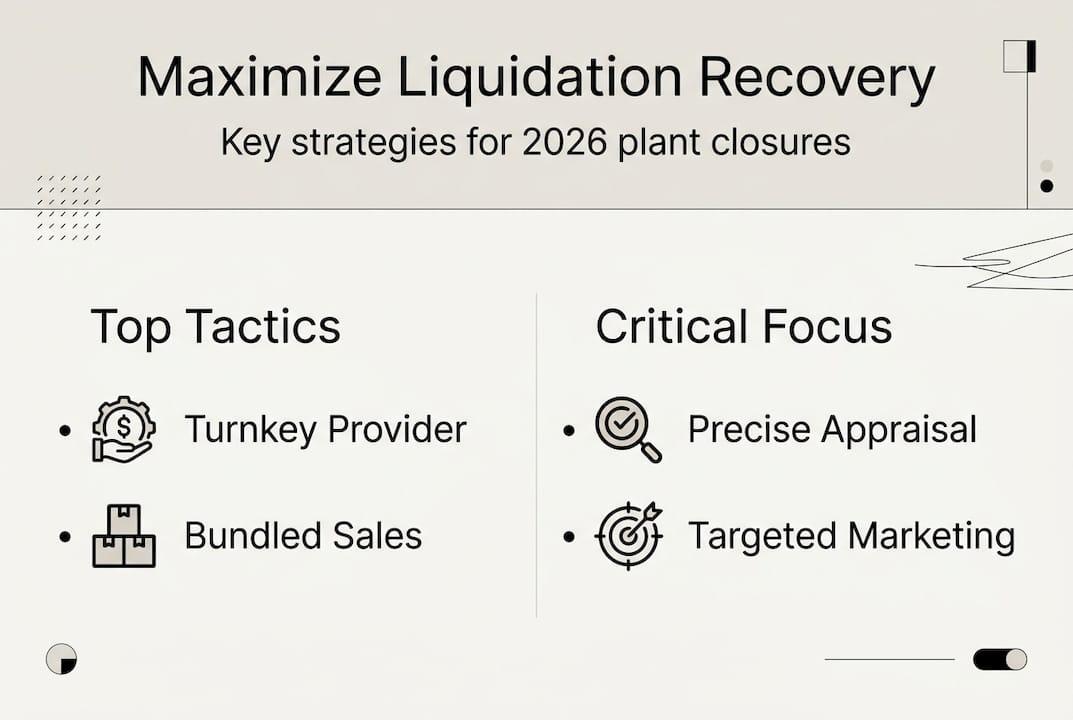
Full turnkey services maximize efficiency by consolidating appraisal, marketing, logistics, and settlement under a single provider. This eliminates the coordination gaps that occur when multiple vendors manage different phases of the process.
Additional strategies that consistently improve outcomes include:
- Asset pairing and bundling. Selling complementary equipment together attracts buyers who need complete production lines, not just individual components. This approach often yields higher per-unit prices than piecemeal sales.
- Market-specific advertising. Generic listings reach generic buyers. Targeted outreach to industry-specific networks, trade publications, and known buyers in your sector generates competitive bidding from qualified purchasers.
- Reserve price discipline. Setting reserves too high stalls sales and extends carrying costs. Setting them too low leaves recovery on the table. Professional appraisal calibrates this balance accurately.
- Timing relative to market cycles. Selling during periods of high industry activity, when competitors are expanding or replacing equipment, produces better results than selling into a depressed market.
Pro Tip: Review a surplus equipment sale guide before finalizing your asset list. Some equipment categories command significantly higher prices in secondary markets than their book value suggests, and identifying these early changes your prioritization strategy.
Avoiding common pitfalls is equally important. Poor initial valuation, misaligned sales channels, and inadequate buyer outreach are the three most frequent causes of recovery shortfalls. A structured approach to maximize asset recovery addresses all three systematically.
What most decision-makers overlook in plant liquidation
After detailing strategies for maximizing recovery, there is a less-discussed dimension that deserves direct attention: the cost of rushed decisions and the hidden value that specialized provider networks can unlock.
Most decision-makers focus on the visible variables, such as auction format, reserve prices, and marketing reach. What they underestimate is how much value is lost before the sale process even begins. Liquidation often leaves significant value untapped due to rushed timelines or lack of integrated services. This is not a theoretical observation. It reflects what happens when asset documentation is incomplete, when buyers are not given adequate lead time, or when dismantling logistics are not coordinated with the sale schedule.
Bundled asset sales are another area where value is routinely left behind. Individual equipment lots attract dealers looking for margin. Complete production line packages attract operators who will pay a premium to avoid sourcing components separately. The difference in recovery can be substantial, but capturing it requires a provider with both the industry knowledge to identify logical bundles and the buyer network to market them effectively.
Engaging transition strategies from specialists who manage the full process, from initial cataloging through final settlement, consistently produces better outcomes than assembling a piecemeal team under time pressure. The provider’s network, not just their process, is what drives competitive bidding and final recovery rates.
Connect with proven plant liquidation experts
If your organization is managing a distressed facility or planning an industrial asset disposition, the decisions you make in the next 30 to 60 days will define your recovery outcome. Maas Companies brings decades of international experience in marketing industrial plants, equipment, and commercial properties to clients who need results, not just activity.
Review our current plant liquidation projects to see active examples of full-scale industrial auctions across multiple asset categories. When you are ready to move forward, our team is available to evaluate your assets and develop a targeted recovery plan. Visit our sell industrial assets page to start the conversation, or explore the full range of comprehensive Maas services to understand how we support clients from initial appraisal through final settlement.
Frequently asked questions
How is plant liquidation different from plant closure?
Plant liquidation involves selling assets piecemeal to satisfy creditor obligations, while a plant closure may retain assets, transfer them to another facility, or sell the operation as a going concern.
What are the main steps in an industrial plant liquidation?
The key steps are asset cataloging, professional appraisal, sale process execution (auction or negotiated sale), logistics and dismantling coordination, and final settlement. Each phase builds directly on the previous one, as outlined in the liquidation sales process.
How much value is typically recovered in plant liquidation?
Liquidation recovers ~23% for secured creditors on average, though bundled asset sales, targeted marketing, and professional auction management can improve this figure meaningfully.
Is a going-concern sale always better than liquidation?
Going-concern sales recover more at 46 to 64% of fair market value, but they require significantly more time and negotiation. When carrying costs are high or creditor timelines are tight, liquidation may produce a better net outcome despite the lower gross recovery rate.
Recommended
- How Industrial Plant Liquidation Maximizes Recovery Value for Lenders | Blog | Insights on Asset Liquidation and Auction Trends
- Liquidation sales explained: Maximize asset recovery | Blog | Insights on Asset Liquidation and Auction Trends
- Maximize Asset Recovery: Top Real Estate Liquidation Methods | Blog | Insights on Asset Liquidation and Auction Trends
- How to Plan Government Asset Sales for Spring 2026 | Blog | Insights on Asset Liquidation and Auction Trends
- Gold trading strategies: optimize risk and returns in 2026