

Blog
Surplus Disposition Strategy Explained for Asset Managers

TL;DR:
- A surplus disposition strategy is a structured process for liquidating assets to maximize recovery value while ensuring regulatory compliance. Organizations choose between methods like auctions or negotiated sales based on asset profile, market demand, and confidentiality needs to optimize outcomes. Effective execution involves thorough planning, documentation, compliance, targeted marketing, and adapting to evolving trends such as online sales and sustainability requirements.
A surplus disposition strategy is a structured, methodical plan organizations use to liquidate surplus assets in a sequence that maximizes recovery value, satisfies regulatory requirements, and reduces carrying costs. The General Services Administration (GSA) codifies this approach through a mandated disposition hierarchy, and private-sector frameworks mirror that logic closely. Whether you manage a plant closure, a fleet reduction, or excess inventory from a restructuring, the disposition strategy you select determines how much capital you recover and how quickly you exit the position. This article covers the core methods, decision criteria, implementation steps, and 2026 trends that shape effective surplus assets management.
What is a surplus disposition strategy and why does it matter?
A surplus disposition strategy is the formal process by which an organization evaluates, markets, and transfers surplus assets through the channel most likely to produce the highest net recovery at acceptable risk. The term “surplus disposal” is often used interchangeably in operational contexts, though “disposition strategy” is the recognized industry term because it encompasses the full decision framework, not just the act of removal.
The financial case is direct. Surplus assets generate carrying costs: insurance, storage, maintenance, and depreciation. Every month an asset sits unresolved, its market value typically declines while its cost burden grows. A well-designed strategy converts that liability into capital, often funding the next operational cycle or satisfying lender covenants.
A well-designed surplus disposition strategy integrates legal compliance, operational logistics, marketing methodology, and tailored deal processes to maximize net recovery and minimize delay and risk. That integration is what separates a reactive clearance from a planned disposition program. For corporate decision-makers, the distinction is material: unplanned disposals routinely leave 20 to 40 percent of recoverable value on the table.

What are the main methods used in surplus disposition strategies?
Surplus disposal methods fall into four primary categories, each suited to different asset profiles, timelines, and stakeholder requirements.
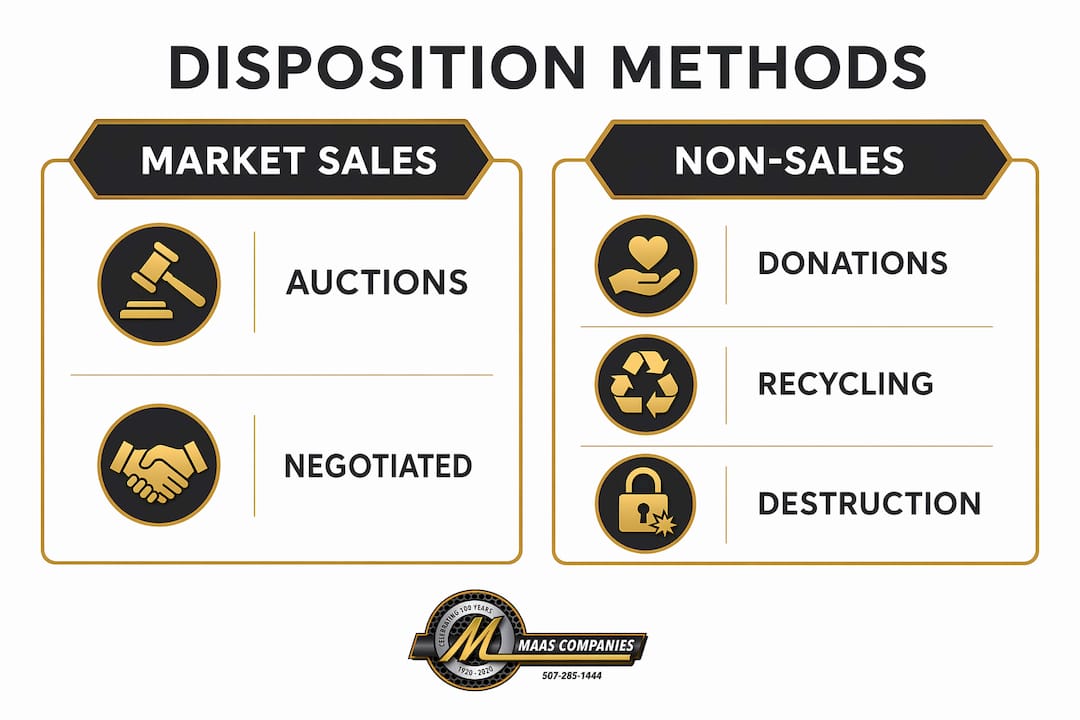
Competitive auctions are the most common method for assets with broad market appeal. Auctions create price discovery through competitive bidding, which is particularly effective when buyer demand is uncertain or when the seller wants to demonstrate market-clearing transparency. GSA Auctions® enables electronic bidding on federal surplus property, with standard terms requiring full payment before asset removal. That payment-before-removal requirement protects the seller from default risk and is a model worth adopting in private-sector auction contracts.
Bilateral or negotiated sales involve direct engagement with a pre-qualified buyer or a short list of candidates. This method is preferred when confidentiality matters, when the asset requires specialized knowledge to value, or when deal complexity demands bespoke terms. Negotiated sales allow the seller to structure representations, warranties, and indemnities in ways that a public auction cannot accommodate.
Donation and screening hierarchies apply primarily to government and nonprofit contexts. The federally mandated disposition hierarchy requires stepwise consideration: internal reuse, federal transfer, state agency donation, public sale, then disposal. This sequence governs federal surplus IT asset disposition and ensures reuse before destruction. Private organizations with sustainability mandates increasingly adopt analogous frameworks.
Recycling and destruction represent the terminal disposition route for assets with no recoverable market value, assets that pose environmental liability, or regulated items that cannot be transferred. This category carries cost rather than generating revenue, so it should be reached only after the prior methods have been genuinely exhausted.
Pro Tip: Before committing to any single method, conduct a rapid asset triage: segment your surplus inventory by condition, market demand, and regulatory constraint. Assets that qualify for multiple methods should be routed to the highest-value channel first, not the most convenient one.
How do you choose between auction and negotiated sale?
The choice between an auction and a bilateral negotiated sale is fundamentally a risk allocation decision, where auction functions as a price-discovery tool and bilateral negotiation functions as a problem-solving tool addressing confidentiality and deal complexity. Neither method is universally superior.
The table below summarizes the key decision variables:
| Factor | Auction | Bilateral negotiated sale |
|---|---|---|
| Price discovery | High: competitive bidding drives headline price | Moderate: price set through negotiation |
| Confidentiality | Low: public process, visible to competitors | High: terms and parties remain private |
| Deal complexity | Low: standardized terms, limited structuring | High: bespoke representations, warranties, and conditions |
| Closing certainty | Moderate: winning bidder may default | High: pre-qualified buyer, negotiated conditions |
| Timeline | Faster for standard assets | Longer for complex or regulated assets |
| Best fit | Broad-appeal assets, price-sensitive mandates | Specialized equipment, sensitive transactions |
Auctions tend to deliver higher headline prices, but bilateral sales may yield better net proceeds through lower leakage and higher closing certainty. Professional advisors favor a scenario analysis approach over headline valuations alone. That means modeling the expected net proceeds under each method after accounting for buyer default risk, re-marketing costs, and time value.
Asset condition and market depth also drive the decision. A piece of standard manufacturing equipment with 50 qualified buyers in the market is an auction candidate. A specialized chemical processing unit with three potential buyers globally is a negotiated sale candidate. Forcing the wrong method onto an asset profile produces suboptimal outcomes regardless of execution quality.
Pro Tip: For large or complex disposals, run a hybrid process: solicit preliminary indications of interest from a short list of qualified buyers before deciding whether to proceed with a formal auction or convert to exclusive bilateral negotiations. This preserves competitive tension while managing execution risk.
What are the operational steps to implement a disposition strategy?
Effective implementation of a surplus disposition strategy follows a defined sequence. Skipping steps or compressing timelines without adequate preparation is the most common cause of recovery shortfalls.
-
Internal asset review and classification. Catalog every surplus asset with condition ratings, original cost, book value, and estimated market value. Identify assets subject to regulatory constraints, environmental liability, or lien encumbrances before marketing begins.
-
Reuse and transfer screening. Evaluate whether any assets can be redeployed internally or transferred to affiliated entities. For government-regulated disposals, the disposition hierarchy mandates this step before any public offering.
-
Compliance and documentation preparation. Regulated assets require specific documentation before transfer. IT assets subject to federal rules must be sanitized to NIST 800-88 Rev. 2 standards with serialized certificates to ensure data security. Environmental assessments under NEPA may be required for real property disposals. Environmental and regulatory compliance, such as NEPA impact assessments and remediation, can affect timing and method of asset disposition. Build compliance timelines into your project schedule, not as an afterthought.
-
Marketing and buyer qualification. Select the disposition method based on the asset profile analysis from the prior section. Develop targeted marketing materials that reach qualified buyers through industry-specific channels. For equipment liquidation, this means reaching maintenance buyers, dealers, and end-users simultaneously rather than relying on a single channel.
-
Sale execution and chain of custody. Execute the transaction with documented transfer of title, payment confirmation, and physical removal protocols. Maintain a complete chain of custody record, particularly for IT assets and regulated equipment.
-
Post-disposition reporting and performance review. Record actual recovery against projected value, document timeline variances, and identify process improvements for the next disposal cycle.
Key performance metrics to track throughout the process include:
- Recovery rate: actual proceeds divided by estimated market value
- Days to close: from asset identification to payment receipt
- Compliance incidents: number of documentation deficiencies or regulatory findings
- Carrying cost per day: total holding costs divided by disposition timeline
Common pitfalls include delayed disposals caused by tenant relocation funding gaps, multi-agency interest conflicts, and incomplete documentation that stalls buyer due diligence. Federal property disposal delays often stem from tenant relocation funding gaps and multi-agency interest, complicating surplus disposition timelines. Private-sector organizations face analogous delays when internal approvals, legal reviews, or environmental clearances are not sequenced in advance.
What trends are shaping surplus disposition strategies in 2026?
Several converging factors are reshaping how organizations plan and execute surplus asset disposals this year.
-
Staffing and capacity constraints. A reduction in GSA staff by a third contributed to delays in surplus property sales, with fewer on-site inspections and extended lead times. This is a direct warning for any organization that relies on government-adjacent processes or that underestimates the operational labor required to execute a disposal program.
-
Online auction dominance. Over 90% of government property sales now occur via online auctions. This shift reduces transaction costs and expands buyer reach, but it also increases competition among sellers for buyer attention. Data-driven marketing, quality photography, and detailed condition reports are now baseline requirements, not differentiators.
-
Cybersecurity and data compliance requirements. The NIST 800-88 Rev. 2 framework for IT asset sanitization is increasingly enforced, and buyers of surplus IT equipment are demanding serialized destruction certificates as a condition of purchase. Organizations that cannot produce this documentation face either reduced buyer pools or liability exposure.
-
Sustainability and environmental remediation. Reuse and recycling requirements are expanding beyond IT assets into industrial equipment and real property. Environmental remediation obligations can materially affect net recovery on real estate disposals and must be quantified before marketing begins.
-
Data-driven sale strategy. Asset managers are applying market analytics to disposition timing, using equipment age curves, commodity price trends, and buyer demand signals to select optimal sale windows. This approach treats surplus assets management as a capital markets exercise rather than a facilities management task.
Key takeaways
A surplus disposition strategy that integrates compliance, marketing, and deal structure selection consistently produces higher net recovery than reactive or single-method approaches.
| Point | Details |
|---|---|
| Method selection drives recovery | Choose between auction and negotiated sale based on asset profile, buyer depth, and confidentiality requirements. |
| Compliance is non-negotiable | IT assets require NIST 800-88 Rev. 2 sanitization; real property may require NEPA review before any public offering. |
| Sequence matters | Follow the reuse-transfer-screen-sell hierarchy to satisfy regulatory requirements and maximize value at each stage. |
| Operational capacity determines timelines | Staffing shortfalls and documentation gaps are the leading causes of disposition delays and recovery shortfalls. |
| Online auctions are now the standard | Over 90% of government surplus sales occur online; private-sector disposals are following the same trajectory. |
What experienced advisors know that theory misses
After working through dozens of surplus disposal engagements across industrial, government, and commercial sectors, the pattern that stands out most is this: organizations consistently underestimate the preparation phase and overestimate the marketing phase. They spend weeks debating auction platforms and reserve prices while the asset catalog remains incomplete, compliance documentation is missing, and buyer qualification criteria have not been defined.
The second recurring issue is treating auction and negotiated sale as mutually exclusive. The most effective surplus equipment disposals I have observed use a phased approach: negotiate with the highest-probability buyers first, and only convert to a public auction if those conversations do not produce acceptable terms within a defined window. This preserves optionality without sacrificing timeline discipline.
Finally, the organizations that achieve the best recovery rates are those that treat disposition as a recurring program, not a one-time event. They maintain asset registers, track market conditions, and build vendor relationships before a disposal is triggered. When the trigger event arrives, whether it is a plant closure, a lender enforcement, or a portfolio rationalization, they execute in weeks rather than months.
— Vector
How Maascompanies supports effective surplus disposition execution

Maascompanies brings decades of experience executing surplus asset disposals across industrial plants, manufacturing equipment, real estate, and commercial properties on an international scale. The firm’s service portfolio covers both competitive auction programs and orderly negotiated sales, giving clients the flexibility to select the method that fits their asset profile and recovery objectives. Maascompanies applies targeted marketing to reach qualified buyers through industry-specific channels, maximizing competitive tension and net proceeds. If you are managing a plant closure, excess inventory reduction, or capital recovery mandate, explore current projects and sell industrial equipment through a team that treats recovery as a measurable outcome, not a best-effort exercise.
FAQ
What is a surplus disposition strategy?
A surplus disposition strategy is a structured plan for liquidating surplus assets through a sequenced process that maximizes recovery value, satisfies regulatory requirements, and minimizes carrying costs. It encompasses method selection, compliance preparation, marketing, and sale execution.
When should you use an auction vs. a negotiated sale?
Use an auction when the asset has broad market appeal and price discovery is the priority. Use a negotiated sale when confidentiality, deal complexity, or a limited buyer pool makes a public process impractical or value-destructive.
What compliance requirements apply to surplus IT asset disposition?
Federal IT asset disposition requires sanitization to NIST 800-88 Rev. 2 standards with serialized destruction certificates and a documented chain of custody. These requirements apply to federal agencies and contractors handling government data.
What causes delays in surplus property disposals?
The most common causes are incomplete documentation, tenant relocation funding gaps, multi-agency interest conflicts, and insufficient operational staffing to conduct inspections and process transfers on schedule.
How do online auctions affect surplus asset recovery?
Online auctions expand buyer reach and reduce transaction costs, with over 90% of government surplus sales now conducted through digital platforms. Effective use requires quality asset documentation, targeted marketing, and clear payment and removal terms.
Recommended
- Surplus equipment sale guide: maximize asset recovery fast | Blog | Insights on Asset Liquidation and Auction Trends
- How Auctions Help Speed Up Industrial Asset Disposition | Blog | Insights on Asset Liquidation and Auction Trends
- How Auctions Help Speed Up Industrial Asset Disposition | Blog | Insights on Asset Liquidation and Auction Trends
- Liquidation sales explained: Maximize asset recovery | Blog | Insights on Asset Liquidation and Auction Trends