
Blog
The Role of Marketing in Liquidation: Maximize Recovery

TL;DR:
- Effective marketing transforms distressed assets into maximum cash recovery through targeted outreach and competitive bidding. Prioritizing early, multi-channel campaigns enhances buyer pools, increases recovery, and shortens timelines, while operational alignment ensures credibility. Underestimating marketing’s strategic importance risks undervaluation, extended costs, and lost opportunity in liquidation processes.
The role of marketing in liquidation is to convert distressed or surplus assets into maximum cash recovery through structured audience targeting, competitive pricing, and multi-channel exposure. Liquidation marketing is not a synonym for discounting. It is a defined process that determines gross recovery percentage, time-to-cash, inventory coverage, and dispute rates. Organizations that treat marketing as an afterthought in liquidation consistently leave value on the table. Those that deploy it as a core operational discipline, as Maascompanies and leading asset recovery specialists do, achieve materially better outcomes across every performance metric.
How does marketing influence orderly liquidation value?
Orderly liquidation value (OLV) is defined as the estimated amount recoverable from an asset sale conducted over a reasonable marketing period, typically 3 to 9 months, with active buyer outreach and competitive bidding. This definition is not incidental. The marketing period is embedded in the OLV assumption itself, meaning that the marketing timeline and effort are fundamental variables in any credible appraisal, not optional enhancements.
The contrast with forced liquidation is stark. A forced sale compresses the marketing window, shrinks the buyer pool, and eliminates competitive tension. The result is a lower clearing price, often significantly below what a structured marketing campaign would achieve. Forklifts and common industrial equipment can reach full OLV within 60 to 90 days when marketed actively. Specialized process equipment, by contrast, may require 6 to 9 months of marketing to attract the narrow buyer pool capable of paying full value.
A well-executed marketing campaign can increase returns by 45% over immediate bulk sales, with platform fees of 5 to 15% typically recovered through competitive bidding. That figure reflects what happens when two to three competing offers are generated through multi-channel marketing over a 4 to 12 week period. The implication for corporate decision-makers is direct: compressing the marketing timeline to accelerate cash does not save money. It destroys value.
“Liquidity timelines and competitive buyer pools achieved through early marketing preparation are critical levers for maximizing creditor recoveries in insolvency liquidations.” — Bankrupt Stock UK: Maximise Returns
Marketing also carries legal weight. Under frameworks such as the Insolvency Rules 2016, marketing channels must include industry publications, online auctions, specialist brokers, and public listings to satisfy the “best price reasonably obtainable” standard. Documentation of the marketing exercise is mandatory in connected-party transactions and formal valuations. Marketing is not just a commercial strategy. In regulated liquidation contexts, it is a compliance requirement.
| Asset Type | Typical OLV Marketing Period | Key Channel |
|---|---|---|
| Common forklifts and material handling | 60 to 90 days | Online auction platforms |
| General manufacturing equipment | 3 to 6 months | Trade publications and brokers |
| Specialized process equipment | 6 to 9 months | Targeted industry outreach |
| Intellectual property and intangibles | Variable, often 3 to 12 months | Specialist brokers and curated platforms |
What marketing strategies maximize recovery during liquidation?
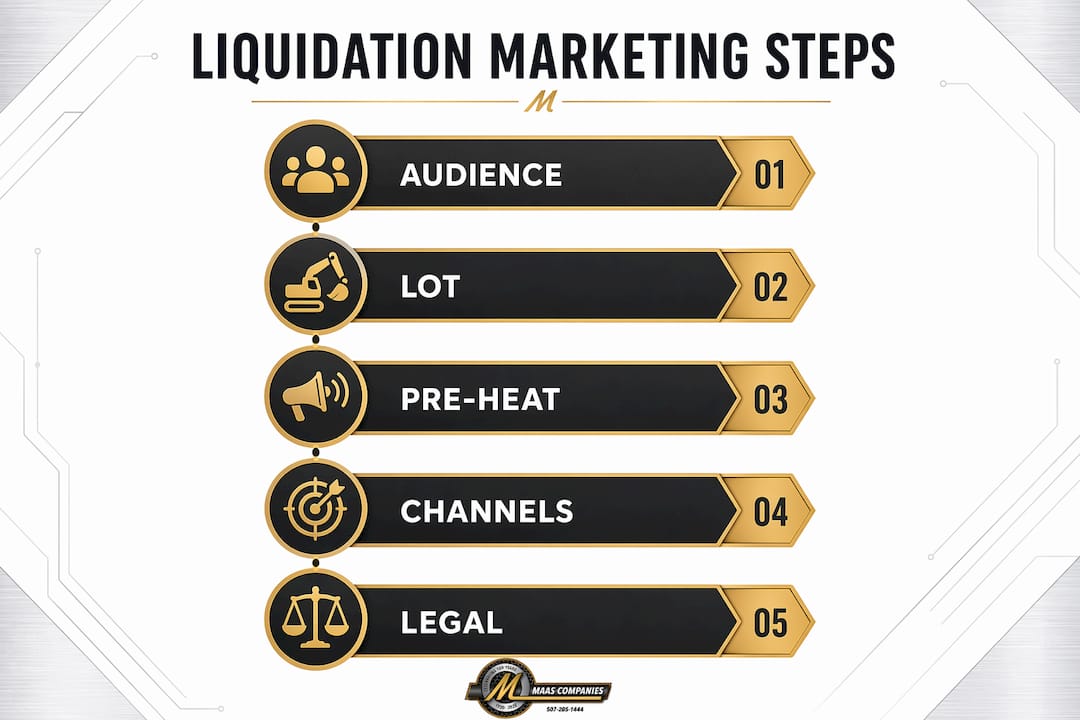
Effective liquidation marketing tactics begin with audience segmentation. Resellers, jobbers, exporters, and direct end-users each respond to different pricing signals, lot structures, and messaging. A reseller evaluating a mixed pallet of industrial components applies a different margin model than an end-user buying a specific machine for production. Treating these audiences identically produces suboptimal results for both.

Lot construction is a direct determinant of recovery. Homogenous lots, groupings of similar equipment or inventory by type, grade, and application, attract specialist buyers who can pay more because they understand the asset. Mixed lots serve buyers seeking volume at a discount. Both have a place in a structured liquidation, but the decision must be deliberate and tied to the buyer segment being targeted. Accurate grading using recognized schemes such as New, Grade A through C, and Salvage, supported by representative photographs and serial number coverage, reduces disputes and improves auction competitiveness and repeat buyer trust.
Pricing strategy matters as much as channel selection. Dutch auctions with a transparent price-reduction cadence create urgency without signaling desperation. Buyers who understand the schedule act earlier to secure preferred lots. This approach generates competitive tension even in thin markets, where the buyer pool is narrow and traditional bidding wars are unlikely.
Channel selection should follow a tiered logic:
- Owned channels first: Email lists of pre-qualified buyers, direct outreach to known industry contacts, and proprietary databases generate the highest-quality leads at the lowest cost.
- Paid and third-party channels second: Industry-specific platforms, trade publications, and geo-fenced digital advertising extend reach to buyers outside the existing network.
- Broad marketplace exposure third: General auction platforms and public listings maximize coverage but attract lower-margin buyers and require stronger lot presentation to compete.
The event calendar and preheat marketing period are often underestimated. Releasing detailed lot manifests, condition reports, and inspection schedules 10 to 21 days before an auction closing date allows serious buyers to conduct due diligence, arrange financing, and coordinate logistics. Staged fulfillment planning, communicated in advance, removes a common barrier to participation for buyers managing complex removal operations.
Pro Tip: Release lot manifests and inspection windows at least two weeks before auction close. Buyers who complete due diligence early bid more aggressively because they have eliminated their uncertainty premium.
How do targeted channels and buyer relationships enhance outcomes?
In thin markets for unconventional assets, trustees and asset managers increasingly rely on curated platforms and targeted outreach over traditional broad auctions to improve sale speed and price. The logic is straightforward: a buyer pool of 200 highly qualified specialists will generate better pricing than a pool of 20,000 general bidders who lack the technical knowledge or operational need to pay full value.
Pre-approved buyer networks are a structural advantage. Organizations that maintain vetted lists of qualified buyers, segmented by asset type, geography, and purchasing capacity, can launch campaigns within days of instruction rather than weeks. Building a buyer list from scratch under time pressure consistently reduces yield. The pre-built network is not a convenience. It is a recovery multiplier.
The following sequence describes how a structured multi-channel marketing approach should be deployed:
- Identify and segment the buyer universe by asset type, industry application, geographic reach, and purchasing history.
- Activate owned channels with personalized outreach to pre-qualified buyers, including detailed asset descriptions and inspection access.
- Deploy paid industry channels including trade publications, specialized auction platforms, and targeted digital advertising with demographic and industry filters.
- Execute geo-fenced campaigns for assets with regional buyer pools, such as real estate or location-specific equipment, to concentrate exposure where it generates the highest conversion.
- Monitor leading indicators including lot-page views, email open rates, and inspection registrations to identify underperforming lots and adjust messaging or pricing before the sale closes.
- Manage simultaneous multi-channel exposure carefully to avoid channel conflicts that could alert competitors or undermine partner relationships.
Marketing also functions as a speed advantage. Compressing the time from asset identification to qualified buyer engagement reduces carrying costs, which include storage, insurance, security, and administrative overhead, and limits litigation exposure in time-pressured insolvency cases. For corporate leaders managing a plant closure or restructuring, every week of carrying cost avoided is direct recovery improvement. The impact of marketing on liquidation sales is therefore measurable not only in final sale price but in cost avoidance throughout the disposition timeline.
What are common pitfalls in liquidation marketing?
The most damaging error in liquidation marketing is the “fire sale” approach. Broad, undifferentiated advertising that signals distress attracts opportunistic buyers at the expense of value-oriented ones. It also damages brand equity with existing channel partners, distributors, and customers who may interpret the messaging as a signal of broader organizational instability. Poorly planned liquidation marketing creates channel conflicts that undermine core business relationships and reduce long-term trust.
Operational disconnects between marketing, grading, logistics, and documentation are a second major risk. When lot descriptions in marketing materials do not match physical condition reports, disputes increase, sales slow, and buyer confidence erodes. Marketing content must align with operational reality. Accurate cataloging, honest grading, and confirmed staging timelines are not back-office functions. They are direct inputs to marketing credibility and, by extension, recovery performance.
Key operational risks to monitor include:
- Inaccurate condition reporting: Overstating asset condition generates disputes, chargebacks, and reputational damage with repeat buyers.
- Insufficient buyer pool development: Launching a sale without a pre-qualified audience forces reliance on broad, low-margin channels.
- Premature pricing decisions: Setting reserve prices before completing market research and buyer outreach limits competitive tension.
- Inadequate documentation: Missing chain-of-control records, title documents, or maintenance histories reduce buyer confidence and achievable price.
- Misaligned timelines: Marketing campaigns that launch before assets are staged, photographed, and accessible for inspection waste buyer attention and reduce conversion rates.
Pro Tip: Treat grading and cataloging as marketing functions, not logistics functions. The quality of your asset descriptions directly determines the quality of your buyer pool.
Insufficient marketing planning is the root cause of most forced-sale outcomes. When organizations delay marketing decisions or underinvest in buyer outreach, they compress their own timeline and replicate the conditions of a forced liquidation even when one is not legally required. Data-driven decision-making, tracking lot-page views, email open rates, and inspection registrations as leading indicators, allows teams to identify and correct underperformance before the sale window closes.
Key takeaways
Marketing is the primary determinant of gross recovery percentage in liquidation, and organizations that deploy it as a structured discipline consistently outperform those that treat it as a secondary consideration.
| Point | Details |
|---|---|
| OLV depends on marketing effort | Active marketing over 3 to 9 months is embedded in orderly liquidation value assumptions, not optional. |
| Early decisions define outcomes | Marketing decisions made within the first 48 hours post-appointment shape the entire recovery profile. |
| Channel selection drives buyer quality | Pre-approved buyer networks and tiered channel deployment produce higher-value bidders than broad marketplace exposure alone. |
| Operational alignment is non-negotiable | Accurate grading, cataloging, and staging are direct inputs to marketing credibility and recovery performance. |
| Fire sale tactics destroy value | Undifferentiated distress advertising reduces recovery and damages brand equity with channel partners. |
Why marketing is the most underestimated lever in liquidation
Having worked through hundreds of industrial and commercial asset dispositions, the pattern is consistent: organizations that engage marketing strategy early recover more, spend less on carrying costs, and close with fewer disputes. The ones that treat marketing as a final step, something to execute after all the operational decisions are made, consistently underperform.
The importance of marketing in liquidations is not a soft claim. It is embedded in how OLV is calculated, how legal compliance is demonstrated, and how buyer competition is generated. When a corporate leader asks what marketing has to do with asset recovery, the answer is: everything. The buyer pool, the competitive tension, the clearing price, and the timeline are all direct outputs of marketing quality.
What I find most underappreciated is the compounding effect of pre-built buyer relationships. Organizations and advisors who maintain curated, segmented buyer networks do not just perform better on individual transactions. They perform better on every subsequent transaction because trust, track record, and repeat participation raise the quality of every future buyer pool. That is a structural advantage that no single-event marketing campaign can replicate.
The discipline of tracking leading indicators, lot views, open rates, inspection registrations, and adjusting in real time is also underused. Most teams wait for final sale results to evaluate performance. By then, the window is closed. Iterative adjustment during the marketing period is where the real recovery gains are captured.
— Vector
How Maascompanies drives recovery through strategic marketing
Maascompanies brings decades of experience marketing and selling industrial plants, manufacturing equipment, real estate, and commercial properties across international markets. The firm deploys tailored, multi-channel marketing programs that combine pre-qualified buyer networks, targeted industry outreach, and precise asset cataloging to generate competitive bidding and maximize gross recovery. Every engagement is supported by operational coordination from initial asset assessment through final fulfillment, ensuring that marketing materials reflect physical reality and that buyer expectations are met at every stage.
For corporate leaders managing a plant closure, restructuring, or surplus asset disposition, Maascompanies offers a structured path from asset identification to cash recovery. Explore an active example of this approach in the Feed Pelletizer System auction or review the Clayton Industries orderly sale to see how strategic marketing translates into documented recovery outcomes. Contact Maascompanies to discuss your specific disposition requirements.
FAQ
What is the role of marketing in liquidation?
Marketing in liquidation is the structured process of targeting qualified buyers, building competitive tension, and managing pricing and channel exposure to maximize gross recovery from distressed or surplus assets. It directly determines recovery percentage, time-to-cash, and dispute rates.
How does marketing affect orderly liquidation value?
Orderly liquidation value assumes an active marketing period of 3 to 9 months with multi-channel buyer outreach. Compressing or eliminating this period reduces the buyer pool and lowers the clearing price, effectively converting an orderly liquidation into a forced sale.
What marketing channels work best for industrial asset liquidation?
Pre-approved buyer networks, trade publications, specialized auction platforms, and geo-fenced digital advertising are the most effective channels for industrial assets. Broad marketplace exposure is a secondary layer, not a primary strategy, for assets with specialized buyer pools.
How early should marketing begin in a liquidation process?
Marketing decisions made within the first 48 hours post-appointment shape the overall recovery profile. Pre-built buyer lists and pre-approved marketing plans are critical. Building these from scratch under time pressure consistently reduces final yield.
Can marketing reduce carrying costs in liquidation?
Yes. Targeted marketing compresses the time from asset identification to qualified buyer engagement, directly reducing storage, insurance, security, and administrative carrying costs throughout the disposition timeline.
Recommended
- Liquidation sales explained: Maximize asset recovery | Blog | Insights on Asset Liquidation and Auction Trends
- How Industrial Plant Liquidation Maximizes Recovery Value for Lenders | Blog | Insights on Asset Liquidation and Auction Trends
- Plant liquidation strategies: maximize recovery in 2026 | Blog | Insights on Asset Liquidation and Auction Trends
- Equipment liquidation explained: maximizing asset recovery | Blog | Insights on Asset Liquidation and Auction Trends