

Blog
What Is a High-Recovery Sale? A 2026 Executive Guide

TL;DR:
- A high-recovery sale is a structured process to maximize the value recovered from distressed assets. It relies on accurate metrics like recovery rate, which is calculated after deducting all costs and comparing net sale price to original retail value. Operational discipline and real-time data are key to consistently achieving high recovery rates and superior asset disposition outcomes.
A high-recovery sale is defined as the deliberate, data-driven process of recapturing the maximum possible percentage of original retail value from distressed, surplus, or end-of-life assets. The governing metric is the recovery rate, which functions as the primary KPI in reverse logistics and liquidation operations. The reverse logistics market reached USD 982.65 billion in 2025 and is growing at a 17.65% compound annual growth rate through 2034. That scale reflects how central asset recovery has become to corporate financial planning. For financial decision-makers and corporate leaders, understanding what a high-recovery sale entails is the first step toward converting idle or distressed assets into measurable capital.
What is the recovery rate and why does it drive high-recovery sales?
Recovery rate is the single most important metric in any high-recovery sale operation. The recovery rate formula is calculated as (Net Sale Price / Original Retail Value) x 100%. Net sale price accounts for all processing, transportation, and storage costs before the calculation runs. That distinction matters because gross sale figures routinely overstate actual performance.
Many organizations rely on informal benchmarking, comparing their results against industry averages without accounting for asset category, condition, or channel mix. This practice masks real inefficiencies and prevents leaders from identifying where margin is actually lost. Recovery rate must also be read alongside sell-through rate. High recovery on low volume often underperforms slightly lower recovery achieved at high volume. Both metrics together give a complete picture of liquidation health.
Detailed inventory manifests and item-level data are the foundation of accurate recovery measurement. Without verified, granular asset data, pricing decisions rest on estimates rather than facts, and buyer confidence erodes quickly.
- Recovery rate: (Net Sale Price / Original Retail Value) x 100%
- Net sale price: Gross proceeds minus processing, logistics, and storage costs
- Sell-through rate: Percentage of listed inventory that actually sells within a defined period
- Quote-to-close ratio: Measures how efficiently buyer inquiries convert to completed transactions
- Manifest accuracy: Item-level data quality that directly affects pricing power and buyer trust
Pro Tip: Run recovery rate calculations by asset category, not just in aggregate. A blended rate hides which product lines or equipment types are dragging overall performance.
How does a high-recovery sale differ from high-ticket sales?
The two concepts are frequently confused, and the confusion carries real operational consequences. High-ticket sales focus on consultative, relationship-driven transactions for high-value products or services, typically in B2B or premium B2C contexts. The sales cycle is long, the buyer qualification process is intensive, and the goal is closing a single high-value deal through trust-building over time.

A high-recovery sale operates on entirely different logic. The objective is not to cultivate a long-term buyer relationship. The objective is to recapture residual value from assets that are already depreciating. Speed, transparency, and asset condition drive outcomes. Success depends on transparency and rapid processing rather than consultative lead qualification.
| Dimension | High-recovery sale | High-ticket sale |
|---|---|---|
| Primary objective | Maximize residual asset value | Close a high-value new transaction |
| Sales cycle | Short to medium, urgency-driven | Long, relationship-driven |
| Buyer focus | Broad buyer pool, competitive bidding | Narrow, qualified prospect list |
| Key success factor | Asset condition, pricing accuracy, speed | Trust, consultative expertise |
| Outcome metric | Recovery rate, sell-through rate | Revenue per deal, close rate |
Corporate leaders managing plant closures, restructuring events, or excess inventory need to apply high-recovery sale logic, not high-ticket sales methodology. Applying the wrong framework to distressed asset disposition produces predictable underperformance.
What are the key strategies for conducting high-recovery sales?
Operational discipline separates organizations that consistently achieve strong recovery rates from those that leave significant value unrealized. Four factors interact to drive margin: speed to market, buyer pool depth, pricing accuracy, and manifest quality. Weakness in any one of these areas compounds across the others.
Asset grading with the ABC framework
The ABC grading framework classifies assets into three tiers before any sale activity begins. Grade A assets are like new, with full functionality and minimal wear. Grade B assets are functional with minor cosmetic or operational issues. Grade C assets are suitable for parts or salvage only. Tiered pricing based on grading consistently outperforms undifferentiated lot sales because buyers pay a premium when condition is verified and clearly communicated. Mixing grades into a single lot forces buyers to price for the worst item in the group.
Dynamic pricing and market responsiveness
Static pricing is one of the most common causes of margin erosion in liquidation. The dynamic pricing software market reached $3.49 billion in 2025 and is projected to reach $6.9 billion by 2030. That growth reflects how widely organizations now recognize that pricing must respond to buyer inquiry volume, seasonal demand, and inventory aging. Premium lots priced dynamically capture more margin. Slow-moving inventory repriced proactively avoids deep discounting later.
Buyer network segmentation
A deep, segmented buyer network is a structural advantage in high-recovery sales. Broad outreach to undifferentiated lists produces lower competitive pressure and weaker bids. Segmenting buyers by asset type, industry, and purchasing history allows targeted outreach that generates genuine competition. Competitive bidding is the mechanism that drives recovery rates toward their ceiling.
Pro Tip: List assets within 48–72 hours of intake whenever possible. Depreciation accelerates with time, and buyer interest peaks early in the listing cycle.
The following steps represent the core operational sequence for a high-recovery sale:
- Complete a verified inventory manifest with item-level condition data before any pricing or listing activity.
- Apply ABC grading to every asset category and document findings with photographs and specifications.
- Set tiered pricing based on grade, market comparables, and current buyer inquiry data.
- Activate segmented buyer outreach targeting buyers with demonstrated interest in the specific asset type.
- List assets rapidly across relevant channels, including auctions, direct sales, and industry-specific marketplaces.
- Monitor inquiry volume daily and adjust pricing based on demand signals and inventory aging.
- Close transactions with full documentation to maintain chain of control and support post-sale reporting.
How do you measure performance in high-recovery sales operations?
Sustained high recovery rates require real-time visibility into operational performance. Real-time dashboards tracking recovery rate, days-to-sale, sell-through rate, and quote-to-close ratio give operations teams the data needed for proactive repricing and margin control. Waiting for end-of-period reports means decisions always lag behind market conditions.
Channel performance analysis is equally critical. Auctions, direct negotiated sales, and industry marketplaces each produce different recovery profiles depending on asset type and buyer urgency. Leaders who analyze channel performance by asset category can allocate inventory to the channel most likely to maximize return, rather than defaulting to a single method for all assets.
Manifest accuracy has a direct and measurable effect on buyer confidence and pricing power. Buyers who receive inaccurate or incomplete manifests discount their bids to account for uncertainty. Accurate manifest counts and timely repricing are the two operational levers most directly tied to preventing capital loss.
- Recovery rate by category: Identifies which asset types are underperforming and where pricing adjustments are needed
- Days to sale: Measures how quickly inventory converts to cash and signals whether carrying costs are accumulating
- Sell-through rate: Tracks what percentage of listed inventory sells, revealing channel effectiveness
- Quote-to-close ratio: Exposes gaps between buyer interest and completed transactions, pointing to pricing or qualification issues
- Inventory aging report: Flags assets approaching the point where value deterioration accelerates
Practical steps for leaders implementing high-recovery sales
Translating high-recovery sale strategy into execution requires a formal plan tied to specific corporate events. Plant closures, corporate restructuring, and excess inventory accumulation each create distinct timelines and asset profiles. Leaders who treat asset disposition as an afterthought consistently recover less than those who plan it as a structured program. When business bankruptcy restructuring is involved, recovery planning must begin at the earliest stage of the process to preserve asset value.
- Define a formal recovery plan with clear scope, timeline, and accountability before any assets are moved or listed.
- Set measurable KPI targets for recovery rate and sell-through rate by asset category, not just in aggregate.
- Audit your buyer network and identify gaps by asset type. Expand outreach to buyers with verified purchasing history in relevant categories.
- Implement pricing intelligence tools that track market demand, comparable sales, and inventory aging in real time.
- Establish manifest quality standards and assign responsibility for data accuracy before listing begins.
- Plan for rapid inventory turnover by setting repricing triggers at defined intervals, such as 14 days and 30 days post-listing.
- Review market conditions quarterly and adjust channel strategy based on economic shifts, supply chain volatility, and buyer demand patterns.
Sales recovery planning requires proactive strategies built on real-time data and flexible plan adjustment, particularly in periods of economic uncertainty. That principle applies directly to asset liquidation: the plan must be built to adapt, not just to execute.
Pro Tip: Align your internal operations, finance, and legal teams on the recovery plan before engaging any buyers. Misalignment on asset ownership, encumbrances, or valuation creates delays that cost real money.
Understanding the distinction between an asset sale and a stock sale also affects how recovery is structured and what liabilities transfer with the assets. Corporate leaders should resolve this question at the planning stage, not mid-transaction.
Key Takeaways
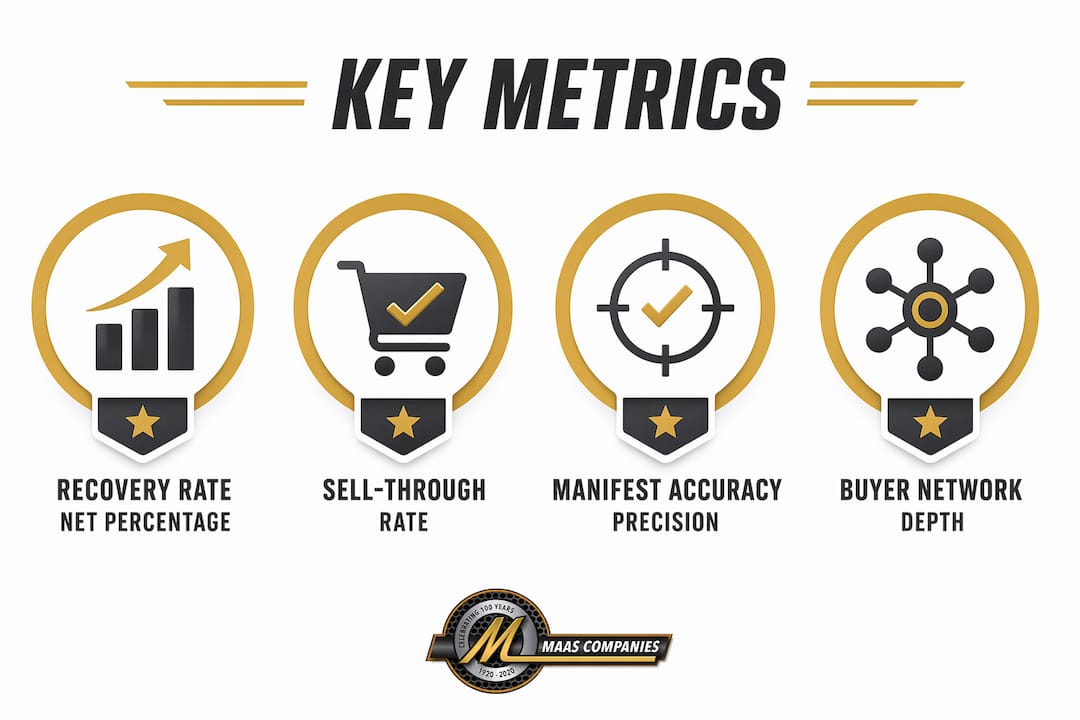
A high-recovery sale succeeds when recovery rate, sell-through rate, manifest accuracy, and buyer network depth are managed together as an integrated system rather than as separate tasks.
| Point | Details |
|---|---|
| Recovery rate is the core KPI | Calculate it as net sale price divided by original retail value, after deducting all costs. |
| ABC grading drives tiered pricing | Grading assets by condition before listing prevents buyers from discounting for uncertainty. |
| Speed to market preserves value | List assets within 48–72 hours of intake to capture peak buyer interest and reduce carrying costs. |
| Real-time dashboards enable proactive control | Tracking days-to-sale and sell-through rate by category allows repricing before margin erodes. |
| Formal planning outperforms reactive disposition | A structured recovery plan tied to corporate events consistently produces higher recovery rates. |
Why operational discipline is the real differentiator in asset recovery
The most common mistake I see in distressed asset disposition is treating it as a logistics problem rather than a financial one. Organizations focus on moving inventory out the door and measure success by how quickly the warehouse clears. Recovery rate is an afterthought, if it is tracked at all.
The organizations that consistently achieve strong recovery rates share one characteristic: they treat liquidation as a structured process with defined inputs, measurable outputs, and real-time feedback loops. They grade every asset before pricing. They build buyer networks before they need them. They reprice based on data, not instinct.
Market conditions in 2026 make this discipline more valuable, not less. Supply chain volatility, shifting industrial demand, and compressed corporate timelines all increase the cost of getting asset disposition wrong. The organizations that have invested in manifest quality, buyer segmentation, and dynamic pricing are positioned to recover significantly more than those still relying on informal benchmarking and bulk lot sales.
The competitive advantage in high-recovery sales is not a secret. It is operational discipline, applied consistently, supported by verified data, and executed with urgency. That combination is harder to replicate than any single tactic or tool.
— Vector
Maascompanies: a structured approach to maximum asset recovery
Maascompanies brings decades of experience in marketing industrial plants, equipment, real estate, and commercial properties to clients who need more than a transaction. The firm operates as a strategic asset recovery partner, applying condition-based grading, segmented buyer outreach, and structured sale formats to every engagement.

For corporate leaders managing plant closures, restructuring, or surplus equipment, Maascompanies designs recovery programs built around your specific asset profile and timeline. The firm’s orderly negotiated sale process illustrates how structured disposition, combined with an aggressive marketing plan and deep industry buyer networks, produces recovery outcomes that informal or reactive approaches cannot match. Contact Maascompanies to discuss a tailored recovery plan for your assets.
FAQ
What is a high-recovery sale in asset liquidation?
A high-recovery sale is the structured process of recapturing the maximum percentage of original retail value from distressed, surplus, or end-of-life assets. Recovery rate, calculated as net sale price divided by original retail value, is the primary performance metric.
How is recovery rate calculated?
Recovery rate equals (Net Sale Price / Original Retail Value) x 100%, where net sale price is gross proceeds minus all processing, transportation, and storage costs.
What is the ABC grading framework in liquidation?
The ABC framework classifies assets as Grade A (like new), Grade B (functional with minor issues), or Grade C (parts or salvage only). Tiered pricing based on these grades consistently produces higher total recovery than undifferentiated lot sales.
How does a high-recovery sale differ from a high-ticket sale?
High-ticket sales focus on consultative, long-cycle transactions for high-value products. High-recovery sales focus on speed, asset condition, and market transparency to recapture residual value from existing assets.
What metrics should leaders track in a high-recovery sale program?
Leaders should track recovery rate by category, days to sale, sell-through rate, quote-to-close ratio, and inventory aging. Real-time dashboards combining these metrics enable proactive repricing and prevent margin erosion.
Recommended
- Why assets go to auction: High-recovery strategies explained | Blog | Insights on Asset Liquidation and Auction Trends
- Strategic auctioneers: Maximizing asset recovery in sales | Blog | Insights on Asset Liquidation and Auction Trends
- Liquidation sales explained: Maximize asset recovery | Blog | Insights on Asset Liquidation and Auction Trends
- Asset Sale Benefits 2026: A Strategic Guide for Sellers | Blog | Insights on Asset Liquidation and Auction Trends