
Blog
Strategic auctioneers: Maximizing asset recovery in sales

TL;DR:
- Auctioneers play a crucial role as project managers, market analysts, and sales strategists, not just bid announcers.
- Choosing the appropriate auction format and thorough pre-sale preparation significantly impact recovery rates and sale speed.
- Effective auction processes depend on market knowledge, extensive buyer networks, and strategic timing rather than just format selection.
Many executives assume the auctioneer’s role begins and ends at the podium, taking bids and announcing a winner. That assumption is costly. In distressed industrial asset sales, the auctioneer’s strategic decisions, from auction structure and bidder recruitment to reserve pricing and market timing, directly determine how much capital you recover and how quickly. Understanding the full scope of an auctioneer’s responsibilities is not just useful background knowledge; it is essential preparation for any private equity firm or industrial company facing asset disposition under time pressure or financial stress.
Table of Contents
- Core responsibilities of the auctioneer
- Auction methodologies: Choosing the right type
- Auction vs. private sale: Recovery, speed, and transparency
- Critical nuances: Maximizing recovery and avoiding pitfalls
- Industry wisdom: What most auction guides miss
- Connect with recovery-focused auctioneering experts
- Frequently asked questions
Key Takeaways
| Point | Details |
|---|---|
| Auctioneer drives recovery | The auctioneer’s strategy, preparation, and bidder management are critical for maximizing asset value in distressed sales. |
| Auction type matters | Choosing between absolute, reserve, and stalking horse auctions impacts bidding, recovery, and sale outcomes. |
| Transparency and speed | Auctions enable swift, transparent asset disposition but often require trade-offs on price versus private sales. |
| Avoid common pitfalls | Poor asset preparation, wrong auction format, or lack of reserve protection can erode potential recovery. |
| Executive action | Selecting the right auctioneer and approach—and understanding market timing—offers the best path to high-value liquidation. |
Core responsibilities of the auctioneer
Having challenged traditional views, let’s define the auctioneer’s true scope of work. An auctioneer operating at the level required by industrial asset liquidation is far more than an event host. They function as a project manager, market analyst, legal compliance officer, and sales strategist rolled into a single engagement.
The scope begins well before auction day. A qualified auctioneer evaluates the asset portfolio, determines the optimal auction structure, and develops a targeted marketing plan designed to reach serious industrial buyers. This preparation phase shapes every outcome that follows, because the number and quality of bidders attending directly controls competitive pressure and, by extension, recovery rates.
Key responsibilities include:
- Auction design and format selection: Deciding whether to run an absolute auction, a reserve auction, a timed online format, or a hybrid event based on asset type, market conditions, and seller goals.
- Lot structuring: Organizing assets into individual lots, grouped lots, or bulk packages to maximize bidder participation and competition at each price point. Thoughtful auction lot strategies can meaningfully increase total recovery.
- Bidder qualification and registration: Screening potential buyers to ensure financial capacity and legitimate intent, which reduces the risk of failed transactions post-sale.
- Pre-sale preparation coordination: Overseeing asset inspection access, documentation preparation, environmental disclosure management, and condition reporting so bidders arrive informed and confident.
- Stakeholder communication: Maintaining consistent, transparent updates with sellers, legal counsel, creditors, and in bankruptcy cases, the court or trustee, throughout the entire process.
- Legal compliance: Ensuring all sale terms, buyer premiums, disclosure requirements, and transfer protocols meet applicable regulatory standards.
Pro Tip: Require any auctioneer you evaluate to walk you through their pre-sale preparation checklist. An experienced firm can describe exactly how they qualify bidders, stage assets, and handle documentation. Vague answers at this stage are a reliable indicator of weak execution later.
The auctioneer’s communication role is often underestimated. In distressed situations, where creditors, equity holders, and management teams all have conflicting priorities, a skilled auctioneer keeps all parties aligned around a realistic timeline and a transparent process. That alignment reduces legal friction and prevents last-minute disruptions that can derail sale proceedings entirely.
Auction methodologies: Choosing the right type
Understanding the auctioneer’s responsibilities, it’s crucial to explore the tools they use for asset disposition. Not every auction format serves every situation, and selecting the wrong methodology can erode value significantly even when asset quality is strong.
Key auction methodologies include absolute auctions where no reserve is set and the asset sells to the highest bidder, reserve auctions where the seller retains the right to reject the high bid, online and hybrid live formats, stalking horse bids commonly used in bankruptcy sales, and timed online auctions particularly suited to industrial equipment portfolios.
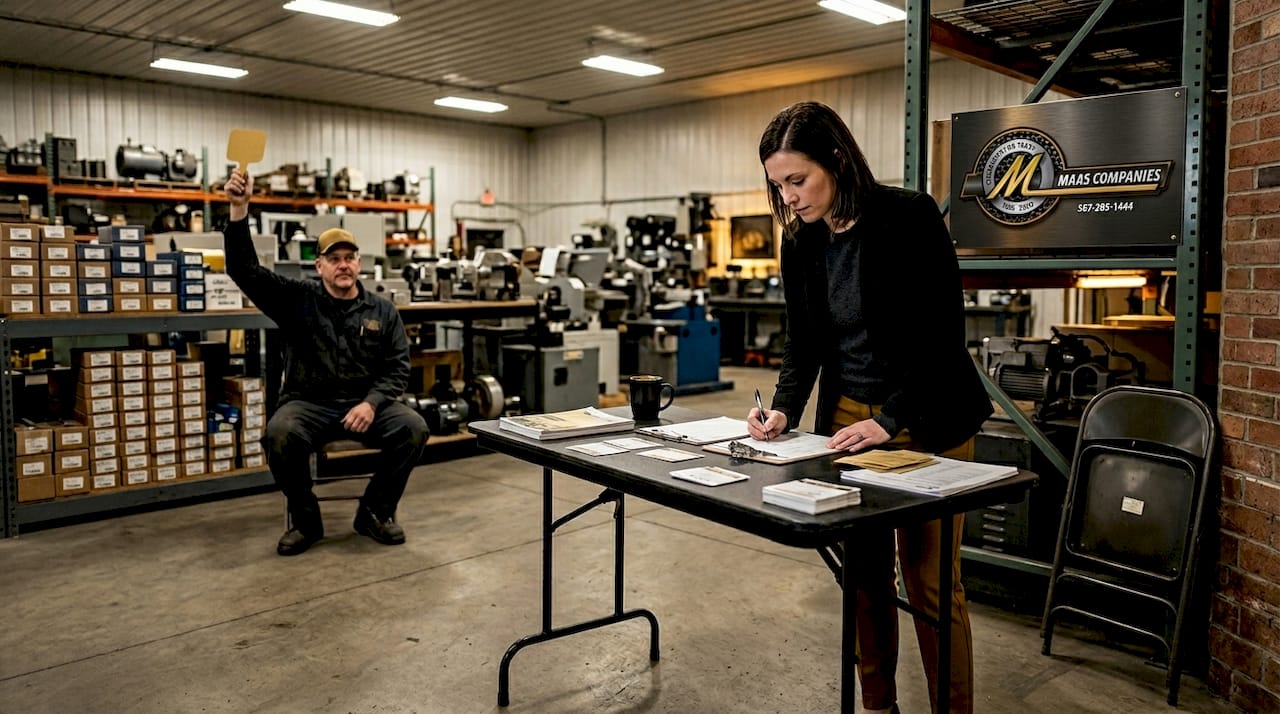
Here is a direct comparison of the most common formats:
| Auction type | Best use case | Recovery potential | Speed |
|---|---|---|---|
| Absolute auction | Liquidation with motivated seller | Moderate to high | Fastest |
| Reserve auction | Assets with strong minimum value | High with protection | Moderate |
| Timed online auction | Equipment, machinery, rolling stock | Moderate | Fast |
| Hybrid (live + online) | Large plant or real estate sales | High | Moderate |
| Stalking horse (bankruptcy) | Chapter 11 or 363 sales | High floor | Structured timeline |
Selecting the right format follows a logical process:
- Assess the asset profile. Complex industrial plants with real estate components benefit from hybrid formats that allow remote bidder participation alongside live attendance. Single-category equipment portfolios often perform well in timed online formats.
- Evaluate the seller’s timeline. Absolute auctions move fastest because they eliminate post-auction negotiation, but they carry the risk of a low-clearing price if bidder turnout is below expectations.
- Quantify recovery targets. If a reserve price can be established based on independent appraisal, a reserve auction protects against distress-level pricing while still creating competitive dynamics.
- Account for the legal context. Bankruptcy proceedings introduce court oversight and creditor scrutiny that require specific formats and protections.
- Match the format to the buyer pool. Choosing the right auction format requires understanding where your potential buyers operate, whether they are active online bidders or prefer attending physical inspection events before committing.
The stalking horse bid deserves particular attention. In a bankruptcy Section 363 sale, the stalking horse bidder negotiates an initial purchase agreement that establishes a minimum price for the court-supervised auction. Stalking horse protections typically include breakup fees payable if a higher bid wins, making the arrangement attractive to sophisticated buyers willing to invest in due diligence upfront. The floor established by the stalking horse encourages competitive overbidding, which protects creditor recovery.
One often-missed consideration involves absentee bidder management. Allowing absentee bidding strategies to function smoothly requires clear pre-auction instructions, maximum bid thresholds, and reliable execution by the auctioneer’s team. A poorly managed absentee bidding process discourages remote participation and reduces overall competition, particularly from international buyers who cannot attend in person.
Auction vs. private sale: Recovery, speed, and transparency
With methodologies and responsibilities defined, the core question becomes which method best serves industrial companies’ goals. Auctions and private sales each offer distinct trade-offs, and the decision should be driven by asset characteristics, market depth, and the seller’s priorities around speed, certainty, and maximum recovery.
Auctions provide several structural advantages. The competitive bidding process is transparent, meaning all parties, including creditors, equity holders, and courts, can observe that the sale price represents genuine market value. Speed is another structural advantage. An auction with a fixed sale date compresses the entire disposition timeline from asset identification through proceeds distribution.
However, auction vs. private sale performance data reveals important nuances. Private sales and structured M&A processes have historically yielded recovery rates in the range of 46 to 64 percent of fair market value when intangible assets, customer relationships, and workforce value are captured in the transaction. Auctions typically recover less when assets are sold on an as-is basis without warranties, because buyers price in the risk of unknown conditions and the absence of recourse.
“Auctions provide transparency and speed, but sellers accept discounts for as-is condition and limited warranties. Private sales and M&A capture intangibles and yield higher recovery over a longer timeline. Sealed bid auctions attract more small bidders and can generate higher total revenue than open formats in specific market conditions.”
The brokerage vs. auction process decision also depends heavily on how urgently carrying costs are accumulating. Industrial facilities with ongoing maintenance obligations, utility costs, and security requirements can consume substantial capital every month they remain unsold. In those situations, the speed advantage of an auction often outweighs the potential upside of a longer private sale process.
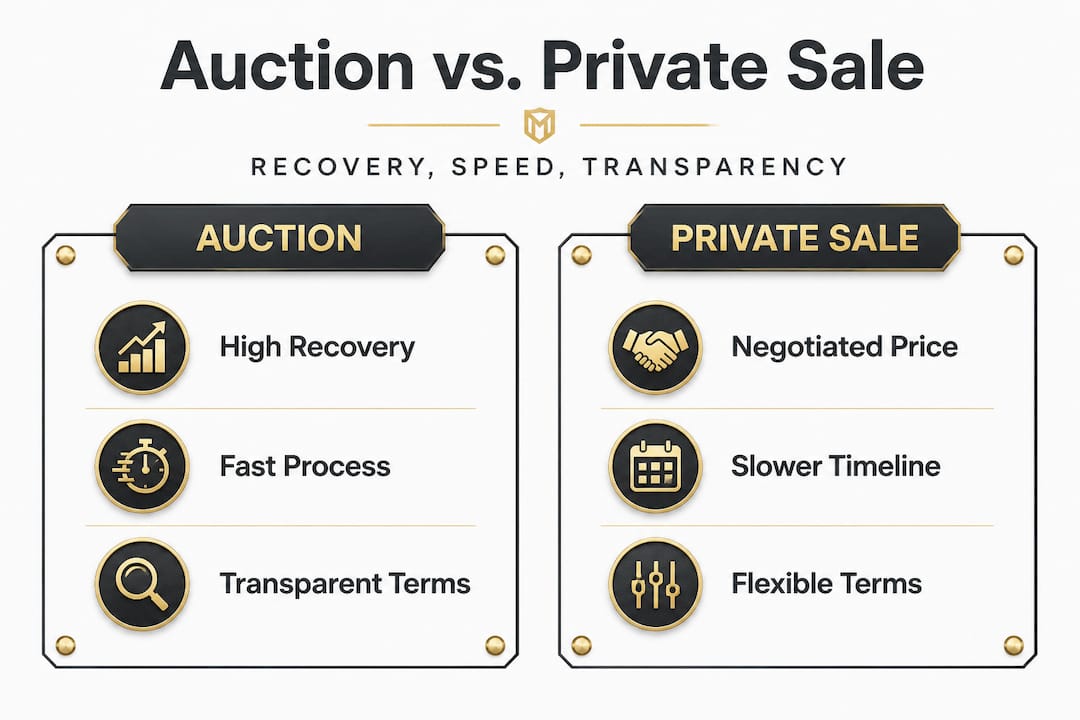
For real estate components within industrial portfolios, the auction speed advantages are especially pronounced. Commercial real estate auctions can close transactions significantly faster than traditional listings, and the compressed timeline reduces carrying cost erosion on properties that generate no revenue while idle. When multiple asset classes are involved, commercial real estate auction speed becomes a critical factor in the overall recovery equation.
Key factors favoring an auction-led sale:
- Assets are tangible, physical, and independently appraisable
- The buyer pool is identifiable and can be reached through targeted marketing
- Legal circumstances require transparent price discovery (bankruptcy, receivership, estate)
- Carrying costs are significant and growing
- The seller needs certainty of closure within a defined timeline
Key factors favoring a private sale or structured process:
- Assets include significant intangible value (brand, customer contracts, workforce)
- A limited number of strategic buyers exist who would pay above market for control
- Time permits a full marketing process without meaningful cost accumulation
- Regulatory approvals require extended due diligence periods
Critical nuances: Maximizing recovery and avoiding pitfalls
Now, let’s address the finer points that separate successful auctions from mediocre outcomes. Technical format selection and legal compliance are necessary but not sufficient. Recovery rates ultimately depend on decisions made in the weeks before the auction and on the floor during live bidding.
The following steps represent the most impactful variables in controlling outcome quality:
- Set reserves with appraisal support. A reserve price established without independent appraisal data is either too conservative, leaving recovery on the table, or too aggressive, causing the asset to pass and requiring a second sale effort at greater cost.
- Build a deep bidder list before advertising. Experienced auctioneers do not rely solely on public advertising. They maintain relationships with active industrial buyers, private equity firms specializing in distressed acquisitions, and international purchasers who regularly participate in plant and equipment sales.
- Stage and document assets thoroughly. Buyers discount for uncertainty. Clear photographs, working condition reports, maintenance records, and organized lot documentation reduce that uncertainty discount and support higher bids.
- Control the timeline between marketing and sale. Too short a window limits bidder preparation and due diligence, suppressing participation. Too long a window gives competitors time to undermine the sale or allows market conditions to shift unfavorably.
- Manage floor dynamics during live bidding. A skilled auctioneer reads the room, identifies active bidders, and paces the auction to maintain energy without rushing decisions that discourage participation.
Pro Tip: For complex industrial plant sales, consider a tiered lot structure. Offer critical process equipment as individual lots to attract specialized buyers, group complementary assets for buyers seeking turnkey solutions, and designate a bulk lot for any remaining inventory. This approach, part of broader auction recovery strategies, consistently generates more total recovery than a single bulk offering.
The speed benefits of auctions are real, but speed without preparation is a false economy. A rushed auction with inadequate marketing, poor asset documentation, and a thin bidder pool will clear assets at distress prices that a properly managed process would have avoided. The most effective auctioneers balance urgency with the preparation necessary to create genuine competition.
Value erosion also comes from unexpected sources. Inconsistent terms and conditions between marketing materials and the actual sale contract create last-minute bidder withdrawals. Ambiguous lot boundaries on equipment that is physically connected or requires disassembly generate disputes that delay closing. A professional auctioneer anticipates these issues in the design phase and resolves them before they reach the sale floor.
Industry wisdom: What most auction guides miss
Most discussions of industrial auctioneering focus almost entirely on format selection, as if choosing between absolute and reserve auction is the primary decision that determines outcomes. That emphasis is misplaced. Format is one variable. The auctioneer’s market knowledge, buyer network, and pre-sale preparation discipline account for far more of the variance in recovery rates than format selection alone.
Executives evaluating auctioneering services should spend less time comparing fee structures between absolute and reserve formats and more time interrogating the auctioneer’s buyer database, their prior sales in comparable asset categories, and their specific approach to lot structuring lessons for complex portfolios.
Market timing is another factor that receives insufficient attention. An industrial auction scheduled during a period of weak demand in the relevant sector will attract fewer qualified buyers regardless of how well the event itself is organized. Experienced auctioneers monitor secondary market conditions for specific equipment categories and advise clients on timing windows that align with periods of stronger buyer activity. That intelligence is difficult to replicate through internal analysis and represents genuine value that a specialized firm brings to every engagement.
The uncomfortable truth about auctioneer selection is that the lowest-cost provider rarely delivers the highest recovery. Marketing investment, buyer outreach, documentation preparation, and experienced staff on the sale floor all cost money. Firms that compete primarily on commission percentage are typically cutting those costs somewhere, and that reduction shows up directly in recovery outcomes. Evaluate auctioneers on their track record of total recovery in comparable sales, not on their fee structure in isolation.
Connect with recovery-focused auctioneering experts
When the analysis is complete and the decision to proceed with an auction-led disposition is made, the next priority is selecting a firm with demonstrated experience across the full range of industrial asset categories and auction formats.
Maas Companies provides auctioneer services backed by decades of international industrial marketing experience, covering plant and equipment sales, real estate disposition, and complex multi-asset liquidations. Our marketing approach combines targeted buyer outreach, aggressive advertising across relevant industry channels, and thorough pre-sale preparation designed to maximize competitive participation. If you are ready to sell industrial assets and need a partner focused on maximizing your recovery through a proven, transparent process, connect with our team to discuss your specific portfolio and timeline.
Frequently asked questions
What distinguishes an auctioneer from a traditional broker in industrial asset sales?
Auctioneers create competitive bidding environments that produce transparent, time-certain price discovery, while brokers negotiate privately over longer timelines that may yield higher recovery when intangible asset value is present. The right choice depends on asset type, legal context, and timeline requirements.
How can auctioneers maximize asset value despite distressed conditions?
Strategic auctioneers use thorough pre-sale preparation, carefully selected format structures, and active bidder management to generate competition that offsets distress discounting, since reserves protect value while absolute formats maximize bidder participation and turnout.
When is a stalking horse bid used in industrial auctions?
Stalking horse bids are used in bankruptcy sale processes to establish a court-approved minimum price floor before competitive overbidding opens, protecting creditor recovery and encouraging serious buyer participation.
Which auction format is best for selling equipment quickly?
Timed online auctions are typically the most efficient format for rapid industrial equipment sales, allowing broad buyer participation without requiring physical attendance while maintaining structured bidding deadlines.
Recommended
- Auction strategies for small businesses: Maximize asset recovery | Blog | Insights on Asset Liquidation and Auction Trends
- Maximize Asset Recovery: Top Real Estate Liquidation Methods | Blog | Insights on Asset Liquidation and Auction Trends
- How Auctions Help Speed Up Industrial Asset Disposition | Blog | Insights on Asset Liquidation and Auction Trends
- Why companies auction machinery: maximize asset recovery | Blog | Insights on Asset Liquidation and Auction Trends
- Real Estate Auction Blog | Tips, Strategies & Insights