

Blog
What Is a Multi-Parcel Auction? A Guide for Investors

TL;DR:
- A multi-parcel auction divides assets into parcels, allowing bids on individual, combined, or full packages simultaneously. This format captures synergistic value and eliminates the exposure risk for buyers, maximizing recovery for sellers. Advanced optimization software determines the highest-value configuration, making it ideal for complex asset dispositions like industrial plants and real estate portfolios.
A multi-parcel auction is a specialized auction format that divides a property or asset group into distinct parcels, allowing bidders to place offers on individual parcels, specific combinations, or the entire package simultaneously. This structure applies combinatorial auction logic to solve a problem that traditional single-lot sales cannot: capturing the full market value of assets that different buyers value differently. For investors, lenders, and asset recovery professionals managing liquidations, plant closures, or portfolio dispositions, understanding what is multi-parcel auction methodology means understanding one of the most effective tools available for maximizing recovery.
What is a multi-parcel auction and how does it work?
A multi-parcel auction, also called a multi-par auction, is defined by its flexible bidding structure that allows the market to determine the most valuable configuration of assets rather than forcing a single predetermined sale structure. The seller divides assets into logical parcels, and bidders compete across multiple configurations at once. This is the core distinction from a standard auction: the allocation is not fixed in advance.
The multi-parcel auction process typically follows a structured two-round sequence.
-
Round 1 — Individual parcel bidding. Each parcel is offered separately. Bidders establish baseline prices on individual lots, which creates a price floor for every asset in the portfolio. This round reveals which parcels attract standalone interest and at what value.
-
Round 2 — Combination and package bidding. Bidders may now place offers on combinations of parcels or the entire property as a whole. A buyer who needs three adjacent land tracts together, for example, can bid a single price for that bundle. A manufacturer bidding on a plant closure may bid on the processing equipment as one lot and the real estate as another, or submit a combined offer for both.
-
Winner determination. The auction platform evaluates all submitted bids across every possible configuration and selects the allocation that produces the highest total revenue without selling any parcel twice. This step is computationally intensive. The winner determination problem is classified as NP-hard in computer science, meaning the number of possible configurations grows exponentially with the number of parcels. Modern auction software solves this using optimization algorithms and heuristic methods that process results in real time.
Pro Tip: When preparing assets for a multi-par auction, define parcel boundaries based on how buyers are likely to use the assets operationally, not just how they are physically located. Logical parcel design drives competitive bidding in Round 2.
The following table illustrates how bid configurations are evaluated in a simplified three-parcel scenario.

| Configuration | Parcel A | Parcel B | Parcel C | Total Value |
|---|---|---|---|---|
| Individual bids | $120,000 | $95,000 | $80,000 | $295,000 |
| Bundle: A + B | $240,000 | — | $80,000 | $320,000 |
| Full package: A + B + C | $340,000 | — | — | $340,000 |
In this example, the winning configuration is the full package bid, which exceeds the sum of individual bids by $45,000. The allocation logic identifies this outcome automatically.
What are the strategic benefits for sellers and buyers?
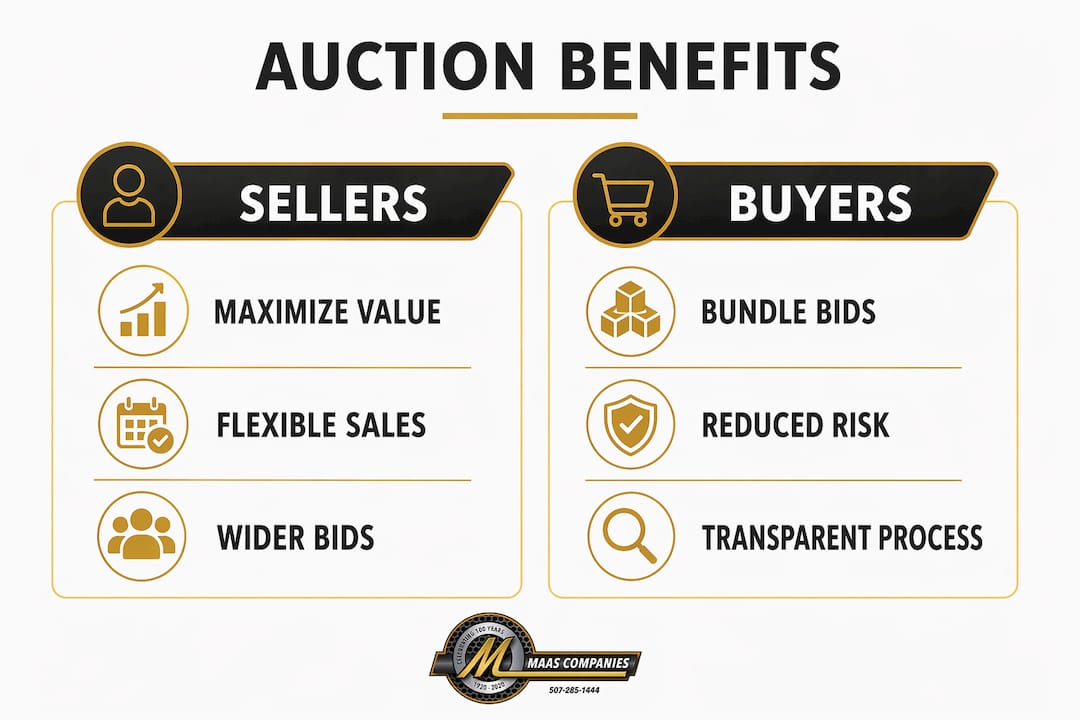
The core economic advantage of multi-parcel auctions is their ability to capture complementary value between assets. When two parcels are worth more together than apart, a standard sequential auction will almost always undervalue at least one of them. Multi-par bidding captures this synergistic value by letting buyers express what the combination is actually worth to them.
Benefits for sellers:
- Higher total recovery values compared to sequential single-lot sales, because buyers can bid their true combined valuation
- Broader buyer participation, since smaller buyers can bid on individual parcels while larger buyers compete for bundles
- Faster disposition timelines, as all configurations are resolved in a single auction event rather than multiple sequential sales
- Market-driven allocation that removes the seller’s need to guess the optimal lot configuration in advance
Benefits for buyers:
- Protection from the exposure problem. Bidders only win their desired bundle as a complete set, so they never end up holding a partial asset group that lacks operational value
- Ability to express precise preferences by bidding on exactly the combination of assets that fits their operational or investment requirements
- Transparent competition, since all bids are evaluated simultaneously against the same allocation logic
Pro Tip: Buyers entering a multi-par auction should prepare bundle bids in advance, not just individual parcel bids. Knowing your maximum combined valuation before the auction starts prevents reactive overbidding during Round 2.
For lenders managing collateral recovery or investors acquiring assets from distressed sellers, these benefits translate directly into measurable outcomes. The multi-par auction format enables manufacturers, lenders, and investors to match bids to the real operational value of combined assets, which is the standard that recovery professionals are measured against.
Multi-parcel auctions vs. traditional auction formats
Traditional single-lot auctions require the seller to make a binary decision: sell the entire property as one unit or divide it into fixed lots sold sequentially. Both approaches carry significant risk of leaving value unrealized.
| Format | Best for | Key limitation |
|---|---|---|
| Single-lot auction | Uniform assets with one clear buyer profile | Excludes buyers who only want part of the asset |
| Sequential multi-lot auction | Clearly separable assets with independent value | Buyers face exposure risk; early lots may underperform |
| Multi-parcel auction | Complex assets with varied buyer profiles | Requires specialized software and bidder education |
A sequential multi-lot auction creates what practitioners call the exposure problem. A buyer who needs parcels 1, 2, and 3 together must bid aggressively on parcel 1 without knowing whether they will win parcels 2 and 3. If they lose parcel 2, they are left with an asset that does not meet their operational needs. This uncertainty suppresses bidding. The result is lower prices across all lots.
Multi-parcel auctions eliminate this dynamic entirely. Because all bids are submitted and evaluated simultaneously, buyers can commit to their true valuation for a bundle without the risk of partial wins. This is why multi-parcel auctions maximize total sale value in scenarios where asset configurations vary across the buyer pool.
For industrial plant closures, commercial real estate portfolios, and equipment liquidations, the multi-par format consistently outperforms traditional approaches when the asset base includes buyers with different operational needs.
Practical challenges in implementing multi-parcel auctions
The primary implementation challenge is computational. The winner determination problem requires evaluating every possible allocation of parcels to bidders to identify the revenue-maximizing combination. For a 10-parcel auction, the number of configurations runs into the thousands. Auction software must solve this in real time, which requires purpose-built optimization engines rather than general-purpose tools.
The second challenge is bidder experience. Multi-parcel auctions are more complex than standard auctions, and bidders who do not understand the mechanics may underbid or disengage. Modern auction platforms address this through intuitive interfaces that display real-time bid status, traffic-light indicators showing whether a current bid is winning or losing, and clear summaries of which configurations are currently leading.
Common implementation pitfalls include:
- Presenting too many parcels without logical groupings, which overwhelms bidders and reduces participation
- Failing to educate bidders on the two-round process before the auction begins, leading to confusion during Round 2
- Setting minimum bids too high on individual parcels, which discourages the baseline pricing that makes Round 2 competitive
- Neglecting to communicate the winner determination logic, which can create post-auction disputes if buyers do not understand why certain bids did not win
Pro Tip: Hold a pre-auction briefing for registered bidders that walks through a simplified example of the winner determination process. Bidders who understand the mechanics place more aggressive bids, which directly improves seller recovery.
On the technology side, the field continues to advance. Neural combinatorial auction mechanisms now use graph neural networks and behavior-driven feature learning to model complex bidder preferences and improve allocation efficiency. These approaches are beginning to appear in commercial platforms, particularly for large-scale asset portfolios where traditional optimization methods reach their computational limits.
Real-world applications in asset recovery and liquidation
Multi-parcel auctions are especially effective for land, farms, and commercial assets where parcel size and buyer needs vary significantly across the bidder pool. The format has been applied across several asset categories relevant to investors and recovery professionals:
- Industrial plant closures. A manufacturing facility with production equipment, warehouse space, and real estate can be offered as individual parcels, equipment-only bundles, or a full-facility package. Buyers who want only the equipment compete against buyers who want the entire operation, and the allocation logic determines which configuration produces the highest total recovery.
- Agricultural and land portfolios. Large tracts are divided into smaller parcels that appeal to neighboring landowners, developers, and investors simultaneously. Bundle bids allow buyers who need contiguous acreage to compete effectively without risking partial acquisitions.
- Commercial real estate portfolios. Lenders disposing of multi-property collateral can offer individual properties and portfolio bundles in the same event, attracting both single-asset buyers and portfolio investors.
- Equipment liquidations. Production lines, processing systems, and support equipment can be parceled by function or location, allowing buyers to bid on the specific assets that match their operational requirements.
Maascompanies has applied this format in complex industrial dispositions, including facilities where industrial equipment auctions serve as the primary vehicle for capital recovery after plant closures or restructuring events. The ability to attract both operational buyers and asset investors in the same event consistently produces stronger recovery outcomes than sequential or single-lot alternatives.
Key takeaways
Multi-parcel auctions maximize asset recovery by allowing simultaneous bidding on individual parcels, bundles, and full packages, with allocation logic selecting the configuration that produces the highest total value.
| Point | Details |
|---|---|
| Core structure | Assets are divided into parcels; bids accepted on single lots, combinations, and full packages simultaneously. |
| Two-round process | Round 1 establishes individual parcel prices; Round 2 opens combination and package bidding. |
| Exposure problem solved | Bidders only win complete bundles, eliminating the risk of holding partial, low-value asset sets. |
| Technology requirement | Winner determination is NP-hard; purpose-built auction software is required for real-time allocation. |
| Best applications | Industrial plant closures, land portfolios, commercial real estate, and equipment liquidations with varied buyer profiles. |
Why multi-parcel auctions are becoming the standard for complex dispositions
I have worked through enough industrial liquidations and commercial real estate dispositions to recognize when an auction format is genuinely suited to a situation versus when it is being applied out of habit. Multi-parcel auctions fall firmly in the first category for complex asset sales, and I expect their adoption to accelerate through 2026 and beyond.
The reason is straightforward. Most significant asset portfolios do not have a single natural buyer. A biodiesel plant, for example, attracts equipment buyers, real estate investors, and operational acquirers simultaneously. A sequential auction forces the seller to guess which configuration to offer first, and that guess almost always costs money. Multi-par bidding removes the guess entirely.
What I find underappreciated is the bidder confidence effect. When buyers know they cannot end up with an incomplete asset set, they bid more aggressively. The exposure problem is not just a theoretical concern. It is a real behavioral constraint that suppresses bids in traditional formats. Solving it structurally, as multi-par auctions do, produces measurably better outcomes.
The technology improvements are also meaningful. Neural auction mechanisms and real-time optimization engines are making it practical to run multi-par events with larger parcel counts and more complex configurations than were feasible five years ago. For investors evaluating auction options in 2026, the question is no longer whether multi-parcel auctions work. The question is whether your auction partner has the platform and the process expertise to run one correctly.
— Vector
How Maascompanies supports multi-parcel asset recovery
Maascompanies brings decades of experience managing complex industrial and commercial asset dispositions, including auctions structured to maximize recovery across varied buyer profiles.

A current example is the 3-MGY Biodiesel Plant auction, which includes oilseed processing facilities, grain handling infrastructure, manufacturing and warehouse space, retail fuel stations, and surplus equipment. This multi-asset disposition is structured to attract both operational buyers and individual asset investors, with parcel configurations designed to maximize total recovery. Sellers looking to apply this format to their own portfolios can explore options through Maascompanies’ asset disposition services to determine the right auction structure for their situation.
FAQ
What is a multi-parcel auction in simple terms?
A multi-parcel auction divides a property or asset group into parcels and allows bidders to place offers on individual parcels, specific combinations, or the entire package at the same time. The allocation logic selects the configuration that produces the highest total sale value.
How does the winner determination process work?
The auction platform evaluates every possible allocation of parcels across all submitted bids and selects the combination that maximizes total revenue without selling any parcel twice. This process is computationally complex and requires purpose-built auction software.
What types of assets are best suited for multi-parcel auctions?
Multi-parcel auctions work best for land, farms, and commercial portfolios where buyer needs vary, as well as industrial plant closures and equipment liquidations where operational buyers and asset investors compete simultaneously.
How does a multi-parcel auction prevent the exposure problem?
Bidders submit bundle bids as a single price for a complete set of parcels. They only win if they receive the entire bundle, so they never end up holding a partial asset group that lacks the value they were bidding for.
What is the difference between a multi-parcel auction and a standard multi-lot auction?
A standard multi-lot auction sells lots sequentially, exposing buyers to the risk of winning some lots but not others. A multi-parcel auction accepts all bids simultaneously and resolves the allocation in a single determination step, eliminating sequential exposure risk entirely.
Recommended
- Commercial Real Estate Auctions Speed Up Sales | Blog | Insights on Asset Liquidation and Auction Trends
- Common Commercial Foreclosure Auction Questions for Lenders | Blog | Insights on Asset Liquidation and Auction Trends
- How Auctions Help Speed Up Industrial Asset Disposition | Blog | Insights on Asset Liquidation and Auction Trends
- Real estate auctions: Fast liquidation for industrial assets | Blog | Insights on Asset Liquidation and Auction Trends