

Blog
What Is Property Disposition? A Practical Guide

What is property disposition, and why does it matter?
Property disposition is the legal transfer or relinquishment of ownership rights in real or personal property. Under U.S. law, the Legal Information Institute at Cornell defines it as the transfer, gift, or sale of property from one individual to another, typically executed through a deed or will. The term is broader than “sale.” It covers every mechanism by which an owner parts with property rights, voluntarily or not.
Understanding the distinction matters for executives, lenders, and legal professionals because the method of disposition directly determines tax exposure, documentation requirements, and closing risk. A sale and a gift both constitute dispositions, yet they trigger entirely different legal and financial consequences.
Property disposition includes:
- Voluntary transfers: Sales, gifts, leases, assignments, wills, and trusts
- Involuntary transfers: Foreclosure, eminent domain, involuntary conversion, and court-ordered transfers
- Partial transfers: Assignment of leasehold interests, easements, or fractional ownership stakes
Disposition is not synonymous with liquidation. Liquidation refers specifically to converting assets to cash, often under distressed conditions. Disposition is the broader legal concept governing all conveyances of property interests, regardless of the circumstances or consideration received.
Table of Contents
- Types of property disposition and their legal frameworks
- How the commercial property disposition process works
- Real-world examples and practical considerations
- Tax and financial implications you need to plan for
- Maascompanies brings proven execution to complex dispositions
- Key Takeaways
Types of property disposition and their legal frameworks
The types of property disposition fall into two primary categories, each governed by distinct legal requirements and documentation standards.
Voluntary dispositions occur when the owner initiates the transfer with legal intent:
- Sale: The most common form, requiring a purchase agreement, deed, and title transfer recorded with the appropriate county or state authority
- Gift: Transfer without monetary consideration; requires donative intent, delivery, and acceptance to be legally valid
- Lease: Conveys possessory rights for a defined term without transferring fee ownership
- Will or trust: Transfers ownership upon death or into a fiduciary arrangement, subject to probate or trust administration rules
Involuntary dispositions occur without the owner’s consent:
- Foreclosure: A lender enforces its security interest after default, transferring title through a court process or trustee sale
- Eminent domain: A government entity takes private property for public use, with constitutionally required just compensation
- Involuntary conversion: Property is destroyed, condemned, or stolen, triggering an involuntary transfer that may qualify for tax deferral under IRS Section 1033
Every valid disposition requires legal formalities. The Statute of Frauds mandates that transfers of real property interests be in writing. Deeds must be signed, notarized, and recorded. Contracts must reflect mutual assent and consideration. Regulatory compliance, including environmental disclosures, title searches, and lien clearances, is not optional; it is a prerequisite to a clean transfer.

How the commercial property disposition process works
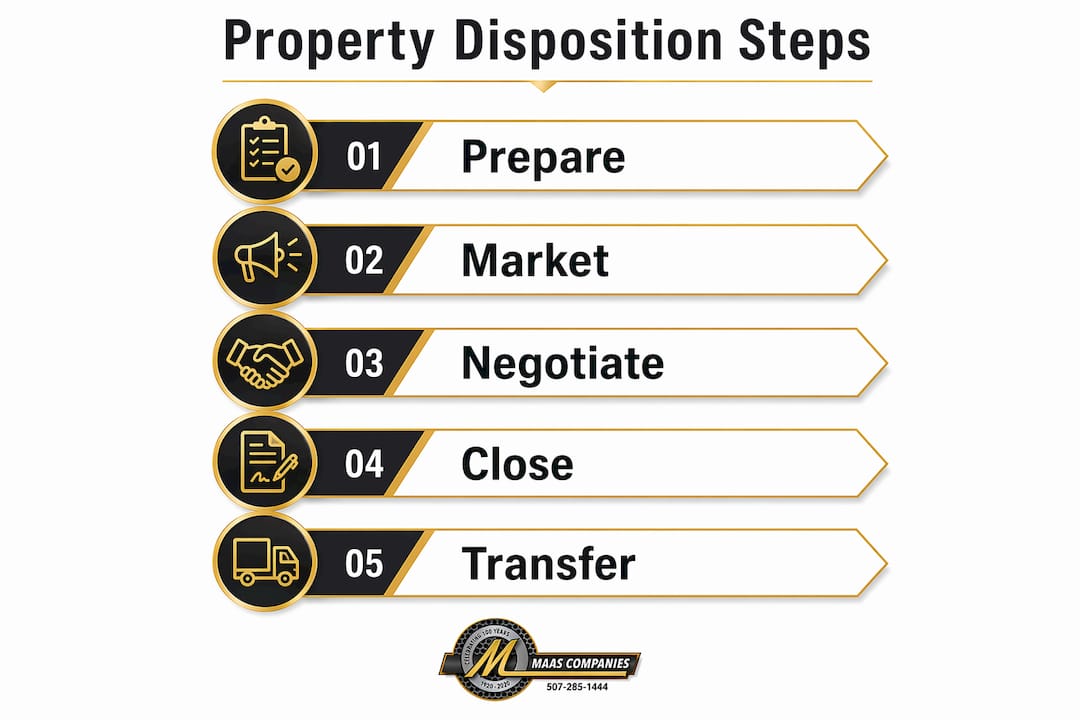
Commercial real estate dispositions routinely take several weeks to several months from the decision to sell through final closing. That timeline demands disciplined project management across legal, financial, and marketing workstreams simultaneously.
The process follows a defined sequence:
- Hold/sell analysis: Evaluate current asset performance, carrying costs, market conditions, and portfolio objectives to confirm disposition is the right decision
- Advisor and broker selection: Engage a disposition team with sector-specific expertise, including legal counsel, a commercial broker, and financial advisors
- Asset preparation: Resolve title issues, complete deferred maintenance, and organize all property records
- Data room assembly: Compile environmental reports, title surveys, lease abstracts, and financial histories into a centralized data room; gaps here erode price during due diligence
- Buyer targeting and marketing: Profile likely buyers by type (owner-users, institutional investors, developers) and build tailored offering materials to create competitive tension
- Negotiation and letter of intent: Qualify offers, negotiate price and terms, and execute a letter of intent that protects closing certainty
- Due diligence management: Actively manage buyer access to the data room, respond to inquiries promptly, and monitor for price-reduction attempts
- Closing: Coordinate title company, legal counsel, and lender payoffs to execute the transfer and record the deed
Pro Tip: Prepare the data room before launching marketing, not after receiving offers. Buyers who find missing documents mid-diligence use the gap as leverage to renegotiate price downward.
Tenant and lease management runs parallel throughout. Active leases affect marketability, buyer financing, and closing timelines. Disposition teams that treat tenant coordination as a separate workstream, rather than an afterthought, consistently close with fewer delays. For a structured framework on managing these decisions, Maascompanies’s industrial asset disposition guide covers risk mitigation and decision frameworks in detail.

Real-world examples and practical considerations
Property disposition takes many forms in practice, and the context shapes both the process and the outcome.
A manufacturing company closing a regional facility disposes of the real estate either through a direct sale to an owner-user or through an auction process targeting investors. A family transferring commercial property to the next generation may use a trust or gifting structure to minimize estate tax exposure. A lender taking back a defaulted industrial building through foreclosure faces an involuntary disposition, with the added complexity of managing an asset it never intended to own.
Effective disposition is not simply an exit event. It is a proactive strategy to validate the selling decision, create competitive tension among buyers, and protect price and closing certainty through disciplined execution. Treating it as a transaction rather than a campaign is the most common reason owners leave value on the table.
Practical challenges that derail dispositions include incomplete due diligence packages, unrealistic pricing unsupported by market data, and marketing that reaches the wrong buyer pool. Asset valuation must reflect current market conditions, not historical cost or aspirational figures. Timing matters too: disposing of a property during a period of rising interest rates compresses buyer purchasing power and can extend the marketing period well beyond initial projections.
Disposition proceeds directly affect financial statements. The gain or loss recognized on transfer flows through the income statement, affects ownership equity, and requires accurate disclosure to lenders and investors. For a closer look at how these outcomes play out across different asset types, the successful asset dispositions guide from Maascompanies provides case-level detail.
Tax and financial implications you need to plan for
The method of disposition determines the tax outcome, and that relationship is direct. Tax and financial professionals consistently emphasize that upfront planning is the only reliable way to avoid capital gains leakage after the fact.
A sale of appreciated commercial property triggers capital gains tax on the difference between the adjusted basis and the net sale proceeds. The rate depends on the holding period and the owner’s tax classification. Depreciation recapture under IRS Section 1250 applies to real property, taxed at a maximum rate of 25% for most taxpayers, and must be calculated separately from the capital gain.
Two deferral mechanisms deserve attention before any disposition closes:
- 1031 exchange: Allows an owner to defer capital gains tax by reinvesting proceeds into a like-kind property within strict IRS timelines (45 days to identify a replacement, 180 days to close). The exchange must be structured before the original property closes.
- IRS Section 1033: Applies to involuntary conversions such as eminent domain takings or casualty losses. If reinvestment conditions are met within the required replacement period, the gain can be deferred.
Pro Tip: Engage a tax advisor before signing a letter of intent, not after. Once a sale is under contract, restructuring the transaction to qualify for a 1031 exchange or Section 1033 deferral becomes significantly harder and sometimes impossible.
Disposition also affects the balance sheet. Removing an asset at a gain increases retained earnings; a loss reduces them. Lenders monitoring debt covenants tied to asset values or net worth thresholds need accurate, timely reporting of any disposition event.
Maascompanies brings proven execution to complex dispositions
When a plant closure, restructuring, or portfolio rebalancing puts commercial real estate or industrial assets on the market, the gap between a well-executed disposition and a poorly managed one shows up directly in recovery value.

Maascompanies brings decades of experience marketing industrial plants, equipment, and commercial properties across the United States and internationally. The firm’s approach combines targeted buyer outreach, coordinated marketing across relevant industry channels, and hands-on management of the full disposition process from asset preparation through closing. That means owners and asset managers work with a single team accountable for results, rather than coordinating separately between brokers, marketers, and advisors.
For decision-makers facing a time-sensitive disposition, whether a commercial building auction or a large-scale industrial site, Maascompanies structures the process to maximize recovery and reduce execution risk. Contact Maascompanies through the sell industrial equipment page to discuss your asset and get a disposition plan built around your timeline and objectives.
Key Takeaways
Property disposition is a legal transfer of ownership rights that encompasses sales, gifts, involuntary transfers, and every other conveyance of property interests, with the method chosen determining tax exposure, documentation requirements, and financial reporting outcomes.
| Point | Details |
|---|---|
| Disposition vs. sale | Disposition covers all legal conveyances of property rights, not just sales; gifts, leases, and foreclosures all qualify. |
| Involuntary transfers | Foreclosure, eminent domain, and involuntary conversion are dispositions with distinct legal and tax consequences. |
| Commercial timelines | Commercial real estate dispositions typically take 90 days or longer, requiring coordinated legal, financial, and marketing management. |
| Tax planning window | 1031 exchanges and IRS Section 1033 deferrals must be structured before closing; post-contract restructuring is rarely feasible. |
| Maascompanies | Maascompanies manages the full commercial and industrial disposition process, from buyer targeting through closing, to maximize recovery value. |
Recommended
- Types of Industrial Asset Disposition: A Strategy Guide | Blog | Insights on Asset Liquidation and Auction Trends
- Examples of Successful Asset Dispositions: 2026 Guide | Blog | Insights on Asset Liquidation and Auction Trends
- Real Estate Disposal Guide for Business Decision-Makers | Blog | Insights on Asset Liquidation and Auction Trends
- Surplus Disposition Strategy Explained for Asset Managers | Blog | Insights on Asset Liquidation and Auction Trends