

Blog
Turnkey Plant Sale: What Industrial Buyers Must Know

TL;DR:
- A turnkey plant sale involves delivering a fully operational facility under a single contract, ready for immediate production.
- It shifts responsibility and risk to the seller or contractor, offering speed and cost predictability for buyers.
What is a turnkey plant sale?
A turnkey plant sale is a single-contract transaction in which a fully operational industrial facility is delivered to the buyer ready for immediate production. The buyer assumes ownership of a complete, functioning plant rather than managing individual procurement, construction, and commissioning phases separately. The name captures the concept precisely: the buyer simply turns the key and starts operations.
Under this model, one contractor or seller takes total responsibility for delivering the facility in working condition. That scope typically covers equipment, utilities, process systems, installation, commissioning, and performance validation. The International Chamber of Commerce (ICC) classifies these agreements as hybrid contracts, blending the legal characteristics of an equipment sale with the obligations of a construction or works contract, including erection, performance testing, and personnel training.
Turnkey plant sales appear across pharmaceuticals, chemical manufacturing, food processing, biodiesel production, and heavy industry. Each sector uses the model for the same core reason: acquiring a proven, operational facility is faster and less operationally complex than building one from the ground up.
Key characteristics that define a turnkey plant sale:
- Single-point accountability: One party is responsible for the full scope of delivery, from design through commissioning.
- Ready-to-operate handover: The buyer receives a facility capable of immediate production, not a collection of components.
- Integrated scope: Equipment, utilities, process lines, documentation, and training are bundled into one transaction.
- Risk transfer: Cost overruns, integration failures, and commissioning delays fall on the seller or contractor, not the buyer.
- Regulatory alignment: In regulated industries, the delivered facility typically includes GMP compliance documentation, validation protocols, and operational certifications.
How turnkey contracts define responsibility and risk
The legal and operational structure of a turnkey contract sets it apart from standard equipment purchases or construction agreements. Single-point accountability means the contractor manages design, procurement, construction, installation, and commissioning as an integrated whole, transferring both cost risk and integration risk away from the owner.
Most turnkey plant contracts include fixed-price and fixed-schedule commitments. The buyer knows the total cost and expected delivery date before signing. That predictability is one of the primary reasons corporate buyers and lenders favor this model during plant acquisitions or capital recovery transactions.
The ICC describes turnkey contracts for industrial plant supply as hybrid agreements: primarily a contract for the sale of equipment, but with essential accessory obligations regarding erection, performance testing, and personnel training that align more closely with complex construction works. This dual nature means the contract must be drafted with precision to avoid ambiguity about where equipment sale obligations end and construction obligations begin.
Components commonly included in a turnkey plant sale contract:
- Process equipment and machinery, fully installed and tested
- Utility systems including electrical, HVAC, compressed air, and water treatment
- Civil and structural works where applicable
- Automation and control systems, including software and calibration
- Factory Acceptance Testing (FAT) and Site Acceptance Testing (SAT) protocols
- Performance qualification (PQ) documentation
- Operator training and technical documentation transfer
- Spare parts inventory and maintenance records
Maascompanies functions as a full-service marketing intermediary in these transactions, coordinating engineering assessments, dismantling logistics, and buyer outreach to connect sellers with qualified industrial buyers. The ICC Model Contract for the Turnkey Supply of an Industrial Plant provides a widely referenced framework for structuring these agreements, particularly in cross-border transactions.
How does a turnkey plant sale work in practice?
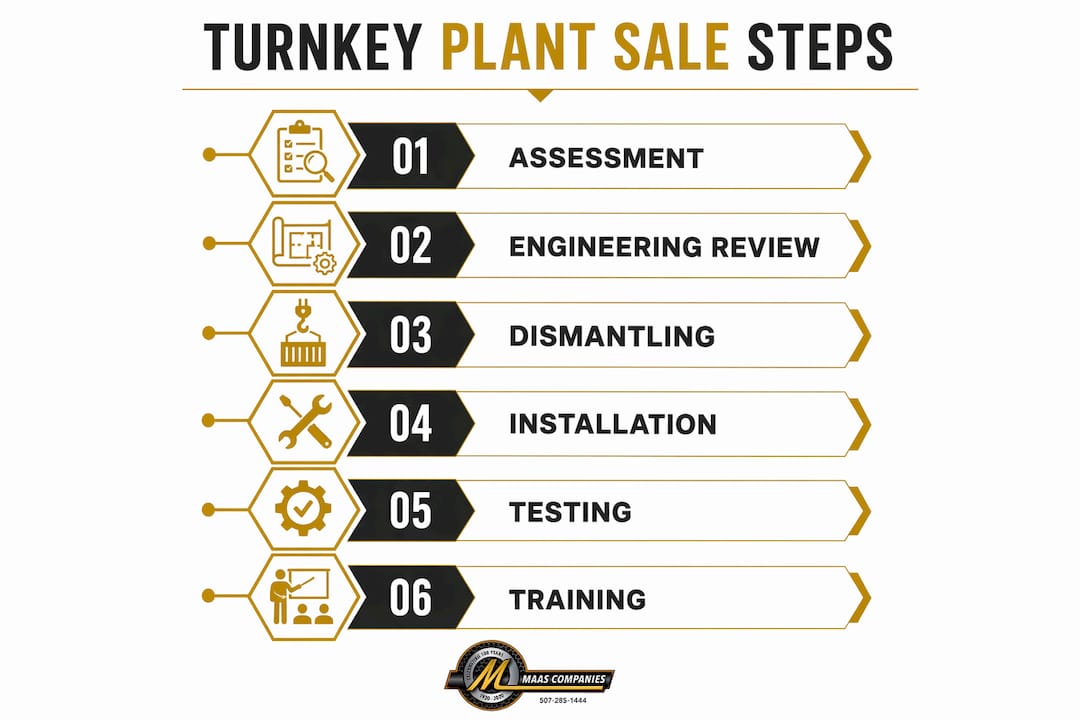
The lifecycle of a turnkey plant sale follows a structured sequence from initial assessment through operational handover. Each phase carries specific responsibilities and deliverables that must be completed before the next begins.
Phase 1: Strategic assessment and valuation

The seller or intermediary conducts a full asset inventory, equipment appraisal, and operational review. This phase establishes the plant’s current production capacity, maintenance history, and compliance status. For buyers, this is also the due diligence window: reviewing financial records, environmental permits, and regulatory certifications.
Phase 2: Engineering review and scope definition
Engineers assess whether the plant can be transferred intact or requires partial dismantling and relocation. The scope of work is documented in detail, covering what is included in the sale, what modifications are required, and what the buyer will receive at handover.
Phase 3: Procurement, dismantling, and logistics
If the plant is being relocated, dismantling is executed according to a documented plan that preserves equipment integrity. Logistics coordination covers transport, customs (for cross-border transactions), and site preparation at the receiving location.
Phase 4: Installation and commissioning
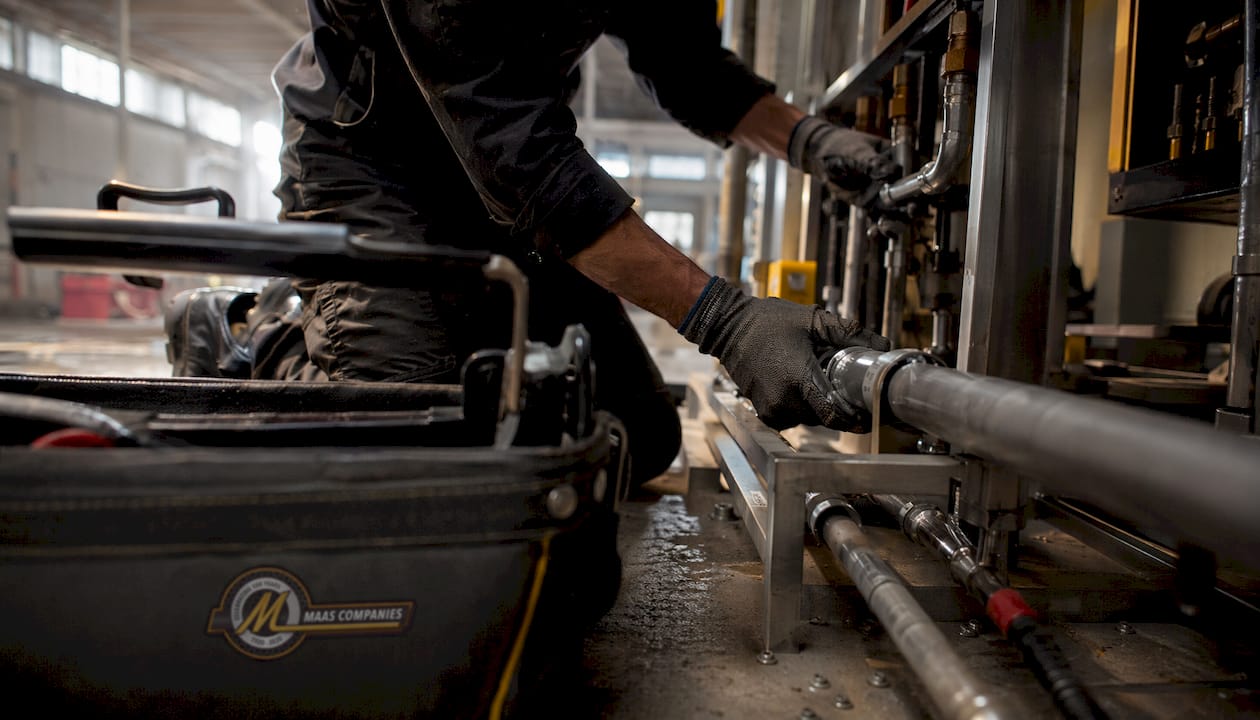
Equipment is reinstalled, utilities are connected, and the full process line is brought online. Commissioning engineers verify that each system performs to specification before formal testing begins.
Phase 5: Testing and validation
FAT and SAT protocols confirm that equipment meets performance requirements. In regulated industries, process qualification (PQ) validates that the facility can consistently produce output within defined parameters. This documentation is transferred to the buyer as part of the handover package.
Phase 6: Training and documentation transfer
Operators receive formal training on equipment operation, maintenance procedures, and safety protocols. The buyer receives a complete documentation package including P&IDs, maintenance logs, calibration records, and regulatory submissions.
Pro Tip: Before signing a turnkey plant sale agreement, require the seller to provide a full documentation index at the term sheet stage. Gaps in validation records or missing environmental permits are far easier to negotiate before contract execution than after.
What are the benefits of turnkey plant sales for buyers and sellers?
Turnkey plant solutions deliver concrete advantages on both sides of the transaction. For buyers, the primary benefit is speed. Acquiring a complete operational facility can enable production within months rather than the multi-year timeline associated with greenfield construction. That time compression translates directly into revenue and market positioning.
For sellers, the turnkey model preserves asset value. Selling a plant as an integrated, operational unit consistently recovers more capital than liquidating equipment piece by piece. Operational continuity is maintained through the sale process, and the buyer receives a facility with a documented production history, which reduces their due diligence risk and supports a faster closing.
Key benefits for industrial buyers:
- Faster time to production: A proven facility can be commissioned in months, not years.
- Cost predictability: Fixed-price contracts eliminate the financial uncertainty of phased construction projects.
- Reduced management burden: One contract, one point of contact, and one accountable party simplify project oversight.
- Proven performance: The buyer acquires a facility with a documented operational track record rather than an unproven design.
- Integrated compliance: In regulated sectors, GMP-compliant operational plants come with pre-integrated documentation, reducing the regulatory burden on the buyer.
Key benefits for industrial sellers:
- Higher capital recovery: Selling a complete, operational plant generates better returns than piecemeal equipment auctions.
- Faster sale cycle: A fully documented, operational facility attracts more qualified buyers and closes faster.
- Reduced carrying costs: A structured turnkey sale shortens the period during which the seller bears insurance, maintenance, and facility costs.
- Broader buyer pool: Maascompanies’ marketing reach connects sellers with qualified buyers across domestic and international markets, as detailed in their plant liquidation recovery guide.
What risks and challenges should you anticipate in turnkey plant sales?
Turnkey plant sales carry real operational and financial risks that buyers and sellers must address before contract execution. The most common source of disputes is an inadequately defined User Requirements Specification (URS). When the URS is ambiguous, the contractor’s interpretation of “fully operational” often diverges from the buyer’s expectations, generating costly change orders despite the fixed-price structure of the agreement.
A second risk category involves the transfer of operational certifications and compliance documentation. Buyers frequently underestimate how much regulatory standing is embedded in a facility’s documentation history. Without complete FAT/SAT records, maintenance logs, and environmental permits, a plant that appears operational may fail to meet current GMP or environmental compliance standards. In that scenario, the equipment becomes a liability rather than a productive asset.
Additional risks to plan for:
- Contractor reliability: The turnkey model concentrates delivery risk in one party. If that party lacks project management depth or financial stability, delays cascade across the entire scope.
- Interface risk: In complex facilities, the boundaries between process technology, utility systems, and civil infrastructure require precise coordination. Minimizing interface risks between these systems is one of the primary reasons pharmaceutical and chemical manufacturers favor the turnkey model, but it requires explicit scope definition in the contract.
- Upfront cost concentration: Fixed-price contracts require substantial capital commitment before production begins. Buyers must model the ROI timeline carefully, particularly when acquiring a facility that requires modifications before it can serve their specific process requirements.
- Regulatory transfer complexity: Environmental permits, operating licenses, and zoning approvals are often facility-specific and non-transferable. Buyers should engage legal counsel early to assess which authorizations must be reapplied for and how long that process takes.
- Hidden deferred maintenance: A plant sold “as operational” may carry deferred maintenance costs that surface only after the buyer takes possession. A thorough pre-sale inspection and maintenance record review are non-negotiable steps in the due diligence process.
Consulting resources like IET Hamburg can provide additional technical guidance on risk management frameworks for turnkey industrial facility setups.
How does turnkey differ from EPC and LSTK contracts?
Turnkey, Engineering-Procurement-Construction (EPC), and Lump Sum Turn Key (LSTK) contracts are related but distinct project delivery models. The differences center on risk allocation, contractor scope, and the degree of buyer involvement during execution.
| Feature | Turnkey | EPC | LSTK |
|---|---|---|---|
| Contractor scope | Full delivery: design, supply, install, commission | Engineering, procurement, and construction; may exclude commissioning | Full turnkey scope with lump sum pricing |
| Pricing structure | Fixed price or negotiated | Often reimbursable or hybrid | Fixed lump sum |
| Risk allocation | Contractor bears cost and integration risk | Shared; owner retains more schedule risk | Contractor bears maximum risk |
| Buyer involvement | Minimal during execution | Moderate; owner typically approves design stages | Minimal; similar to turnkey |
| Commissioning included | Yes, typically | Not always; varies by contract | Yes |
| Best suited for | Plant acquisitions, asset transfers, regulated industries | Large infrastructure projects with phased design | Projects where cost certainty is the primary driver |
Turnkey projects differ from EPC and LSTK primarily in how risk is allocated and how comprehensively the contractor’s scope is defined. EPC contracts are common in large infrastructure projects where the owner wants to maintain design approval authority. LSTK is essentially a turnkey contract with an explicit lump sum price, making it the highest-risk model for the contractor and the most cost-predictable for the buyer.
For industrial plant acquisitions in the United States, the turnkey model is typically preferred when the buyer wants a ready-to-operate facility with minimal post-handover integration work. EPC is more common in new construction where the owner’s engineering team is actively involved in design development.
Expert insights and best practices in turnkey plant sales
The ICC’s framework for turnkey plant supply contracts reflects decades of international transaction experience. Its model contract addresses supply of technical documentation, equipment and spare parts, erection, testing, taking over, and training as an integrated set of obligations. That structure prevents the fragmentation that occurs when buyers attempt to manage these elements through separate agreements with separate vendors.
Industry practitioners in pharmaceutical and chemical manufacturing consistently identify interface management as the discipline that separates successful turnkey plant sales from troubled ones. When process technology, cleanroom infrastructure, and facility utilities are managed by disconnected parties, gaps in responsibility create delays and compliance failures. The turnkey model closes those gaps by placing a single entity in charge of all interfaces.
Successful turnkey plant sales require full transfer of operational certifications, maintenance records, and performance validation protocols. Without this documented evidence of prior compliance, a buyer may find that a fully equipped facility cannot pass regulatory inspection, effectively resetting the compliance clock and adding months to the production start timeline.
Best practices for buyers and sellers:
- Buyers: Commission an independent technical audit before signing. Verify that all FAT/SAT records, calibration certificates, and environmental permits are current and transferable.
- Sellers: Prepare a complete documentation package before marketing the plant. A well-documented facility commands a higher price and attracts more serious buyers.
- Both parties: Engage legal counsel experienced in industrial asset transfers to review URS language, performance guarantees, and warranty provisions before execution.
- Due diligence scope: Review not just equipment condition but also the facility’s regulatory standing, pending inspections, and any outstanding compliance obligations.
- Maascompanies’ role: Maascompanies acts as a full-service marketing intermediary in turnkey plant sales, coordinating engineering assessments, logistics, and buyer outreach to accelerate capital recovery for sellers and reduce search costs for buyers.
For sellers preparing a plant for market, the industrial plant sale checklist published by Maascompanies provides a structured framework for documentation review, asset valuation, and marketing preparation. A real-world example of this process in action is the 3-MGY biodiesel plant auction, which included oilseed processing facilities, grain handling, and retail fuel stations as a fully integrated asset package.
Key takeaways
A turnkey plant sale delivers a fully operational industrial facility under a single contract, giving the buyer immediate production capability while transferring integration and cost risk to the seller or contractor.
| Point | Details |
|---|---|
| Single-contract delivery | One agreement covers design, supply, installation, commissioning, and documentation transfer. |
| Speed to production | Acquiring an operational plant compresses the timeline to production compared to greenfield construction. |
| Risk transfer | Fixed-price contracts shift cost overrun and integration risk from the buyer to the contractor. |
| Documentation is critical | Without complete FAT/SAT records and compliance certifications, a plant may fail regulatory inspection post-sale. |
| Turnkey vs. EPC vs. LSTK | Turnkey maximizes contractor scope and minimizes buyer involvement; LSTK adds lump sum pricing; EPC retains more owner control. |
The case for turnkey plant sales in the US industrial market
The turnkey model addresses a specific and growing pressure in US industrial markets: the need to expand capacity or recover capital quickly without absorbing the full complexity of a new construction project. Plant closures, corporate restructuring, and sector consolidation regularly produce fully equipped facilities that are available at a fraction of replacement cost. The turnkey sale structure is the mechanism that converts those facilities into productive assets for new owners.
What practitioners often underestimate is how much of a plant’s value resides in its documentation, not its equipment. A reactor vessel or a processing line has a market price. But a validated, GMP-compliant production facility with a clean regulatory history and a documented maintenance record is worth considerably more, because it eliminates months of qualification work for the buyer. Sellers who invest in documentation preparation before going to market consistently achieve better recovery outcomes.
Single-point accountability also changes the risk calculus for lenders and special asset managers involved in plant dispositions. When one party is contractually responsible for delivering a working facility, the lender’s exposure to post-sale operational disputes is substantially reduced. That clarity supports faster credit decisions and cleaner transaction structures.
Maascompanies brings this perspective to every plant sale engagement. The firm’s experience across pharmaceuticals, food processing, biodiesel, and heavy manufacturing means that buyers and sellers work with a team that understands both the technical and financial dimensions of a turnkey transaction. For organizations evaluating a plant sale or acquisition, that combination of marketing reach and operational knowledge is what separates a well-structured transaction from a prolonged, costly process.
If you are managing a plant disposition or evaluating a turnkey acquisition, Maascompanies offers specialized asset marketing services designed to maximize recovery value and accelerate time to close.
Recommended
- Industrial Plant Sale Checklist for Maximum Recovery | Blog | Insights on Asset Liquidation and Auction Trends
- Pre-Auction Selling Checklist for Industrial Equipment | Blog | Insights on Asset Liquidation and Auction Trends
- How to Attract Industrial Buyers: Strategies That Work | Blog | Insights on Asset Liquidation and Auction Trends
- How to Sell Industrial Equipment and Maximize Value | Blog | Insights on Asset Liquidation and Auction Trends