

Blog
Why Use Professional Auction Firms for Asset Recovery

TL;DR:
- Professional auction firms provide market expertise, broad buyer networks, and legal protections, ensuring higher asset recovery. They complete disposals within 30 to 90 days, reducing costs and meeting urgent restructuring deadlines. Their full-service management minimizes operational burdens, allowing leadership to focus on core recovery efforts.
When a business faces restructuring, plant closure, or forced liquidation, the instinct for many decision-makers is to handle asset sales internally or rely on local contacts. That instinct is costly. Understanding why use professional auction firms reveals a fundamentally different level of market reach, speed, legal protection, and price realization than any in-house effort can deliver. This article breaks down the specific, practical advantages that licensed auction professionals bring to complex asset disposals, from pricing strategy to compliance, so you can make a fully informed decision before your next liquidation event.
Table of Contents
- Key takeaways
- Why use professional auction firms: market expertise and pricing strategy
- Speed and efficiency when time is critical
- Legal compliance and risk mitigation
- Access to qualified buyer networks
- Full-service management reduces operational burden
- My perspective on choosing the right auction partner
- How Maascompanies delivers these advantages for your business
- FAQ
Key takeaways
| Point | Details |
|---|---|
| Market expertise drives higher returns | Auction firms use sector-specific data and buyer networks to price assets competitively, outperforming fixed-price sales. |
| Speed reduces carrying costs | Professional auctions complete disposals within 30 to 90 days, protecting cash flow during restructuring. |
| Legal compliance is built in | Licensed auctioneers provide documented records, due diligence materials, and dispute resolution that protect sellers legally. |
| Buyer network reach is irreplaceable | Global marketing and established buyer databases generate competitive bidding pressure that DIY sales cannot replicate. |
| Full-service management frees leadership | Auction firms handle cataloging, photography, marketing, and documentation, so executives can focus on recovery priorities. |
Why use professional auction firms: market expertise and pricing strategy
The most common mistake businesses make when disposing of assets is setting prices based on book value or internal estimates. Neither reflects actual market conditions. Professional auction firms maintain continuous intelligence on sector-specific buyer behavior, regional demand cycles, and real-time comparables for industrial equipment, commercial real estate, and specialty assets. That intelligence translates directly into pricing strategies that attract the right buyers at the right moment.
Consider a manufacturing facility undergoing restructuring. An internal team may know the replacement cost of a CNC machining center, but they rarely know which buyers are actively acquiring that equipment type, what recent auction clearance rates were, or how to position the asset to trigger competitive bidding. An experienced auction firm knows all three.
Key advantages of professional pricing expertise include:
- Sector-specific buyer pool access. Auction firms maintain databases of qualified buyers categorized by asset type, geography, and acquisition capacity. This eliminates the guesswork in buyer identification.
- Data-driven pricing benchmarks. Firms use actual transaction data from prior auctions to set realistic reserve prices that protect sellers without suppressing bidder participation.
- Competitive bidding activation. Properly priced assets attract multiple bidders, and competitive pressure consistently drives final prices above opening bids.
- Hybrid liquidation strategies. Separating high-value assets for targeted international auctions while disposing of lower-value items locally has been shown to maximize total recovery across a mixed asset portfolio.
Pro Tip: Ask any auction firm you evaluate to provide clearance rate data and comparable sales for your specific asset category before signing an engagement. Firms with genuine market depth can produce this within 48 hours.
Professional auction services also provide consulting and valuation expertise that builds decision-maker confidence before the process begins, reducing the risk of undervaluing assets or misjudging market timing.
Speed and efficiency when time is critical
In distressed or restructuring scenarios, time is not neutral. Every week assets sit idle accumulates carrying costs including insurance, security, property taxes, and maintenance. The ability to convert assets to cash quickly is not a convenience; it is a financial necessity.
Professional auctions complete estate and asset liquidations within 30 to 90 days as a standard timeline, compared to traditional private sales that routinely take six months to over a year. For businesses under creditor pressure or operating under court supervision, that difference is decisive.

The data supporting auction speed is substantial. 30% of active auction buyers are ready to complete transactions within two months, far faster than buyers in traditional sales who average up to five months. This reflects a fundamental shift in how buyers engage with auction formats. Auctioneering has evolved from a last-resort disposal method into a strategic, technology-integrated process that aligns with modern buyers’ expectations for efficiency.
The context for urgency is significant. Nearly 70,000 incidents of critical financial distress were recorded in 2025, with manufacturing and engineering sectors accounting for more than 15,000 cases. For businesses in those sectors, a professional auction firm offers something a private sale cannot: a near-guarantee of sale within a defined, predictable window.
Predictability matters as much as speed in restructuring contexts. Legal counsel, creditors, and bankruptcy trustees need to operate from a defined disposition timeline. Auction firms provide that certainty from day one, with structured bidding periods, fixed closing dates, and transparent settlement terms. Learn more about how auction timelines compress the industrial asset disposition process to meet restructuring deadlines.
Legal compliance and risk mitigation
Asset liquidation carries significant legal exposure. Title transfers, payment processing, buyer disputes, and documentation requirements are not administrative details. They are potential liabilities. Working with licensed professional auctioneers addresses each of these directly.
Here is how reputable auction firms protect sellers through the entire transaction lifecycle:
- Licensed operation and regulatory compliance. Licensed auctioneers operate under legal mandates governing conduct, record-keeping, and financial handling. Unlicensed operators have been documented engaging in illegal practices including fraudulent asset seizures and sale manipulation, outcomes that expose sellers to serious legal and reputational risk.
- Due diligence documentation for buyers. 43% of potential buyers report feeling increased risk in auction formats due to the absence of traditional sale contingencies. Professional firms counter this directly by providing comprehensive property reports, inspection records, and legal documentation upfront, which reduces hesitation and increases buyer participation.
- Transparent transaction records. Auction firms maintain meticulous records including photographs, condition reports, bid histories, and buyer information. These records support legal audits and protect sellers in court proceedings and tax evaluations.
- Dispute resolution protocols. Professional firms have established processes for handling buyer disputes, payment defaults, and title challenges, removing that burden from the seller’s legal and operations teams entirely.
Pro Tip: Before engaging any auction firm, verify their licensing status with the relevant state auctioneer licensing board and request references from attorneys or trustees who have worked with them on court-supervised liquidations.
For businesses working through insolvency proceedings, this level of documented compliance is not optional. Courts and creditors require it. Choosing a licensed, reputable firm from the start eliminates an entire category of risk.
Access to qualified buyer networks
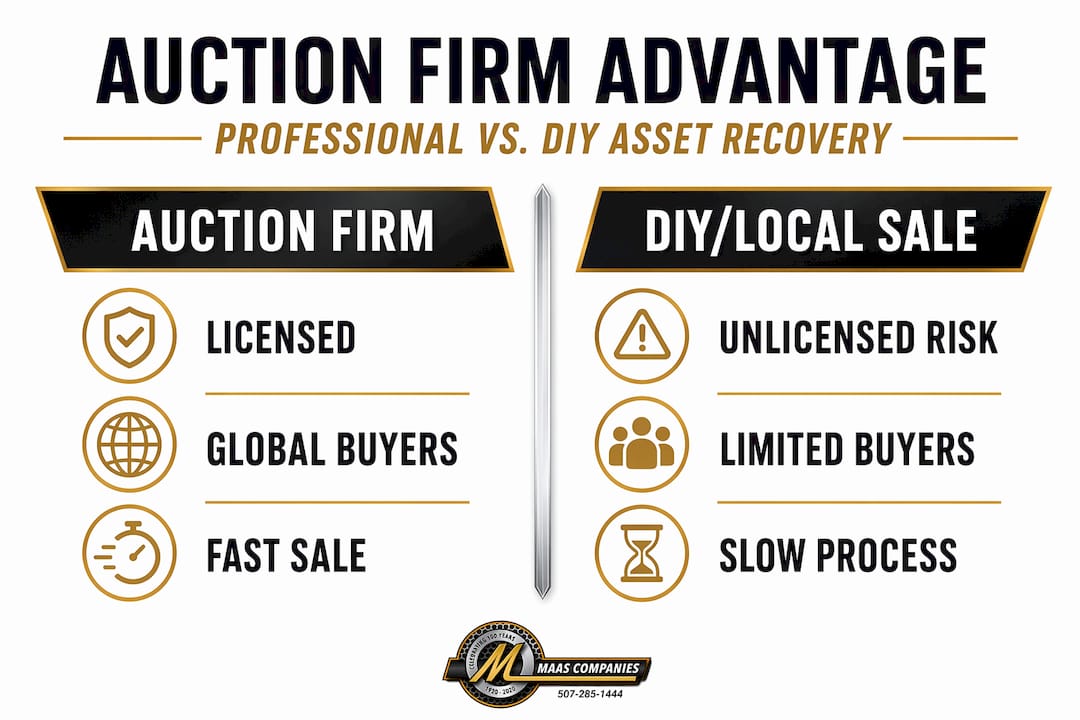
The price realized for any asset is directly limited by the number of qualified buyers competing for it. This is the area where the advantages of professional auctions over DIY or local sales are most pronounced.
Established auction firms invest continuously in buyer relationship development, targeted marketing, and digital platform reach. The result is a pool of verified, financially capable buyers who are actively seeking specific asset types at any given time.
| Factor | Professional auction firm | DIY or local sale |
|---|---|---|
| Buyer reach | Global database of verified buyers | Limited to local contacts or public listings |
| Marketing investment | Professional photography, catalogs, and digital campaigns | Typically minimal or informal |
| Competitive bidding | Multiple bidders drive price above reserve | One-to-one negotiation, less price pressure |
| Asset specialization | Buyers segmented by industry and asset class | Generic outreach with no segmentation |
| Net recovery | Higher net proceeds than DIY sales consistently | Subject to single-buyer price pressure |
For industrial and commercial assets specifically, buyer geography matters enormously. A surplus processing line may attract minimal interest locally but command strong bidding from international buyers in sectors where that equipment is actively needed. Professional auction firms maintain those international connections through years of market participation and targeted outreach, which a business conducting its own sale simply cannot replicate.
Full-service management reduces operational burden
One of the underappreciated benefits of auction firms is the degree to which they remove operational complexity from the seller’s organization. During restructuring or distress, leadership attention is finite and expensive. Every hour a CFO or operations director spends managing an asset sale is an hour not spent on the core recovery process.
Professional auction firms consolidate the entire disposition under one managed engagement:
- Asset cataloging and inventory. Firms conduct detailed inventories with condition assessments, serial number verification, and categorization by asset type and value tier.
- Professional photography and marketing materials. Quality visual presentation drives buyer engagement and bidder registration. This is not incidental. It directly affects participation rates.
- Advertising and digital distribution. Firms distribute listings through industry-specific platforms, email campaigns to qualified buyer lists, and targeted digital advertising.
- Coordination with legal and financial stakeholders. Auction firms consolidate communication with attorneys, trustees, and financial advisors, reducing coordination overhead for the seller’s team.
- Settlement and documentation delivery. Post-sale, firms deliver complete transactional records suitable for legal filings, tax reporting, and creditor reconciliation.
This full-service model means decision-makers receive a single, professionally managed process from initial asset assessment through final settlement, with clear reporting at each stage. The right auction approach depends on asset type and market conditions, but the operational relief is consistent across formats.
My perspective on choosing the right auction partner
I’ve seen businesses enter liquidation with solid assets and walk away with significantly less than market value, not because the market was weak but because they chose the wrong disposal method or the wrong firm. The difference between a credible, experienced auction firm and a generalist operation is not always visible upfront, but it shows clearly in the final recovery numbers.
What I’ve learned from years of observing industrial asset disposals is that the quality of buyer relationships a firm maintains matters more than its fee structure. A firm charging a slightly higher commission but delivering three times the bidder registrations will always outperform a discount provider with a thin buyer network.
The risks of DIY or unlicensed sales are real and consequential. I’ve seen title disputes, payment failures, and regulatory challenges arise from sales conducted without professional oversight, events that added months and legal costs to situations that were already under financial pressure.
My strongest observation is this: the auction firm you select should have documented experience in your specific asset category, verifiable references from attorneys or financial professionals, and a transparent marketing plan before you sign anything. Experience in industrial equipment auctions is different from experience in real estate auctions. Specificity matters.
— Vector
How Maascompanies delivers these advantages for your business
For businesses facing restructuring, plant closures, or capital recovery needs, Maascompanies brings decades of specialized experience in marketing industrial plants, manufacturing equipment, commercial real estate, and process facilities to qualified buyers worldwide.

Maascompanies has managed complex, multi-asset liquidations across diverse industries, including an online auction for a 5-ton per hour feed pelletizer system and a large-scale biodiesel plant and oilseed processing facility auction spanning multiple facility types and asset classes. These engagements reflect the firm’s capacity to handle specialized, high-value assets with the legal compliance, market reach, and buyer network access that maximize recovery.
If your organization is evaluating asset disposition options, visit Maascompanies’ seller services to discuss a tailored liquidation strategy with a team that has managed successful outcomes across industrial and commercial sectors internationally.
FAQ
What makes professional auction firms better than selling assets directly?
Professional auction firms deliver qualified buyer networks, competitive bidding pressure, and full legal documentation that direct sales cannot match. Higher net proceeds are consistently achieved through professional marketing and auction structure versus one-on-one negotiation.
How long does a professional auction take to complete?
Most professional asset auctions complete within 30 to 90 days from engagement to settlement, compared to six months or longer for traditional private sales. This speed is critical for businesses managing restructuring timelines and creditor obligations.
Are there legal risks in using unlicensed auctioneers?
Yes. Unlicensed operators have been documented engaging in fraudulent practices, and their transactions lack the legal protections that licensed firms provide. Always verify licensing and request references from legal professionals before engaging any auction firm.
How do auction firms handle compliance documentation?
Licensed auction firms maintain complete transaction records including photographs, condition reports, bid histories, and buyer information. These records are structured to support court filings, tax reporting, and creditor reconciliation requirements.
When should a business hire auction experts versus using a broker?
Auction experts are the stronger choice when speed, broad buyer reach, and competitive price realization are priorities, particularly in distressed or restructuring scenarios. Brokerage may be appropriate for single high-value assets with a known buyer universe and longer disposal timelines.
Recommended
- How Auctions Help Speed Up Industrial Asset Disposition | Blog | Insights on Asset Liquidation and Auction Trends
- How Auctions Help Speed Up Industrial Asset Disposition | Blog | Insights on Asset Liquidation and Auction Trends
- Auction strategies for small businesses: Maximize asset recovery | Blog | Insights on Asset Liquidation and Auction Trends
- Why companies auction machinery: maximize asset recovery | Blog | Insights on Asset Liquidation and Auction Trends