

Blog
Asset Liquidation Trends 2026: What Financial Pros Must Know

TL;DR:
- The asset liquidation market is expanding to a projected value of $62.4 billion by 2026, driven by retail closures and e-commerce returns. Regulatory reforms and a liquidity fracture are compressing liquidation timelines and influencing buyer strategies, emphasizing early action and thorough documentation. Digital platforms and blockchain technology are reshaping processes by increasing transparency, reducing timelines, and expanding buyer pools globally.
Asset liquidation, formally defined as the conversion of physical or financial assets into cash through structured disposition processes, is entering its most consequential period in a decade. The global liquidation market is valued at $62.4 billion in 2026, growing at a 6.8% CAGR through 2035. Asset liquidation trends 2026 are being shaped by three converging forces: regulatory reforms compressing timelines, a retail closure wave generating record inventory volumes, and a liquidity fracture that has fundamentally altered distressed asset demand. Financial professionals who understand these forces now will position their portfolios and clients for materially better recovery outcomes.
What are the major market and regulatory drivers shaping asset liquidation trends in 2026?
The market expansion is not incidental. Over 15,000 U.S. retail store closures are projected across 2025 and 2026, with 8,234 closures recorded in 2025 alone and an estimated 7,900 more in 2026. That volume of closures generates unprecedented closeout inventory, flooding disposition channels and creating both pressure and opportunity for asset managers.
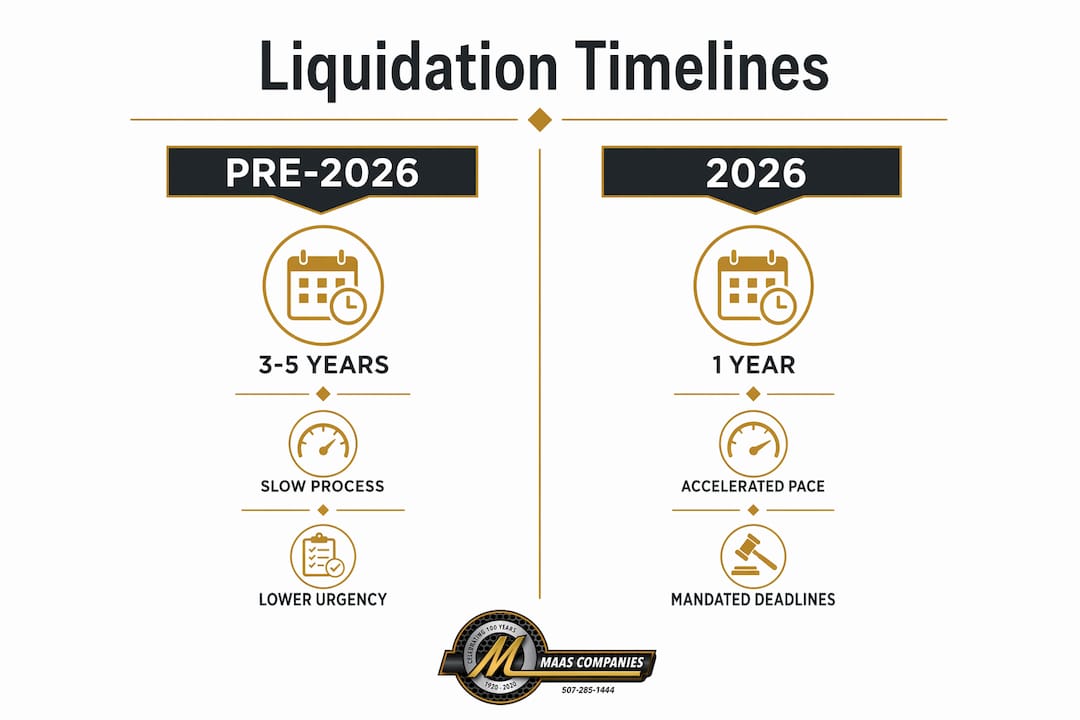
Regulatory reform is accelerating the pace of disposition on a global scale. India’s IBBI 2026 amendments enforce a 1-year liquidation completion deadline, down from the previous 3–5 year norm, with a clear priority on going-concern sales. The EU’s insolvency harmonization directive is moving in the same direction, displacing fragmented broker networks in favor of integrated digital disposition platforms. These changes are not administrative adjustments. They fundamentally alter how long assets can remain in limbo before carrying costs destroy recovery value.
The macroeconomic backdrop adds further urgency. April 2026 saw a $14 trillion global equity market contraction that triggered a 304% increase in private credit redemption queues. That liquidity fracture has pushed institutional investors toward faster asset disposition to meet redemption demands, compressing timelines that were already tightening under regulatory pressure.
Key market drivers at a glance:
- Retail closures: 15,000+ U.S. store closures in 2025 and 2026 combined, generating record closeout inventory volumes
- Regulatory compression: IBBI 1-year deadline replaces multi-year liquidation cycles; EU harmonization reduces broker fragmentation
- Liquidity fracture: $14 trillion equity contraction forces accelerated disposition across institutional portfolios
- E-commerce returns surge: Returns from online retail now dominate liquidation merchandise composition, shifting asset profiles
| Driver | Pre-2026 Condition | 2026 Condition |
|---|---|---|
| Liquidation timeline (India) | 3–5 years | 1 year (IBBI mandate) |
| U.S. retail closures | Cyclical, moderate volume | 15,000+ projected closures |
| Private credit redemption queues | Stable | Up 304% post-April contraction |
| Merchandise composition | Shelf pulls dominant | Premium e-commerce returns dominant |
How are buyers and sellers adapting their asset liquidation strategies in 2026?
The professionalization of information is the defining operational shift in 2026. Sophisticated buyers now demand manifests accurate to 95%–99%, complete with barcode validation and MSRP precision. Traditional blind-buying practices, where buyers purchased lots without detailed content verification, are effectively obsolete. Sellers who cannot provide this level of documentation face lower bids, longer sale cycles, and reduced buyer pools.

Merchandise composition has also shifted materially. Premium e-commerce returns now dominate liquidation channels, replacing the shelf-pull merchandise that characterized earlier market cycles. These returns carry higher original retail values but require more careful condition grading and documentation. Asset managers handling these lots need grading protocols and manifest systems that reflect this new reality.
Logistical nearshoring is reshaping sourcing patterns across the market. Buyers are moving away from 60-day Asian import cycles toward domestic U.S. procurement to reduce exposure to global supply chain volatility. This shift benefits sellers with U.S.-based inventory and creates a structural advantage for domestic disposition specialists.
Key strategic adaptations financial professionals should recognize:
- Manifest accuracy: Require 95%–99% accurate lot manifests with barcode and MSRP data before committing to any acquisition
- Condition grading: Build grading protocols suited to premium e-commerce returns, not just traditional shelf-pull merchandise
- Nearshoring preference: Prioritize domestic inventory sourcing to avoid lead-time exposure and tariff uncertainty
- Reverse seasonality: Large buyers are acquiring assets off-season to gain local market advantage before peak demand cycles
Pro Tip: When evaluating a liquidation lot in 2026, request the manifest before any site visit. If the seller cannot provide barcode-level accuracy, price the information gap into your bid or walk away. Blind buying is a 2019 strategy.
What are the practical challenges and opportunities in asset liquidation for investment recovery in 2026?
Timing is the cardinal variable in 2026 asset disposition. Fast-moving consumer goods in good condition recover approximately 30%–60% of original cost when liquidated promptly. Delay accelerates depreciation and storage costs, compressing net recovery well below that range. For financial professionals managing distressed portfolios, this means disposition decisions must be made at the point of trigger, not after extended evaluation periods.
Tariff exposure adds a new layer of urgency. Assets tied to imported goods or components face price compression as tariff costs work through the supply chain. Immediate liquidation yields better net recovery than delay in a tariff-impacted market. This is not a theoretical risk. It is a documented pattern from 2025 trade policy impacts that has carried directly into 2026 asset values.
The practical steps for maximizing recovery in 2026 follow a clear sequence:
- Trigger early: Initiate disposition at the point of decision, not after carrying costs accumulate. Every week of delay reduces net recovery in a depreciating or tariff-exposed asset class.
- Appraise before listing: Commission an independent appraisal that reflects current market conditions, not book value. 2026 market dynamics have diverged significantly from pre-2025 valuations.
- Select the right channel: Match the asset class to the disposition method. Industrial equipment and plant assets recover best through integrated appraisal-to-disposition services that combine auction and brokerage options.
- Document the chain of control: Buyers in 2026 require clear title documentation and condition records. Gaps in chain of control reduce competitive bidding and final recovery.
- Monitor regulatory deadlines: Under IBBI-style frameworks and emerging U.S. state-level reforms, missing statutory deadlines can force fire-sale conditions that destroy value.
Pro Tip: For industrial plant and manufacturing assets, engage a disposition specialist before the closure announcement goes public. Early engagement preserves optionality and prevents the market from pricing in distress before you have a recovery plan in place. Maascompanies structures plant liquidation strategies around this principle.
Environmental and sustainability mandates are also influencing asset handling. Buyers increasingly factor environmental compliance costs into bids, particularly for industrial equipment with fluid systems, refrigerants, or hazardous material exposure. Sellers who complete environmental remediation before listing consistently achieve higher recovery rates than those who transfer liability to buyers.
Which technologies and digital innovations are reshaping asset liquidation processes in 2026?
Digital auction infrastructure is the most consequential technology shift in the 2026 liquidation market. Digital platforms and blockchain tracking reduce liquidation timelines and improve buyer confidence by providing verifiable provenance and title security. These are not incremental improvements. They address the two primary friction points in distressed asset transactions: time and trust.
The technology stack reshaping disposition in 2026 includes:
- Digital auction platforms: Compress timelines from months to weeks by enabling simultaneous global bidding, reducing geographic constraints on buyer pools
- Machine learning pricing: Real-time demand analytics adjust reserve prices and lot structures based on current market signals, improving recovery rates versus static pricing models
- Blockchain provenance tracking: Immutable ownership and condition records reduce buyer due diligence costs and increase competitive bidding by eliminating title uncertainty
- Mobile platforms: Enable micro-retailers and regional buyers to participate in auctions previously accessible only to large institutional buyers, diversifying demand and supporting price discovery
| Technology | Primary Benefit | Impact on Recovery |
|---|---|---|
| Digital auction platforms | Global buyer access, compressed timelines | Higher competitive bidding |
| Machine learning pricing | Real-time market-aligned reserves | Reduced under-recovery from static pricing |
| Blockchain provenance | Verified title and condition history | Lower buyer risk premium, higher bids |
| Mobile bidding platforms | Expanded buyer pool diversity | Improved price discovery |
Regulatory harmonization in the EU and India is accelerating adoption of these platforms by displacing fragmented broker networks. Integrated digital disposition platforms now handle appraisal, marketing, auction execution, and settlement in a single workflow. For financial professionals managing industrial plant liquidation, this integration reduces coordination costs and eliminates the handoff errors that historically delayed recovery.
Key Takeaways
The 2026 liquidation market rewards financial professionals who act early, document thoroughly, and use integrated digital platforms to access the broadest possible buyer pool.
| Point | Details |
|---|---|
| Market scale is expanding | The liquidation market reaches $62.4 billion in 2026, driven by retail closures and e-commerce returns. |
| Regulatory timelines are compressing | IBBI 2026 amendments enforce a 1-year completion deadline, replacing 3–5 year cycles. |
| Information quality determines recovery | Manifests accurate to 95%–99% are now required; blind buying reduces bids and buyer pools. |
| Early disposition protects value | Timely liquidation of fast-moving goods recovers 30%–60% of original cost; delay erodes this range. |
| Technology expands buyer access | Digital auctions and blockchain provenance reduce timelines and increase competitive bidding. |
The 2026 liquidation market rewards preparation, not reaction
Financial professionals who treat liquidation as a last resort consistently leave recovery value on the table. The evidence from 2026 is unambiguous: the market has professionalized, timelines have compressed, and buyers are better informed than at any prior point in the cycle.
The professionals I have seen navigate this environment well share one characteristic. They engage disposition specialists before the trigger event forces their hand. When a plant closure, restructuring, or portfolio rebalancing is under consideration, the time to assess liquidation options is during the planning phase, not after the announcement. Early engagement preserves negotiating position, allows proper appraisal, and prevents the market from pricing in distress before a recovery strategy is in place.
The nearshoring shift is also underappreciated by many analysts. The move away from long-lead Asian imports toward domestic U.S. inventory sourcing is not just a logistics preference. It reflects a structural recalibration of risk tolerance after years of supply chain disruption. For sellers of U.S.-based industrial and manufacturing assets, this creates a genuine demand tailwind that did not exist three years ago.
The regulatory changes deserve more attention than they typically receive in investment committee discussions. IBBI-style deadline compression is not confined to India. The EU harmonization directive and emerging U.S. state-level reforms are moving in the same direction. Financial professionals who build disposition timelines around old regulatory assumptions will find themselves in forced-sale conditions that destroy the recovery value they spent years building.
The practical conclusion is straightforward. Align your liquidation timeline with the regulatory environment, document assets to the standard buyers now require, and engage a disposition partner with the market reach to generate competitive bidding. The 2026 market has the scale and the tools to deliver strong recovery outcomes. The variable is preparation.
— Vector
Maascompanies: a specialized partner for complex asset recovery in 2026
Maascompanies brings decades of experience managing industrial plant closures, equipment auctions, and multi-asset disposition projects across North America and internationally. In a market where timing, documentation, and buyer reach determine recovery outcomes, Maascompanies provides the integrated appraisal, marketing, and auction execution that financial professionals need.

Current active projects include a biodiesel plant and oilseed processing facility auction that demonstrates the firm’s capacity to handle complex, multi-asset dispositions with diverse industrial components. For financial professionals managing distressed portfolios, lenders overseeing collateral recovery, or restructuring specialists coordinating plant closures, Maascompanies offers the full-service asset recovery expertise that 2026 market conditions demand.
FAQ
What is the size of the asset liquidation market in 2026?
The liquidation services market is valued at $62.4 billion in 2026, growing at a 6.8% CAGR through 2035, driven by retail closures, e-commerce returns, and institutional distressed asset activity.
How has the IBBI 2026 amendment changed liquidation timelines?
The IBBI 2026 amendments enforce a 1-year liquidation completion deadline, replacing the previous 3–5 year norm, with priority given to going-concern sales over piecemeal asset disposal.
What recovery rate can financial professionals expect from timely liquidation?
Fast-moving consumer goods in good condition recover approximately 30%–60% of original cost when liquidated promptly. Delay through storage and depreciation compresses this range significantly.
Why is manifest accuracy so critical in 2026 liquidation transactions?
Sophisticated buyers now require manifests accurate to 95%–99% with barcode and MSRP validation. Sellers who cannot meet this standard face lower bids, reduced buyer pools, and longer sale cycles.
How does logistical nearshoring affect asset liquidation strategy in 2026?
Buyers are shifting from 60-day Asian import cycles to domestic U.S. procurement to reduce supply chain risk. This creates a structural demand advantage for sellers of U.S.-based industrial and manufacturing assets.
Recommended
- Plant liquidation strategies: maximize recovery in 2026 | Blog | Insights on Asset Liquidation and Auction Trends
- How to Plan Government Asset Sales for Spring 2026 | Blog | Insights on Asset Liquidation and Auction Trends
- Liquidation sales explained: Maximize asset recovery | Blog | Insights on Asset Liquidation and Auction Trends
- Equipment liquidation explained: maximizing asset recovery | Blog | Insights on Asset Liquidation and Auction Trends