

Blog
Auction catalogs: The key to distressed asset liquidation

TL;DR:
- Auction catalogs in distressed sales are legally significant documents shaping bidder behavior and recovery outcomes.
- They must be complete, clear, compliant with court orders, and user-friendly to maximize participation.
- Modern digital formats enhance engagement, transparency, and ultimately improve liquidation results.
Auction catalogs are routinely treated as administrative formalities in distressed asset sales, mere lists of lots with serial numbers and reserve prices. That assumption is costly. For professionals managing liquidations through private equity portfolios, distressed lending workouts, or court-supervised proceedings, the auction catalog is a legally consequential document that shapes bidder behavior, defines asset exposure, and directly influences recovery rates. Understanding what a well-constructed catalog requires, and what it must comply with, is not optional knowledge. It is the foundation of every successful distressed sale.
Table of Contents
- Understanding the auction catalog: Beyond a sales list
- How auction catalogs function in distressed asset liquidation
- Designing an effective auction catalog for asset liquidation
- Practical applications: Auction catalogs in modern distressed asset sales
- The uncomfortable truth: Why most auction catalogs fall short in court-supervised sales
- Unlock your next successful liquidation with expert auction catalog solutions
- Frequently asked questions
Key Takeaways
| Point | Details |
|---|---|
| Auction catalogs are strategic tools | They shape the outcome of distressed asset sales by controlling bidder knowledge and access. |
| Legal compliance is non-negotiable | Court-supervised auctions require catalogs to follow exact procedural rules to be valid. |
| Design impacts recovery value | Clear, compliant, and user-friendly catalogs maximize bidder confidence and asset recovery. |
| Digital innovation drives success | Modern catalogs leverage technology to boost participation and streamline asset liquidation. |
Understanding the auction catalog: Beyond a sales list
An auction catalog in the context of distressed asset management is a structured, legally informed document that communicates the precise scope, condition, and terms governing each asset offered for sale. It is not a brochure. It functions as the primary interface between the selling party, legal counsel, and prospective bidders, carrying obligations that extend well beyond what a typical commercial sales listing would require.
In court-supervised proceedings, particularly Section 363 bankruptcy sales, the catalog does not exist independently. It operates within a framework that the court has already defined. The bidding procedures order governs auction mechanics and determines how bidders interact with cataloged lots, including deposit requirements, bid increments, stalking horse protections, and information disclosure standards. Every element of the catalog must align with that order, or the auction’s legal standing is at risk.
What does that mean practically? It means the catalog must be:
- Complete: Every asset included in the estate or portfolio must be accounted for, with accurate lot assignments and no omissions that could later constitute undisclosed encumbrances.
- Clear: Lot descriptions must be precise enough for a sophisticated buyer to conduct independent due diligence without ambiguity.
- Compliant: The catalog must reflect the bidding procedures order in its terms of sale, deadlines, and buyer qualification requirements.
- Auditable: The document must support post-auction review, including any disputes over asset condition, lot boundaries, or bidder eligibility.
“The auction catalog is not just a list of what is being sold. In a court-supervised sale, it is the commercial expression of a legal order, and it carries the same weight.”
When facilitating auction sales for industrial facilities or complex portfolios, treating the catalog as a living compliance document rather than a static listing changes every downstream outcome. Bidder engagement increases. Legal exposure decreases. Recovery improves.
How auction catalogs function in distressed asset liquidation
Now that we have established the foundational importance of auction catalogs, the specific mechanics of how they operate within legally governed distressed sales deserve careful attention. The process is sequential and procedurally strict.
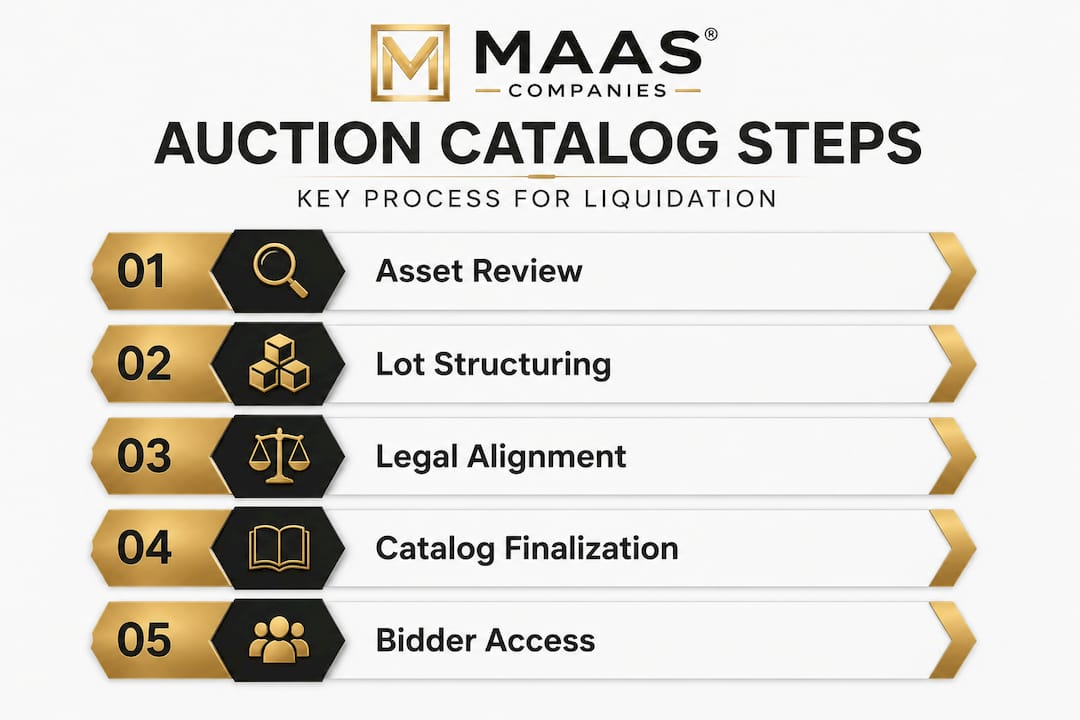
Here is how the catalog moves from legal order to bidder interaction in a Section 363 context:
- Court issues the bidding procedures order. This document sets the legal parameters for the auction, including stalking horse bid terms, auction timeline, qualified bidder requirements, and asset disclosure standards.
- Legal counsel and the auction manager align catalog structure to the order. Every lot description, legal disclosure, and bidder instruction must map directly to the court-approved procedures.
- Asset inventory is conducted and documented. Physical inspections, appraisals, and condition assessments are captured and formatted for catalog inclusion.
- The catalog is published to qualified bidders. Timing matters here. Late publication compresses due diligence windows and reduces competitive bidding.
- Bidder inquiries are managed through defined Q&A channels. Any material update to the catalog must be distributed to all registered bidders, often requiring court notification.
- The catalog is finalized prior to auction day. Last-minute changes can create grounds for bid protest or judicial review.
The auction lot structuring decisions made during this process directly affect recovery. Lots that are too broadly defined reduce competitive bidding from specialized buyers. Lots that are too granular increase administrative burden and can fragment asset value for equipment that performs better as an operational set.
| Step | Action | Risk if skipped |
|---|---|---|
| Bidding procedures alignment | Match catalog to court order | Catalog invalidation |
| Asset documentation | Physical inspection and appraisal | Disputed lot values |
| Timely publication | Release to qualified bidders | Reduced bid competition |
| Q&A management | Structured bidder inquiry process | Misinformation, legal exposure |
| Catalog finalization | Lock all lot details pre-auction | Bid protests |
Pro Tip: Before finalizing the catalog, run it through a cross-check against the bidding procedures order line by line. Any discrepancy, however minor, creates a gap that bidders or objecting creditors can exploit. Pair this with your selling checklist to ensure no documentation step is missed.
The Section 363 sale process places the auction catalog downstream of the legal order. This hierarchical relationship means the catalog cannot define its own terms. It must reflect what the court has already sanctioned. For legal counsel and asset managers, that constraint is also an opportunity: a rigorously compliant catalog reduces the likelihood of post-auction litigation and protects creditor recoveries.
Designing an effective auction catalog for asset liquidation
Once the procedural foundations are established, the next factor is crafting a catalog that is both legally compliant and commercially effective. These two objectives are not in conflict, but they require deliberate planning to achieve simultaneously.
The format of the catalog matters more than many professionals expect. Consider the three primary options currently in use:
| Format | Features | Advantages | Limitations | Compliance fit |
|---|---|---|---|---|
| Print catalog | Fixed layout, physical distribution | Tangible, no access barriers | No real-time updates, high print cost | Suitable for smaller, local auctions |
| PDF catalog | Digital distribution, static | Wide accessibility, low cost | Cannot be updated post-distribution | Adequate for straightforward sales |
| Interactive digital catalog | Dynamic updates, hyperlinked docs, site visit scheduling | Maximum bidder engagement, real-time accuracy | Requires platform infrastructure | Best fit for complex, court-supervised sales |
For distressed asset sales of any complexity, the interactive digital catalog provides the most defensible and highest-recovery outcome. Bidders can access linked documentation, schedule inspections, review legal disclosures, and submit qualified bids within a single platform environment. Streamlining processes through integrated digital catalog platforms reduces administrative friction and minimizes the risk of information gaps that suppress bidder confidence.
Every effective auction catalog for distressed assets should include the following, regardless of format:
- Lot-specific asset descriptions: Make, model, serial number, year of manufacture, operational status, and location.
- Legal status disclosures: Liens, encumbrances, title chain, UCC filings, or environmental contingencies attached to individual assets.
- Condition reports: Third-party inspection findings or seller-disclosed condition ratings, presented consistently across all lots.
- Terms of sale: Buyer’s premium, deposit requirements, payment deadlines, removal timelines, and as-is disclaimers.
- Bidder instructions: Registration requirements, qualified bidder criteria, and the bid submission process as defined by the procedures order.
- Court order references: Where applicable, explicit references to the bidding procedures order governing each lot or the sale as a whole.
The decision about choosing auction types also influences catalog design. A sealed-bid process requires different bidder instruction sections than an open-outcry or online ascending auction. Similarly, a brokerage and auction hybrid approach may require the catalog to distinguish between lots subject to pre-auction negotiated offers and those reserved strictly for competitive bidding.
Pro Tip: Catalog transparency is not just a legal obligation. It is a commercial strategy. Bidders who trust the completeness and accuracy of your catalog bid more aggressively because they have reduced their due diligence risk. Higher bidder confidence directly translates to higher recovery rates for your client or portfolio.
The bidding procedures order governs how bidders interact with cataloged lots, which means every design choice you make for the catalog either supports or undermines the legal framework already in place.
Practical applications: Auction catalogs in modern distressed asset sales
Having established how to construct compliant and commercially effective catalogs, it is worth examining how these tools are deployed in actual distressed sales today, where technology and legal complexity intersect at a practical level.

Online and hybrid auction formats have fundamentally expanded what a catalog can accomplish. A digital catalog accessible to registered bidders across multiple geographies removes the geographic constraint that once limited competitive bidding to regional buyers. For industrial plants, large equipment portfolios, or commercial real estate in distressed estates, this expanded reach is material. More qualified bidders mean more competitive tension. More competitive tension means better recovery outcomes for creditors and estates.
Technology’s role in sales now extends to catalog integration with asset monitoring systems. For equipment still in operation at the time of sale, real-time performance data can be linked directly within the catalog, giving bidders verified operational metrics rather than relying solely on seller-prepared condition reports. This is a significant shift in bidder due diligence capability and one that sophisticated buyers increasingly expect.
The Section 363 sale process requires that bidders have access to complete, structured information about each lot, and modern digital catalog platforms are now the most effective vehicle for meeting that standard while simultaneously maximizing buyer engagement.
Current best practices for catalog deployment in distressed sales include:
- Publish the catalog as early as the procedures order permits. Extended due diligence windows consistently produce higher bid participation and better pricing.
- Link all relevant legal documents directly within each lot entry. Court orders, lien searches, environmental reports, and title documentation should be accessible without leaving the catalog platform.
- Establish a structured Q&A channel with documented response protocols. All bidder questions and seller responses should be distributed to the entire registered bidder pool to maintain fairness and legal defensibility.
- Maintain an audit trail of all catalog updates. Date-stamped version control is essential in court-supervised sales where any post-publication change may require judicial notification.
- Integrate inspection scheduling directly into the catalog. Site visits are a key due diligence mechanism, and catalogs that make scheduling frictionless see measurably higher participation from out-of-market buyers.
For real estate auction insights in distressed contexts, the catalog must also address title chain verification, zoning status, and any pending regulatory actions. Real estate lots carry a different disclosure burden than equipment lots, and the catalog structure must reflect that distinction clearly to protect both the estate and the winning bidder from post-closing disputes.
Digital catalogs have measurably increased bidder participation rates across distressed asset auctions, with some platforms reporting participation increases of 30 to 50 percent compared to traditional print or PDF formats. The operational implication is straightforward: format is not a stylistic choice. It is a recovery strategy.
The uncomfortable truth: Why most auction catalogs fall short in court-supervised sales
With years of practical experience managing complex distressed asset sales across industrial, commercial, and real estate portfolios, one pattern emerges consistently. Most auction catalogs fail not because they are legally wrong, but because they are commercially unusable.
Legal counsel preparing catalogs for Section 363 sales rightly focuses on compliance. Every disclosure is present. Every court reference is cited. The lot descriptions satisfy the bidding procedures order. And yet, sophisticated industrial buyers routinely disengage because the catalog reads like a court filing rather than a usable commercial document. The legal accuracy and the user experience are both present, but they are not integrated.
This creates a measurable problem. When buyers cannot efficiently navigate a catalog, assess individual lots, or identify which assets match their acquisition criteria, they do not bid. Or they bid conservatively to account for the uncertainty. Either outcome reduces recovery for the estate.
The uncomfortable reality is that many legal teams and asset managers treat catalog usability as a secondary concern, something to address after compliance is confirmed. That sequencing is backward. The most effective catalogs are built simultaneously for legal compliance and commercial utility, with usability testing conducted before publication, not after bidder participation disappoints.
Consider the case of a large manufacturing facility liquidation where 400 individual equipment lots were cataloged across a 200-page PDF. Legal disclosures were complete. Lot descriptions were accurate. But the document had no searchable index, no cross-referenced equipment categories, and no visual asset identification. Bidder registration was half what comparable sales had achieved. Final recovery was significantly below appraised value. The catalog was legally defensible. It was commercially ineffective.
The auction channel selection decision must account for how the catalog will be presented within that channel. A catalog built for a live in-person auction cannot simply be repurposed for an online platform without redesign. The navigation logic, lot organization, and bidder support features must match the channel.
Our direct advice: conduct a catalog audit at least two weeks before publication. Have a commercial buyer, not a lawyer, attempt to complete due diligence on five lots using only the draft catalog. Where they struggle is where bidder participation will be lost. Fix those gaps before publication, not after the auction fails to perform.
Unlock your next successful liquidation with expert auction catalog solutions
Maas Companies brings decades of hands-on experience managing auction catalogs for complex distressed asset sales, from industrial plant closures to multi-asset bankruptcy estates. We understand that catalog compliance and catalog effectiveness are inseparable in court-supervised and private liquidations alike.

Whether your portfolio includes heavy equipment, commercial real estate, or entire plant facilities, our team designs catalogs that satisfy legal requirements while driving genuine bidder engagement and maximizing recovery. We combine aggressive marketing reach with technical asset expertise to ensure that every lot is positioned for competitive bidding. If you are managing a distressed sale and need catalog solutions that perform under legal and commercial scrutiny, contact Maas Companies to discuss how we can support your next auction from catalog design through final disposition.
Frequently asked questions
What is an auction catalog in the context of a Section 363 sale?
In a Section 363 bankruptcy sale, the auction catalog is a formal document listing assets for sale, structured to comply with the court-approved bidding procedures order, which governs auction mechanics and defines how bidders interact with each cataloged lot.
Why must auction catalogs meet specific legal standards?
Legal standards ensure that bidders receive complete, accurate, and court-authorized information about each asset, which reduces litigation risk post-sale and supports maximum recovery for the estate and its creditors. Catalogs that fail this standard can be challenged, causing delays that increase carrying costs and reduce net proceeds.
What should be included in an effective auction catalog for distressed assets?
An effective catalog must contain detailed lot descriptions, legal status disclosures including liens and encumbrances, third-party condition reports, terms of sale, qualified bidder instructions, and direct references to the governing court order where applicable.
How do digital catalogs change the asset liquidation process?
Digital catalogs expand buyer reach beyond regional markets, enable real-time document linking and inspection scheduling, and support transparent Q&A management, all of which increase bidder participation and produce more competitive pricing outcomes for distressed estates.
Recommended
- Real estate auctions: Fast liquidation for industrial assets | Blog | Insights on Asset Liquidation and Auction Trends
- Maximize Asset Recovery: Top Real Estate Liquidation Methods | Blog | Insights on Asset Liquidation and Auction Trends
- Auction strategies for small businesses: Maximize asset recovery | Blog | Insights on Asset Liquidation and Auction Trends
- Liquidation sales explained: Maximize asset recovery | Blog | Insights on Asset Liquidation and Auction Trends