
Blog
Auction registration guide for industrial asset managers

TL;DR:
- Effective registration is critical to securing industrial auction opportunities, and it requires thorough document preparation and early submission. Key documents include business certifications, tax IDs, proof of authority, and compliance paperwork, which must be verified and organized in advance. Following a detailed step-by-step process and confirming approval ensures smooth bidding while minimizing registration-related risks and delays.
Missing out on a high-value industrial auction rarely comes down to budget or timing. More often, it comes down to a registration step that was overlooked, a document that wasn’t ready, or a submission made too late for the platform to complete its review. For corporate asset managers and decision-makers responsible for equipment liquidation, these administrative gaps translate directly into delayed asset disposition, extended carrying costs, and diminished recovery value. This guide walks you through every stage of the industrial auction registration process, from document preparation to post-registration verification, so that no opportunity is lost to process failures.
Table of Contents
- What you need before registering: Documents and requirements
- Step-by-step industrial auction registration process
- Avoiding common pitfalls during registration
- Confirming registration and next steps for efficient bidding
- Why auction registration is simpler, and riskier, than most realize
- Ready to register? Unlock industrial auction opportunities with expert support
- Frequently asked questions
Key Takeaways
| Point | Details |
|---|---|
| Prepare documents early | Having your business credentials ready prevents costly delays in auction registration. |
| Register 24–48 hours ahead | Early registration ensures you pass document checks and avoid missing crucial deadlines. |
| Understand all terms | Read every auction agreement, including buyer’s premiums and sale conditions, to avoid surprises. |
| Verify registration status | Always check your approval and access before auction day so you’re able to bid when it counts. |
What you need before registering: Documents and requirements
Now that you’ve seen why effective registration is essential, let’s clarify exactly what you’ll need to have in hand to avoid last-minute hurdles.
Industrial auction registration is not a simple sign-up form. High-value asset sales involve rigorous vetting, and auction platforms require verified corporate credentials before granting bidding access. Some auctions require KYC, AML, and corporate verification for registration, especially for high-value industrial assets. Understanding what to prepare before you even visit the registration page removes unnecessary delays and prevents rejection.
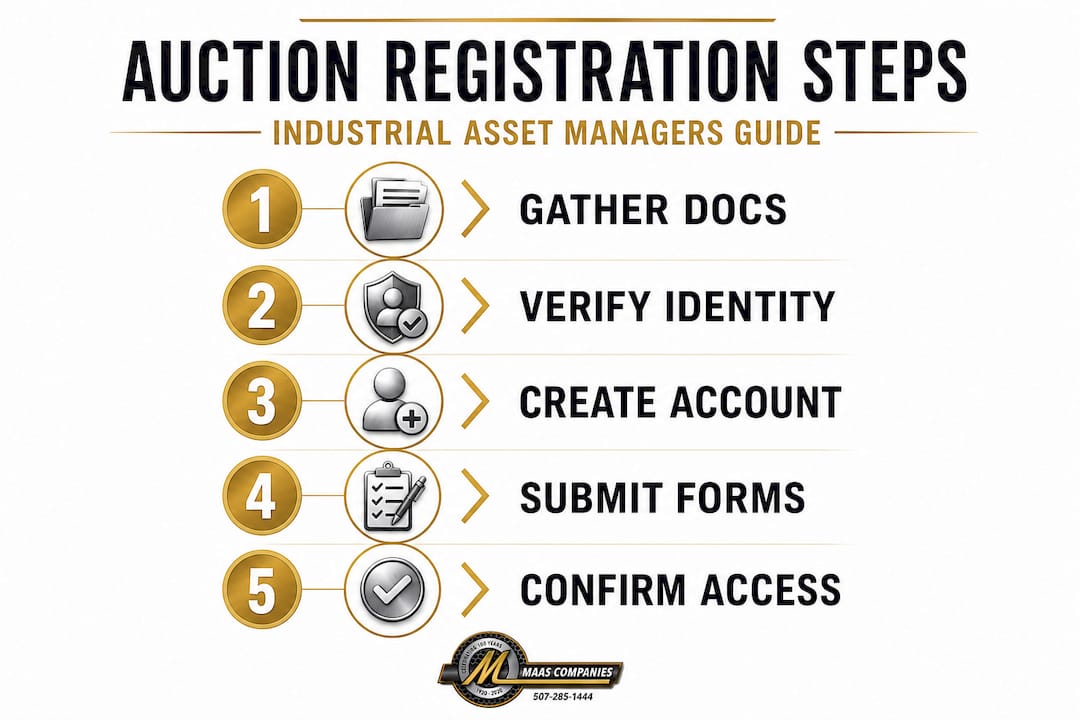
Core documents and credentials you will typically need
| Document type | Purpose | Notes |
|---|---|---|
| Business registration certificate | Confirms legal entity status | Must match the bidding entity name exactly |
| Tax identification number | Required for transaction reporting | EIN for U.S. entities; VAT for international |
| Proof of authority | Confirms signatory rights | Board resolution or power of attorney |
| KYC documentation | Identity verification for bidder | Government-issued photo ID, utility bill |
| AML verification | Anti-Money Laundering compliance | Bank reference letters, source of funds |
| Banking details | Deposit or wire transfer reference | Voided check or bank letter on letterhead |
| Company address and contact info | Account creation | Physical address, not P.O. Box |
| User login credentials | Platform access | Unique email per bidder; avoid shared logins |
Beyond the documents themselves, account creation on most industrial auction platforms requires a valid corporate email address, a confirmed physical address, and a tax identification number linked to the purchasing entity. Some platforms also require a pre-registration deposit to validate financial capacity before granting access to high-value lot categories.
Auction platforms that handle precision manufacturing requirements or specialized industrial equipment often impose additional technical verification for buyers in regulated industries. If your organization operates in sectors such as aerospace, defense, or chemical processing, you may be required to submit additional compliance documentation confirming your authorization to purchase specific asset types.
Use your organization’s pre-auction checklist to standardize the document collection process across multiple auctions and ensure nothing slips through the cracks. Consistency at this stage dramatically reduces rejection rates.
- Verify that all documents are current (not expired) and match the legal name of your bidding entity
- Confirm your tax ID is correctly formatted for the jurisdiction of the auction house
- Ensure proof of authority documents have been signed by the appropriate authorized signatories
- Prepare certified translations for any documents issued in a foreign language
- Organize all files in a single digital folder for fast upload during registration
Pro Tip: Create a “registration-ready” folder on your shared drive containing all standard auction documents. Refresh it quarterly so that credentials are always current. This eliminates the scramble that occurs when an attractive auction is announced with a short registration window.
The timing of preparation matters as much as the completeness of your documents. Registering 24 to 48 hours before the deadline gives your team time to address any platform-side issues, such as file format rejections or verification delays, before the window closes.

Step-by-step industrial auction registration process
Once you have all required documents, you’re ready to follow the auction registration process. Here’s the step-by-step you can’t miss.
-
Select your auction platform. Identify whether the auction is being conducted through a dedicated industrial auction house, a general commercial platform, or a live onsite event with a digital component. Your platform choice affects how registration works, what documents are accepted, and how quickly approval is granted.
-
Create or log into your corporate account. Use a dedicated company email address. Avoid personal email accounts, as these can complicate compliance verification and may not be accepted on platforms serving high-value transactions.
-
Complete your company profile. Enter your legal entity name, registered address, tax identification, and contact information. Accuracy here is critical. Even a minor discrepancy between your profile and your uploaded documents can trigger a manual review or outright rejection.
-
Upload required documents. Submit your business registration certificate, KYC documentation, AML materials, and proof of authority. Most platforms accept PDF format. Ensure file sizes meet platform specifications and that documents are clearly legible.
-
Complete KYC and AML verification. Some platforms process this instantly through automated systems. Others use third-party verification services that may take 24 to 48 hours. High-value industrial auctions should be expected to require the longer review window.
-
Select the specific auction you wish to join. Navigate to the auction listing and click to register for that event. General account creation and auction-specific registration are often separate steps on major platforms.
-
Review and agree to terms and conditions. Register for the specific auction early, agree to the buyer’s premium (typically 10 to 15%) and “as-is where-is” terms before submitting. Do not click through these terms without reading them. The buyer’s premium is added directly to your winning bid and is a real cost that must be factored into your bidding strategy. “As-is where-is” means the asset is sold in its current condition, at its current location, with no warranties or representations from the seller.
-
Submit registration and await confirmation. After submission, most platforms issue an automated confirmation email. Do not assume that this email constitutes full approval. Many platforms distinguish between registration submission and registration approval.
Pro Tip: Register 24 to 48 hours in advance rather than the day of the auction. This gives you a meaningful troubleshooting window if documents are rejected, verification stalls, or technical issues arise. Last-minute registration leaves no room for correction.
Online versus onsite registration: Key differences
| Factor | Online registration | Onsite registration |
|---|---|---|
| Document handling | Digital uploads; file format restrictions apply | Physical copies may be accepted |
| Processing speed | Instant to 48 hours depending on verification | Can be same-day with correct documents |
| Risk of rejection | Higher for automated KYC mismatches | Lower if staff review documents directly |
| Flexibility | Available 24/7 | Limited to auction house business hours |
| Absentee bidding | Fully supported | Requires separate arrangement |
If you plan to use absentee bidding in industrial auctions, confirm that the platform supports it and that your registration is flagged accordingly. Onsite registration may not automatically grant absentee bidding rights. When selecting the right auction for your assets, evaluate both registration complexity and platform support for your preferred bidding method.
Understanding the differences between online vs. onsite registration processes will help your team allocate the right resources and timeline for each auction type.
Avoiding common pitfalls during registration
Even with a good checklist and a step-by-step approach, small oversights can sabotage your participation. Here’s what to watch out for.
Failure to register early or incomplete KYC can exclude you from the bidding process entirely, with no recourse once the auction has begun. The following pitfalls are among the most frequently observed across industrial asset auctions.
- Inconsistent entity names. If your business registration says “Acme Industrial LLC” but your tax ID is registered under “Acme Industrial,” the mismatch will likely trigger a manual hold or rejection. Use exactly the same legal name across every document.
- Expired credentials. Business licenses, KYC documents, and certificates of good standing have expiration dates. Submitting an expired document is one of the most common causes of registration denial.
- Misunderstanding “as-is where-is” terms. Asset managers who have not previously participated in industrial auctions sometimes assume that auction-listed assets have been inspected, serviced, or tested. They have not. All risk transfers to the buyer at the moment of purchase. Review the auction terms explained in detail before committing.
- Overlooking the buyer’s premium in budget calculations. A 12% buyer’s premium on a $500,000 lot is $60,000 in additional cost. Failing to account for this can erode the financial rationale for the acquisition entirely.
- Registering minutes before the deadline. Platforms have technical issues. Document uploads fail. Verification services go offline. Registering at the last minute leaves your participation vulnerable to factors entirely outside your control.
- Using shared or personal login credentials. Platforms track bidding activity by account. Shared logins create compliance risk and can result in account suspension at the worst possible time.
“Early, complete compliance is the simplest way to secure your seat at the auction table.” This principle applies equally to the administrative side of industrial asset acquisition as it does to technical due diligence. The organizations that consistently win the most competitive lots are those that treat registration as a strategic activity, not an administrative afterthought.
Document discipline is not bureaucratic overhead. It is risk management. Organizations that standardize their registration process across multiple auction platforms report significantly fewer rejected registrations and far less time spent on resubmissions and appeals.
Confirming registration and next steps for efficient bidding
With the hard part behind you, let’s ensure your registration is verified and you’re fully prepared for efficient, competitive bidding.
Check registration approval and test your access before auction day to prevent technical issues from disrupting your participation at a critical moment. Confirmation email receipt is not the same as approved bidder status.
-
Log into the platform dashboard and check your status. Look for a clear “Approved” or “Active Bidder” designation on your account. If your status shows “Pending” or “Under Review” within 24 hours of the auction, contact the auction house directly.
-
Confirm deposit requirements are met. Some auctions require a good-faith deposit before bidding access is granted. Verify that your deposit has cleared and is reflected on your account.
-
Review the lot catalog and set your bidding parameters. Confirm which specific lots you are approved to bid on. Certain high-value or regulated asset categories may require separate authorization even within the same auction.
-
Set calendar alerts and notifications. Configure alerts for the auction start time, lot order, and any preview or inspection windows. Many platforms allow email or SMS notifications for auction activity.
-
Run a test login and platform walkthrough the day before. Confirm that your bidding credentials work, that your browser or app is compatible with the platform interface, and that your internet connection is stable. This is especially important for auctions where bidding moves quickly and milliseconds matter.
Pro Tip: Test your login and bidding interface during business hours the day before the auction. If you encounter technical issues, you will have time to reach platform support before they close for the day.
If your registration is denied at any stage, do not wait to escalate. Contact the auction house immediately, request a specific explanation of the deficiency, and resubmit corrected documentation as quickly as possible. Some platforms allow same-day corrections if the auction has not yet opened for bidding. Understanding how to speed up asset disposition begins with ensuring your team can access the bidding process without interruption.
Why auction registration is simpler, and riskier, than most realize
To frame everything you’ve learned, here’s a reality check on the registration process from an industrial auction insider’s perspective.
Online auction systems have dramatically reduced the friction of registration. What once required in-person appearances, notarized documents, and extended processing times can now be completed in under 30 minutes on a well-designed platform. This accessibility is genuinely valuable for asset managers working across multiple auctions simultaneously or across different geographies.
But ease of access creates a specific risk. When registration feels fast and simple, experienced professionals sometimes treat it as a low-priority task. They underestimate the depth of the compliance review happening behind the interface. High-value industrial asset sales still involve strict vetting, and the simplicity of the form does not reflect the complexity of what the platform is checking. A clean-looking upload screen is not evidence that your documents will pass review.
The “as-is where-is” clause is the most underestimated element in industrial auction participation. Asset managers focused on recovery value and liquidation timelines sometimes move through registration so quickly that they treat terms acceptance as a formality. It is not. That clause determines your liability exposure and your recourse options once the lot is transferred. Misunderstanding it is not a registration error. It is a financial risk management failure.
The organizations that perform best in industrial auctions are defined by their detail orientation at the registration stage. They maintain current document libraries, they submit early, they verify approval status, and they understand every term they agree to. Maximizing asset recovery in a competitive auction environment starts well before the bidding opens. It starts the moment the auction is announced and your team begins preparing for registration.
Ready to register? Unlock industrial auction opportunities with expert support
If you’re poised for your next industrial auction, expert support can turn readiness into ROI.
Maas Companies specializes in marketing industrial plants, equipment, real estate, and commercial properties through structured auction processes that are designed to maximize recovery for sellers and provide clear, accessible opportunities for qualified buyers. Our team understands the full registration lifecycle and works to ensure that all parties can participate efficiently and compliantly.
Whether you are looking at selling industrial equipment or seeking to understand how to participate as a buyer in upcoming auction events, the Maas Companies team provides the guidance and structure to support your goals. Explore our Maas services portfolio to learn how we bring together aggressive marketing, verified buyer networks, and experienced auction management to deliver results across the full spectrum of industrial asset liquidation.
Frequently asked questions
How long does industrial auction registration usually take?
Most industrial auction registrations are completed in 15 to 30 minutes, but corporate paperwork review and KYC verification may require 24 to 48 hours for approval, so early submission is essential.
What is a buyer’s premium and how does it affect my costs?
A buyer’s premium is an additional fee, typically 10 to 15%, added on top of your winning bid, meaning your total acquisition cost will exceed the hammer price by that percentage.
Can I register on the day of the auction?
It is risky to wait until auction day, as many platforms require registration 24 to 48 hours in advance to complete document review and compliance verification before bidding access is granted.
Are online industrial auction registrations secure?
Reputable platforms use encrypted data transmission and require multi-step identity verification, but you should always confirm the site’s legitimacy and review its data handling policies before submitting corporate credentials.
What happens if my registration is denied?
Contact the auction house immediately to request a specific explanation of the deficiency, then correct and resubmit your documentation as quickly as possible before the auction closes for bidder entry.
Recommended
- How Auctions Help Speed Up Industrial Asset Disposition | Blog | Insights on Asset Liquidation and Auction Trends
- How to Choose the Right Auction for Industrial Equipment | Blog | Insights on Asset Liquidation and Auction Trends
- Auction lots for industrial asset sales: maximize value | Blog | Insights on Asset Liquidation and Auction Trends
- How Auctions Help Speed Up Industrial Asset Disposition | Blog | Insights on Asset Liquidation and Auction Trends