
Blog
Auction Solutions for Corporate Industrial Asset Recovery

For corporate and institutional sellers facing a plant closure, lender-ordered liquidation, or surplus equipment disposal, professional auction solutions deliver the fastest, most defensible path to maximum recovery. The recommended first step is a confidential asset evaluation with a qualified provider who can assess your specific asset categories and recommend the right sale format.
The scope of a managed program typically covers:
- Industrial plants and process equipment (manufacturing, energy, food processing, agriculture)
- Commercial real estate and land parcels tied to operational facilities
- Surplus inventory, vehicles, and specialty assets across healthcare, education, and contractor operations
- Court-ordered, lender-ordered, and government foreclosure liquidations requiring documented chain of control
Sale formats range from live onsite auctions and timed online events to hybrid programs and negotiated private treaty sales, depending on asset type, buyer pool, and timeline constraints.
Table of Contents
- What professional auction solutions cover and when each type fits
- What does the end-to-end auction process look like?
- How do you choose the right auction partner?
- A representative Maascompanies project: biodiesel plant liquidation
- What does Maascompanies offer for industrial asset recovery?
- Key Takeaways
- A practical note on industrial asset recovery
- Ready to request a confidential asset evaluation from Maascompanies?
- Sources and further reading
What professional auction solutions cover and when each type fits
Auction management systems today support several distinct sale formats, each suited to different recovery objectives.
- Onsite/live auctions create competitive urgency and work well for large industrial plants where buyers need to inspect equipment in person before bidding.
- Timed online auctions extend geographic reach, attract remote bidders, and are well-suited to surplus equipment lots where condition can be documented photographically.
- Hybrid events combine a live floor with simultaneous online bidding, maximizing buyer participation without sacrificing the price discovery of a competitive room.
- Negotiated/private treaty sales apply when a buyer pool is narrow, assets are highly specialized, or confidentiality is a priority for the seller.
- Managed marketplace placements work for ongoing surplus inventory where assets are listed continuously rather than cleared in a single event.
| Format | Sale speed | Buyer reach | Price discovery | Compliance fit |
|---|---|---|---|---|
| Onsite/live auction | Fast (single day) | Regional/national | High | Strong for court/lender orders |
| Timed online auction | Moderate (days–weeks) | National/global | Moderate–high | Suitable with proper KYC controls |
| Hybrid auction | Fast | Broadest | High | Strong |
| Negotiated/private treaty | Slower | Targeted | Moderate | Requires documented process |
| Managed marketplace | Ongoing | Global | Variable | Depends on platform controls |
For industrial equipment dispositions, the hybrid format increasingly delivers the best combination of buyer competition and geographic reach, particularly when assets include both high-value process equipment and ancillary inventory that attracts different buyer segments.
What does the end-to-end auction process look like?
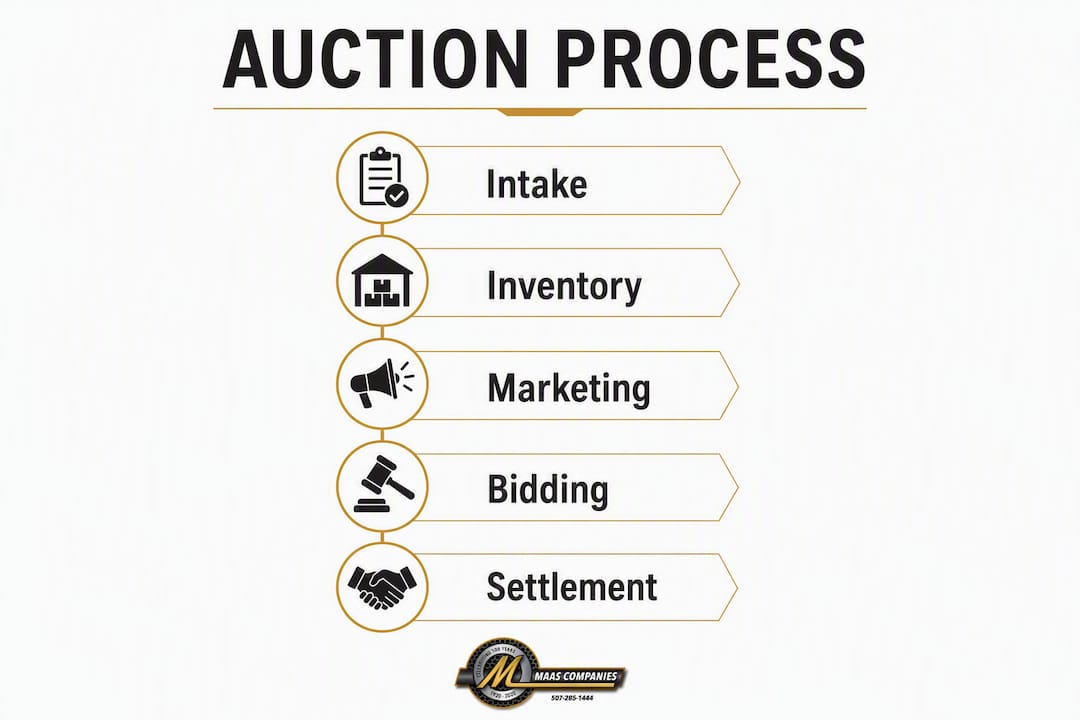
A professionally managed industrial auction runs from initial intake through final asset removal in a structured sequence, typically spanning 8–16 weeks for a large disposition. Here is how each phase unfolds:
- Intake and asset inventory (2–4 weeks): The provider conducts a site visit, catalogs assets, and identifies title, lien, and legal encumbrances that must be resolved before sale.
- Valuation and engineering review (1–3 weeks, overlapping): Independent appraisals or internal valuations establish reserve guidance; engineering inspection documents condition for the catalog.
- Title and legal clearance (1–3 weeks): For court-ordered or lender-ordered sales, counsel confirms the authority to sell and any required court approvals or lender sign-offs.
- Staging, photography, and catalog production (2–4 weeks): Assets are organized into lots, photographed, and described with technical specifications. Effective lotting strategy directly affects hammer prices.
- Targeted marketing and buyer outreach (3–6 weeks, concurrent with catalog): The marketing plan distributes the catalog to qualified industrial buyers, trade publications, and direct outreach lists. Large industrial dispositions succeed when marketing reaches both technical buyers (maintenance and operations teams) and financial buyers; blending technical specifications with asset provenance history is critical.
- Bidding event (1 day to 2 weeks depending on format): Live, timed, or hybrid bidding is conducted under documented procedures.
- Settlement and invoicing (1–3 weeks): Buyers remit payment per stated terms; funds are held in escrow and disbursed to the seller net of fees. Unified auction platforms reduce settlement errors and accelerate buyer reconciliation, which shortens the time from sale to cash.
- Asset removal and logistics (1–4 weeks post-sale): Buyers coordinate removal per contract terms; the provider manages site access, scheduling, and compliance with removal deadlines.
- Post-sale reporting: The provider delivers a final accounting, hammer results by lot, buyer data, and any required court or lender documentation.
| Phase | Typical duration | Key milestone |
|---|---|---|
| Intake and inventory | 2–4 weeks | Asset list confirmed |
| Valuation and legal clearance | 1–3 weeks | Authority to sell confirmed |
| Catalog and marketing | 3–6 weeks | Catalog published, outreach complete |
| Bidding event | 1 day–2 weeks | Hammer prices recorded |
| Settlement and removal | 2–7 weeks | Funds disbursed, site cleared |
Fee structures vary by project scope. Commission rates are typically negotiated as a percentage of gross proceeds, with pass-through expenses (photography, advertising, removal coordination) itemized separately. Payment terms commonly require buyer deposits at the time of bidding, with full settlement within 5–10 business days of the auction close.
How do you choose the right auction partner?
Track record with comparable asset categories and legal contexts is the single most important selection criterion. A provider experienced in industrial equipment auctions will have documented hammer results, established buyer lists in the relevant industries, and familiarity with the compliance requirements of court-ordered or lender-ordered sales.
Decision criteria to evaluate:
- Documented case studies with sell-through rates and gross recovery figures for similar asset types
- Geographic reach and active buyer database in the relevant industry verticals
- Written marketing plan with specific distribution channels, buyer outreach lists, and timeline commitments
- Settlement and escrow controls, including proof of bonding or insurance
- Experience with court-ordered and lender-ordered processes, including required documentation
- Logistics capability for large-scale asset removal coordination
Questions to ask during shortlisting:
- Can you provide three recent case studies for assets similar to ours, with hammer results?
- What is the size and composition of your active buyer database for this asset category?
- What does your marketing plan include, and which channels will you use?
- How do you handle escrow, and what are your standard payment terms?
- What is your experience with court-ordered or lender-ordered liquidations?
- Who manages title and legal clearance, and what is the timeline?
- How are removal deadlines enforced, and what happens if a buyer defaults?
- What KYC and anti-money-laundering procedures do you follow for buyer registration?
- What insurance do you carry, and does it cover assets in your custody?
- What reporting will we receive post-sale, and in what format?
Red flags to watch for: vague marketing plans with no named channels or buyer lists; no documented escrow or settlement process; unclear removal logistics; unverified buyer registration procedures; reluctance to provide prior hammer results.
Pro Tip: Request a sample marketing plan from any shortlisted provider before signing. A credible firm will produce a project-specific plan, not a generic brochure. Also confirm that the contract specifies removal deadlines with financial penalties for buyer default, since uncleared assets create carrying costs that erode net recovery.
A representative Maascompanies project: biodiesel plant liquidation
Maascompanies executed an online-only auction for a 5 MMGY biodiesel plant in Arapahoe and Lexington, Nebraska, covering oilseed, soybean, and hemp cleaning equipment. The trigger was a facility closure requiring orderly disposition of specialized process equipment across multiple asset categories.
The project demonstrated that a timed online format, combined with targeted outreach to technical and commodity-processing buyers, can achieve competitive bidding on highly specialized industrial equipment that would otherwise attract only a narrow local audience. Buyer reach extended well beyond the regional market, producing competitive hammer prices on assets that a purely local sale would have underpriced.
The lesson for procurement and operations leaders: format selection must match the buyer pool, not just the timeline. Specialized process equipment requires a marketing program that finds the right buyers nationally, and a timed online format removes geographic barriers without sacrificing competitive tension.
What does Maascompanies offer for industrial asset recovery?
Maascompanies provides end-to-end auction and negotiated sale services for industrial asset recovery, with documented experience in court-ordered and lender-ordered liquidations across manufacturing, energy, hospitality, healthcare, education, agriculture, and contractor inventory.
Service modules include:
- Confidential asset evaluation and project scoping
- Valuation, engineering review, and catalog production
- Targeted buyer outreach and multi-channel marketing
- Live, timed, and hybrid auction execution
- Settlement, escrow, and disbursement management
- Asset removal coordination and logistics oversight
- Post-sale reporting and documentation for lender or court requirements
Differentiators: Maascompanies combines global buyer outreach with industry-tailored marketing that addresses both technical and financial buyer segments. Settlement controls and documented chain-of-control procedures meet the requirements of court and lender-ordered processes. Prospective clients can initiate a confidential evaluation by contacting Maascompanies directly with asset type, location, and project timeline.
Key Takeaways
Auction solutions deliver maximum recovery when the format, marketing, and settlement process are matched to the asset category and the legal context of the sale.
| Point | Details |
|---|---|
| Format selection matters | Match the auction format to your buyer pool: hybrid and timed online events extend reach for specialized industrial assets. |
| Timeline expectations | A full managed program typically runs 8–16 weeks from intake to site clearance for large industrial dispositions. |
| Provider selection priority | Prioritize documented case studies, active buyer databases, and experience with court/lender-ordered processes. |
| Fee model | Commission rates are negotiated as a percentage of gross proceeds; pass-through expenses are itemized separately. |
| Maascompanies | Provides end-to-end industrial auction and negotiated sale services, including court- and lender-ordered liquidations, with global buyer outreach. |
A practical note on industrial asset recovery
The most consistent mistake in large industrial dispositions is treating the auction as a logistics event rather than a marketing program. Timing matters, but buyer reach matters more. Projects that underperform almost always share a common cause: the marketing plan reached too narrow an audience, too late, with insufficient technical detail to attract qualified bidders.

Across multiple industrial liquidations, the projects that achieve the strongest recovery are those where the marketing plan is built before the catalog is finalized, not after. Technical buyers need lead time to evaluate process equipment, arrange financing, and plan removal logistics. Financial buyers need provenance and usage history to assess residual value. A marketing program that addresses both audiences simultaneously, through direct outreach, trade publications, and digital distribution, consistently produces more competitive bidding than one that relies on a single channel or a generic listing.
The other variable that executives often underestimate is settlement speed. A provider with documented escrow controls and unified back-office procedures closes the gap between hammer price and cash in hand. That gap has real carrying-cost implications, particularly in lender-ordered or court-supervised sales where the clock is running.
Ready to request a confidential asset evaluation from Maascompanies?
Maascompanies works with corporate sellers, lenders, and legal professionals to structure and execute industrial asset recovery programs that maximize net proceeds. The intake process is straightforward and confidential.
To prepare for an initial evaluation, have the following ready:
- Asset type and general inventory scope (equipment categories, real estate, inventory)
- Facility location and access status
- Trigger event (plant closure, restructuring, lender-ordered sale, surplus disposal)
- Target timing or any court/lender deadlines
Request a confidential evaluation to discuss your project with the Maascompanies team. For a full overview of available service modules, the Maascompanies services portfolio outlines the complete range of auction, negotiated sale, and marketing consultation options.
Sources and further reading
The following sources support claims made in this article and are provided for verification and further research. Readers should use the provider-selection checklist in this article when evaluating any vendor.
Maascompanies pages (primary source for service claims):
- Maascompanies corporate overview — service scope, industries served, and positioning as a strategic asset recovery partner
- Online-only auction: 5 MMGY biodiesel plant, Nebraska — project-level evidence of auction format and asset scope
- Seller intake and confidential evaluation — primary conversion page for prospective sellers
External resources (for technology and industry context):
- Circuit Auction AI — auction management platform illustrating cataloging, settlement, and bidding technology at scale
- BidHarvest — unified auction back-office platform demonstrating settlement and payment integration capabilities
- Artisio — cloud-based auction management system with multi-branch and financial reporting features
- AuctionMethod — auction software platform covering lot management, bidder registration, and reporting
- WJ Prototypes: industrial machinery categories — manufacturer context for understanding industrial equipment buyer segments
These sources are provided for verification. Vendor selection should follow the criteria and questions outlined in the provider-selection section of this article. This article is general information, not legal or financial advice; confirm applicable requirements with qualified legal or financial counsel for your specific situation.
Recommended
- How Auctions Help Speed Up Industrial Asset Disposition | Blog | Insights on Asset Liquidation and Auction Trends
- Why Auctions Outperform Private Sales for Industrial Asset Recovery | Blog | Insights on Asset Liquidation and Auction Trends
- How Auctions Help Speed Up Industrial Asset Disposition | Blog | Insights on Asset Liquidation and Auction Trends
- Auction terminology explained for industrial asset recovery | Blog | Insights on Asset Liquidation and Auction Trends