

Blog
Auction terminology explained for industrial asset recovery

TL;DR:
- Precise understanding of auction terms like reserve price and buyer’s premium is essential for maximizing recovery.
- Misunderstanding key terms can lead to lower sale prices and unexpected costs, reducing net proceeds.
- Choosing the appropriate auction format and clarifying contractual language improves bidding competitiveness and outcomes.
Auction terminology is often dismissed as background noise by investors who assume the bidding process speaks for itself. That assumption is costly. In industrial asset liquidation, a single misunderstood term, whether it is the reserve price, buyer’s premium, or as-is condition, can quietly erode recovery value before the hammer even falls. This guide is built for investors and asset managers who need to operate with precision in high-stakes auction environments. You will find clear definitions, practical frameworks, and recovery benchmarks that connect terminology directly to outcomes. Mastering this language is not optional; it is the foundation of any effective liquidation strategy.
Table of Contents
- Why auction terminology matters in industrial asset sales
- Essential auction terms explained
- Types of auction methods and their terms
- Auction terminology in the context of asset liquidation benchmarks
- What most guides miss about auction terminology in practice
- Unlock better recovery with expert-guided auctions
- Frequently asked questions
Key Takeaways
| Point | Details |
|---|---|
| Master auction language | Knowing essential auction terminology can directly impact your asset recovery results. |
| Pick the right method | Different auction formats use unique terms—choose the one that matches your asset and goals. |
| Benchmark for value | Understanding terminology helps you compare expected recovery rates and set realistic goals. |
| Clarify all costs | Fees, premiums, and contractual terms can reduce net proceeds if not understood up front. |
| Partner for success | Expert support makes navigating auction jargon and optimizing liquidation smoother and more profitable. |
Why auction terminology matters in industrial asset sales
In industrial asset sales, the difference between a well-executed liquidation and a disappointing one often comes down to preparation, and preparation starts with language. Precise understanding of auction terms directly shapes the strategies you bring to the table and the final recovery values you walk away with.
Auctions remain the preferred method for industrial asset disposition because they create transparent, competitive pricing under defined timelines. The auction speed benefits are well documented: faster conversion of assets to cash, reduced carrying costs, and clear market-driven pricing. But those advantages only materialize when all parties understand the rules of engagement.
“Online industrial auctions reach 10M+ global viewers for maximum visibility, making format selection and terminology clarity critical to competitive outcomes.”
Terminology gaps create real operational risk. Consider these common challenges asset managers face when auction language is unclear:
- Reserve price confusion: Setting the reserve too high stalls the sale; too low, and you leave recovery on the table.
- Buyer’s premium miscalculation: Sellers sometimes forget that buyer’s premiums affect bidder behavior, not just the buyer’s final cost.
- As-is liability exposure: Failing to understand what “as-is, where-is” means legally can expose sellers to post-sale disputes.
- Bid increment surprises: Increments set by the auctioneer can slow competitive tension and reduce final hammer prices.
- Fee stacking: Multiple additive fees, including buyer’s premiums, documentation fees, and removal charges, can distort your net recovery estimate.
Selecting the right auction channel is equally important, and that decision is impossible to make wisely without understanding what each format’s terminology commits you to.
Pro Tip: Always request a full fee schedule and reserve structure in writing before committing assets to any auction. Verbal assurances are not enforceable, and surprises at settlement reduce net recovery.
The bottom line is that auction methodologies vary significantly, and each one carries its own contractual language. Treating terminology as a formality rather than a strategic input is one of the most avoidable mistakes in industrial asset management.
Essential auction terms explained
With the stakes established, it is time to define the terms that matter most. The following table maps each core auction term to its plain-English definition and its practical impact on your industrial asset disposition.
| Term | Plain-English definition | Auction impact |
|---|---|---|
| Reserve price | Minimum acceptable bid set by the seller | Protects against underselling; if not met, asset may not sell |
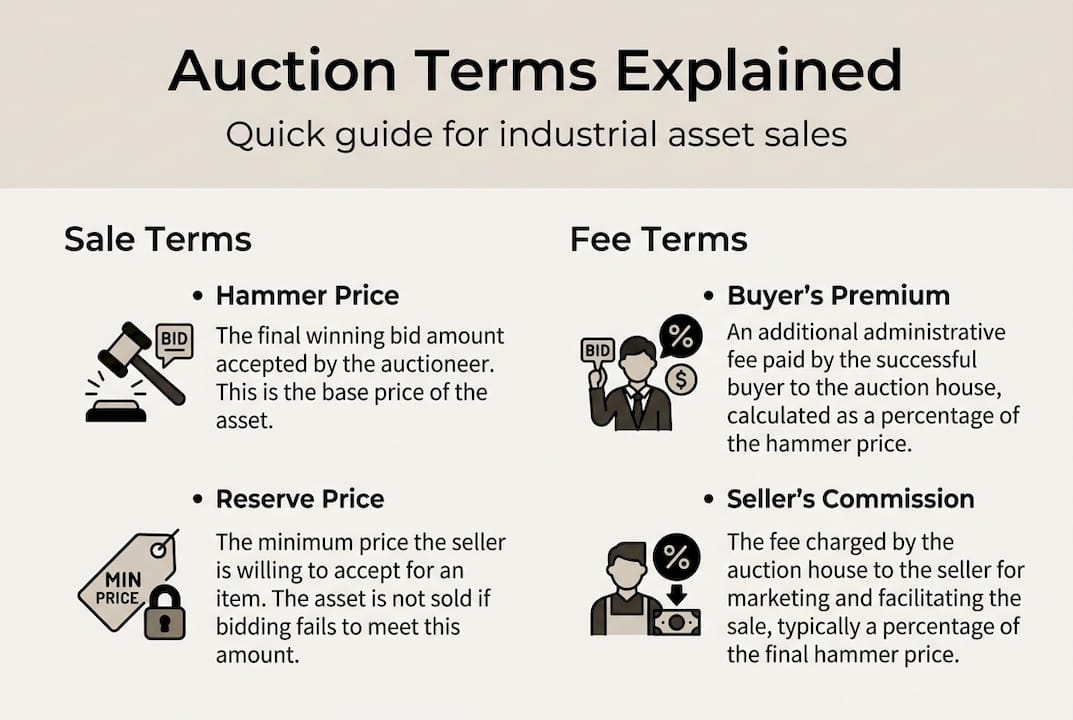
| Hammer price | Final accepted bid when the auctioneer closes bidding | The gross sale price before fees |
| Buyer’s premium | Fee added to hammer price, paid by the buyer | Increases total buyer cost; affects bidder participation |
| Bid increment | Minimum amount each new bid must exceed the previous | Controls pace and competitive tension |
| As-is condition | Asset sold without warranties or guarantees | Seller liability ends at sale; buyers assume all risk |
| Lot | A grouped set of assets sold together | Bundling strategy affects individual item recovery |
| Timed extension | Automatic time added when a bid arrives near closing | Prevents sniping; encourages final competitive bids |
| Absolute auction | No reserve; highest bid wins regardless of price | Maximizes participation but carries downside risk |
According to liquidation ROI guidelines, preparation and terminology clarity are among the top factors in improving auction outcomes. Here is a numbered process for applying these terms during an actual industrial sale:
- Define your reserve price before engaging an auctioneer, based on minimum acceptable recovery thresholds.
- Calculate total net recovery by subtracting buyer’s premium, auctioneer fees, and removal costs from the expected hammer price.
- Review lot structure to determine whether bundling or individual listings maximize competitive interest. Reviewing auction lots best practices can guide this decision.
- Confirm bid increment schedules in advance to ensure they support competitive bidding rather than slowing it down.
- Clarify as-is terms with legal counsel to ensure your liability exposure is properly defined and disclosed.
Statistic callout: Industrial liquidation auctions recover 28-35% of net book value on average, making fee awareness and reserve-setting critical to maximizing that range.
Misunderstanding “as-is” condition is one of the most common and costly errors in industrial sales. Buyers who discover post-sale defects they believe were concealed may pursue legal remedies, creating carrying costs and delays that wipe out recovery gains. Similarly, failing to account for buyer’s premium when modeling expected proceeds leads to settlement surprises that undermine stakeholder confidence.

Types of auction methods and their terms
Not all auctions operate the same way, and the terminology shifts depending on the format. Understanding those differences helps you select the right approach and anticipate the contractual language you will encounter.
Auction types include online/timed, live onsite, tender (sealed bid), and marketed/private treaty, each with distinct rules and terminology implications.
| Auction format | Key terms | Best suited for |
|---|---|---|
| Online/timed | Timed extension, proxy bid, reserve, buyer’s premium | Wide-reach asset sales; equipment with national buyer pools |
| Live onsite/webcast | Hammer price, floor bid, absentee bid, bid increment | High-value single assets; plant closures with local interest |
| Tender (sealed bid) | Bid submission deadline, minimum tender price, award criteria | Sensitive disposals; regulated or government-linked assets |
| Private treaty | Asking price, negotiated price, exclusivity period | Complex assets; situations requiring confidentiality |
Each format suits different circumstances:
- Online/timed auctions work well for equipment with a broad national or international buyer base.
- Live onsite or webcast auctions generate competitive floor energy and are effective for plant closures or large equipment lots.
- Tender processes are appropriate when confidentiality, regulatory compliance, or asset complexity requires controlled bidding.
- Private treaty suits unique or high-value assets where negotiation produces better outcomes than open competition.
For sellers weighing format options, reviewing how to choose the right auction provides a structured decision framework. If you plan to participate remotely, understanding absentee bidding strategies is essential to avoid being outmaneuvered by floor bidders.
For context on where auctions fit within broader exit strategies, the auction vs M&A process comparison is instructive, particularly for asset managers evaluating multiple disposition paths simultaneously.
Pro Tip: In online auctions, always review the timed extension rules before listing. Some platforms extend bidding by 2-5 minutes per late bid, which can significantly increase final hammer prices. Others do not, making last-second sniping a real risk to competitive outcomes.
Auction terminology in the context of asset liquidation benchmarks
Knowing the terms is necessary. Knowing how they connect to actual recovery outcomes is where strategy becomes actionable. The following benchmarks give asset managers a realistic baseline for evaluating auction performance.
| Disposition method | Typical recovery range | Key terminology driver |
|---|---|---|
| Industrial auction (online/live) | 23-51% of fair market value | Reserve price, buyer’s premium, bid increments |
| Private treaty/negotiated sale | Variable; potentially higher with time | Asking price, exclusivity, negotiated terms |
| Tender process | Moderate; depends on buyer pool | Minimum tender price, submission deadline |
| Scrap/distressed liquidation | 5-15% of book value | As-is condition, lot structure, removal terms |
“Auctions typically recover 23-51% of fair market value, while private sales and M&A may achieve more depending on timeline and buyer availability.”
The following recovery strategies are directly tied to proper term application:
- Set the reserve strategically: A reserve that reflects current market conditions, not original book value, prevents failed auctions and preserves credibility with buyers.
- Model net recovery, not gross: Subtract buyer’s premium, auctioneer commissions, and logistical costs from the hammer price to get an accurate picture of realized value.
- Use lot structure to drive competition: Grouping complementary assets into well-defined lots, informed by asset recovery strategies, can increase per-unit recovery.
- Disclose as-is terms clearly: Transparent disclosure reduces buyer hesitation and supports higher bids by reducing perceived risk.
- Prepare documentation in advance: A thorough pre-auction checklist ensures that title documents, maintenance records, and condition reports are ready, which directly supports higher bids.
For a detailed comparison of private sale ROI versus auction outcomes, the data consistently shows that timeline and buyer pool size are the two variables that most influence final recovery, both of which are shaped by the auction format and its associated terminology.
What most guides miss about auction terminology in practice
Most articles on auction terminology stop at definitions. That is useful, but it misses the operational reality that experienced asset managers encounter in the field.
The real risk is not misunderstanding the headline terms. It is overlooking the fine print: additive premiums, stacked fees, and “as-is, where-is” clauses that shift liability in ways that are not immediately obvious. We have seen transactions where the buyer’s premium alone reduced net recovery by 8-12 percentage points relative to initial projections, simply because it was not factored into the seller’s model.
Competitive tension is another area where terminology mastery pays off. Bid increment structures, extension rules, and reserve placement all influence whether a room, physical or virtual, reaches its competitive ceiling. Seasoned operators know to scrutinize these elements before signing any auction agreement.
The uncomfortable truth is that urgency in distressed asset scenarios often leads to shortcuts in contract review. That is precisely when terminology traps are most dangerous. Insisting on clarity before committing assets is not a sign of inexperience; it is the standard practice of operators who consistently achieve strong recovery outcomes. Pairing that discipline with well-tested small business auction strategies produces measurably better results.
Pro Tip: Before signing any auction agreement, request a line-item breakdown of all fees, including buyer’s premium, seller’s commission, marketing costs, and removal charges. Compare that against your minimum acceptable net recovery before proceeding.
Unlock better recovery with expert-guided auctions
Understanding auction terminology is a significant advantage, but applying it effectively under real-world time pressure is where expert partnership makes the difference. At Maas Companies, we work directly with investors and asset managers to clarify contractual terms, structure auction strategies, and execute liquidation plans that maximize recovery across all asset classes.

Our team brings hands-on experience across industrial plant closures, equipment liquidations, and commercial property sales worldwide. Whether you are preparing your first auction or optimizing a multi-asset disposition, we can help you navigate the terminology, select the right format, and position assets for the strongest possible outcome. Explore your options at our sell industrial equipment page, or review our full range of specialized auction solutions to find the right fit for your recovery goals.
Frequently asked questions
What is the difference between ‘hammer price’ and ‘reserve price’ in auctions?
The hammer price is the final winning bid accepted by the auctioneer, while the reserve price is the minimum the seller will accept. If bidding does not reach the reserve minimum, the asset may be withdrawn from sale.
What is a buyer’s premium and how does it affect final cost?
A buyer’s premium is a fee added on top of the hammer price and paid by the winning bidder. It typically ranges 10-25% and must be factored into total acquisition cost calculations.
How do online and live auctions differ for industrial asset sales?
Online auctions offer broader reach with timed extensions, while live formats generate direct competitive energy on the floor. Online auctions reach 10M+ global viewers, making them effective for assets with wide buyer appeal.
What recovery percentage should I expect from an industrial auction?
Most industrial equipment auctions recover between 28-35% of net book value, though outcomes vary based on asset condition, market timing, and auction format selection.
How does due diligence impact auction outcomes?
Thorough due diligence, including asset inspection and documentation review, reduces buyer risk perception and supports stronger bids. Due diligence mitigates as-is liability and improves overall recovery odds significantly.
Recommended
- How Auctions Help Speed Up Industrial Asset Disposition | Blog | Insights on Asset Liquidation and Auction Trends
- How Auctions Help Speed Up Industrial Asset Disposition | Blog | Insights on Asset Liquidation and Auction Trends
- Auction lots for industrial asset sales: maximize value | Blog | Insights on Asset Liquidation and Auction Trends
- Auction absentee bidding: strategies for industrial equipment | Blog | Insights on Asset Liquidation and Auction Trends