

Blog
Bid Deadlines: A Strategic Guide for Asset Sales

TL;DR:
- Bid deadlines are strict, court-enforced cutoffs that determine qualification and auction scheduling in distressed asset sales. Proper management and strategic positioning of these deadlines are essential for maximizing recovery and avoiding disputes during liquidation. Asset managers benefit from clear communication, diligent documentation, and partnering with experienced professionals to ensure a seamless auction process.
In distressed asset markets, a missed bid deadline is not a minor administrative error. It can disqualify a serious buyer, collapse a competitive auction, and reduce recovery values significantly for creditors and stakeholders alike. Asset managers and financial professionals who treat bid deadlines as routine calendar notes often find themselves managing avoidable disputes, frustrated bidders, and compromised liquidation outcomes. This guide cuts through the ambiguity by defining exactly what bid deadlines are, how they function across procurement and bankruptcy sale contexts, and what proven strategies protect both the process and the recovery value of every asset class you manage.
Table of Contents
- What is a bid deadline?
- How bid deadlines shape the auction and liquidation process
- Bid deadline disputes and qualification challenges
- Best practices for setting and managing bid deadlines
- A practical perspective on bid deadlines: what experts get wrong
- Partnering for efficient auctions and seamless asset disposition
- Frequently asked questions
Key Takeaways
| Point | Details |
|---|---|
| Bid deadline defines eligibility | Only bids received by the stated deadline are considered, protecting fairness and process integrity. |
| Timing drives success | Setting the right deadline maximizes bidder participation and auction outcomes. |
| Strategic flexibility matters | Bid deadlines work best when adapted to asset type, market, and process specifics. |
| Manage disputes proactively | Address potential deadline disputes early, during the bid procedure phase for a stronger position. |
What is a bid deadline?
A bid deadline is the precise date and time by which all qualifying offers must be received to be considered valid in a given sale process. It is not a guideline or a suggestion. In formal procurement settings, 48 C.F.R. § 14.302 makes this explicit: bids must be received no later than the exact time set for the opening of bids. Any submission arriving after that moment is disqualified regardless of value or buyer intent.
In distressed asset sales governed by bankruptcy law, the definition carries additional weight. A Section 363 sale process establishes the bid deadline as the court-ordered cutoff by which qualified bids must be submitted before an auction can proceed. This is not simply about closing a submission window. It is about establishing which parties have standing to participate, which bids meet the minimum qualification criteria, and whether the auction itself can be scheduled and confirmed.
The distinction between procurement bid deadlines and distressed asset bid deadlines matters considerably for asset managers operating across both contexts. Review the table below for a direct comparison.
| Feature | Procurement bid deadline | Distressed asset (Section 363) bid deadline |
|---|---|---|
| Who sets it | Contracting officer or agency | Bankruptcy court via bidding procedures order |
| Legal authority | Federal Acquisition Regulation (48 C.F.R.) | Bankruptcy Code and court order |
| Primary purpose | Fair competition in government contracts | Qualify bids, schedule auction, protect creditors |
| Consequences of late bid | Automatic rejection | Disqualification, possible motion to extend |
| Flexibility | Very limited | Moderate, subject to court approval |
| Notification requirements | Published in solicitation | Published in bidding procedures notice |
“Bid deadlines in Section 363 sales are not merely administrative cutoffs. They are judicial orders with enforceable consequences for all parties involved in the estate.”
Understanding how to maximize value in industrial asset sales begins with recognizing that bid deadline compliance is one of the earliest and most consequential steps in that process. Similarly, professionals exploring auction absentee bidding strategies must account for deadline timing in their planning to remain competitive. Even auditing procurement workflows reveals that deadline violations are among the top sources of post-award disputes.
How bid deadlines shape the auction and liquidation process
The timing of a bid deadline does not exist in isolation. It creates a sequenced chain of events that determines how the auction unfolds, who qualifies, and how efficiently the liquidation process moves toward closing.

A Section 363 bidding procedures order typically sets the bid deadline at least 14 to 21 days before the auction itself. This window is designed to give the debtor’s advisors adequate time to review all submitted bids, verify buyer qualifications, confirm deposit requirements, and determine whether a competitive auction is warranted or whether the stalking horse bid will be approved without further competition.
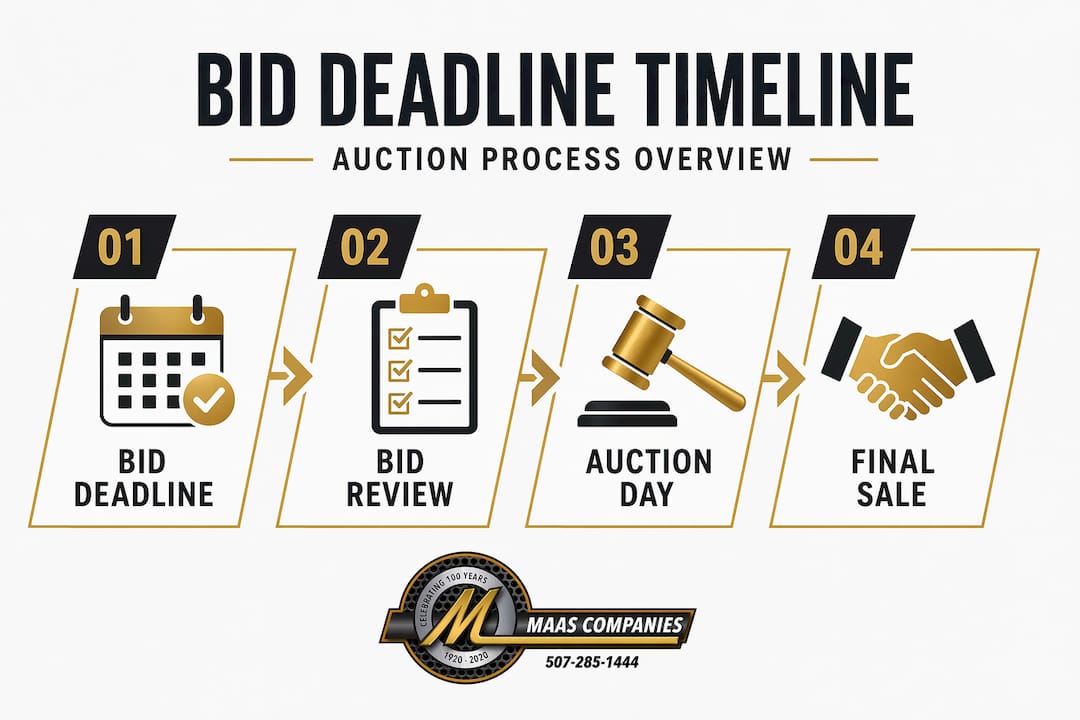
The comparison below illustrates how compressed versus extended bid deadline periods affect the entire liquidation timeline.
| Deadline period | Advantages | Disadvantages |
|---|---|---|
| Compressed (fewer than 14 days before auction) | Faster process, lower carrying costs | Risk of insufficient bidder qualification, disputes, fewer participants |
| Standard (14 to 21 days before auction) | Balanced qualification time, manageable risk | Requires strong upfront marketing to attract bidders |
| Extended (more than 21 days before auction) | More diligence time for complex assets | Carrying costs increase, market interest may wane, stalking horse exposure grows |
What happens between the bid deadline and the auction day is equally important. Asset managers should plan for the following key activities during that window:
- Bid review and qualification: Each submitted bid is assessed against the minimum terms set in the bidding procedures, including deposit amounts, proof of financial capacity, and absence of contingencies.
- Stalking horse comparison: The debtor’s advisors compare all qualifying bids against the stalking horse offer to determine whether competitive bidding will occur.
- Dispute window: Any party objecting to a bid’s qualification status must raise concerns before the auction opens.
- Auction notice: All qualified bidders receive formal notice of the auction date, location, and ground rules.
- Logistical coordination: Equipment access, site security, transfer documentation, and auctioneer communications are finalized.
Pro Tip: Set your internal bid review deadline at least 48 hours before the official external deadline. This buffer allows your team to verify incoming bids, flag incomplete submissions, and communicate with potential bidders who may have encountered technical or procedural issues. It also preserves the integrity of the process by ensuring no bid is accidentally overlooked in the final hours.
Understanding how to speed up industrial asset disposition often comes down to how well the bid deadline is positioned within the overall auction timeline. For real estate portfolios, commercial real estate auction timelines follow similar logic. And when timelines face risk, avoiding auction delays through careful preparation makes the difference between a successful close and a costly postponement.
Bid deadline disputes and qualification challenges
Disputes around bid deadlines are more common than many asset managers anticipate. They tend to cluster around three areas: timing compliance, qualification hurdles, and bid procedure provisions such as credit bid rights.
Timing disputes arise when a bidder claims their submission arrived before the deadline but was logged after it due to technical failure, courier delay, or platform error. These disputes are difficult to resolve retroactively and often require documented proof of submission. Qualification disputes involve disagreements over whether a submitted bid meets the minimum terms established in the bidding procedures order, including deposit thresholds, due diligence access, and the absence of financing contingencies. Credit bid disputes are a specialized category in bankruptcy sales, where secured creditors seek to bid the value of their lien rather than cash.
“Disputes around bid procedures, including credit bidding, are best raised during the bidding procedures phase when the record is most developed and the court can address issues before the auction.” Source: acquisitionstars.com
This guidance has direct practical implications. Waiting until auction day to raise a procedural objection is strategically poor and often procedurally defective. Courts and auctioneers expect challenges to be raised during the procedures hearing, not on auction morning. Asset managers who understand this timeline can position disputes appropriately and protect the integrity of the liquidation process.
To manage a bid deadline dispute effectively, follow these numbered steps:
- Document everything in real time. Maintain timestamped records of all bid submissions, acknowledgment confirmations, and any communications with potential bidders during the open bidding period.
- Issue written acknowledgment of receipt. Every bid received, whether qualified or not, should receive a written confirmation with the exact timestamp of receipt. This record becomes critical if a dispute arises.
- Apply the bidding procedures order literally. Qualify or disqualify bids based strictly on the court-approved or contractually established criteria. Do not exercise informal discretion without authority.
- Communicate decisions promptly. Notify all affected parties of qualification decisions as quickly as possible, giving them maximum time to respond within the permitted window.
- Escalate to counsel when necessary. When disputes involve credit bids, late submissions claiming force majeure, or challenges to the procedures themselves, legal counsel must be involved before any response is issued.
For asset managers selecting the appropriate auction structure, understanding how to choose the right auction is fundamental to avoiding these disputes in the first place. Choosing industrial auctions for asset disposition from a position of knowledge significantly reduces exposure to qualification challenges. And for lenders navigating foreclosure processes, reviewing commercial foreclosure auction questions provides a helpful framework for anticipating procedural complexity. Staying current with procurement-to-payment training also ensures your team understands the compliance landscape surrounding bid submissions and deadline management.
Best practices for setting and managing bid deadlines
Asset managers who consistently achieve strong recovery values treat bid deadline management as a core operational discipline, not a clerical task. The following practices reflect field-tested standards across industrial, real estate, and commercial asset liquidations.
Deadlines that are set too close to the auction date create qualification and analysis problems for both the debtor’s advisors and potential buyers. Deadlines set too far in advance can reduce diligence time and the number of ultimately qualified bidders by giving serious buyers less reason to commit early and more time to find alternative opportunities. The optimal window depends on asset complexity, market conditions, and the size of the potential bidder pool.
The following bullet points outline the core best practices for bid deadline management:
- Confirm the deadline in writing across all channels. Publish the bid deadline in the marketing materials, the bidding procedures notice, your auction platform, and all direct outreach to potential bidders. Redundancy is not excessive here. It is essential.
- Use digital time-stamping for all submissions. Whether bids are submitted by email, online portal, or courier, every receipt must be logged with an irrefutable timestamp. This single practice resolves the majority of timing disputes before they escalate.
- Send deadline reminders at 14 days, 7 days, and 48 hours. Potential bidders are managing multiple priorities. Structured reminders increase participation rates and reduce last-minute scramble on both sides.
- Specify the time zone explicitly and repeatedly. In multi-jurisdictional sales involving international bidders, a deadline of “5:00 PM” is meaningless without a clearly stated time zone. Eastern, Central, and Pacific time differences have caused real disputes in actual auctions.
- Build a no-exception policy into the procedures order. Setting a clear expectation upfront that late bids will not be considered, without exception, protects the auctioneer and the process from pressure to accommodate favored parties.
- Coordinate with your marketing timeline. The bid deadline should fall at the natural end of the marketing campaign, not before it. Asset managers who set deadlines before their marketing effort reaches peak audience exposure leave recovery value on the table.
Pro Tip: Implement a countdown system visible on your auction platform that updates in real time as the bid deadline approaches. Pair this with automated email alerts to all registered interested parties at each major interval. Bidders who feel well-informed and well-supported are significantly more likely to complete their submission and participate competitively in the auction.
Professionals focused on absentee bidding strategies in particular benefit from proactive deadline communication, since they rely on proxy or written bids submitted in advance. Additionally, monitoring developments in AI fraud detection in procurement is increasingly relevant as asset managers adopt digital platforms for bid submission and verification.
A practical perspective on bid deadlines: what experts get wrong
Experienced auction professionals often describe bid deadlines as fixed points in a process. In practice, they are strategic instruments that should be calibrated to market conditions, asset complexity, and the realistic size of the qualified bidder pool.
The conventional view treats a bid deadline as a compliance requirement: set it, publish it, enforce it. That is accurate as far as it goes, but it misses the strategic dimension. A well-positioned deadline generates urgency without compressing the qualification window so tightly that capable buyers walk away. A poorly positioned deadline, even if fully compliant, can produce a thin auction with little competition and a weak final recovery.
The most common mistake we see asset managers make is applying a one-size-fits-all deadline structure regardless of the asset class. A manufacturing plant with environmental liability, specialized equipment, and complex site access requires a longer bidding window than a fleet of vehicles or a portfolio of standard commercial real estate. The bidder pool for a 3 MGY biodiesel facility is narrower than for a warehouse complex, and potential buyers need more time to complete engineering reviews, environmental assessments, and financing arrangements. Compressing the deadline for a complex asset to keep the overall timeline tight often backfires by reducing competition and lowering recovery.
The second overlooked consideration is market timing. Bid deadlines set during major industry conferences, holiday periods, or periods of broad market disruption tend to produce fewer qualified submissions. Experienced asset managers build calendar awareness into their auction scheduling from the start, choosing bid deadlines that land when their target buyer pool is active and engaged.
Understanding auction efficiency insights from this lens reveals that speed and recovery value are not always in tension. A thoughtfully extended deadline that attracts two additional qualified bidders can outperform a fast process that generates only one. The bid deadline, when treated as a strategic lever rather than a procedural checkpoint, becomes one of the most powerful tools available to asset managers seeking maximum recovery.
Partnering for efficient auctions and seamless asset disposition
Applying these principles consistently requires more than process knowledge. It requires an experienced auction partner who understands the mechanics of bid deadline management across industrial, real estate, and commercial asset classes at an international scale.

Maas Companies Inc. brings decades of field-tested expertise to every liquidation engagement, from complex industrial plants to commercial real estate portfolios. Our aggressive, targeted marketing programs are structured to maximize bidder engagement before the deadline and drive competitive participation on auction day. When you are ready to move assets efficiently and recover maximum value, our team is positioned to support every phase of the process. Explore how we can help you sell industrial equipment, review our full Maas services portfolio, or see our current major auction listings for active examples of how we structure high-recovery liquidation processes.
Frequently asked questions
What happens if a bid is received after the deadline?
Late bids are not accepted or considered in most auction and procurement settings. Per 48 C.F.R. § 14.302, bids must be received no later than the exact time set for opening, making any late submission automatically disqualified.
How far in advance should a bid deadline be set for an asset sale?
Bid deadlines are typically set two to three weeks before the auction to allow adequate due diligence and qualification. A Section 363 procedures order commonly sets this window at 14 to 21 days before the auction date.
Who sets the bid deadline in a bankruptcy auction process?
The court sets the bid deadline as part of the formal bidding procedures order issued under the Section 363 process, and all parties must comply with that court-established timeline.
Can the bid deadline be changed after it is announced?
Yes, bid deadlines can be extended or modified by the auctioneer or court in certain circumstances, but any change must be formally communicated to all registered interested parties and, in bankruptcy cases, may require court approval.
Do bid deadlines differ between procurement and distressed asset sales?
Significantly. Procurement deadlines are strict administrative cutoffs with no qualification review, while Section 363 distressed asset deadlines exist specifically to allow qualification of bids before the auction and carry court-enforceable authority over all participants.
Recommended
- Plan Equipment Auctions Before Spring Delays Hit | Blog | Insights on Asset Liquidation and Auction Trends
- How to Plan Government Asset Sales for Spring 2026 | Blog | Insights on Asset Liquidation and Auction Trends
- How Auctions Help Speed Up Industrial Asset Disposition | Blog | Insights on Asset Liquidation and Auction Trends
- Auction absentee bidding: strategies for industrial equipment | Blog | Insights on Asset Liquidation and Auction Trends