

Blog
Legal Professionals’ Checklist for Asset Recovery and Court-Ordered Sales

The one-page operational checklist below gives lender counsel, receivers, and special servicers the six highest-priority actions to take the moment a commercial or industrial borrower defaults. Preserve collateral value, secure title, and start disposition planning before the situation deteriorates.
Immediate Priority Actions — Day 0
- Legal: Confirm note, security agreement, and UCC filings are original, endorsed, and perfected. Flag any gaps for emergency corrective action.
- Legal: Issue written notice of default and acceleration to borrower, guarantors, co-lenders, and agent bank per loan documents.
- Operations/Receiver: Secure the site physically — rekey locks, engage a security vendor, and shut off non-essential utilities to prevent waste or vandalism.
- Operations/Receiver: Begin photographic inventory with serial numbers and condition notes; establish a chain-of-custody log from day one.
- Legal: Order UCC, lien, tax, bankruptcy, and title searches in all relevant jurisdictions immediately.
- Auction/Marketing Partner (Maascompanies): Notify your marketing partner of the anticipated asset type, location, and projected timeline so pre-marketing planning can begin in parallel.
| Role | Day 0–3 Deliverable | Day 4–14 Deliverable |
|---|---|---|
| Lender Counsel | Default/acceleration notices sent | Enforcement path decision memo |
| Receiver/Special Servicer | Site secured, inventory started | Initial inventory report filed |
| Outside Counsel | Search orders placed | Search results reviewed, defects flagged |
| Auction/Marketing Partner | Intake call completed | Marketing timeline draft delivered |
Key Takeaways
A complete, phase-based legal checklist — from document assembly through final accounting — is the single most reliable way to protect recovery and withstand creditor or court challenge in an industrial or commercial asset disposition.
| Point | Details |
|---|---|
| Assemble documents before default | Locate original notes, UCC filings, and insurance policies before an enforcement event forces a reactive search. |
| Secure the site on day 0 | Rekey access, engage security, and begin photographic inventory within 24 hours to establish chain of custody. |
| Order all searches immediately | UCC, title, tax, bankruptcy, and environmental searches in every relevant jurisdiction reveal priority defects early enough to cure them. |
| Choose the enforcement path deliberately | Receivership, judicial foreclosure, and negotiated sale each carry different timelines and recovery implications — confirm with local counsel. |
| Engage title insurer and marketing partner early | Both need lead time; late engagement is the most common cause of closing delays and compressed buyer pools. |
| Maascompanies as strategic partner | Early intake of court orders, inventory, and title records allows Maascompanies to launch marketing in parallel with the sale motion, compressing timelines and improving recovery. |
Table of Contents
- How the checklist for legal professionals is organized by phase
- Pre-default preparedness: documents, filings, and contacts to assemble
- Immediate post-default actions (day 0–14): preservation, control, and inventory
- Diligence checklist: what to order and how to read the results
- Choosing the enforcement path: foreclosure, receivership, or negotiated sale
- Receivership operational checklist from appointment through discharge
- Asset preparation and compliance before marketing
- Working with a professional auction and asset-marketing partner
- Sale execution and closing checklist
- Post-sale reporting, accounting, and record retention
- Red flags and common pitfalls — practical mitigation steps
- Downloadable templates, sample language, and checklists to adapt
- What early coordination actually changes — a practitioner’s perspective
- Maascompanies: a strategic asset-marketing partner for lender and recovery counsel
- Sources
How the checklist for legal professionals is organized by phase
Seven phases structure this workflow from first default signal through final accounting. Each phase has a lead role and a close deliverable.
- Prepare (pre-default): Assemble documents, contacts, and search templates before any enforcement event.
- Day 0–14 Preservation: Secure site, establish custody, issue notices, order searches.
- Diligence: Review search results, resolve lien defects, confirm perfection and priority.
- Enforcement Choice: Select judicial foreclosure, nonjudicial foreclosure, or receivership based on asset type, jurisdiction, and timeline.
- Asset Preparation: Clear title gating items, address environmental disclosures, prepare marketing package.
- Sale Execution: File sale motion, run marketing and bidding, obtain court approval, close.
- Post-Sale Accounting: Distribute proceeds, file final accounting, retain records.
For multi-jurisdiction matters, run phases 1–3 simultaneously in each state. Local counsel should own the jurisdiction-specific statutory checklist; the Commercial Foreclosure Toolkit on Practical Law/Westlaw maintains state-specific flowcharts that map directly onto this phase structure.
Pre-default preparedness: documents, filings, and contacts to assemble
The Cleary Gottlieb lender checklist is explicit: assembling original documents before default occurs is what separates a controlled enforcement from a reactive scramble. Build this package now.
Core Document Pack
| Document Category | Specific Items to Locate |
|---|---|
| Loan Documents | Original promissory note (wet-ink), security agreement, all endorsements and allonges |
| Real Property | Mortgage/deed of trust, assignments of rents and leases, recorded legal descriptions |
| Personal Property | UCC-1 financing statements, fixture filings, all amendments and continuations |
| Collateral Support | Insurance policies (property, liability, casualty), escrow/lockbox agreements |
| Credit Support | Guaranties, intercreditor agreements, co-lender/participation agreements |
| Leases | All tenant leases, estoppels, subordination/non-disturbance agreements |
Contact List Template
- Local counsel in each state where collateral is located
- Title company with commercial foreclosure experience
- Environmental counsel familiar with the asset’s industry sector
- A qualified receiver with commercial/industrial experience
- Auction and marketing partner (Maascompanies) with subject-matter expertise in the asset class
- Key vendors: utilities, security, maintenance, and any specialized equipment service contractors
Pro Tip: Index all borrower correspondence chronologically in a separate litigation-ready file. Courts and opposing counsel will scrutinize lender communications for evidence of waiver or loan modification. A clean, dated correspondence log is your first line of defense.
Immediate post-default actions (day 0–14): preservation, control, and inventory
The Neubert, Pepe & Monteith practical checklist identifies early field exams and physical collateral verification as the actions most likely to shape enforcement strategy. Move fast.
Step-by-Step Site Control
- Engage a licensed security firm and rekey all access points within 24 hours of appointment or authorization.
- Audit utilities: maintain power and HVAC for equipment preservation; terminate non-essential services to control carrying costs.
- Post no-trespassing notices and document the posting with photographs and timestamps.
- Hire emergency maintenance vendors for any hazardous systems (pressure vessels, chemical storage, electrical panels).
- Establish a visitor log and require sign-in for all site access from day one.
Inventory and Chain-of-Custody Protocol
- Photograph every asset from multiple angles; capture nameplate data, serial numbers, and visible condition defects.
- Generate an equipment list keyed to physical location (building, bay, row) — not just asset category.
- Record the date, photographer’s name, and chain-of-custody transfer on every inventory form.
- Cross-reference the inventory against the security agreement’s collateral description to identify any gaps.
Well-documented photographic inventories materially reduce post-sale disputes and support a court’s finding of commercial reasonableness. See the pForm Solutions receivership asset management guide for the commercial-reasonableness standard receivers must meet.
Notice Priorities
- Borrower and all guarantors (written, per loan documents)
- Agent bank and all co-lenders
- Property and casualty insurers (to add lender as loss payee if not already)
- Tenants in possession (if real property is involved)
- Key vendors whose continued service is needed to preserve value
Pro Tip: Send notices via certified mail and email simultaneously, and retain delivery confirmations. Courts treat documented notice as a threshold requirement for commercial reasonableness.
Diligence checklist: what to order and how to read the results
Order searches in every jurisdiction where collateral is located or where the borrower is organized.
- UCC searches: Secretary of State in borrower’s state of organization and all states where fixtures or titled equipment are located. Flag expired continuations (UCC-1s lapse after five years without a UCC-3 continuation).
- Lien and tax searches: County recorder and state tax authority for mechanics’ liens, judgment liens, and delinquent property taxes.
- Bankruptcy search: PACER for any pending or recent filing by borrower or guarantors.
- Litigation search: State and federal court dockets for pending actions that could affect title or collateral.
- Title search: Full chain-of-title for real property; confirm legal description matches the mortgage.
- Environmental lien/record search: State environmental agency databases and EPA records for recorded liens or notices of violation.
Common Red Flags and Next Steps
- Misfiled debtor name: File a corrective UCC-3 amendment immediately; consult local counsel on whether the original filing is still effective.
- Expired UCC continuation: Assess whether the security interest is still perfected; may require a new filing and subordination analysis.
- Tax lien: Determine priority relative to the mortgage; budget for payoff in the distribution waterfall.
- Mechanics’ lien: Verify filing date and amount; evaluate whether a bond or escrow is needed to clear title for sale.
- Pending bankruptcy: Automatic stay applies — stop enforcement and engage bankruptcy counsel immediately.
- Environmental lien: Engage environmental counsel; assess whether remediation is required before sale and how it affects buyer pool.
Choosing the enforcement path: foreclosure, receivership, or negotiated sale
The right path depends on asset type, jurisdiction, and how quickly value is eroding.
Decision Criteria
- Receivership is preferable when the asset is an operating facility, when immediate stabilization is needed, or when a court-supervised free-and-clear sale will increase buyer confidence. How receivership works in commercial real estate confirms that court-ordered sale authority materially improves buyer diligence outcomes.
- Judicial foreclosure is appropriate for real property in states without a nonjudicial option, or when a deficiency judgment is a priority.
- Nonjudicial foreclosure (deed of trust states) is faster but offers less flexibility for complex multi-asset sales.
- Negotiated sale (UCC Article 9 disposition or deed-in-lieu) works when the borrower cooperates and title is clean.
Appointment Order Checklist
| Order Element | What to Confirm |
|---|---|
| Receiver’s scope of authority | Covers all collateral, real and personal property |
| Sale authority | Explicit power to sell free and clear of liens |
| Bonding requirement | Amount and insurer approved by court |
| Reporting obligations | Initial inventory, monthly reports, fee applications |
| Lender approval rights | Lender consent required for material decisions |
| Discharge conditions | Final accounting approved before discharge |
State-specific timing varies significantly. The Ballard Spahr foreclosure and receivership booklet details appointment procedures, reporting requirements, and how receivers are compensated from property income.
Receivership operational checklist from appointment through discharge
Initial Duties (Initial Period)
- File the appointment order with the court and serve all parties.
- Open a segregated receiver’s account; redirect all income streams immediately.
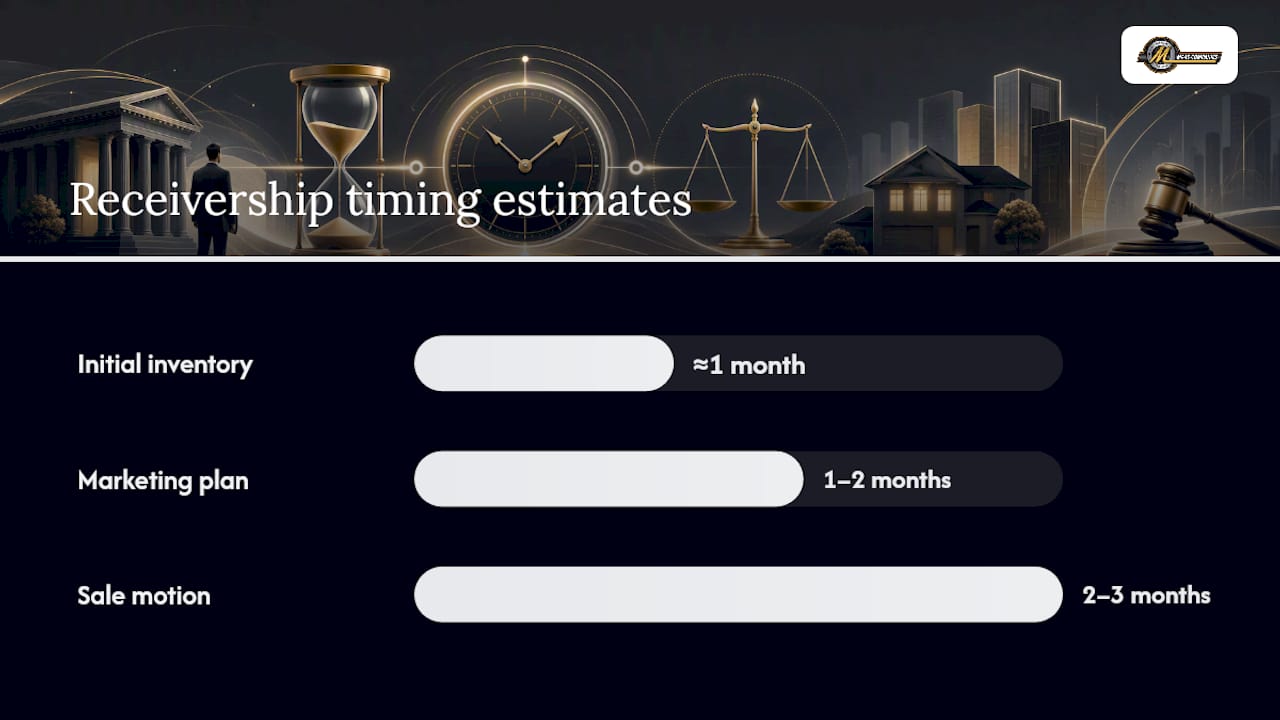
- File an initial inventory with the court within the deadline specified in the order (commonly 30 days).
- Implement an over-noticing strategy: serve notice on all known lienholders, tenants, and creditors, even those not strictly required by statute.
- Assess whether continued operations preserve or erode value; make a documented recommendation to the court.
Reporting and Accounting Cadence
- Monthly reports: income, expenses, maintenance actions, and any material asset changes.
- Fee applications: receiver fees and counsel fees, supported by detailed time records, submitted per the order’s schedule.
- Final accounting: gross receipts, all disbursements, net proceeds available for distribution.
Lender counsel should review each monthly report within five business days and flag discrepancies before they compound.
Sale Mechanics Under Receivership
- Submit a marketing plan to the court for approval before active marketing begins.
- File a motion for sale with full notice to all lienholders and interested parties.
- Include free-and-clear language in the proposed order; confirm the title insurer has reviewed draft order language before filing.
- Allow the statutory appeal window to close before closing the sale. Title insurers typically will not issue a free-and-clear policy until that window has passed.
- File a motion for discharge after the final accounting is approved.
| Receivership Milestone | Timing Estimate |
|---|---|
| Appointment order entered | At appointment |
| Initial inventory filed | Within about a month |
| Marketing plan approved | Within one to two months |
| Sale motion filed | Within two to three months |
| Sale hearing and order | Several months after appointment |
| Appeal window closes | Following sale order approval |
| Closing and distribution | After appeal window closes |
| Final accounting and discharge | Following closing |
Asset preparation and compliance before marketing
Title insurers should be engaged at the planning stage, not after court approval. Waiting until a sale order is entered often prevents issuance of a free-and-clear policy and can derail closing.
Pre-Sale Title and Legal Checklist
- Verify the legal description in the mortgage matches county records exactly.
- Confirm all easements, covenants, and restrictions are disclosed and will not impair buyer use.
- Obtain tenant estoppels and confirm lease status (active, expired, month-to-month).
- Identify any required third-party consents (franchise agreements, operating licenses, permits).
- Resolve any gap in chain-of-title with a corrective deed or affidavit before marketing.
Environmental and Permitting Disclosures
| Item | Action Required |
|---|---|
| Phase I ESA | Order if not completed within 1 year |
| Recorded environmental liens | Engage environmental counsel; assess remediation scope |
| Operating permits | Confirm transferability; notify issuing agency of pending sale |
| Hazardous material inventory | Document and disclose; arrange licensed disposal if needed |
| SPCC/NPDES compliance | Confirm current status; cure any open violations before marketing |
Logistics Matrix
- Develop a removal plan with buyer access windows, equipment staging areas, and rigging contractor contacts.
- Lot assets strategically: group by buyer type (process equipment separately from support infrastructure).
- Arrange licensed hazardous-material handling for any regulated substances on site.
- Confirm utility disconnection sequence so buyers can remove equipment safely.
For manufacturing-specific logistics, the industrial plant sale checklist provides a complementary operational reference.
Working with a professional auction and asset-marketing partner
An experienced marketing partner needs a complete intake package before active marketing can begin. Delays in document delivery directly delay the marketing timeline and reduce buyer pool depth.
Vendor Intake Documentation List
- Copies of the court order or lender authorization for sale
- Full equipment inventory with serial numbers, condition notes, and photographs
- Title records and any known encumbrances
- Environmental disclosures and Phase I ESA (if available)
- Site access information: address, contact, hours, and any safety requirements
- Utility status and any operational constraints for buyer previews
Marketing Timeline and Milestones
- Intake call and document review (Week 1)
- Asset catalog preparation and photography (Weeks 2–3)
- Advertising launch across industry-specific channels (Week 3)
- Bidder qualification and preview days (Weeks 4–5)
- Sale execution — live or online auction (Week 6)
- Post-sale settlement reporting and removal coordination (Weeks 7–8)
Maascompanies brings subject-matter expertise across manufacturing, energy, healthcare, and process industries. The marketing channel is matched to the asset class rather than running a generic listing. For distressed commercial properties, the lender’s marketing playbook outlines the buyer-outreach tactics that drive competitive bidding.
Sale execution and closing checklist
Sale Motion Contents
- Description of assets, legal authority for sale, and proposed sale terms
- Notice recipients: all lienholders, taxing authorities, tenants, and parties of record
- Stalking-horse bid terms (if applicable): break-up fee, bid increments, deposit amount
- Proposed bid procedures and objection deadline
- Free-and-clear order language reviewed and approved by the title insurer in advance
Closing Document List
| Document | Responsible Party |
|---|---|
| Court-approved sale order (certified copy) | Receiver/Counsel |
| Bill of sale for personal property | Receiver |
| Deed (for real property) | Receiver/Counsel |
| Title insurance commitment and policy | Title Company |
| Lien releases (all satisfied liens) | Lender Counsel |
| Escrow closing statement | Escrow Agent |
| Buyer’s proof of funds / wire confirmation | Buyer |
Post-Sale Distribution Waterfall
- Senior secured lender (first-priority lien)
- Junior lienholders in order of priority
- Receiver fees and expenses (court-approved)
- Legal fees (court-approved)
- Auction/marketing fees
- Taxing authorities (if not paid at closing)
- Remaining proceeds to borrower or estate
Deficiency and redemption rights vary by state. Confirm with local counsel whether a deficiency judgment is available and whether the borrower has a statutory redemption period that could affect buyer confidence. For common lender questions on auction mechanics, see commercial foreclosure auction guidance.
Post-sale reporting, accounting, and record retention
- Final accounting template: gross proceeds, receiver fees, legal fees, auction/marketing fees, cure amounts, taxes paid, liens satisfied, and net distributable proceeds — line by line.
- Required filings: motion for approval of final accounting, fee applications with supporting time records, and proposed distribution order.
- Objection period: allow the statutory period for creditor objections before seeking court approval of distribution.
- Record retention schedule: retain all sale documentation, chain-of-custody records, inventory forms, and title/closing files for a minimum of seven years, or longer if litigation is pending.
- Audit trail: preserve all correspondence, notices, and court filings in a single indexed file to support appellate review or creditor challenge.
Red flags and common pitfalls — practical mitigation steps
- Incomplete chain-of-title: order a full title search before marketing; cure gaps with corrective deeds or affidavits before the sale motion is filed.
- Environmental liens: engage environmental counsel at the diligence stage; undisclosed environmental liability is the single most common deal-stopper in industrial asset sales.
- Misfiled or lapsed UCCs: run searches in all relevant jurisdictions; a lapsed continuation can render a security interest unperfected and subordinate to a later lien.
- Inadequate notice: over-notice rather than under-notice; a commercially unreasonable notice process is grounds for a sale challenge that can unwind a closed transaction.
- Rushed sales with insufficient market exposure: compressed timelines reduce the buyer pool and depress recovery. Independent valuations before marketing set a defensible floor and protect against later claims of commercial unreasonableness.
- Late title insurer engagement: title insurers need time to review draft orders, escrow instructions, and lien releases. Engaging them after court approval is often too late.
Pro Tip: Engage both the title insurer and environmental counsel at the diligence phase — not after the sale order is entered. Last-minute discoveries in either area are the most common cause of closing delays and failed sales in industrial asset transactions.
For a structured approach to recovery trade-offs, the structured liquidation guide covers cost-versus-recovery analysis in detail.
Downloadable templates, sample language, and checklists to adapt
- Printable one-page checklist: the Day 0 accountability matrix at the top of this article is designed to print on a single page for field use.
- Receivership order checklist: use the appointment order table in the Enforcement Path section as a drafting reference; adapt scope-of-authority language to the specific asset type and jurisdiction.
- Chain-of-custody form: build from the inventory protocol in the Day 0–14 section; include fields for date, location, photographer, serial number, and condition rating.
- Inventory form: key to physical location (building/bay/row), not just asset category, to support lotting decisions.
- Sample sale motion language: the closing document table in the Sale Execution section identifies the required elements; confirm free-and-clear order language with the title insurer before filing.
For multi-jurisdiction matters, run the Practical Law/Westlaw state-specific flowcharts alongside these templates and flag any statutory requirement that conflicts with the standard language.
What early coordination actually changes — a practitioner’s perspective
The conventional wisdom in asset recovery is that legal process drives the timeline. In practice, the documentation handoff to the marketing partner is what drives recovery. When counsel delivers a complete intake package — court order, clean inventory, title run, and site access — within the first two weeks, the marketing partner can launch advertising while the sale motion is still being drafted. That parallel-path approach compresses the overall timeline by weeks and keeps the buyer pool engaged before deal fatigue sets in.

The difference in net recovery between an early-engaged marketing partner and a late-engaged one is not marginal. In industrial plant dispositions, a compressed buyer pool consistently produces fewer competitive bids, and fewer bids mean lower final prices. The assets do not change; the process does.
Selecting a partner with subject-matter experience in the specific asset class matters as much as timing. A firm that has marketed scientific laboratory equipment understands the buyer universe for that asset differently than one that primarily handles general manufacturing. Creditors should provide input on partner selection and confirm the proposed marketing channels reach the right buyers before approving the plan.
Maascompanies’s experience across manufacturing, energy, hospitality, and process industries means the marketing plan is built around the asset, not around a generic auction template.
Maascompanies: a strategic asset-marketing partner for lender and recovery counsel
When legal teams are managing a court-ordered or lender-directed sale, the gap between a defensible process and a maximum-recovery outcome often comes down to one variable: how early the marketing partner is engaged and how complete the intake package is.

Maascompanies supports lender counsel, receivers, and special servicers with court-sale experience across industrial plants, commercial real estate, and specialized equipment. The intake process is straightforward: provide the court order or lender authorization, a current equipment inventory with photographs, a title run, and site access information, and Maascompanies can begin marketing planning immediately.
What Maascompanies delivers:
- Industry-specific marketing across manufacturing, energy, healthcare, and process sectors
- Buyer qualification, escrow handling, and removal logistics coordination
- Post-sale settlement reporting formatted for court submission
- Experience with free-and-clear sale mechanics and title insurer coordination
To begin a project or discuss an upcoming disposition, contact Maascompanies and submit your intake package. The earlier the engagement, the stronger the recovery.
Sources
- Preparing for a Foreclosure: A Checklist for Commercial Real Estate Lenders (Cleary Gottlieb)
- Foreclosure and Receivership Process Booklet (Ballard Spahr)
- Commercial Foreclosure Toolkit (Practical Law / Westlaw)
- Commercial Loan Default: A Practical Checklist for Banks and Lenders (Neubert, Pepe & Monteith, P.C.)
- Free and Clear Sales in State Court Receivership: What You Need To Know (DailyDAC)
- Asset management in receivership: a guide for secured creditors (pForm Solutions)
For county-level lien and title searches, contact the recorder’s office in each county where real property is located. For environmental record searches, consult the relevant state environmental agency database and EPA’s ECHO system. Tailor every checklist item to the jurisdiction by running the Practical Law state-specific flowchart alongside local counsel review before filing any motion or notice.
This article is general information, not a substitute for advice from a qualified lawyer. Consult a qualified legal professional about your own circumstances before acting on anything here.
Recommended
- Bankruptcy Asset Management Tips for Creditors: Maximize Recovery | Blog | Insights on Asset Liquidation and Auction Trends
- Distressed asset auction checklist: maximize recovery | Blog | Insights on Asset Liquidation and Auction Trends
- Step-by-step asset auction guide for maximizing recovery | Blog | Insights on Asset Liquidation and Auction Trends
- Online auctions: maximizing distressed asset recovery | Blog | Insights on Asset Liquidation and Auction Trends