

Blog
Step-by-step asset auction guide for maximizing recovery

TL;DR:
- Effective process discipline is crucial in distressed industrial asset sales to avoid costly shortfalls. Constructing a legally sound, step-by-step auction with proper prerequisites, valuation strategies, and procedural safeguards maximizes recovery and supports legal defensibility. Transparency, market-aligned valuations, and contingency planning are vital for auction success, backed by expert execution and strategic buyer engagement.
When a major industrial facility faces forced sale under time pressure, the margin between a successful recovery and a costly shortfall often comes down to process discipline. Private equity firms and special asset managers handling distressed portfolios know the stakes: carrying costs accumulate daily, creditor patience is finite, and regulatory missteps can delay or derail a sale entirely. A well-structured, step-by-step auction process is not optional in these situations. It is the mechanism that converts a distressed asset into realized value, with legal defensibility and competitive bidder turnout built in from the start.
Table of Contents
- Core requirements and prerequisites for a compliant asset auction
- Choosing your valuation premise and setting winning objectives
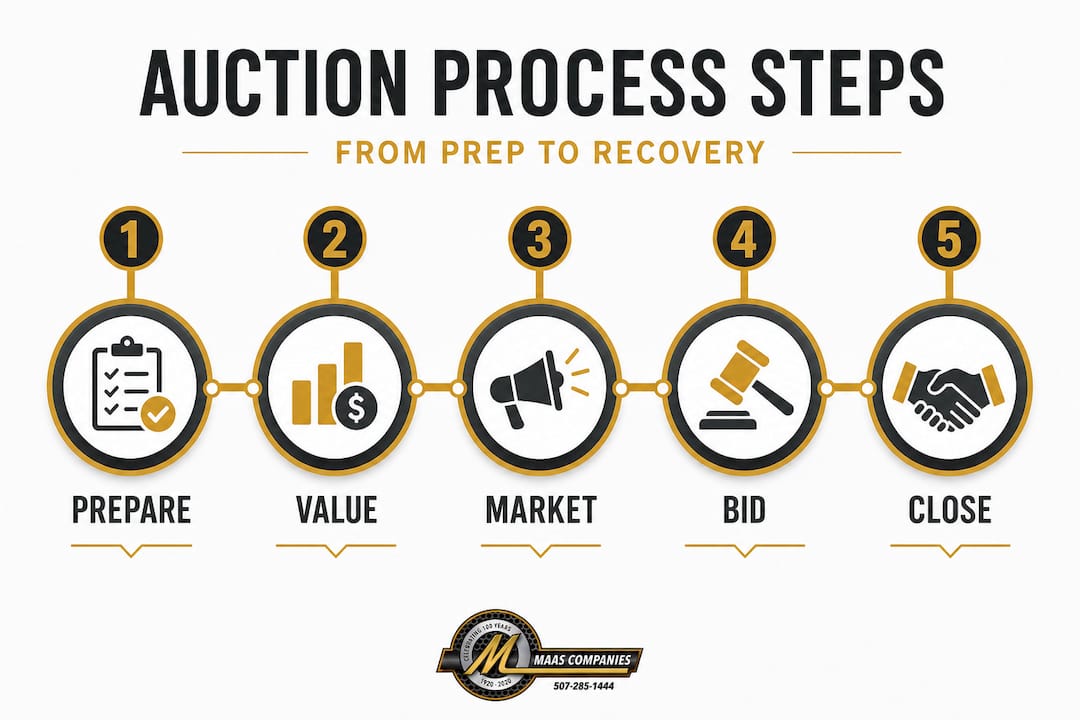
- Designing robust auction procedures: The step-by-step playbook
- Executing, monitoring, and verifying auction success
- Perspective: Why most asset auctions fall short — and what actually works
- Unlock expert auction execution: Partner with industry leaders
- Frequently asked questions
Key Takeaways
| Point | Details |
|---|---|
| Court-approved procedures | A well-structured Section 363 auction relies on formal, court-approved rules and timelines. |
| Valuation drives outcomes | Choosing the right valuation premise is the foundation for successful recovery. |
| Bidder qualification is crucial | Balance open participation with robust defenses against unqualified or collusive bidders. |
| Document every step | Thorough documentation and open processes guard against legal objections and maximize final results. |
| Professional guidance pays off | Specialized auction teams help navigate complex auctions and optimize asset recovery. |
Core requirements and prerequisites for a compliant asset auction
Before a single bid is solicited, the legal and procedural groundwork must be firmly in place. For distressed industrial assets held within bankruptcy proceedings, Section 363 sale process structures are the standard framework, where the court-approved bidding procedures order governs the entire auction mechanics, from qualified bidder criteria to deposit requirements and final confirmation. Understanding this framework is not just advisable; it is the foundation upon which every subsequent decision rests.
The bidding procedures order serves as the governing document of the auction. It defines who may participate, what financial qualifications are required, the timeline of key events, overbid increments, and the conditions under which the stalking horse agreement, if one is used, can be superseded. Courts require this order to be formally approved before marketing begins, which means the legal team and the auction firm must collaborate early to draft terms that are both competitive and defensible.
Key preparatory work includes the following items, all of which should be completed or substantially underway before the court motion is filed:
- Asset documentation: Complete inventories, equipment condition reports, environmental assessments, and title verification.
- Stakeholder notifications: Creditor committees, secured lenders, and other parties in interest must receive proper advance notice.
- Compliance documents: UCC lien searches, equipment appraisals, and any permits or regulatory disclosures tied to specific asset classes.
- Marketing materials: Technical datasheets, facility photographs, and operational summaries prepared for prospective buyers.
- Qualified bidder criteria: Deposit amounts, proof of financial capacity, and confidentiality agreements ready for distribution.
| Compliance element | Purpose | Timing |
|---|---|---|
| Section 363 motion | Triggers the court process | Filed before auction |
| Bidding procedures order | Governs all auction mechanics | Court-approved pre-auction |
| Asset appraisal | Establishes value benchmark | Completed before marketing |
| Lien and title searches | Confirms free-and-clear transfer | Completed before sale hearing |
| Creditor notification | Ensures legal standing | Required by local court rules |
| Confidentiality agreements | Protects proprietary information | Distributed during marketing |
Pro Tip: Engage bankruptcy counsel and an independent valuation specialist simultaneously, not sequentially. Gaps between legal readiness and valuation completion are one of the most common sources of costly timeline delays.
Refer to the industrial auction readiness checklist for a detailed, practical breakdown of pre-auction preparation tasks specific to manufacturing and plant assets.
Choosing your valuation premise and setting winning objectives
Once prerequisites are in place, the most consequential strategic decision is the choice of valuation premise. This is where many auction processes either gain traction or lose it before the first buyer inquiry arrives. The distressed asset valuation methodology is a case-specific decision, requiring analysis of whether liquidation value or going-concern value better reflects the asset’s marketability and the legal context of the sale.

Liquidation value applies when assets will be sold on a piecemeal basis, typically in situations where operations have ceased or are expected to cease. This method discounts for time pressure, removal costs, and limited buyer pools. Going-concern value, by contrast, assumes the business or facility can continue operating, which typically produces higher aggregate valuations but requires a buyer capable of continuing operations.
| Valuation method | Best use case | Typical outcome | Key considerations |
|---|---|---|---|
| Liquidation value | Operations ceased, forced timeline | Lower recovery, faster execution | Accounts for removal and carrying costs |
| Going-concern value | Business still operational | Higher potential recovery | Requires buyer with operating capability |
| Orderly liquidation value | Moderate timeline, equipment focus | Intermediate recovery | Common for industrial equipment auctions |
| Fair market value | Non-distressed context | Highest theoretical value | Rarely achievable in distressed scenarios |
The choice of valuation premise also directly informs your minimum bid threshold and reserve price strategy. Setting these numbers too high, relative to the realistic buyer pool, can suppress bidder turnout and result in an auction with fewer qualified participants. Setting them too low risks undervaluing assets that have genuine going-concern potential, particularly for operational plants with active permits and trained workforces.
Steps for establishing internal value thresholds:
- Commission an independent appraisal using the chosen valuation premise before the bidding procedures motion is filed.
- Identify the secured creditors’ claim amounts and determine the minimum recovery needed to satisfy lender requirements.
- Review comparable asset sales in the same sector within the prior 12 to 24 months to calibrate market expectations.
- Consult with the marketing firm about realistic buyer pool depth given asset type, geography, and condition.
- Set the stalking horse bid, if applicable, at a level that anchors value without discouraging competitive bidding.
- Document all threshold decisions and the rationale behind them for court review.
Pro Tip: Revisit the value premise if significant market shifts occur between the appraisal date and auction day. Commodity price changes, regulatory shifts, or changes in buyer demand within the sector can all affect what qualified bidders are willing to pay, and a stale valuation anchored to an outdated premise can mislead reserve-setting decisions.
For additional context on aligning valuation with recovery strategy, see how liquidating industrial assets connects appraisal decisions to final outcomes.
Designing robust auction procedures: The step-by-step playbook
With valuation and objectives established, the next step is structuring the auction procedures themselves. This is where legal defensibility and competitive bid pool construction intersect. The procedural sequence for a 363 sale follows a defined progression: the debtor files a motion describing the marketing process and any stalking horse agreement, the court holds a hearing on bidding procedures, the marketing and auction proceed under the approved rules, and a second hearing approves the final sale and enters the sale order.
The structure of each stage must be designed with two priorities in mind: ensuring maximum competitive participation and maintaining legal defensibility against any post-auction objections.
- Draft the motion and bidding procedures. Define the marketing timeline, minimum bid qualifications, required deposits (typically 10% of opening bid), overbid increments, and auction format. Specify whether bids must be cash-only or whether non-cash consideration is allowed.
- Establish qualified bidder criteria. These requirements filter for financially capable buyers without unnecessarily restricting the pool. Overly strict requirements can “chill” bidding, a concern courts take seriously.
- Set the auction calendar. Typical timelines include 30 to 45 days for marketing, a bid submission deadline 3 to 5 days before the auction date, and a confirmation hearing within 7 to 14 days after the auction.
- Notify all required parties. Creditors, regulatory agencies, unions, and any entities with liens or interests in the assets must receive proper notice per applicable local rules.
- Prepare for the open auction session. Most jurisdictions require the auction to be conducted openly, with attendance available to all qualified bidders and their advisors.
- Document every step. Bid logs, qualification checklists, and communication records must be maintained to support the final court approval.
Critical safeguards: Auction procedures must include explicit provisions against collusion and bad-faith bidding. Courts expect certification from participants confirming no improper communications have occurred. Failure to include these provisions, or failure to monitor for violations, can expose the entire sale process to legal challenge after the fact.
A common mistake is setting deposit and qualification thresholds that effectively exclude all but one or two buyers. This narrows the competitive field and can suppress the final sale price by removing the pressure of genuine competition. Bidder qualification strategies that balance access with financial screening are consistently associated with stronger auction outcomes. For broader tactical approaches, reviewing auction strategies for competitive bidding can provide additional framework options applicable to larger industrial dispositions.
Executing, monitoring, and verifying auction success
With auction mechanics fully defined and court-approved, the execution phase begins. This is where careful preparation pays dividends, but also where last-minute issues can undermine months of work if not actively managed. Local court auction rules provide concrete guidance on mechanics expected by judges, including open attendance, documented bidding, bad-faith certification, proper notice, and a confirmed court date for approval of auction results.
Key tasks for auction day, documentation, and legal confirmation include:
- Auction day operations: Verify bidder qualifications and deposit receipt before the session opens; maintain a written bid log noting each bidder, amount, and time of each bid.
- Objection handling: Have counsel present to address any procedural objections from creditors or competing bidders in real time.
- Winner selection: Identify the highest qualified bid and the backup bid; document both formally in the auction record.
- Post-auction notification: Notify all qualified bidders of the result within 24 to 48 hours; retain documentation of the notice.
- Sale motion filing: File the motion for sale approval with the court immediately after the auction, attaching the complete bid record.
- Court confirmation hearing: Present the auction record, confirm compliance with procedures, and obtain the sale order.
- Closing coordination: Transfer title, release liens, distribute sale proceeds per the approved distribution priority, and obtain lender releases.
| Milestone | Typical timing | Responsible party |
|---|---|---|
| Auction conducted | Per bidding procedures order | Auction firm |
| Backup bid documented | Same day as auction | Legal counsel |
| Sale motion filed | Within 1 to 3 days post-auction | Bankruptcy counsel |
| Objection deadline | 7 to 14 days post-auction | Court-managed |
| Sale confirmation hearing | 10 to 21 days post-auction | Judge |
| Sale order entered | At confirmation hearing | Court |
| Closing and title transfer | 5 to 30 days post-confirmation | Closing counsel |
| Lien releases completed | At or before closing | Secured creditors |
Poor documentation during the auction session is one of the most preventable causes of sale confirmation delays. When objecting parties challenge the process, a complete and contemporaneous bid record is the primary evidentiary tool available to the debtor and the auction firm. The process of speeding up the disposition process depends directly on procedural completeness at each stage.
Perspective: Why most asset auctions fall short — and what actually works
After years of executing industrial auctions across multiple jurisdictions and asset classes, we have observed a consistent pattern in underperforming sales: the problem almost never originates on auction day. It originates weeks or months earlier, in decisions about valuation premise, bidder qualification thresholds, and marketing reach.
Private equity firms managing distressed industrial portfolios sometimes enter the auction process with internally set recovery targets that are disconnected from current market conditions. They anchor to the book value of assets acquired at cycle peaks, or they rely on appraisals conducted under different market conditions. When the bid pool produces results below those internal targets, the instinct is to attribute the shortfall to the auction firm or the process. In most cases, the root cause is a value premise that was never calibrated to what the market would actually support.
The counterintuitive truth about open auction sessions and extensive documentation is that they consistently produce better outcomes than restricted, lightly documented processes. Transparency attracts more serious buyers. Qualified bidders are more willing to commit capital when the process is clearly governed and legally defensible, because they have confidence that their bid, if highest, will result in a clean title transfer. Restricting the process to reduce procedural complexity tends to reduce buyer confidence and bidder turnout simultaneously.
Timeline risk is also chronically underestimated. Court calendars, creditor objection periods, and regulatory approval timelines are not always predictable. Building contingency time into the auction calendar is not a sign of poor planning; it is a sign of experienced planning. Auctions that try to compress every deadline to minimize carrying costs often encounter procedural delays that cost far more than the carrying cost savings they were designed to achieve.
Build flexibility into your auction process design, and always have a defined contingency plan if the auction does not produce a qualified bid above the minimum threshold. Understanding how maximizing lender recovery value works in practice means accepting that the path to best execution is rarely the shortest one.
Unlock expert auction execution: Partner with industry leaders
Executing a compliant, competitive industrial auction at the level described in this guide requires both specialized legal coordination and deep marketing reach across qualified buyer networks.

Maas Companies brings extensive experience in marketing industrial plants, manufacturing facilities, and commercial properties to buyers worldwide. Our auction execution process is built around aggressive, targeted marketing campaigns that generate genuine competitive bidder turnout, not just procedural compliance. From biodiesel processing facilities to large-scale manufacturing complexes, our current major industrial auctions demonstrate the scope and quality of assets we handle. If you are ready to maximize recovery on industrial equipment or a complete plant disposition, sell industrial equipment through a firm that knows how to reach the right buyers. Explore our full range of specialist auction services to find the right approach for your assets.
Frequently asked questions
What is a Section 363 sale, and why is it used in asset auctions?
A Section 363 sale is a court-supervised auction process for selling distressed assets in bankruptcy, providing a clear legal structure and free-and-clear title transfer that protects buyers from pre-existing claims against the seller.
How do I determine whether to use liquidation value or going-concern value?
Choose liquidation value if the business will not continue operating, or going-concern if operations may persist; as noted in distressed asset valuation guidance, the legal case context, asset type, and creditor interests together typically guide this choice.
What are the key deadlines in a step-by-step asset auction?
Typical deadlines include the bid submission date, auction date, confirmation hearing, and final closing, all of which are formalized in the court-approved bidding procedures order as part of the 363 auction procedural sequence.
Who can bid in a Section 363 asset auction?
Any qualified bidder who meets the financial and procedural criteria set in the court-approved bidding procedures and submits the required deposit can participate, subject to the judge’s formal approval of those procedures.
What are common pitfalls to avoid when structuring auction procedures?
Overly restrictive bidding requirements or incomplete notification can reduce competitive participation, while poorly documented auction records risk legal challenges during the sale confirmation process before the court.
Recommended
- Auction strategies for small businesses: Maximize asset recovery | Blog | Insights on Asset Liquidation and Auction Trends
- Maximize Asset Recovery: Top Real Estate Liquidation Methods | Blog | Insights on Asset Liquidation and Auction Trends
- How Auctions Help Speed Up Industrial Asset Disposition | Blog | Insights on Asset Liquidation and Auction Trends
- Surplus equipment sale guide: maximize asset recovery fast | Blog | Insights on Asset Liquidation and Auction Trends