

Blog
The Commercial Asset Marketing Process: A Corporate Seller’s Guide

The commercial asset marketing process is a structured, phased workflow that moves industrial and commercial physical assets from inventory through valuation, targeted promotion, and sale execution to final settlement, with recovery rate, days-to-sale, and bidder engagement as the primary success metrics. Done correctly, it converts idle or surplus assets into maximum recoverable value on a defined timeline.
Core elements every seller must address:
- Inventory and condition assessment: Catalog assets, document condition, and confirm title chain before any marketing begins.
- Valuation: Establish guide prices using market comparables, replacement cost less depreciation, and salvage benchmarks.
- Disposition strategy: Choose between auction, negotiated sale, or a hybrid based on time constraints, asset type, and market depth.
- Targeted marketing and channel execution: Deploy direct outreach, listing portals, trade publications, and buyer-specific campaigns.
- Sale execution and closing: Manage bidding or negotiation, execute contracts, and coordinate buyer removal and settlement.
Table of Contents
- When should you start the marketing process, and who leads it?
- What does the commercial asset marketing process look like, step by step?
- Which marketing channels produce the most qualified buyers for industrial assets?
- Auction vs. negotiated sale: how do you choose the right execution method?
- How are commercial assets valued, and what should you expect?
- What legal and compliance checks must you clear before marketing?
- What are the realistic timelines and costs for a commercial asset sale?
- How do you select the right asset-marketing partner?
- What do real asset dispositions look like in practice?
- Key Takeaways
- What most sellers get wrong about asset recovery
- Maascompanies: a strategic partner for commercial asset recovery
- Useful sources for U.S. commercial asset sellers
When should you start the marketing process, and who leads it?
Delay is the single most expensive mistake in commercial asset disposition. Every week an asset sits idle, it accumulates carrying costs, depreciates, and risks condition deterioration that directly reduces recovery. Engage an asset-marketing specialist the moment a trigger event is confirmed.
Common trigger events that require immediate action:
- Plant closure or facility consolidation
- Lender enforcement, foreclosure, or receivership
- Corporate restructuring or merger divestiture
- Excess or obsolete inventory requiring capital recovery
- Court-ordered or government-mandated liquidation
Internally, the CRO, COO, or a designated asset manager should own the engagement. Legal, finance, environmental, and facilities teams must be looped in from day one, not after marketing launches.
Pro Tip: Engage your asset-marketing partner at least 60–90 days before the intended sale date for a single-site surplus sale, and 120–180 days for a full-plant liquidation. Earlier engagement preserves documentation, title chain integrity, and asset condition, all of which directly support higher recovery.
What does the commercial asset marketing process look like, step by step?
A disciplined process assigns clear responsibilities at each stage and leaves no material step to chance.
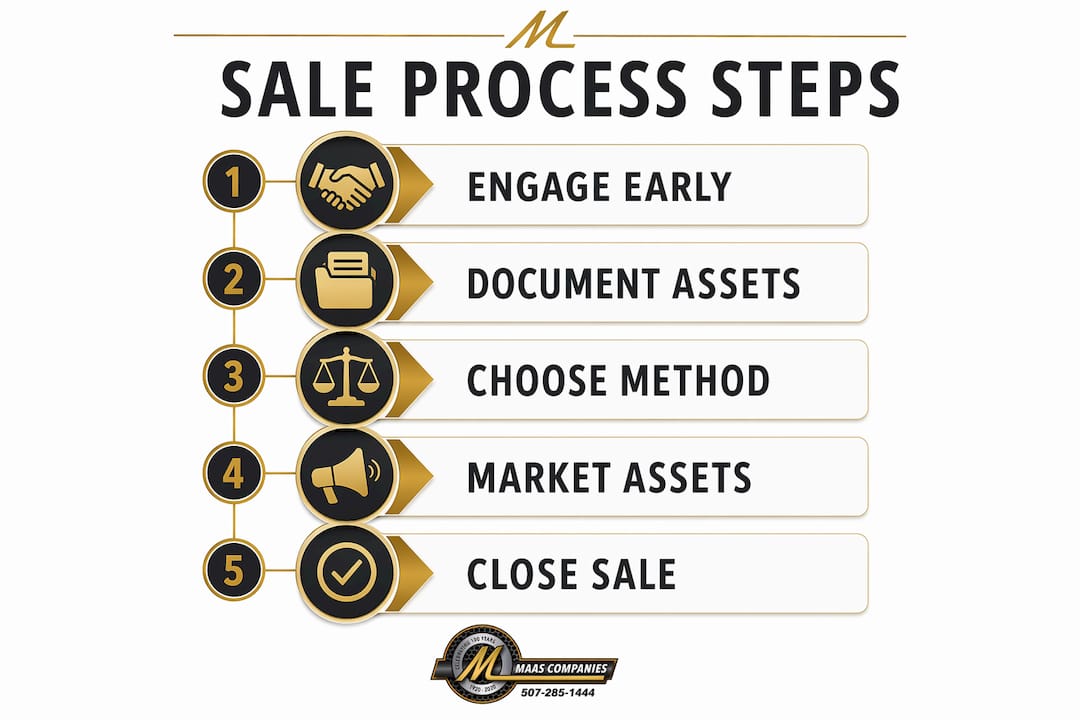
- Inventory and condition assessment (Seller + marketing partner): Catalog all assets by category, document condition with photography and inspection reports, confirm serial numbers, and flag any assets with title complications or environmental concerns.
- Valuation (Marketing partner + independent appraiser): Apply market comparables, replacement cost less depreciation, and salvage benchmarks to establish guide prices and reserve levels.
- Disposition strategy selection (Seller + marketing partner + legal): Choose auction, negotiated sale, or hybrid. Confirm whether court, lender, or regulatory approvals are required before proceeding.
- Marketing campaign launch (Marketing partner): Deploy targeted outreach, listing portals, trade publications, and direct buyer campaigns. A documented sales action plan with defined KPIs materially improves campaign effectiveness.
- Sale execution (Marketing partner + legal): Manage auction event or negotiated offers, qualify buyers, execute purchase agreements, and collect deposits.
- Buyer removal and settlement (Buyer + seller + logistics): Coordinate removal windows, confirm liability transfer, and complete financial settlement.
Typical stage durations vary depending on the sale type, with shorter timelines for single-site surplus sales and longer for full-plant liquidations.
Which marketing channels produce the most qualified buyers for industrial assets?
Strategic property marketing creates demand through positioning, professional materials, and targeted outreach. Passive listing alone rarely produces the bidder depth needed to maximize recovery on large, technical assets.
High-impact channels, ranked by buyer intent:
- Direct outreach to qualified buyer lists: Dealers, owner-operators, and aggregators who have purchased similar assets. Highest intent, fastest response.
- Industry broker networks: Sector-specific brokers who represent active buyers and can move quickly on well-documented assets.
- Trade publications and associations: Targeted advertising in sector publications reaches buyers who are actively in the market.
- Commercial listing portals: CoStar, LoopNet, and industry-specific portals provide broad visibility and attract buyers outside existing contact lists.
- Email campaigns to segmented buyer databases: Institutional audiences respond well to email and LinkedIn distribution, particularly when content is educational and specific.
Pro Tip: Combine drone photography, 3D walkthroughs, and detailed technical spec sheets with your direct outreach. Buyers who can assess an asset remotely submit more confident bids, which increases participation and drives recovery. For more on remarketing channels by asset type, Maascompanies maintains a practical breakdown.
Channel reach vs. buyer intent

| Channel | Reach | Buyer Intent |
|---|---|---|
| Direct buyer outreach | Narrow | Very high |
| Industry broker network | Moderate | High |
| Trade publications | Broad | Moderate |
| Listing portals (CoStar/LoopNet) | Very broad | Low to moderate |
| Email to segmented database | Targeted | High |
Auction vs. negotiated sale: how do you choose the right execution method?
The execution method determines the pace, confidentiality, and competitive dynamics of your sale. Neither approach is universally superior; the right choice depends on your specific circumstances.
| Factor | Auction | Negotiated Sale |
|---|---|---|
| Time to close | Fast (days to weeks) | Slower (weeks to months) |
| Market demand depth | Requires multiple qualified bidders | Works with limited buyer pool |
| Confidentiality | Low | High |
| Court/lender constraints | Preferred for transparency | Requires lender/court approval |
| Asset complexity | Works for standard lots | Better for specialized single units |
Choose auction when: multiple qualified buyers exist, a court or lender requires transparent price discovery, or a whole-plant teardown needs rapid execution. Choose negotiated sale when: the asset is highly specialized, confidentiality is a priority, or the buyer pool is narrow and relationships matter. For a detailed breakdown of disposition strategy options, including hybrid approaches, Maascompanies provides a dedicated strategy guide.
How are commercial assets valued, and what should you expect?
Valuation establishes the floor for recovery expectations and informs reserve pricing. Four methods are commonly applied:
- Market comparables: Recent sale prices for similar assets in comparable condition and markets.
- Replacement cost less depreciation: Useful for equipment with active secondary markets and documented service histories.
- Salvage-value benchmarking: Applied when assets are at end-of-life or when removal costs are significant.
- Broker or engineer appraisal: Independent third-party input that adds credibility for lender-ordered or court-ordered sales.
Critical inputs that materially affect price: age and operating condition, maintenance and calibration records, availability of spare parts and documentation, site-specific installation complexity, and any environmental remediation obligations. Assets with complete documentation and clear title consistently command higher recovery than those without. A surplus asset marketing approach that addresses these inputs before launch is measurably more effective.
What legal and compliance checks must you clear before marketing?
Title defects, undisclosed liens, and environmental liabilities are the most common causes of failed transactions and buyer withdrawal. Clear these before marketing goes live.
- Title and lien searches: Confirm ownership and identify any UCC filings, mortgages, or judgment liens attached to the assets.
- Environmental site assessment: Flag any Phase I or Phase II findings that affect transferability or require disclosure.
- Warranty and assignment review: Confirm which warranties transfer and which require manufacturer or licensor consent.
- Contract novation: Identify any service or lease agreements that must be novated or terminated before sale.
- Lender and court approvals: In lender-ordered or court-ordered liquidations, early coordination between the asset marketer, counsel, and the lender to clear title and scope removal terms reduces transaction friction and preserves buyer confidence.
Pro Tip: Involve legal counsel at the inventory stage, not after a buyer is under contract. Discovering a lien or environmental flag after marketing launches forces delays that erode buyer confidence and recovery.
What are the realistic timelines and costs for a commercial asset sale?
Sellers frequently underestimate the cost of doing nothing. Carrying costs, security, insurance, and depreciation accumulate daily on unsold assets.
| Scenario | Typical Days to Sale | Removal Window |
|---|---|---|
| Single-site surplus sale | 60–90 days | 2–4 weeks post-sale |
| Full-plant liquidation | 90–180 days | 4 weeks post-sale |
| Multi-lot international remarketing | 120–180 days | Varies by jurisdiction |
Cost buckets to budget include marketing and advertising, cataloging and inspection, staging and preparation, logistics and handling, storage and security, and fees or commissions.
On removal responsibility: buyer-removes terms are standard in most industrial auctions and shift logistics liability to the purchaser. Seller-arranged removal can accelerate timelines but adds cost. The choice affects net recovery and should be decided before marketing launches. For guidance on surplus equipment sale timelines, Maascompanies publishes a stepwise reference.
How do you select the right asset-marketing partner?
The partner you choose determines the quality of your buyer pool, the rigor of your documentation, and ultimately your recovery outcome. Evaluate candidates on these criteria:
- Documented methodology: Can they show a written process from inventory through settlement? Vague references to “experience” are not a substitute.
- Sector experience: Have they handled assets in your specific industry (manufacturing, energy, hospitality, healthcare, agriculture)?
- Recovery benchmarks: Can they provide case studies with measurable recovery rates and days-to-sale figures?
- Lender and government liquidation record: Experience with court-ordered and lender-ordered engagements signals the ability to manage complex title and compliance requirements.
- Transparent fee disclosure: Commission structures, marketing cost pass-throughs, and buyer premiums should be disclosed in writing before engagement.
Red flags to watch for: vague or unverifiable references, case studies without metrics, unclear fee structures, no written methodology, and limited logistics or removal support. A proven set of marketing tactics and a documented recovery metric set, including recovery rate, average days-to-sale, and bidder-to-lot ratios, are the baseline for any credible partner. A well-structured marketing plan with defined KPIs and scheduled performance reviews, as recommended by institutional marketing frameworks, materially improves campaign outcomes.
What do real asset dispositions look like in practice?
Maascompanies has managed asset dispositions across manufacturing, energy, hospitality, healthcare, education, and agriculture, including court-ordered, lender-ordered, and government foreclosure liquidations. Their 2026 disposition examples illustrate how the process produces measurable outcomes across asset classes.
Representative engagement structure:
- Assignment context: Lender-ordered liquidation of a multi-line food processing facility following borrower default.
- Approach: Full inventory and condition assessment completed in three weeks; title and lien clearance coordinated with lender counsel; targeted outreach to 200+ qualified buyers across direct lists and broker networks; live auction conducted on-site with remote bidding access.
- Result: Bidder participation exceeded initial projections; recovery rate exceeded the lender’s minimum threshold; all assets removed within the agreed window.
The methodology that drives these outcomes combines a documented sales action plan, rich technical marketing materials, multi-channel buyer outreach, and post-sale logistics coordination. Sellers who engage early, clear title before launch, and invest in professional marketing materials consistently achieve higher recovery than those who treat disposition as an afterthought.
Key Takeaways
A disciplined commercial asset marketing process, executed by an experienced partner with documented methodology and sector-specific buyer networks, consistently produces higher recovery rates and shorter days-to-sale than ad-hoc or listing-only approaches.
| Point | Details |
|---|---|
| Engage early | Trigger engagement 60–180 days before the target sale date to preserve condition, documentation, and title chain. |
| Clear title and liens first | Undisclosed liens or environmental flags discovered after marketing launches erode buyer confidence and recovery. |
| Match execution method to context | Auction suits multi-buyer, court-ordered, or rapid-close scenarios; negotiated sale fits specialized or confidential dispositions. |
| Invest in targeted outreach | Direct buyer outreach and rich technical materials produce higher bidder intent than broad listing portals alone. |
| Maascompanies as strategic partner | Maascompanies provides documented methodology, sector-specific experience, and lender/court-ordered liquidation capability across industrial and commercial asset classes. |
What most sellers get wrong about asset recovery
The conventional wisdom in asset disposition is that speed and price are in direct tension. Get out fast and accept a lower number, or wait for the right buyer and risk carrying costs. That framing is wrong, and it leads sellers to make decisions that cost them on both dimensions.
The real driver of recovery is preparation quality, not timeline. Assets that go to market with complete documentation, clear title, professional photography, and a targeted buyer list close faster and at higher prices than assets rushed to a listing with incomplete records. The timeline pressure is real, but the response to it should be accelerating preparation, not skipping it.
Late engagement is the most common and most expensive mistake. When a plant closure or lender enforcement triggers a disposition, the instinct is often to list immediately. The assets that suffer the worst recovery outcomes are those that hit the market before title is clear, before condition is documented, and before the right buyers have been identified. A few additional weeks of preparation almost always produces a better net outcome than weeks of carrying costs on a stalled sale.
The second mistake is underinvestment in marketing. Passive listing on a portal is not a marketing strategy. Buyers of complex industrial assets need technical documentation, site access, and direct engagement to bid with confidence. The difference between a well-marketed asset and a poorly marketed one is not marginal.
Maascompanies: a strategic partner for commercial asset recovery
When the stakes are high, whether a lender-ordered liquidation, a plant closure, or a multi-site divestiture, the difference between a competent marketing firm and a strategic recovery partner is measurable in dollars and days.
Maascompanies brings decades of experience managing auction and negotiated sale engagements for industrial plants, equipment, real estate, and commercial properties across the United States and internationally. Their capabilities span court-ordered and government foreclosure liquidations, surplus equipment remarketing, and complex multi-asset dispositions across manufacturing, energy, hospitality, healthcare, agriculture, and contractor inventory. Every engagement begins with a documented scope, transparent fee disclosure, and a marketing plan tied to defined recovery metrics.
To begin an engagement, contact Maascompanies for an initial assessment. Bring your asset inventory, any known title or lien documentation, and your target timeline. The team will scope the engagement, outline the marketing approach, and provide a clear fee structure before any commitment is made.
Useful sources for U.S. commercial asset sellers
- HVS Sales and Marketing Assessment: Framework for documented sales action plans and marketing audits; applicable to hospitality and other commercial asset classes.
- PA Commercial: Marketing vs. Listing: Explains the distinction between proactive marketing and passive listing for commercial properties.
- Cerulli: Institutional Digital Marketing: Data on how institutional asset managers use email, LinkedIn, and audio/visual content to reach asset owners.
- Maascompanies: Marketing Strategies for Asset Sales: Nine proven tactics for industrial asset disposition, including channel selection and buyer targeting.
- Maascompanies: How to Market Surplus Assets: Operational playbook covering recovery metrics, channel tactics, and preparation steps.
- SharpLaunch: CRE Marketing Strategy Guide: Comprehensive overview of digital channels, listing portals, and campaign measurement for commercial real estate marketing.
Recommended
- Commercial Property Sale Guide for Investors and Owners | Blog | Insights on Asset Liquidation and Auction Trends
- Marketing Strategies for Asset Sales: 9 Proven Tactics | Blog | Insights on Asset Liquidation and Auction Trends
- Asset Sale Benefits 2026: A Strategic Guide for Sellers | Blog | Insights on Asset Liquidation and Auction Trends
- Examples of Successful Asset Dispositions: 2026 Guide | Blog | Insights on Asset Liquidation and Auction Trends