

Blog
How to Market Surplus Assets for Maximum Recovery

TL;DR:
- Proper surplus asset disposition involves a structured process of auditing, cataloging, and marketing assets to maximize cash recovery. Asset managers who plan sales early, maintain detailed listings, choose suitable channels, and time their sales to demand cycles outperform those who react hastily. Using multiple channels and phased releases reduces market flooding and helps achieve higher net recovery values.
Surplus asset disposition is the structured process of identifying, valuing, and selling idle or excess equipment, inventory, and property to recover capital before depreciation erodes its value. Asset managers who treat this process as a formal marketing program consistently outperform those who treat it as a cleanup task. The difference shows up directly in cash recovery rates. This guide covers the full process: from initial audit through channel selection, pricing strategy, and execution, with benchmarks drawn from current market practice and government guidance.
How to market surplus assets: the preparation phase
Strong recovery starts before a single listing goes live. The preparation phase determines whether buyers trust your assets and whether you attract the right buyers at all.
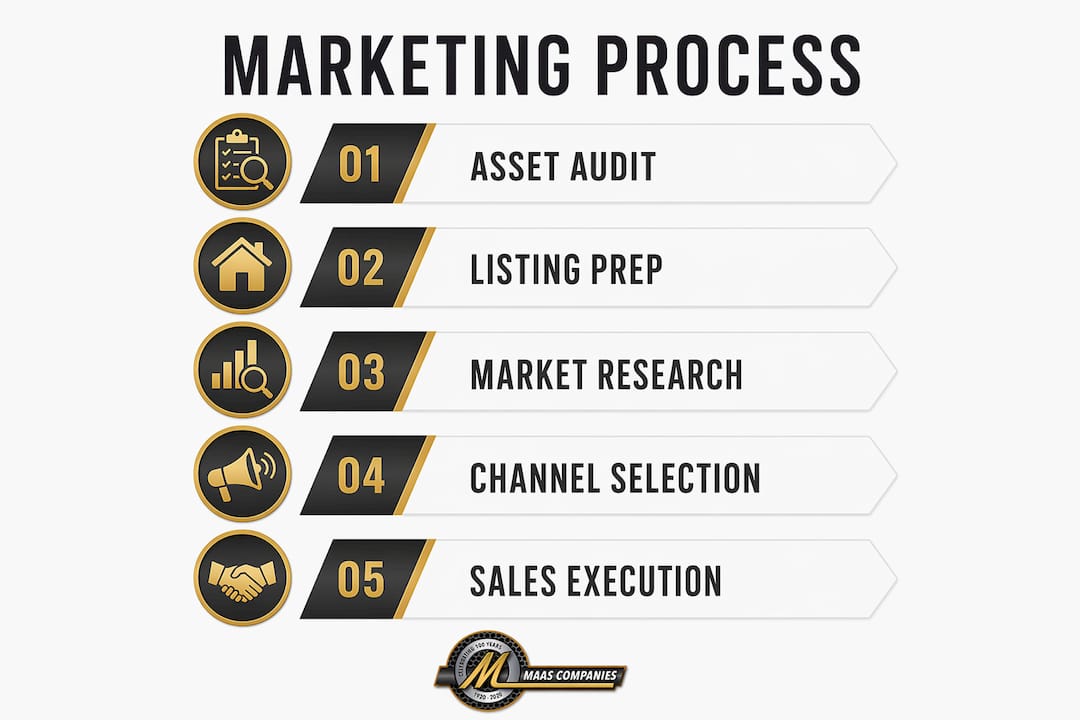
The first step is a formal asset audit. Catalog every item by category, condition, age, and depreciation status. For industrial equipment, include make, model, serial number, maintenance history, and current operational status. Idle assets depreciate monthly, eroding recovery potential while carrying costs accumulate. Early identification and prioritized sale directly reduce those losses.
The second step is building detailed listings before you approach any channel. Clear, detailed listings with multiple high-resolution photos from different angles are a documented driver of buyer confidence and sale efficiency. Include specifications, usage history, known defects, and any remaining warranty or certification. Buyers who receive complete information upfront submit stronger offers and require less negotiation time.
Pro Tip: Photograph surplus equipment in natural light from at least four angles: front, back, both sides, and a close-up of the nameplate or serial number. This single step reduces buyer inquiries by a measurable margin and accelerates the sales cycle.

The third step is market research. Understand current demand for your specific asset types before setting a price or choosing a channel. Construction equipment, food processing lines, and commercial real estate each follow distinct demand cycles. Matching your sale timeline to active buyer demand is one of the highest-leverage decisions in the entire process.
| Preparation Task | Purpose | Key Output |
|---|---|---|
| Asset audit and catalog | Identify all surplus items and their condition | Itemized asset register |
| Condition assessment | Establish accurate valuation baseline | Condition grades per asset |
| Market research | Align timing with buyer demand cycles | Target sale window |
| Listing preparation | Build buyer confidence and reduce friction | Photo sets, specs, history |
| Compliance review | Meet regulatory and governance requirements | Documented appraisal, approvals |
Government Functional Standard GovS 004 requires documented marketing efforts and formal appraisal as part of any surplus asset disposal. Public-sector asset managers must treat this compliance layer as a non-negotiable part of preparation, not an afterthought.
Which marketing channels deliver the best financial recovery?
Channel selection is the single most consequential decision in surplus asset marketing. Each channel trades recovery rate against speed, and the right choice depends on asset type, volume, and urgency.
Direct sales to known buyers
Direct sales typically achieve prices closer to fair market value than any other channel. The tradeoff is time. Direct sales require identifying qualified buyers, managing negotiations, and completing due diligence. For high-value individual assets such as a Clayton Industries steam generator or specialized processing equipment, the time investment is justified by the recovery premium. Maascompanies regularly executes negotiated sales for industrial assets where direct buyer relationships produce materially better outcomes than open auction.
Auctions for speed and market-clearing
Auctions compress the sales timeline and create competitive bidding pressure that can offset lower starting prices. They work best for large volumes of similar assets, plant closures with hard deadlines, and equipment categories with active secondary markets. The tradeoff is that auction recovery rates run lower than direct sales. Understanding how auctions speed up disposition is critical for asset managers who face carrying cost pressure or regulatory deadlines.
B2B wholesale and secondary marketplaces
B2B wholesale channels recover 40%–70% of original value for excess consumer-brand inventory. Liquidation auctions recover 10%–30%, while secondary consumer marketplaces recover 25%–60% depending on category and brand strength. These benchmarks apply primarily to inventory and lighter equipment. For heavy industrial assets, direct sales and specialized auctions consistently outperform general wholesale channels.
The channel comparison below summarizes the key tradeoffs:
| Channel | Typical Recovery Rate | Speed | Best For |
|---|---|---|---|
| Direct sale to known buyers | Closest to fair market value | Slow (weeks to months) | High-value individual assets |
| Specialized auction | Moderate | Fast (days to weeks) | Plant closures, large volumes |
| B2B wholesale | 40%–70% | Moderate | Excess consumer inventory |
| Liquidation auction | 10%–30% | Fast | Low-value or time-critical lots |
| Secondary consumer marketplace | 25%–60% | Variable | Specific categories with retail demand |
Asset managers handling mixed portfolios often use multiple channels simultaneously. High-value items go to direct sale or negotiated disposition. Commodity-grade surplus goes to auction. Remaining inventory moves through wholesale or secondary channels. This tiered approach extracts maximum value from each asset category rather than applying a single method to everything.
How to execute the surplus asset sales process step by step
Execution quality determines whether preparation and channel selection translate into actual cash recovery. A well-prepared asset marketed through the wrong process still underperforms.
-
Launch listings with complete information. Post all assets with full specifications, condition grades, photos, and asking prices before accepting inquiries. Incomplete listings attract low-ball offers and time-wasting negotiations.
-
Stagger asset releases to avoid market flooding. Selling surplus assets in phases rather than all at once prevents oversupply signals that depress prices. Release high-demand items first, then follow with secondary lots as the market absorbs initial inventory.
-
Apply tiered markdown pricing with defined intervals. Start markdowns at 20%–30% below retail or appraised value. Use tiered markdown intervals of approximately two weeks, benchmarked against holding costs. If carrying costs exceed the recovery gain from waiting, accelerate the markdown schedule.
-
Time sales to demand cycles. Construction equipment sells better in early spring when project cycles begin than in late fall when budgets are closing. Food processing equipment moves faster before seasonal production ramp-ups. Matching your sale window to buyer demand cycles is a direct lever on final recovery value.
-
Manage negotiations with documented baselines. Enter every negotiation with a written appraisal or comparable sale data. Buyers who sense an uninformed seller will anchor low. A documented valuation baseline shifts the negotiation to a factual discussion rather than a guessing exercise.
-
Complete documentation before closing. Prepare bills of sale, title transfers, export documentation if applicable, and any environmental or safety compliance records. Incomplete documentation delays closings and, in regulated sectors, can void transactions entirely.
Pro Tip: For surplus equipment with a detailed asset recovery guide, build a one-page asset summary sheet for each major item. Include appraised value, condition grade, key specs, and asking price. Share it with every qualified buyer inquiry. This single document reduces back-and-forth by days and signals professionalism that supports your asking price.
What common challenges occur in selling excess inventory and how to avoid them?
Even well-prepared asset managers encounter predictable obstacles. Recognizing them early is the most reliable way to avoid their costs.
-
Delayed sales and accelerating depreciation. Assets sitting idle lose value every month. The longer a surplus item sits unsold, the lower the net recovery after carrying costs. Early identification and a firm sale timeline are the primary defenses against this erosion.
-
Market flooding and price collapse. Releasing large volumes of similar assets simultaneously signals distress to buyers and invites low offers. Phased releases, as noted in the execution section, directly counter this risk.
-
Insufficient buyer reach. Posting a listing on a single platform limits competition and suppresses final prices. Effective surplus asset marketing uses multiple channels simultaneously: direct outreach to known buyers, specialized auction platforms, industry publications, and targeted digital advertising.
-
Buyer skepticism from incomplete information. Buyers who cannot verify an asset’s condition, history, or title will either walk away or discount their offer to account for unknown risk. Transparent asset information is the most cost-effective way to increase buyer confidence and close rates.
-
Non-compliance with disposal requirements. GOV.UK’s surplus property guidance requires a formal business case, appraisal, and documented marketing for government disposals. Private-sector asset managers operating under lender covenants or regulatory oversight face similar requirements. Skipping documentation creates legal exposure and can unwind completed sales.
-
Underestimating holding costs. Storage, insurance, security, and maintenance costs accumulate on unsold assets. Asset managers who track holding costs against projected recovery values make better decisions about when to accept a lower offer versus when to hold for a better one.
Key takeaways
Effective surplus asset marketing requires a documented audit, channel-matched disposition strategy, and phased execution to prevent price erosion and maximize net cash recovery.
| Point | Details |
|---|---|
| Audit before marketing | Catalog all assets with condition grades and depreciation status before approaching any sales channel. |
| Match channel to asset type | Direct sales recover the most value; auctions recover faster; B2B wholesale suits excess inventory. |
| Phase your releases | Staggered sales prevent market flooding and protect per-unit recovery across large asset portfolios. |
| Time to demand cycles | Aligning sale windows to seasonal or industry demand cycles directly increases final recovery values. |
| Document everything | Appraisals, compliance records, and complete listings reduce buyer friction and protect against legal risk. |
What experienced asset managers get right that others miss
The most consistent mistake I see in surplus asset disposition is treating it as a reactive process. A plant closes, a product line gets cut, or a lease expires, and suddenly there is pressure to move assets fast. That pressure almost always costs money. The organizations that recover the most value are the ones that identify surplus assets early, before the urgency sets in, and build a disposition plan while they still have time to choose the right channel and wait for the right buyer.
The second pattern worth noting is the undervaluation of buyer relationships. Asset managers who maintain contact with known buyers in their industry, whether equipment dealers, processors, or operators, can often move high-value items through direct negotiation at prices that no auction would match. That network is built over years, not weeks. If you do not have it, partnering with a firm that does is the fastest way to access it.
The third observation is about documentation. I have seen transactions fall apart at closing because a title was unclear, an environmental record was missing, or a compliance step was skipped. Buyers at the institutional level will walk away from an undocumented deal regardless of price. The cost of getting documentation right upfront is trivial compared to the cost of a failed closing.
Finally, the equipment liquidation strategies that consistently outperform are the ones that treat disposition as a marketing problem, not a logistics problem. The asset has value. The job is to find the buyer who values it most and give them enough information and confidence to pay for it.
— Vector
Maascompanies: a strategic partner for surplus asset recovery
Maascompanies brings decades of experience marketing industrial plants, equipment, real estate, and commercial properties to qualified buyers worldwide. The firm executes auctions, negotiated sales, and full-service marketing programs for asset managers who need results, not just exposure.

Current projects include a biodiesel plant and surplus equipment auction and an online feed pelletizer auction, both illustrating the firm’s reach across industrial sectors. Asset managers ready to move surplus equipment or property can review available services and start the selling process directly through the Maascompanies platform.
FAQ
What is the fastest way to sell surplus assets?
Auctions are the fastest disposal method, typically closing within days to weeks. The tradeoff is a lower recovery rate compared to direct sales or negotiated disposition.
How do I determine the right price for surplus equipment?
Commission a formal appraisal and research comparable sales in the secondary market. Start listings at 20%–30% below appraised value and apply tiered markdowns at two-week intervals if the asset does not sell.
What is the difference between liquidation and surplus asset marketing?
Liquidation prioritizes speed and typically accepts lower recovery rates. Surplus asset marketing is a broader process that uses multiple channels, timed releases, and direct buyer outreach to maximize net recovery value.
Do government agencies need to follow special rules when disposing of surplus property?
Yes. Government Functional Standard GovS 004 requires documented marketing, formal appraisal, internal approvals, and a business case before any surplus government property disposal can proceed.
How does staggering asset sales improve recovery?
Releasing assets in phases prevents oversupply signals that depress prices. Buyers perceive phased releases as orderly disposition rather than distress selling, which supports stronger offers across the full portfolio.
Recommended
- Surplus equipment sale guide: maximize asset recovery fast | Blog | Insights on Asset Liquidation and Auction Trends
- Auction strategies for small businesses: Maximize asset recovery | Blog | Insights on Asset Liquidation and Auction Trends
- Maximize Asset Recovery: Top Real Estate Liquidation Methods | Blog | Insights on Asset Liquidation and Auction Trends
- How Industrial Plant Liquidation Maximizes Recovery Value for Lenders | Blog | Insights on Asset Liquidation and Auction Trends