

Blog
How auction commissions work: the asset recovery guide

TL;DR:
- Understanding auction commissions requires accounting for the hammer price, buyer’s premium, and seller’s fees, which collectively influence net recovery. Tiered buyer’s premium structures apply varying rates to different price bands, significantly affecting total buyer costs and bidding behavior. Accurate pre-auction modeling of all costs, including taxes and ancillary fees, is essential for maximizing net proceeds in distressed industrial asset sales.
When professionals in private equity and asset recovery talk about maximizing liquidation proceeds, the conversation almost always starts and ends with the hammer price. That is a costly oversimplification. Understanding how auction commissions work reveals a layered system of buyer’s premiums, seller-side deductions, ancillary fees, and tax obligations that can shift your net recovery figures significantly. In distressed industrial asset sales, where individual lots may carry six or seven-figure valuations, failing to account for the full auction commission breakdown is not a minor budgeting error. It can mean the difference between a successful liquidation and a disappointing one.
Table of Contents
- Auction fee components: hammer price, buyer’s premium, and seller commission
- Understanding buyer’s premiums: tiered structures and pricing implications
- Seller commissions and additional fees: beyond the hammer price
- Taxes and total all-in costs: budgeting for purchase and recovery accuracy
- Nuances and strategic considerations in auction commission structures
- Why auction fees are more than just rates: practical lessons for asset recovery professionals
- Partner with Maas for strategic industrial asset auctions
- Frequently asked questions
Auction fee components: hammer price, buyer’s premium, and seller commission
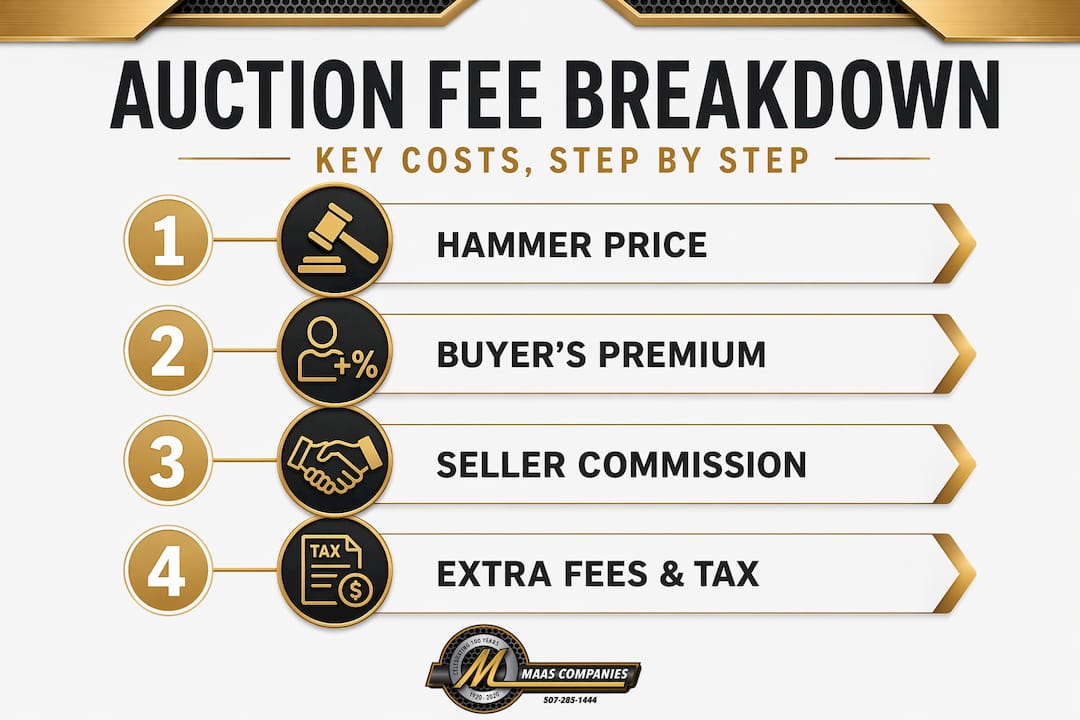
To understand how auction commissions work in practice, you first need a clear picture of the three primary financial components in any auction transaction: the hammer price, the buyer’s premium, and the seller commission.
The hammer price is the winning bid declared by the auctioneer when the gavel falls. It is the number everyone in the room focuses on, but it is neither what the buyer actually pays nor what the seller actually receives. It is the reference point from which all other calculations flow.
The buyer’s premium is an additional fee charged to the winning bidder, calculated as a percentage of the hammer price. The buyer’s premium is added on top of the hammer price and is entirely separate from any seller-side commissions. If a CNC machining center sells for $200,000 at hammer, and the buyer’s premium is 15%, the buyer owes $230,000 before taxes or shipping.
The seller commission flows in the opposite direction. The auction house deducts this percentage from the hammer price before remitting proceeds to the seller. Seller commissions in industrial equipment auctions typically range from 5% to 15%, though structures vary considerably. For industrial asset disposition strategies that involve multiple asset categories or complex lot structures, that range can shift further.
Here is how the money actually flows:
- The buyer pays: hammer price + buyer’s premium + applicable taxes + shipping and handling
- The seller receives: hammer price minus seller commission minus applicable additional fees
- The auction house earns: buyer’s premium revenue + seller commission revenue + ancillary fee income
Understanding auction fees begins with recognizing that the auction house earns from both sides of the transaction simultaneously. The hammer price sits at the center of both calculations.
Understanding buyer’s premiums: tiered structures and pricing implications
Most private equity and asset recovery professionals are familiar with the concept of a buyer’s premium. Fewer understand how tiered structures affect the actual dollar amount owed.
Major auction houses apply tiered buyer’s premium tables where percentages decrease as hammer prices rise, applied progressively within price bands. This is a regressive sliding-scale model. A bid of $500,000 does not carry a flat 15% premium on the entire amount. Instead, different rates apply to different portions of the price.
Here is an example of how a tiered buyer’s premium structure might look in a major industrial auction context:
| Hammer price band | Buyer’s premium rate | Premium charged on band |
|---|---|---|
| $0 to $100,000 | 18% | Up to $18,000 |
| $100,001 to $500,000 | 13% | Up to $52,000 |
| $500,001 and above | 10% | On remaining amount |
On a $600,000 hammer price, the total buyer’s premium would be $18,000 + $52,000 + $10,000 = $80,000, making the total buyer outlay $680,000 before taxes. The premium applies only to the portion of the hammer price in each tier, not the entire amount.
When choosing industrial equipment auctions as a disposition channel, modeling buyer-side costs accurately is essential because high buyer costs suppress competitive bidding. If buyers know the all-in cost will exceed their internal valuation, they bid less aggressively or sit out entirely.
To apply this correctly, follow these steps:
- Obtain the specific tiered premium schedule from the auction house before the sale.
- Identify the band breakpoints and associated percentage rates.
- Calculate the premium due on each band sequentially using the expected hammer price range.
- Sum the band-specific premiums to arrive at total buyer’s premium.
- Add this figure to the hammer price to model the buyer’s true cost.
Pro Tip: When you are the seller, consider that a high buyer’s premium depresses net hammer prices. Evaluate whether a lower buyer’s premium with a slightly higher seller commission might generate better competitive bidding and higher gross proceeds.
Seller commissions and additional fees: beyond the hammer price
Auction commission rates explained from the seller’s side involve more than one line item. The headline commission percentage is real, but it is rarely the only deduction.

Seller commissions vary by auction house and sale format, often calculated as a percentage of hammer price, with possible additional fees for marketing, cataloging, storage, and handling. For private equity firms managing portfolios of distressed industrial assets, these secondary fees can accumulate meaningfully across a large lot count.
Common seller-side costs in industrial equipment auctions include:
- Marketing and advertising fees: Costs for online listings, email campaigns, trade publication placements, and video production, often billed separately from commission.
- Photography and cataloging: Professional asset documentation for auction catalogs, charged per lot or as a lump sum.
- Storage and carrying costs: Fees for holding assets on-site or in a warehouse between consignment and sale date.
- Rigging and removal: Labor and equipment required to move heavy industrial assets to a sale-ready position or load-out area.
- Minimum commission guarantees: Some contracts specify a minimum commission amount per lot regardless of final hammer price.
- Lot withdrawal or kill fees: Charges applied if an asset is pulled from auction after the catalog has been published.
Commission and fee structures vary depending on asset type and labor required, with percentage-based models more common than flat fees in industrial liquidation contexts. For maximizing lot value in auctions, understanding the total seller-side cost burden before signing a consignment agreement is non-negotiable.
Pro Tip: Request a full fee schedule in writing before consignment, not just the commission rate. Build a simple cost model that applies all line-item fees to a conservative hammer price estimate. This gives you a realistic net recovery floor before the auction begins.
Taxes and total all-in costs: budgeting for purchase and recovery accuracy
One of the most frequently underestimated costs in an auction commission breakdown is the tax obligation. For buyers acquiring distressed industrial assets, taxes are often imposed on the combined hammer price plus buyer’s premium, increasing total payment and materially affecting budgeting accuracy.
This means sales tax is calculated on the full purchase price, not just the hammer price. If a piece of processing equipment sells at $300,000 hammer, carries a $45,000 buyer’s premium, and the applicable sales tax rate is 7%, the tax bill is $24,150 on the combined $345,000. That is not an insignificant figure.
Here is a complete all-in cost model for a buyer:
- Identify the hammer price (the winning bid).
- Calculate the tiered buyer’s premium on that hammer price.
- Add hammer price and buyer’s premium to get the pre-tax purchase price.
- Apply the applicable sales tax rate to the pre-tax purchase price.
- Add freight, rigging, shipping, and transportation costs.
- Sum all components for the true all-in acquisition cost.
Key factors that affect total buyer costs:
- Sale jurisdiction: Sales tax rates and exemptions vary significantly by state and sometimes by asset category.
- Asset classification: Some industrial equipment may qualify for exemptions under manufacturing or resale provisions.
- Auction format: Online auctions may have different tax collection obligations than live on-site events.
- Buyer’s tax status: Registered dealers or entities with resale certificates may qualify for tax exemptions.
Practitioners explicitly recommend backing into the allowable hammer price by subtracting buyer’s premium and taxes from the maximum budget to define sustainable bid limits.
This approach prevents the common mistake of setting a bid ceiling at the budget limit without accounting for fees and taxes. For auction absentee bidding strategies in particular, where a bidder cannot react in real time, pre-calculated bid ceilings are essential. Using an industrial equipment selling checklist to map these costs before auction day keeps both buyers and sellers aligned on realistic numbers.
Nuances and strategic considerations in auction commission structures
Experienced asset recovery professionals know that what are auction commissions on paper and what they cost in practice can differ. Contract terms often contain provisions that go unnoticed until they produce unexpected costs.
Contracts often include non-obvious economic terms beyond commission that can affect total costs and risk exposure. These provisions matter when modeling real net proceeds from a distressed industrial asset sale.
Items to evaluate carefully in every auction contract:
- Minimum payout guarantees: Some sellers demand a guaranteed minimum per lot, which the auction house may offset through higher buyer’s premiums or additional fees elsewhere in the agreement.
- Unsold lot terms: If an asset does not sell, does the seller owe any fees for cataloging, marketing, or storage already incurred? These pass-through costs reduce net recovery even on failed lots.
- Reserve price implications: Setting reserves too high can result in unsold lots. Auction houses may charge handling fees regardless of outcome.
- Online vs. live auction formats: Online-only formats often carry different commission structures, potentially lower seller commissions but with platform fees or technology charges added.
- Post-auction sale commissions: Assets sold after the auction event at negotiated prices are often subject to the same commission structure as live auction sales.
Commission structures align auctioneer incentives with sale recoveries, but true net proceeds depend on fully separating hammer price, fees, buyer premiums, and third-party costs. The auctioneer’s motivation to maximize the hammer price is genuine because their earnings depend on it. However, maximizing gross hammer price is not the same as maximizing your net recovery. High carrying costs, extended auction timelines, and unfavorable contract terms can erode proceeds even when hammer prices are strong.
The most productive conversations with auction houses are about total cost modeling, not just the commission rate. If an auctioneer cannot or will not provide a clear fee schedule covering all contingencies, that is meaningful information.
For context on how brokerage and auction collaboration can influence fee structures and recovery outcomes, it is worth exploring hybrid approaches when a single auction event is not the only disposition channel available.
Pro Tip: Build a side-by-side comparison of two or three auction options using identical assumed hammer prices. Apply each firm’s full fee schedule, including ancillary charges and contract terms. The option with the lowest commission rate may not deliver the best net recovery.
Why auction fees are more than just rates: practical lessons for asset recovery professionals
After reviewing auction fee structures across hundreds of industrial transactions, one pattern emerges consistently: professionals who focus only on the headline commission rate almost always leave money on the table or encounter costs they did not model.
The commission percentage is the starting point of the conversation, not its conclusion. Tax treatment alone can shift your effective buyer cost by several percentage points. A tiered premium structure means two bidders with the same budget but different lot size strategies will have materially different all-in costs. And a seller who ignores catalog, storage, and marketing fees may calculate net recovery at 80% of hammer when the actual figure is closer to 70%.
What separates effective asset recovery professionals from reactive ones is the quality of their pre-auction cost model. This means building a complete picture before the consignment agreement is signed: commission rates, buyer’s premium schedules, ancillary fee exposure, contract risk provisions, and tax obligations for the jurisdiction where the sale occurs.
Auction format selection is also underweighted in most liquidation decisions. Online-only auctions can generate broad buyer reach at lower venue costs, but they may reduce real-time competitive bidding intensity. Live on-site auctions create urgency and can drive hammer prices higher on high-demand equipment, but they carry logistical costs that reduce net proceeds. Aligning format to asset type and market conditions is a strategic decision, not a default.
The relationship with the auction house matters in ways that do not appear in any fee schedule. Transparent communication about reserve pricing, marketing reach, and expected buyer attendance allows both parties to set realistic expectations and adjust the approach before auction day. Choosing an auction partner whose industrial equipment auction advantages are aligned with your specific asset profile is worth considerably more than chasing the lowest commission rate.
Partner with Maas for strategic industrial asset auctions
Navigating the full auction commission breakdown for distressed industrial assets requires more than a rate sheet. It requires a partner who models costs transparently and executes with precision.

Maas Companies Inc. brings international experience in marketing industrial plants, equipment, and commercial properties to clients who need efficient, well-supported liquidation outcomes. Our commission structures are clear, tailored to asset type and sale format, and built around maximizing your net recovery, not just the gross hammer price. If you are ready to explore your options, review our selling and liquidation services or learn more about our specialized auction capabilities. You can also review an active example of our work, including a current biodiesel plant and oilseed processing auction, to understand the depth and scope of what we bring to complex industrial sales.
Frequently asked questions
What is the difference between the hammer price and buyer’s premium?
The hammer price is the winning bid declared by the auctioneer, while the buyer’s premium is an additional fee charged as a percentage of that price and paid by the buyer on top of it. As noted in The Auctioneer’s Guide to Buyer’s Premium, the two are calculated and collected separately, meaning they serve as distinct revenue streams for the auction house.
How do tiered buyer’s premiums affect total auction costs?
Tiered buyer’s premiums apply different rates to successive portions of the hammer price within defined bands, so total premium depends on how bid amounts distribute across those bands. The tiered premium applies only to each band’s portion, not to the entire hammer price, which requires band-by-band calculation rather than a simple flat-rate multiplication.
Are there fees beyond commissions and premiums I should watch for?
Yes, additional costs frequently include marketing, cataloging, photography, storage, rigging, shipping, applicable taxes, and contract-specific charges such as minimum payouts or lot withdrawal fees. Contracts often include non-obvious economic terms that must be identified and modeled before any consignment agreement is signed.
How should I calculate my maximum bid to avoid overspending?
Start with your total acquisition budget, then subtract the applicable buyer’s premium, sales tax, and any buyer-side logistics costs to determine the highest sustainable hammer price. Practitioners recommend backing into the maximum allowable hammer price from your all-in budget ceiling, not the other way around.
Recommended
- Auction strategies for small businesses: Maximize asset recovery | Blog | Insights on Asset Liquidation and Auction Trends
- How Auctions Help Speed Up Industrial Asset Disposition | Blog | Insights on Asset Liquidation and Auction Trends
- How to Navigate Commercial Property Foreclosure Sales | Blog | Insights on Asset Liquidation and Auction Trends
- Maximize Asset Recovery: Top Real Estate Liquidation Methods | Blog | Insights on Asset Liquidation and Auction Trends