

Blog
How to Appraise Industrial Assets: A Decision-Maker’s Guide

TL;DR:
- Industrial asset appraisal determines market value using methods like cost, market, and income approaches. Accurate valuation relies on complete data, purpose clarity, and cross-referenced methods to produce defensible results. Proper documentation and standardized processes are essential for meeting audit and lender requirements.
Industrial asset appraisal is the process of determining the current market value of tangible industrial equipment and properties using standardized, multi-method approaches. Financial analysts and industrial decision-makers rely on this process to support liquidation, loan collateral, insurance renewals, and capital budgeting. The three recognized appraisal methods are the cost approach, the market approach, and the income approach. Selecting the right method depends on the asset type, its purpose, and the transaction context. Adherence to professional standards such as USPAP (Uniform Standards of Professional Appraisal Practice) and IVS (International Valuation Standards) is non-negotiable for defensible, audit-ready results.
What are the primary appraisal methods used to value industrial assets?
Professional industrial appraisals use three core approaches, often cross-referenced for accuracy, particularly for transactions above $20,000–$30,000 that require expert valuations to meet audit or lending requirements. Each method serves a distinct purpose and applies to different asset conditions and market contexts.
Cost approach
The cost approach estimates value by calculating replacement cost new (RCN) and then subtracting accumulated depreciation. The replacement cost formula accounts for the current unit price plus all ancillary costs, including installation and commissioning, multiplied by an inflation adjustment factor using the annual Producer Price Index (PPI) rate compounded by years since the last valuation. This method is most reliable for insurance purposes and capital budgeting, where replacement cost is the relevant benchmark. It is also the preferred method when no active secondary market exists for the asset. For a detailed breakdown of this methodology, the cost approach explained by Price & Accountants provides a clear professional reference.
Market approach
The market approach uses confirmed sales data from comparable assets, adjusted for condition, age, usage, and configuration. Listing prices run 5–15% higher than actual transaction prices, so appraisers adjust comparables downward to reflect realistic market values. This method works best for assets with active secondary markets, such as standard CNC machines, forklifts, or commercial HVAC systems. Reliable valuation depends on confirmed sales data, not asking prices.
Income approach
The income approach capitalizes the income streams generated by operating or leasing an asset. It applies primarily to income-generating equipment, such as leased compressors, generators, or processing lines under long-term contracts. Appraisers project future cash flows and apply a capitalization rate to arrive at present value. This method is less common in liquidation scenarios but is the standard for financial reporting when assets generate measurable revenue.
Hybrid valuation
Cross-referencing all three approaches produces the most defensible conclusion. When results from each method align within a reasonable range, the appraiser reconciles them into a final value opinion. When they diverge significantly, that divergence signals a data quality issue or an unusual asset condition that requires further investigation.
Pro Tip: Always document which method carries the most weight in your final reconciliation and explain why. Auditors and lenders expect that reasoning in writing.
| Approach | Best Use Case | Key Input |
|---|---|---|
| Cost | Insurance, capital budgeting | Replacement cost, depreciation |
| Market | Active secondary markets | Confirmed comparable sales |
| Income | Leased or revenue-generating assets | Future cash flows, cap rate |
How to prepare your industrial asset data for an accurate appraisal
Accurate industrial asset valuation starts with complete, organized data. Poor documentation is the single most common cause of appraisal disputes and reduced recovery values. Before commissioning or conducting an appraisal, gather and verify the following:
- Asset register: Record make, model, serial number, year of manufacture, and physical location for every asset. Gaps in this register create uncertainty that buyers price into their bids.
- Maintenance and repair history: Compile service logs, repair records, and scheduled maintenance documentation. Preventive maintenance history adds measurable buyer confidence and supports a sale premium.
- Condition assessments: Document current operating condition, any known defects, and recent inspections. Photographs taken during a site visit validate condition claims.
- Technical manuals and specifications: Include original equipment manufacturer (OEM) documentation where available. This supports replacement cost calculations and buyer due diligence.
- Accessories and ancillary equipment: List all included tooling, chucks, attachments, and peripheral components separately. Accessories can add 15–30% to total asset value, and failing to document them separately risks leaving significant recovery value on the table.
- Appraisal purpose statement: Define whether the appraisal is for liquidation, loan collateral, financial reporting, or insurance. This single decision drives method selection and valuation assumptions.
Standardizing data quality and definitions across a portfolio is equally critical. A unified valuation playbook across multi-sector industrial portfolios drives comparability, consistency, and better capital allocation decisions. Without consistent definitions, two assets of identical type and condition can carry different reported values, which undermines lender confidence and audit readiness.
Pro Tip: Build your asset register in a format that mirrors the data fields your appraiser will need. This cuts appraisal preparation time and reduces the risk of errors introduced during data transfer.

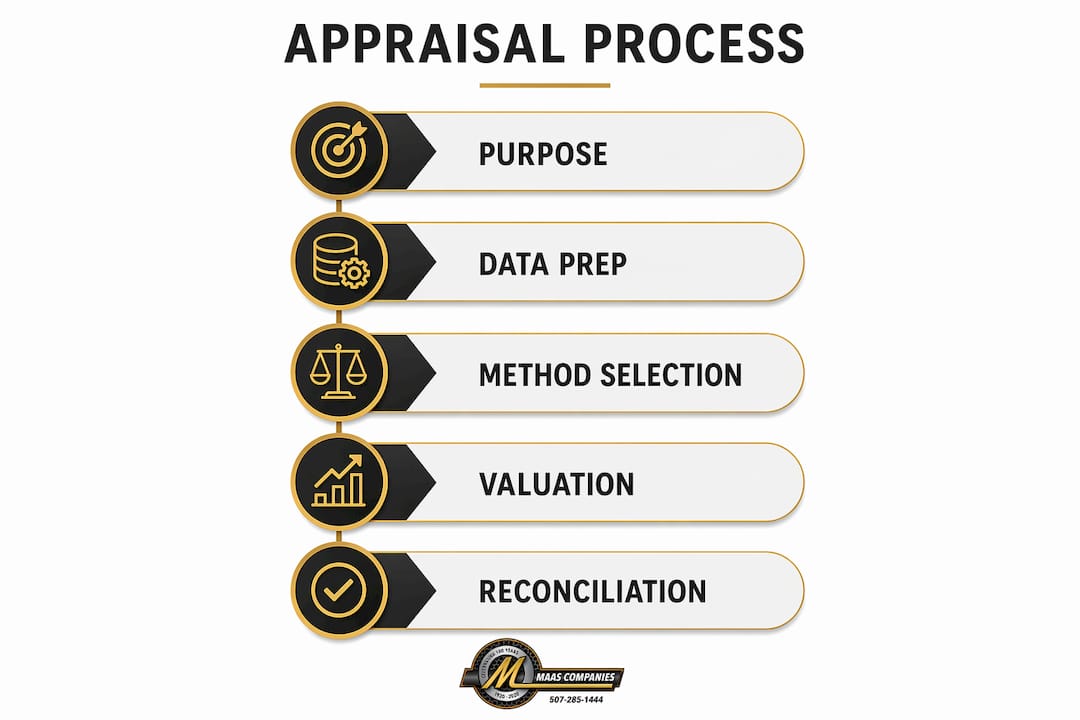
What is the step-by-step process to conduct an industrial asset appraisal?
A structured appraisal process produces results that hold up under lender scrutiny, audit review, and buyer due diligence. The following sequence applies whether you are commissioning an independent appraiser or conducting an internal valuation review.
-
Define the appraisal purpose. Determine whether the valuation is for liquidation, loan collateral, financial reporting, or insurance. Defining the purpose upfront guides the choice of value standard and reduces the risk of professional failure. A liquidation appraisal uses Fair Market Value in exchange (removal), which accounts for de-installation and transportation costs. A collateral appraisal may use Fair Market Value in continued use, which is a higher figure.
-
Select the appropriate valuation method. Match the method to the asset type and market activity. Use the cost approach for specialized or custom equipment. Use the market approach for standard assets with active resale markets. Apply the income approach only when the asset generates documented revenue.
-
Conduct a site inspection. A qualified appraiser physically inspects each asset, verifies condition, takes photographs, and validates the data in the asset register. Remote appraisals based solely on documentation carry higher risk of error and are less defensible in disputes.
-
Collect and analyze market data. For the market approach, gather confirmed sales data from auction results, dealer transactions, and industry databases. Adjust listing prices downward by 5–15% to reflect actual transaction prices.
-
Calculate replacement cost with full ancillary costs. For the cost approach, include installation, commissioning, freight, and inflation adjustments using the PPI rate. Subtract physical, functional, and economic depreciation to arrive at depreciated replacement cost.
-
Estimate income capitalization value where applicable. Project future cash flows from the asset’s operation or lease, then apply an appropriate capitalization rate. This step applies only to income-generating assets.
-
Reconcile results across all applicable methods. Compare the values produced by each approach. Weight the most relevant method most heavily, and document the reasoning for that weighting.
-
Prepare a professional appraisal report. The final report must include scope of work, methodology, assumptions, data sources, and a declaration of appraiser independence. This report is the document that lenders, auditors, and buyers will rely on. For context on what lenders expect from this report, the industrial plant liquidation guide from Maascompanies outlines audit-compliant valuation requirements in detail.
| Step | Key Action | Output |
|---|---|---|
| Purpose definition | Select value basis | Appraisal scope statement |
| Method selection | Match method to asset type | Methodology decision |
| Site inspection | Verify condition and data | Inspection report, photos |
| Market data collection | Gather and adjust comparables | Adjusted sales database |
| Cost calculation | RCN minus depreciation | Depreciated replacement cost |
| Reconciliation | Weight and combine methods | Final value opinion |
Common mistakes in industrial asset appraisal and how to avoid them
Appraisal errors are costly. A valuation variance of 10% can cause hundreds of thousands of dollars in lost equity or excess tax liability. The most frequent mistakes follow predictable patterns, and each one has a clear prevention strategy.
- Confusing book value with fair market value. Book value reflects accounting depreciation schedules, not market conditions. The most common appraisal mistakes include treating book value as a proxy for fair market value, which leads to systematic mispricing during liquidation and insurance renewals.
- Ignoring de-installation and transportation costs. Fair Market Value in exchange (removal) is lower than Fair Market Value in continued use because it accounts for the cost of removing and transporting the asset. Failing to apply the correct value basis inflates expectations and creates friction in transactions.
- Omitting accessories and ancillary equipment. Tooling, chucks, and specialized attachments must be valued separately. Bundling them without documentation leaves recovery value unrealized.
- Mixing valuation reports intended for conflicting purposes. A report prepared for insurance cannot be repurposed for a loan collateral review without adjustment. Using the wrong report for the wrong purpose risks audit rejection and lender disputes.
- Applying inconsistent definitions across a portfolio. Without a standardized valuation framework, assets of similar type and condition carry different reported values across business units. This undermines portfolio-wide analysis and capital allocation decisions.
- Relying on unqualified internal assessors for high-value assets. For assets above the threshold requiring expert valuation, an independent, credentialed appraiser is required. Internal estimates do not satisfy USPAP or IVS standards.
“Standardizing asset registers, maintenance records, and compliance documentation is not an administrative exercise. It is the foundation of a defensible appraisal that lenders and auditors will accept without challenge.”
Pro Tip: Maintain a living asset register updated at least annually. Appraisals conducted on stale data produce values that diverge from market reality, and that gap is always discovered at the worst possible moment.
For a broader view of equipment valuation methods and how they apply across asset classes, Maascompanies has published a practical reference for asset managers.
Key Takeaways
Accurate industrial asset appraisal requires purpose-driven method selection, complete documentation, and cross-referenced valuation approaches to produce defensible results that maximize recovery and satisfy audit requirements.
| Point | Details |
|---|---|
| Define purpose first | Appraisal purpose determines the value basis and method selection before any data collection begins. |
| Cross-reference all three methods | Cost, market, and income approaches should be reconciled to produce the most defensible final value. |
| Document accessories separately | Tooling and ancillary equipment can add 15–30% to total asset value and must be listed individually. |
| Adjust market comparables downward | Listing prices run 5–15% above actual transaction prices; appraisers must apply this adjustment. |
| Standardize portfolio definitions | Consistent data standards and valuation frameworks are required for audit-ready, portfolio-wide reporting. |
What I’ve learned from years of watching appraisals succeed and fail
The appraisals that hold up under pressure share one characteristic: the purpose was defined before a single data point was collected. Financial analysts who commission appraisals without specifying whether the result will be used for liquidation, collateral, or financial reporting create ambiguity that the appraiser has to resolve on their own. That resolution is rarely optimal for the client.
The second pattern I’ve observed consistently is the undervaluation of accessories. Decision-makers focus on the primary asset, a press, a lathe, a compressor, and treat the surrounding tooling as incidental. The 15–30% value contribution from properly documented accessories is not theoretical. It shows up in auction results when the catalog is complete and in lender appraisals when the scope is thorough.
The third lesson is harder to internalize: governance matters as much as methodology. A single well-executed appraisal is useful. A portfolio of appraisals conducted under a unified framework, with consistent definitions and data standards, is what gives leadership the ability to make capital allocation decisions with confidence. The fair value framework is a starting point, but the real work is building internal discipline around data collection and appraisal commissioning.
The analysts and decision-makers who get the best outcomes treat appraisal as a process, not an event. They maintain current asset registers, they define purpose before engaging an appraiser, and they insist on cross-referenced methodology. That discipline is what separates a defensible valuation from one that creates problems at closing.
— Vector
Maascompanies: a partner for industrial appraisal and asset recovery
Maascompanies brings decades of experience in industrial asset appraisal and recovery to clients managing plant closures, restructuring, and capital recovery events worldwide. The firm’s approach combines professional valuation expertise with an aggressive, targeted marketing strategy designed to maximize recovery across equipment, real estate, and commercial properties.

For financial analysts and decision-makers who need more than a number on a page, Maascompanies provides appraisal support, auction brokerage, and liquidation strategy under one roof. The goal is always the same: defensible valuations that hold up to lender and audit scrutiny, paired with a sales process that delivers maximum return. If you are preparing for a liquidation event or need a credible valuation for collateral purposes, explore Maascompanies’ services to understand how a structured recovery process works in practice.
FAQ
What does “how to appraise industrial assets” mean in practice?
Appraising industrial assets means applying the cost, market, and income approaches to determine fair market value for a specific purpose, such as liquidation, loan collateral, or financial reporting. The process requires site inspection, data collection, and a professional report meeting USPAP or IVS standards.
What is the difference between book value and fair market value?
Book value reflects accounting depreciation schedules and rarely matches what a buyer will pay. Fair market value reflects actual market conditions and varies depending on whether the asset remains in use, is sold installed, or is removed and transported.
How does appraisal purpose affect the final value?
Fair Market Value in continued use is higher than Fair Market Value in exchange (removal) because the removal scenario deducts de-installation and transportation costs. Defining the purpose before the appraisal begins determines which value basis applies and prevents mispricing.
Why must accessories be valued separately?
Accessories such as tooling, chucks, and attachments can add 15–30% to total asset value. Bundling them without separate documentation causes appraisers and buyers to undercount their contribution, reducing recovery returns.
When should a company use an independent appraiser?
An independent, credentialed appraiser is required for any transaction above the threshold mandating expert valuation, typically $20,000–$30,000, and for any appraisal that will be submitted to a lender or auditor. Internal estimates do not satisfy USPAP or IVS standards.
Recommended
- Industrial Equipment Value Explained for Decision-Makers | Blog | Insights on Asset Liquidation and Auction Trends
- Types of Industrial Asset Disposition: A Strategy Guide | Blog | Insights on Asset Liquidation and Auction Trends
- Why Conduct Equipment Appraisals: A Corporate Finance Guide | Blog | Insights on Asset Liquidation and Auction Trends
- Demystifying the bidding process for industrial asset liquidation | Blog | Insights on Asset Liquidation and Auction Trends