

Blog
Why Conduct Equipment Appraisals: A Corporate Finance Guide

TL;DR:
- Equipment appraisals determine the true value of assets, supporting financing, insurance, tax compliance, and legal needs. Proper appraisals prevent financial risks such as underestimated asset values, tax penalties, and disputed transactions. Using credentialed, independent appraisers ensures credible reports accepted by lenders, regulators, and courts.
An equipment appraisal is a professional process to determine the true, defensible value of company assets, and it is the foundation of sound financial decision-making in capital-intensive industries. Corporate decision-makers who skip this step expose their organizations to financing gaps, tax penalties, insurance shortfalls, and failed transactions. Professional appraisals follow recognized standards such as USPAP (Uniform Standards of Professional Appraisal Practice) and CUSPAP, and they apply established methodologies to produce values that lenders, auditors, and regulators will accept. Understanding why conduct equipment appraisals matters is the first step toward protecting your organization’s asset base.
Why conduct equipment appraisals: the core business case
Professional equipment appraisals are essential for five core business processes: securing financing, managing insurance coverage, meeting tax reporting requirements, supporting mergers and acquisitions, and providing credible evidence in legal disputes. Each of these processes carries real financial consequences when asset values are wrong or unsupported.
Lenders require independent appraisals before approving equipment-backed loans. A bank or commercial lender will not accept a borrower’s internal asset schedule as collateral evidence. Updated valuations reflect current market conditions and reduce underwriting uncertainty, giving lenders the confidence to approve financing at better terms.
Insurance coverage tied to inaccurate values creates two problems. Under-insurance leaves the company exposed to unrecovered losses after a claim. Over-insurance means the company pays unnecessary premiums for coverage it cannot collect. A professional appraisal sets the correct replacement or actual cash value, eliminating both risks.
Tax compliance is a third driver. Depreciation schedules, property tax assessments, and asset allocation in business sales all depend on defensible equipment values. The IRS requires buyers and sellers to report consistent asset allocations on Form 8594, and an independent appraisal is the primary defense against IRS reallocation challenges during an audit.
- Financing support: Lenders require USPAP-compliant reports to approve equipment-backed credit facilities.
- Insurance accuracy: Correct replacement values prevent under-coverage penalties and premium waste.
- Tax compliance: Independent appraisals defend depreciation schedules and Form 8594 allocations.
- M&A transactions: Credible valuations protect both buyers and sellers from overpayment or undervaluation.
- Litigation and disputes: Courts and arbitrators require methodology-backed, independent appraisal reports.
Pro Tip: Schedule appraisals before financing applications, not after. Lenders who receive an appraisal upfront process credit decisions faster and with fewer conditions.
How does the equipment appraisal process work?
The appraisal process begins with a physical inspection or a structured desktop review, followed by market research, data gathering, and the application of a recognized valuation methodology. The appraiser documents equipment condition, age, manufacturer specifications, maintenance history, and comparable market sales before producing a written report.

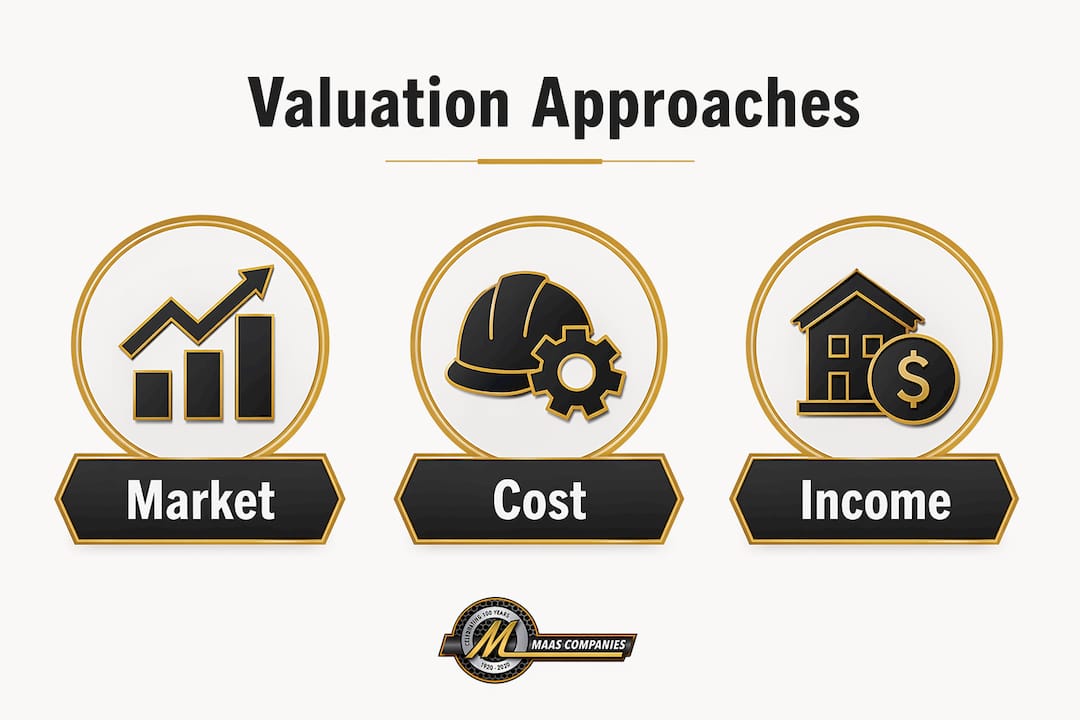
The three primary valuation approaches
Three methodologies govern professional equipment appraisals, and each serves a different purpose.
The Market Approach compares the subject equipment to recent sales of similar assets in active markets. This method works best for common machinery with strong secondary market data, such as forklifts, CNC machines, or commercial vehicles.
The Cost Approach estimates the replacement cost of the equipment, then deducts depreciation for age, condition, and obsolescence. This method applies when comparable sales data is limited, as with specialized or custom-built industrial equipment.
The Income Approach values equipment based on the revenue it generates or enables. This method is less common for individual assets but applies when equipment is integral to a specific income-producing process.
Value types and why they matter
Appraisal outcomes vary significantly depending on which value definition the appraiser applies. The three most common value types are:
| Value Type | Definition | Typical Use Case |
|---|---|---|
| Fair Market Value (FMV) | Price between a willing buyer and seller, neither under compulsion | M&A transactions, tax reporting, estate planning |
| Orderly Liquidation Value | Expected proceeds from a planned, time-limited sale | Loan collateral, restructuring, asset recovery |
| Forced Liquidation Value | Expected proceeds from an immediate, compelled sale | Bankruptcy, foreclosure, distressed asset sales |
Applying the wrong value type does not just produce a lower or higher number. It invalidates the appraisal for its intended purpose. A lender requiring orderly liquidation value for collateral assessment will reject a report prepared on a fair market value basis.
An AIC-designated appraiser uses verified sales data, recognized methodology, and professional standards to produce reports that lenders, lawyers, and auditors will accept without question. Certifications such as AIC (Accredited in Machinery and Technical Specialties) and EECA (Equipment and Machinery Appraisal) signal that the appraiser meets rigorous professional requirements.
Pro Tip: Always confirm the value type required by your lender, insurer, or transaction counsel before engaging an appraiser. Changing the value type after the report is issued requires a new engagement and additional cost.
What financial risks come from inaccurate equipment appraisals?
A 10% variance in equipment valuation can translate to hundreds of thousands of dollars in lost equity or overpaid taxes in capital-intensive industries. That threshold is not theoretical. In a manufacturing facility with $5 million in equipment, a 10% error represents $500,000 in misallocated value across financing, insurance, and tax calculations.
The consequences of inaccurate or missing appraisals fall into four categories:
- Financing rejections or reduced credit: Lenders who receive outdated or self-prepared valuations reduce loan amounts or add restrictive covenants. Lenders and regulators distrust self-prepared valuations and require independent, methodology-backed, USPAP-compliant reports.
- Tax audit exposure: Inconsistent asset allocations between buyers and sellers in a business sale trigger IRS scrutiny. Without an independent appraisal, the IRS can reallocate values to maximize tax liability for either party.
- Insurance penalties and gaps: Under-insured equipment leaves companies absorbing replacement costs after a loss. Some policies include co-insurance clauses that penalize policyholders who carry coverage below a defined percentage of actual value.
- Transaction disputes: Buyers and sellers who rely on informal valuations during M&A negotiations create post-closing disputes over working capital adjustments, earnout calculations, and asset representations.
“Decision-makers often underestimate the role of equipment appraisals as critical credit decision tools rather than mere accounting exercises. The appraisal is not a formality. It is the document that determines whether a lender, buyer, or regulator accepts your asset values as credible.”
The litigation risk alone justifies the cost of a professional appraisal. Shareholder disputes, partnership dissolutions, and insurance claim denials all require defensible, independent valuations. Courts do not accept internal spreadsheets as evidence of fair market value.
How can companies implement equipment appraisals effectively?
Effective implementation starts with selecting a qualified appraiser. Credentials matter more than price. Look for appraisers holding recognized designations such as AIC, ASA (American Society of Appraisers), or EECA, and confirm they follow USPAP standards. Professional appraisers charge fixed or hourly fees, not a percentage of equipment value. Fee structures tied to asset value create a conflict of interest and compromise the appraiser’s independence.
The following steps outline a practical implementation framework for corporate asset managers:
- Identify the appraisal trigger. Determine whether the appraisal is needed for financing, insurance renewal, a pending transaction, tax reporting, or litigation. The trigger defines the required value type and report format.
- Select a credentialed appraiser. Verify professional designations, USPAP compliance, and relevant industry experience. An appraiser who specializes in manufacturing equipment will produce a more defensible report than a generalist.
- Choose the inspection method. Desktop appraisals conducted remotely use photos, inventory lists, and maintenance records, but physical inspections provide more accurate valuations for complex or high-value assets.
- Prepare documentation. Gather purchase records, maintenance logs, depreciation schedules, and any prior appraisal reports. Complete documentation reduces appraisal time and improves accuracy.
- Review the report before submission. Confirm that the value type, effective date, and intended use match your requirements before submitting the report to a lender, insurer, or transaction counterparty.
- Schedule recurring appraisals. Equipment values change with market conditions, technology cycles, and asset age. Annual or biennial appraisals keep your records current and prevent the compounding errors that arise from stale valuations.
Appraisal data also directly supports asset recovery and liquidation outcomes. Companies that enter a liquidation process with current, credible appraisals negotiate from a position of knowledge. They know the floor value of each asset and can set realistic reserve prices that protect recovery while attracting qualified buyers.
Pro Tip: Pair your appraisal with a current market analysis from an experienced asset recovery firm. The appraiser establishes value. The recovery firm tells you what the market will actually pay today, and the gap between those two numbers is your negotiating range.
Key Takeaways
Equipment appraisals are credit decision tools, compliance instruments, and transaction safeguards, not administrative formalities, and organizations that treat them as optional accept avoidable financial and legal risk.
| Point | Details |
|---|---|
| Appraisals serve five core functions | Financing, insurance, tax compliance, M&A transactions, and litigation all require independent valuations. |
| Value type selection is critical | Using the wrong value definition (FMV vs. orderly liquidation) invalidates the appraisal for its intended purpose. |
| A 10% valuation error is costly | In capital-intensive industries, a 10% variance can represent hundreds of thousands in lost equity or overpaid taxes. |
| Credentials and independence matter | Appraisers with AIC or ASA designations following USPAP standards produce reports lenders and regulators will accept. |
| Timing drives outcomes | Appraisals completed before financing applications, insurance renewals, or M&A closings produce better results than reactive ones. |
The appraisal is a credit instrument, not a compliance checkbox
After working with asset-heavy businesses through plant closures, restructurings, and complex M&A transactions, one pattern stands out clearly. The companies that treat equipment appraisals as a routine compliance task consistently underperform in capital recovery compared to those that treat the appraisal as a credit and negotiation instrument.
Lenders read appraisal reports the way underwriters read financial statements. They look for methodology, comparables, appraiser credentials, and value type alignment. A report that fails any of those tests does not just slow the financing process. It signals to the lender that the borrower’s asset management practices are weak, which affects pricing, covenants, and credit availability across the entire relationship.
The trend toward independent appraisals is accelerating. Regulators and auditors are applying more scrutiny to asset-backed lending and business combination accounting. Companies that maintain current, credentialed appraisals on their major equipment portfolios are better positioned for financing, better protected in disputes, and better prepared for the transactions that restructuring or growth will eventually require.
The most common mistake I see is organizations commissioning an appraisal only when a transaction is already in progress. At that point, the appraisal becomes a reactive document rather than a planning tool. The organizations that use appraisal data proactively, to set insurance levels, guide capital allocation, and inform asset disposal timing, consistently achieve better financial outcomes. The cost of a professional appraisal is small relative to the decisions it supports.
— Vector
Maascompanies: connecting appraisal value to real market recovery
When an equipment appraisal confirms asset value, the next question is how to realize that value in the market. Maascompanies brings decades of experience marketing industrial plants, equipment, and commercial properties to qualified buyers worldwide.

Maascompanies pairs credible asset valuations with an aggressive, targeted marketing program that reaches the buyers most likely to pay full value. Whether the situation involves a plant closure, excess inventory, or a structured liquidation, the team at Maascompanies builds a recovery plan around documented asset values. Current projects include a biodiesel plant auction with oilseed processing facilities and surplus equipment. Companies ready to convert appraised assets into capital can contact Maascompanies to discuss auction and brokerage options.
FAQ
What is an equipment appraisal?
An equipment appraisal is a professional assessment that determines the value of physical assets using recognized methodologies such as the Market, Cost, or Income approach, following standards like USPAP. The result is a written report that lenders, insurers, tax authorities, and courts accept as credible evidence of value.
Why do lenders require independent equipment appraisals?
Lenders require independent appraisals because self-prepared valuations lack the methodology, market data, and professional accountability that underwriting standards demand. A USPAP-compliant report from a credentialed appraiser reduces lender risk and supports faster, more favorable credit decisions.
What is the difference between fair market value and liquidation value?
Fair market value assumes a willing buyer and seller with no compulsion, while liquidation value reflects the proceeds from a time-limited or forced sale. Applying the wrong value type to a financing or insurance requirement invalidates the appraisal for that purpose.
How often should companies appraise their equipment?
Companies should appraise major equipment assets annually or biennially, and always before financing applications, insurance renewals, significant transactions, or litigation. Stale valuations compound errors across multiple financial decisions over time.
Can a company prepare its own equipment valuation?
A company can prepare an internal asset schedule, but lenders, regulators, and courts will not accept it as an independent appraisal. Only a credentialed appraiser following USPAP standards and charging a fixed or hourly fee, not a percentage of value, produces a report with the independence and methodology required for financing, tax defense, and legal proceedings.
Recommended
- Equipment Valuation Methods List for Asset Managers | Blog | Insights on Asset Liquidation and Auction Trends
- Equipment liquidation explained: maximizing asset recovery | Blog | Insights on Asset Liquidation and Auction Trends
- What Is Equipment Remarketing? A Decision-Maker’s Guide | Blog | Insights on Asset Liquidation and Auction Trends
- Industrial Equipment Sourcing Process: A Procurement Guide | Blog | Insights on Asset Liquidation and Auction Trends