

Blog
What Is Equipment Remarketing? A Decision-Maker’s Guide

TL;DR:
- Equipment remarketing recovers value from retired machinery and hardware by evaluating, refurbishing, and reselling assets. Acting within 90 days of retirement and batching at least 50 units maximizes financial returns and reduces risks, turning assets into cash more efficiently. Certified partners ensure data security, compliance, and access to global buyer networks for optimal results.
Equipment remarketing is a structured asset disposition process that recovers residual value from retired machinery, IT hardware, and industrial equipment by evaluating, refurbishing, and reselling assets through established secondary markets. Unlike basic disposal, which generates no revenue and often costs $45–65 per unit to process, a well-executed remarketing program returns measurable proceeds to the business. For financial and operational decision-makers managing plant closures, technology refreshes, or restructuring, understanding what is equipment remarketing is the difference between writing off assets and recovering real capital. The process also addresses compliance obligations, carrying costs, and environmental reporting requirements that standard disposal ignores.
What is equipment remarketing and how does it differ from disposal?
Equipment remarketing, also called asset remarketing or IT asset disposition (ITAD) when applied to technology hardware, is the organized process of extracting secondary market value from decommissioned business assets. Disposal ends the asset’s life. Remarketing extends it by placing the asset with a new buyer who can still use it productively.
The financial gap between the two approaches is significant. Structured remarketing programs recover 10–30% of original hardware acquisition costs, while basic disposal generates zero revenue and charges processing fees. That gap compounds across large asset portfolios during a plant closure or technology refresh cycle.
Remarketing also carries compliance weight that disposal does not. Certified remarketing partners manage data destruction to international standards such as NIST and Blancco, producing full audit trails. That documentation protects the organization from data breach liability after the asset leaves the building.
The secondary market for industrial and IT equipment is active and global. Buyers include manufacturers seeking replacement parts, emerging market operators acquiring proven equipment at lower cost, and refurbishers who resell to end users. Access to those buyer networks is what separates a certified remarketing partner from a scrap dealer.
How does the equipment remarketing process work from evaluation to sale?
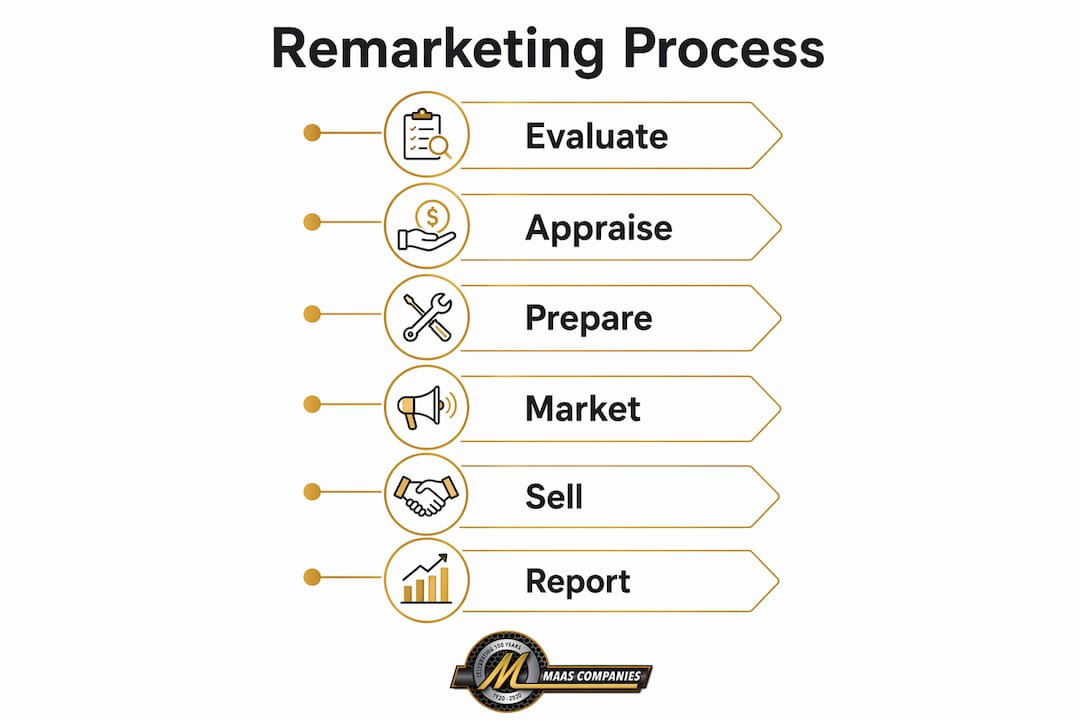
The equipment remarketing process follows a defined sequence. Each step builds on the last, and skipping any one of them reduces final recovery value.
-
Asset audit and grading. A certified technician catalogs each unit by age, model, specification, and physical condition. Grading standards typically run from Grade A (fully functional, cosmetically sound) to Grade C (functional with visible wear) and scrap. The grade directly determines resale price and channel.
-
Certified data sanitization or destruction. For IT hardware, all storage media must be wiped or physically destroyed before remarketing. Certified remarketing partners manage data destruction and compliance reporting, reducing organizational risk. For industrial equipment, this step involves removing proprietary tooling, software licenses, and control system configurations.
-
Refurbishment and pricing. Assets that pass grading thresholds are cleaned, tested, and repaired to a marketable standard. Pricing is benchmarked against current secondary market data, not original acquisition cost. Overpricing slows sales; underpricing leaves recovery on the table.
-
Channel selection and sale. Remarketing processes typically include sales through existing buyer networks, vendor channels, negotiated direct sales, and public auctions. Each channel suits different asset types and urgency levels. Auctions generate competitive pricing quickly. Negotiated sales work better for specialized or high-value equipment where a targeted buyer pool exists.
-
Settlement and reporting. Revenue-sharing or buyback models are common. The remarketing partner deducts processing costs and remits net proceeds with a full disposition report covering chain of custody, data destruction certificates, and environmental compliance documentation.
Pro Tip: Request a sample disposition report from any remarketing partner before signing an agreement. The report format reveals whether the partner can satisfy your audit, compliance, and ESG reporting requirements.
What financial and operational benefits does equipment remarketing offer?
The financial case for remarketing over disposal is direct. Remarketing programs can offset 40–60% of total disposition costs, with typical net recoveries ranging from $200–800 per qualifying asset. Across a 500-unit technology refresh or a multi-line plant decommission, those figures represent material capital recovery.
The operational benefits extend beyond the sale proceeds:
- Reduced carrying costs. Remarketing removes idle equipment from storage, cutting inventory management, insurance, and space costs. These indirect savings are frequently overlooked in disposal cost comparisons.
- Compliance and risk reduction. Certified data destruction with audit trails eliminates post-disposition data breach exposure. For regulated industries, this protection alone justifies the remarketing investment.
- ESG contribution. Extending asset lifecycle through resale reduces electronic and industrial waste. That outcome supports sustainability reporting under frameworks such as GRI and CDP, which institutional investors and regulators increasingly require.
- Faster capital release. A well-run remarketing campaign converts idle assets to cash within a defined timeline, freeing balance sheet capacity for reinvestment.
The break-even threshold matters. Batch processing of at least 50 units is required for profitability because fixed costs such as logistics and data sanitization do not scale down proportionally for small lots. Single-item remarketing rarely generates net gains after processing costs. Decision-makers should aggregate assets across departments or project phases to reach viable batch sizes before engaging a remarketing partner.
For a broader view of how surplus equipment recovery fits into a full liquidation plan, the asset type, age, and market demand all influence which disposition channel produces the best outcome.
When should companies time their equipment remarketing for maximum value?
Timing is the single most controllable variable in equipment remarketing outcomes. Most decision-makers underestimate how quickly asset value declines after retirement.

Enterprise servers retain 15–25% of original value if remarketed within six months of retirement. Assets held beyond five years generate recovery rates roughly three times lower than assets disposed of at two to three years of age. The same depreciation curve applies to industrial equipment, CNC machinery, and commercial vehicles.
| Timing window | Typical recovery outcome |
|---|---|
| Within 90 days of retirement | Highest net proceeds; full buyer pool access |
| 3–6 months after retirement | Moderate recovery; some value erosion |
| 6–12 months after retirement | Significant depreciation; limited buyer interest |
| Beyond 12 months | Near-scrap value; carrying costs may exceed proceeds |
The critical remarketing window is within 90 days of retirement. Holding equipment longer than six months causes value to decline sharply due to depreciation and hidden carrying costs including storage, insurance, and security. Those costs accumulate silently and are rarely captured in standard asset management reports.
Market demand also affects timing. IT hardware tied to a product generation cycle loses value rapidly when a successor model ships. Industrial equipment in active production categories holds value longer but is still subject to condition-based depreciation. Monitoring secondary market pricing for your specific asset categories before setting a remarketing timeline produces better outcomes than applying a fixed calendar rule.
Pro Tip: Build remarketing timelines into your asset refresh planning cycle, not as an afterthought at decommission. Assets flagged for disposition 90 days before retirement consistently achieve higher recovery than those processed reactively.
What are best practices for optimizing equipment remarketing outcomes?
Execution quality determines whether a remarketing program achieves its financial targets. The following practices separate high-recovery programs from average ones.
- Aggregate assets to viable batch sizes. Single-unit remarketing seldom covers processing costs. Batch at least 50 units per disposition event to absorb fixed logistics and data sanitization costs and generate net proceeds.
- Select certified remarketing partners. Strong partnerships with certified vendors provide financial returns, auditability, and environmental compliance. Verify certifications such as R2 (Responsible Recycling) and ISO 14001 before engagement.
- Invest in accurate grading and documentation. Accurate equipment grading and comprehensive documentation, including photographs, service history, and condition disclosure, directly influence pricing and buyer confidence. Incomplete listings attract lower bids and extend sale timelines.
- Benchmark pricing against current market data. Use secondary market platforms and recent comparable sales to set realistic price expectations. Anchoring to original acquisition cost produces overpriced listings that stall.
- Plan logistics before the sale, not after. Inspection access, removal timelines, and freight arrangements must be confirmed before marketing begins. Buyers who encounter logistical barriers withdraw, and re-listing depresses perceived value.
- Require full disposition reporting. Every remarketing engagement should produce a report covering chain of custody, data destruction certificates, environmental compliance, and net proceeds. That documentation satisfies internal audit, legal, and ESG reporting requirements.
For complex industrial assets, auction-based disposition accelerates timelines by generating competitive bids from a pre-qualified buyer pool, which is particularly valuable when carrying costs are accumulating on large equipment.
Key Takeaways
Equipment remarketing delivers superior financial recovery, compliance protection, and operational efficiency compared to standard disposal, but only when executed with proper timing, batch scale, and certified partners.
| Point | Details |
|---|---|
| Define remarketing correctly | Equipment remarketing is a structured resale process, not disposal; it generates revenue rather than costs. |
| Act within 90 days | Remarketing within 90 days of retirement maximizes recovery; value drops sharply after six months. |
| Batch for profitability | Aggregate at least 50 units per disposition event to cover fixed logistics and sanitization costs. |
| Require certified partners | Certified partners provide data destruction audit trails, compliance documentation, and buyer network access. |
| Document everything | Accurate grading, photographs, and service history directly improve pricing and sale speed. |
Why timing and discipline define remarketing results
Equipment remarketing is one of the few asset management decisions where operational discipline produces a directly measurable financial outcome. I have seen organizations recover hundreds of thousands of dollars from assets they were prepared to write off entirely, simply by acting within the right window and working with a partner who had genuine buyer network reach.
The compliance dimension is underweighted in most internal discussions. Data destruction certificates and chain-of-custody reports are not administrative formalities. They are legal protection. A single data breach traced to an improperly disposed asset can cost far more than the entire remarketing program was worth.
The ESG angle is also gaining real traction with boards and lenders. Extending asset lifecycle through certified resale now appears in sustainability reports and loan covenant discussions in ways it did not five years ago. Decision-makers who treat remarketing as a pure cost-recovery exercise are leaving both financial and reputational value on the table.
The organizations that consistently achieve top-quartile recovery rates share three traits: they plan disposition before decommission, they batch assets to viable scale, and they select partners based on certification and buyer reach rather than lowest processing fee.
— Vector
How Maascompanies supports equipment remarketing and asset recovery
Maascompanies brings decades of experience managing complex asset disposition across industrial plants, manufacturing facilities, and commercial properties worldwide. The firm handles the full spectrum of remarketing formats, from competitive equipment auctions to orderly negotiated sales, with an aggressive marketing approach designed to reach qualified buyers in relevant industries.

For financial and operational decision-makers managing a plant closure, technology refresh, or restructuring event, Maascompanies provides the buyer network, compliance documentation, and project management required to maximize net proceeds. Explore the full range of industrial equipment selling services to see how a structured remarketing engagement is structured for your asset category and timeline.
FAQ
What is the difference between equipment remarketing and ITAD?
Equipment remarketing is the broader term covering all asset types, including industrial machinery and commercial equipment. ITAD (IT Asset Disposition) is a subset focused specifically on technology hardware such as servers, laptops, and networking equipment.
How much can a company recover through equipment remarketing?
Structured remarketing programs recover 10–30% of original acquisition costs, with net proceeds typically ranging from $200–800 per qualifying asset depending on age, condition, and market demand.
What is the best time to remarket retired equipment?
The optimal window is within 90 days of retirement. Assets remarketed within six months retain significantly more value than those held longer, where depreciation and carrying costs erode net proceeds.
Do companies need a certified partner for equipment remarketing?
Certified partners are required for any remarketing program involving data-bearing hardware. They provide NIST or Blancco-compliant data destruction, full audit trails, and environmental compliance documentation that internal teams cannot replicate without specialized infrastructure.
What is the minimum batch size for profitable equipment remarketing?
Batch processing of at least 50 units is the standard threshold for profitability. Below that scale, fixed logistics and sanitization costs typically exceed net sale proceeds for most asset categories.
Recommended
- Equipment liquidation explained: maximizing asset recovery | Blog | Insights on Asset Liquidation and Auction Trends
- Surplus equipment sale guide: maximize asset recovery fast | Blog | Insights on Asset Liquidation and Auction Trends
- Why buy surplus equipment? Cut costs, preserve cash, boost ESG | Blog | Insights on Asset Liquidation and Auction Trends
- Sell or Store? How to Decide on Surplus Equipment | Blog | Insights on Asset Liquidation and Auction Trends