
Blog
Industrial Equipment Value Explained for Decision-Makers

TL;DR:
- Properly selecting the appraisal standard is crucial for maximizing equipment value during liquidation. Mechanical condition and market target regions significantly influence equipment worth, with documentation further supporting higher valuations. Leaders who plan ahead and provide complete records achieve better recovery outcomes and more accurate appraisals.
Industrial equipment value is the estimated monetary worth of machinery based on accepted appraisal standards, primarily Fair Market Value (FMV), Orderly Liquidation Value (OLV), and Forced Liquidation Value (FLV). These three premises form the foundation of every credible industrial equipment valuation, and each produces a different number depending on assumed sale conditions and time horizons. Understanding which standard applies to your situation directly determines whether you recover maximum value or leave significant capital on the table. For corporate leaders managing plant closures, restructuring, or surplus asset disposition, getting this right is not optional.
What are the primary methods used to value industrial equipment?
Appraisers use three approaches to determine industrial machinery worth: the cost approach, the market (sales comparison) approach, and the income approach. Each method produces a separate value indication, and a qualified appraiser then weighs these results to reach a defensible final conclusion.
- Cost approach. This method calculates the current replacement cost of the asset, then subtracts physical depreciation, functional obsolescence, and economic obsolescence. It works well for specialized or custom equipment with limited comparable sales data.
- Market (sales comparison) approach. Appraisers gather adjusted transaction data from multiple sources, including auction results, dealer sales, and private transactions. The sales comparison approach typically carries the most weight for common industrial equipment because it reflects what buyers actually paid, not what sellers asked.
- Income approach. This method applies when equipment generates identifiable revenue, such as a leased crane or a production line under a long-term contract. For most general industrial machinery, income approach valuation is rarely the dominant method because isolating equipment-specific income requires assumptions that weaken reliability.
The reconciliation step is where appraiser judgment matters most. A credible conclusion does not simply average the three approaches. It weights each method based on data quality, asset type, and the intended use of the appraisal.
Pro Tip: Online price listings are asking prices, not confirmed sale prices. Relying on them alone for equipment valuation produces unreliable value estimates and can distort collateral assessments or sale expectations.

Which factors most significantly affect industrial equipment value?
Mechanical condition is the single highest-impact variable in industrial equipment valuation. A well-maintained machine can command up to double the value of an identical model in poor condition, and ignoring condition factors can produce valuation errors of 40–60%. That range is large enough to materially affect loan collateral, insurance coverage, or liquidation proceeds.
The following factors drive the most significant valuation variance:
- Mechanical condition. Physical inspection results, including wear on critical components, hydraulic integrity, and electrical systems, directly determine residual value. An appraiser who cannot inspect the machine in operation will discount the value to account for unknown risk.
- Age and usage hours. Age alone is a weak predictor. Usage hours combined with the type of work performed give a more accurate picture of remaining useful life.
- Maintenance history. Documented preventive maintenance records, such as oil sampling reports and service logs, reduce buyer uncertainty and support higher valuations. Appraisers discount refurbishment claims that lack documentation.
- Brand reputation. Equipment from manufacturers with strong dealer networks and parts availability holds value better in secondary markets. This is particularly true for brands with established resale demand in North American industrial sectors.
- Accessories and tooling. Ancillary assets attached to a machine, including dies, fixtures, and specialized attachments, can add 15–30% to total value when inventoried and appraised separately. Bundling them without documentation leaves money on the table.
Pro Tip: Before scheduling an appraisal, compile a complete inventory of all tooling, attachments, and spare parts associated with each machine. Appraisers who receive this list upfront produce more accurate and defensible value conclusions.
How do different sale premises impact equipment valuation?
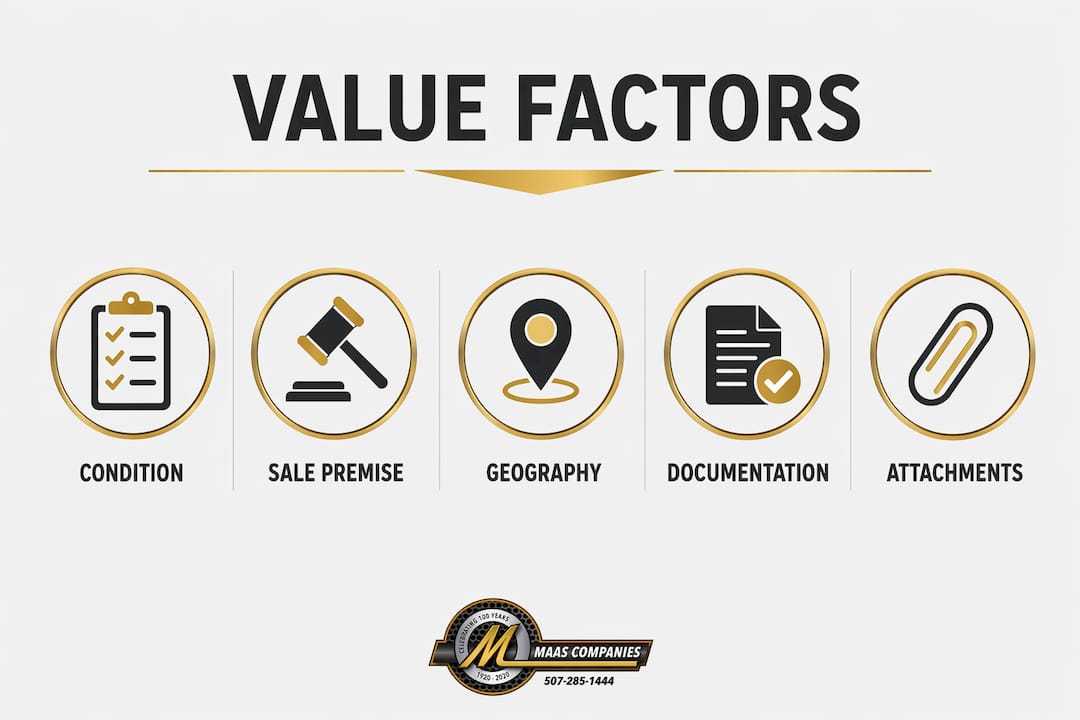
The sale premise is the single most consequential decision in any equipment disposition plan. The same piece of machinery can carry three materially different values depending on which premise applies, and choosing the wrong one at the wrong time costs real money.
| Sale Premise | Assumed Conditions | Typical Timeframe | Value Level |
|---|---|---|---|
| Fair Market Value (FMV) | Willing buyer and seller, optimal marketing, no compulsion | 6–12 months | Highest |
| Orderly Liquidation Value (OLV) | Seller compelled to sell, reasonable marketing period | 3–6 months | Mid-range |
| Forced Liquidation Value (FLV) | Rapid sale required, limited marketing exposure | 1–60 days | Lowest |
FMV assumes both parties are informed, neither is under pressure, and the asset receives full market exposure. This is the standard used in most tax, legal, and financing contexts. OLV reflects a situation where the seller must sell but still has time to reach qualified buyers. FLV applies when a sale must close within days or weeks, as in a bankruptcy liquidation or a lender-directed asset sale.
The gap between FMV and FLV is not trivial. For heavy industrial equipment, that spread can represent 30–50% of asset value. Corporate leaders who understand this relationship can make better decisions about timing, marketing investment, and whether to pursue an orderly liquidation strategy versus an accelerated sale. The importance of equipment appraisal lies precisely in quantifying this spread before committing to a disposition path.
How do geographic and regulatory differences influence equipment value?
Location is a pricing variable that many corporate leaders underestimate. Geographic market adjustments can affect equipment value by 15–20%, driven by regional demand, transportation costs, and the concentration of end-users in a given area. That variance is large enough to justify targeting a different buyer pool entirely.
Key location-based factors include:
- Regional demand concentration. A CNC machining center sells at a premium in a region with dense aerospace or automotive manufacturing activity. The same machine in a rural market with no local buyers requires freight cost adjustments that reduce net recovery.
- Emissions and safety regulations. Regulatory standards directly affect market desirability. Equipment that does not meet California Air Resources Board (CARB) emissions standards, for example, may be worth less in California but command full value in international markets with different requirements.
- International market considerations. Used industrial equipment often finds stronger demand in developing markets where new equipment costs are prohibitive. Maascompanies has marketed equipment internationally precisely because cross-border buyer pools expand the competitive bidding environment and improve recovery rates.
- Transportation and rigging costs. Heavy equipment located in difficult-to-access facilities carries a buyer cost that appraisers factor into adjusted values. Accessible, well-documented assets attract more bidders and higher prices.
The practical implication is clear: matching the asset to the right market is as important as the appraisal itself. A valuation that assumes only local buyers will understate what a nationally or internationally marketed sale can achieve.
What practical steps can leaders take to maximize asset value before liquidation?
Preparation before an appraisal or sale directly affects the final recovery number. Leaders who treat asset disposition as a last-minute task consistently recover less than those who plan ahead.
- Inventory all accessories and tooling separately. Do not bundle ancillary assets with the primary machine without documentation. Separate inventories allow appraisers to assign value to each component, and buyers pay more when they understand exactly what they are purchasing.
- Compile complete maintenance records. Preventive maintenance history is a tangible value driver in negotiations. Service logs, oil analysis reports, and calibration records reduce buyer risk perception and support asking prices.
- Determine the appropriate sale premise early. Understand whether your timeline supports FMV, OLV, or FLV conditions before engaging an appraiser. The premise shapes the entire valuation and disposition strategy.
- Engage a professional appraiser with verified market data access. Appraisers who rely on confirmed transaction data, not listing prices, produce conclusions that hold up in financing, legal, and tax contexts. This matters when the appraisal faces scrutiny from lenders or courts.
- Address logistical barriers before marketing. Clear access paths, available rigging points, and accurate utility specifications reduce buyer friction. Auction bidding strategies consistently show that well-documented, accessible assets attract more competitive bids.
Pro Tip: Differentiate between your overall business valuation and your machinery and equipment (M&E) appraisal. Conflating the two leads to misjudged collateral strength and poor negotiating positions with lenders or buyers.
Key Takeaways
Accurate industrial equipment valuation requires selecting the right appraisal premise, documenting condition thoroughly, and targeting the market that matches the asset’s buyer pool.
| Point | Details |
|---|---|
| Three valuation premises | FMV, OLV, and FLV produce materially different values; choose the premise that matches your sale timeline. |
| Condition outweighs age | Mechanical condition drives more valuation variance than age alone; poor condition can cut value by 40–60%. |
| Accessories add real value | Tooling and attachments can represent 15–30% of total asset value when inventoried and appraised separately. |
| Geography shifts price | Regional demand and regulatory differences can move equipment value by 15–20%; target the right buyer market. |
| Documentation pays off | Verified maintenance records reduce buyer uncertainty and directly support higher valuations in negotiations. |
What most leaders get wrong about equipment valuation
The most common mistake I see is treating equipment appraisal as a formality rather than a decision-making tool. Leaders request a valuation after they have already committed to a sale timeline, which locks them into FLV conditions when OLV or FMV was achievable with two more months of planning. That timing error is entirely preventable.
The second mistake is conflating book value with market value. Depreciation schedules on financial statements follow accounting rules, not market conditions. A ten-year-old press that has been meticulously maintained and runs at full capacity is worth far more than its net book value suggests. Conversely, a three-year-old machine that has been run hard without documented service may appraise below book. The market does not care about your accounting.
What I have found consistently is that leaders who invest in documentation before the sale, not after, hold the most negotiating power. A buyer who sees complete oil sampling records, calibration logs, and a full tooling inventory has less reason to discount. That confidence translates directly into higher bids and faster closings.
— Vector
Maascompanies: asset recovery built on valuation expertise
Maascompanies brings decades of experience marketing industrial plants, equipment, and commercial properties to qualified buyers worldwide. Whether your situation calls for a structured auction or an orderly negotiated sale, Maascompanies builds a disposition plan around the valuation premise that maximizes your recovery, not just the fastest close.

Current projects include active equipment auctions and negotiated sales across processing plants, manufacturing facilities, and surplus equipment portfolios. Leaders who are managing plant closures, restructuring, or excess inventory can review active listings or contact Maascompanies directly for a consultation on how to position assets for the strongest possible outcome.
FAQ
What is the difference between FMV, OLV, and FLV?
FMV, OLV, and FLV are three valuation premises that reflect different assumed sale conditions and timeframes. FMV assumes optimal conditions with no seller compulsion, OLV assumes a compelled seller with reasonable marketing time, and FLV assumes a rapid sale within 1–60 days, producing the lowest value.
How do appraisers determine industrial machinery worth?
Appraisers apply the cost, market, and income approaches, then weigh each method based on data quality and asset type to reach a final value conclusion. The sales comparison approach typically carries the most weight for common industrial equipment.
Why does mechanical condition matter more than age in equipment valuation?
A well-maintained machine can command up to double the value of an identical model in poor condition, making condition the dominant variable in residual value. Age alone is a weak predictor without supporting usage and maintenance data.
How can geographic location affect equipment value?
Regional demand, transportation costs, and local regulatory requirements can shift equipment value by 15–20%. Equipment that does not meet local emissions standards may recover more value in international markets with different regulatory environments.
What documents should I prepare before an equipment appraisal?
Compile service logs, oil sampling reports, calibration records, and a complete inventory of all tooling and accessories before the appraisal. Documented maintenance history reduces buyer uncertainty and directly supports higher valuations.
Recommended
- How to Choose the Right Auction for Industrial Equipment | Blog | Insights on Asset Liquidation and Auction Trends
- Why buy surplus equipment? Cut costs, preserve cash, boost ESG | Blog | Insights on Asset Liquidation and Auction Trends
- Equipment liquidation explained: maximizing asset recovery | Blog | Insights on Asset Liquidation and Auction Trends
- How Auctions Help Speed Up Industrial Asset Disposition | Blog | Insights on Asset Liquidation and Auction Trends