

Blog
How to Manage Multi-Site Liquidations Effectively

TL;DR:
- Effective multi-site liquidation depends on centralized governance, standardized asset inventories, and early planning to maximize recovery value and ensure compliance. Implementing a single oversight layer, uniform data schemas, and a consolidated timeline prevents delays, data fragmentation, and audit issues across all locations. Choosing the right operational model and contractual reconciliation procedures further optimizes outcomes and reduces operational risks.
Multi-site liquidation is defined as the coordinated disposition of assets across two or more physical locations under a unified recovery strategy, and the difference between a well-managed program and a chaotic one is almost always governance. Without centralized control, conflicting vendor timelines, inconsistent asset data, and fragmented documentation erode recovery value before the first bid is placed. This article outlines the core strategies for managing multiple store closures and plant dispositions: how to build a governing oversight layer, standardize asset inventories, sequence timelines, choose the right operational model, and maintain audit-ready documentation from start to finish.
How to manage multi-site liquidations with centralized governance
Coordination failure is the greatest risk in any multi-site liquidation program. When each location operates independently, you get competing vendor schedules, inconsistent disposition rules, and compliance gaps that surface during audits months after the fact. The result is measurable value leakage that no amount of post-sale reconciliation can recover.
Centralized governance means establishing a single oversight layer that controls sequencing, documentation standards, and disposition decisions across all sites. This layer does not replace on-site teams. It coordinates them. Think of it as the master schedule and rule set that every location reports into, rather than a separate management structure running parallel to operations.
The practical benefits of this approach are direct:
- Standardized disposition rules prevent individual site managers from making ad hoc sale or scrap decisions that undercut recovery
- A single governing timeline eliminates the scheduling conflicts that arise when removals at one site block access at another
- Centralized vendor management reduces the risk of conflicting vendor actions that compress timelines and reduce competitive bidding
- Compliance documentation flows through one chain of custody rather than being assembled from multiple disconnected sources after the fact
Pro Tip: Assign a single project lead with authority over all sites before any vendor engagement begins. This person owns the master timeline, approves all disposition decisions, and serves as the single point of contact for your liquidation partner. Without this role defined upfront, governance exists only on paper.
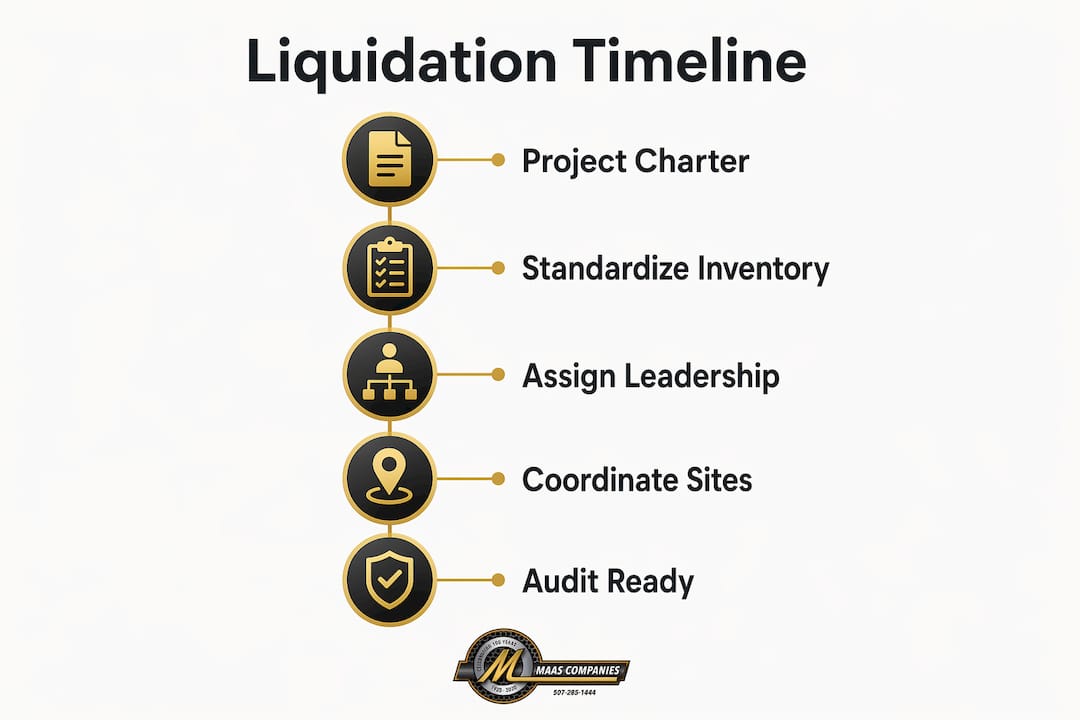
Implementing this layer requires a formal project charter that defines scope, site sequencing, disposition categories, and reporting requirements before any marketing or removal activity starts. The charter becomes the governing document that all parties, including legal, operations, and your liquidation partner, sign off on.
How to build standardized asset inventories across all sites
Inventory quality drives recovery outcomes more directly than any other single variable. Ignoring detailed asset data leads to blind decisions and measurable loss, because buyers cannot bid confidently on assets they cannot evaluate, and your team cannot make sound redeployment versus sale decisions without complete information.
A standardized asset data package for each location should capture the following for every item:
- Make, model, and serial number
- Year of manufacture and current condition rating
- Physical dimensions and weight
- High-resolution photographs from multiple angles
- Maintenance history or known defects
- Location within the facility and any removal constraints
The critical word here is standardized. Data fragmentation from inconsistent inventory schemas across sites forces manual reconciliation work after the fact and reduces visibility into total asset status. A piece of equipment cataloged as “Conveyor Belt Unit A” at one site and “Conveyor, 24-inch, Model CB-400” at another creates matching problems that slow down marketing and confuse buyers.
| Inventory element | Why it matters |
|---|---|
| Serial number | Enables serialized tracking and audit-ready chain of custody |
| Condition rating | Supports accurate reserve pricing and buyer confidence |
| Photos | Reduces buyer inquiries and supports online bidding |
| Removal constraints | Prevents scheduling conflicts during extraction |
| Location code | Links asset to site for location-level reconciliation |

Lock down a single inventory schema before any marketing or removal decisions are made. Apply it uniformly across all locations using the same field names, condition rating scale, and photo standards. This prevents the fragmentation failure mode that consistently undermines multi-site asset recovery programs.
Pro Tip: Use the inventory phase to make redeployment decisions before committing assets to sale. Equipment that can be transferred to an active facility at book value often generates more value than a discounted auction sale. Document these decisions in the asset data package so the final reconciliation reflects true recovery across all disposition channels.
Timing and sequencing: planning a consolidated liquidation timeline
Starting 60 to 90 days before deadlines is the minimum lead time required to execute a multi-site liquidation that reaches a broad buyer pool and supports competitive bidding. Compressed timelines force rushed sales, limit marketing reach, and reduce the number of qualified buyers who can arrange financing, transportation, and inspection visits.
A consolidated timeline serves a different purpose than individual site schedules. It creates a single shared go/no-go date that all locations align to, which allows your marketing partner to launch a unified campaign rather than a series of disconnected local sales. Unified campaigns attract larger buyer pools and generate stronger competitive pressure on pricing.
Key sequencing principles to build into your timeline include:
- Set lease turn-in windows and access constraints for each site before finalizing removal sequences, since these dates are non-negotiable and everything else must work around them
- Schedule removal crews across sites so that equipment extraction at one location does not compete for the same rigging contractors or transportation assets as another
- Build buffer periods between marketing launch and removal deadlines to allow for buyer inspection visits without disrupting ongoing extraction work
- Assign a disposition governing layer with authority to adjust site priorities dynamically when access conflicts or delays arise
The most common timeline failure in managing multiple store closures is treating each site as an independent project with its own schedule. When site managers negotiate their own removal dates with contractors, the result is resource conflicts, rework, and compressed marketing windows that reduce recovery. A single master timeline, owned by the project lead and enforced through the governing layer, prevents this.
For executives planning spring liquidation timelines, the 90-day window also accounts for seasonal buyer activity and transportation availability, both of which affect final recovery values.
Centralized hubs versus decentralized on-site sales
The operational model you choose for executing a multi-site liquidation determines how assets are processed, marketed, and sold. Two primary models apply to most programs, and the right choice depends on asset type, geography, and the volume of locations involved.
| Factor | Centralized hub model | Decentralized on-site model |
|---|---|---|
| Asset consistency | High: uniform inspection and cataloging standards | Variable: depends on site-level execution |
| Operational burden | Lower for client: hub manages logistics | Higher for client: site coordination required |
| Marketing reach | Broader: single campaign across all assets | Narrower: separate campaigns per location |
| Best for | High-volume, portable equipment across many sites | Large or immovable assets, single-site closures |
| Reconciliation | Centralized: single reporting structure | Complex: requires aggregation across sites |
Centralized hubs receive assets from multiple locations, inspect and catalog them under consistent standards, and then offer them through broad sales channels with full reconciliation back to the client. This model relieves operational complexity and enforces quality standards that individual site sales rarely achieve. The tradeoff is transportation cost and lead time for moving assets to the hub.
Decentralized on-site sales work best when assets are too large or too expensive to move, when lease timelines at individual sites are staggered enough to support separate marketing campaigns, or when buyer pools are geographically concentrated near specific locations. A single large manufacturing facility with specialized equipment often warrants an on-site auction rather than hub consolidation.
Many large programs use a hybrid approach: portable, high-value equipment moves to a centralized hub for standardized marketing, while fixed or oversized assets are sold in place. Centralized hub processing consistently improves recovery for portable equipment categories by exposing them to national and international buyer pools rather than local markets.
Ensuring audit readiness and accurate reconciliation across locations
Audit readiness in a multi-site liquidation is not a post-sale activity. It is a workflow requirement built into the process from day one. Auditable chain-of-custody workflows with serialized tracking are the standard for any liquidation involving regulated assets, sensitive data equipment, or financial reporting obligations, and documentation deliverables must be part of the workflow since audits can occur months after disposition completes.
Best practices for maintaining audit readiness across multiple locations include:
- Assign a unique identifier to every asset at the point of inventory, and track that identifier through every stage: cataloging, marketing, sale, removal, and proceeds distribution
- Require location-specific reconciliation reports that show each asset’s origin site, sale price, buyer, removal date, and net proceeds separately from other locations
- Demand itemized reconciliation as a contractual deliverable before signing any liquidation agreement, since retrofitting this requirement after the fact creates costly accounting delays
- Maintain a documented chain of custody for any assets subject to data destruction, environmental compliance, or regulatory disposition requirements
Serialized tracking tied to recorded disposition events provides the defensible records that financial auditors, lenders, and legal counsel require. A certificate of destruction or a sale receipt without serialized linkage to the original asset record is insufficient for regulatory compliance purposes. The end-to-end documentation standard requires that every asset’s journey from inventory to final disposition is traceable through a single connected record.
For accurate equipment liquidation reporting, location-level proceeds data must feed directly into your accounting close process without requiring manual matching. This is only possible when the reconciliation structure is defined contractually before the program begins.
Key takeaways
Effective multi-site liquidation requires centralized governance, standardized inventory, and contractually mandated reconciliation to protect recovery value and maintain compliance across all locations.
| Point | Details |
|---|---|
| Centralized governance is non-negotiable | A single governing layer with sequencing authority prevents value leakage and compliance gaps across sites. |
| Inventory standardization drives recovery | A uniform asset data schema applied before marketing begins eliminates fragmentation and supports competitive bidding. |
| Start 60 to 90 days early | Consolidated timelines with shared go/no-go dates enable broader marketing reach and stronger buyer competition. |
| Match the operational model to asset type | Centralized hubs improve recovery for portable equipment; on-site sales suit large or immovable assets. |
| Mandate reconciliation contractually | Location-specific proceeds reporting must be a contract deliverable to avoid post-sale accounting errors. |
What I’ve learned from large-scale multi-site liquidation programs
The executives who achieve the best recovery outcomes in multi-site programs share one characteristic: they treat governance as a structural requirement, not an administrative preference. The programs that underperform almost always trace their problems back to a decision made early, usually assigning site-level autonomy to local managers without a coordinating authority above them.
Inconsistent asset data is the second most common failure point, and it is entirely preventable. When inventory schemas differ across sites, the downstream effects compound: marketing is delayed, buyers ask more questions, reserve prices are set on incomplete information, and reconciliation takes weeks instead of days. Locking down a single schema before any site begins cataloging is a two-hour decision that prevents weeks of remediation.
The value of selecting an experienced liquidation partner with multi-site program capability cannot be overstated. A partner who has managed 20-location retail closures or multi-facility industrial dispositions brings sequencing knowledge, buyer network depth, and reconciliation infrastructure that a first-time program simply cannot replicate internally. The carrying costs of a delayed or underperforming liquidation, including lease obligations, security, utilities, and management time, consistently exceed the cost of engaging the right partner from the start.
— Vector
How Maascompanies supports multi-site asset recovery programs
Maascompanies brings decades of experience managing complex, multi-location liquidations across industrial plants, commercial properties, and manufacturing facilities worldwide. The firm’s approach combines centralized program management with aggressive, targeted marketing to reach qualified buyers across national and international markets.

For executives managing plant closures, restructuring programs, or portfolio dispositions, Maascompanies provides turnkey coordination that covers inventory, marketing, auction execution, and location-level reconciliation reporting. Every engagement is structured to reduce the operational burden on your team while maximizing competitive recovery. Explore Maascompanies’ current liquidation projects to see the scope and scale of programs the firm manages, or visit the asset recovery services page to discuss your specific program requirements.
FAQ
What is multi-site liquidation?
Multi-site liquidation is the coordinated disposition of assets across two or more physical locations under a unified recovery strategy. It requires centralized governance, standardized inventory, and consolidated timeline management to maximize recovery and maintain compliance.
How early should you start planning a multi-site liquidation?
Planning should begin 60 to 90 days before any hard deadlines. This lead time allows marketing partners to reach broader buyer pools, supports competitive bidding, and provides buffer for access and sequencing conflicts across locations.
What is a centralized hub model in liquidation?
A centralized hub receives assets from multiple locations, inspects and catalogs them under consistent standards, and offers them through broad sales channels. This model improves recovery for portable equipment by exposing it to national buyer pools rather than local markets.
Why does inventory standardization matter across sites?
Inconsistent inventory schemas across locations create data fragmentation that delays marketing, reduces buyer confidence, and forces manual reconciliation after the sale. A single standardized asset data schema applied before marketing begins prevents these failures.
What documentation is required for audit-ready liquidation?
Audit-ready liquidation requires serialized asset tracking tied to recorded disposition events, location-specific reconciliation reports, and chain-of-custody documentation for every asset from inventory through final sale or destruction.
Recommended
- Liquidation sales explained: Maximize asset recovery | Blog | Insights on Asset Liquidation and Auction Trends
- Plan Better Industrial Closures With Expert Auction Help | Blog | Insights on Asset Liquidation and Auction Trends
- Maximize Asset Recovery: Top Real Estate Liquidation Methods | Blog | Insights on Asset Liquidation and Auction Trends
- Facility Liquidation Strategies That Keep Transitions on Track | Blog | Insights on Asset Liquidation and Auction Trends