

Blog
Industrial Property Disposition Process for Owners & Managers

A buyer-qualified, timeline-aligned disposition — one that pairs targeted marketing with staged due diligence and deliberate contract sequencing — consistently produces the strongest recovery for industrial properties. The process is not a single transaction; for owner-occupiers, it runs as two parallel projects: the real estate closing and the operational relocation. Misaligning those timelines erodes value before the first offer arrives.
Start here — two immediate actions:
- Pull title, lien, and survey documents now. Identify every creditor in the debt stack, request payoff letters with per-diem figures, and confirm release conditions for each lender before you engage a buyer.
- Engage a strategic disposition partner and, if site history suggests any environmental exposure, retain environmental counsel to determine whether a Phase I Environmental Site Assessment is warranted under EPA screening standards.
Named authorities to brief your advisors on from the outset:
- EPA — Phase I/II environmental screening triggers and brownfield disclosure obligations
- IRS Section 1031 — tax-deferred exchange identification and closing deadlines (45-day and 180-day clocks)
- Maascompanies — strategic marketing, buyer qualification, and contract sequencing for industrial asset recovery
Table of Contents
- What disposition strategy fits your industrial asset?
- How does the step-by-step disposition process work?
- Industrial-specific issues that can derail your sale
- What are the tax and cost implications of selling industrial property?
- How do you vet buyers and structure deals to protect closing?
- How do lender-led dispositions differ from owner-led sales?
- How Maascompanies executes industrial property dispositions
- Key Takeaways
- What owners consistently underestimate about industrial dispositions
- Maascompanies offers a structured path to maximum recovery
- Authoritative resources for further reference
What disposition strategy fits your industrial asset?
The right channel depends on asset complexity, your timeline, and your recovery objectives. Each approach carries distinct trade-offs.
Traditional brokered sale suits well-located, clean assets where broad market exposure generates competitive offers. A broker builds an Offering Memorandum, runs a call-for-offers process, and manages negotiations. This channel typically takes 3–6 months from engagement to closing.
Targeted private treaty is the correct approach for complex or brownfield sites. As demonstrated in the disposition of United States Steel Corporation’s Keystone Industrial Port Complex, targeted buyer pre-qualification before marketing even begins ensures that only buyers with the technical and financial capability to navigate site complexities receive materials. A broader competitive process on a brownfield typically attracts unqualified bidders and delays closing.
Auction prioritizes speed and certainty of sale. It suits surplus sites, lender-led dispositions, and assets where carrying costs are mounting. The event itself can be organized in 4–8 weeks; removal windows and settlement follow.
Sale-leaseback allows an owner-occupier to monetize the real estate while retaining operational occupancy. It releases capital without disrupting production and is particularly useful when the business needs liquidity but is not yet ready to relocate.
Seller financing spreads proceeds over time and can attract a wider buyer pool when conventional financing is constrained. It introduces counterparty risk and requires careful legal structuring.
IRS Section 1031 exchange defers capital gains tax by rolling proceeds into a like-kind replacement property. The 45-day identification and 180-day closing deadlines are hard; failing either clock triggers full tax recognition.
| Strategy | Best when to use | Speed to market | Value recovery potential | Transaction complexity | Key risks | Typical costs |
|---|---|---|---|---|---|---|
| Traditional brokered sale | Clean, well-located asset; competitive buyer pool | Several months | High with broad exposure | Moderate | Buyer fall-out; market timing | Broker commission (typically a few percent) |
| Targeted private treaty | Complex infrastructure; brownfield; specialized buyer pool | Several months | High with right buyer | High | Limited pool; longer diligence | Broker commission; legal/environmental fees |
| Auction | Speed priority; surplus/lender-led; high carrying costs | A few weeks to event | Moderate to high | Low to moderate | Below-reserve bids; removal disputes | Buyer’s premium; marketing costs |
| Sale-leaseback | Owner-occupier needs capital but not relocation | A few months | Moderate (below outright sale) | Moderate | Long-term lease obligations | Legal; broker; appraisal |
| Seller financing | Constrained buyer financing; spread proceeds | Several months | Moderate | Moderate to high | Counterparty default; legal complexity | Legal; servicing costs |
| 1031 exchange | Tax deferral on appreciated asset; replacement property identified | Adds 45–180 day constraint | High (net of tax) | High | Clock failure; replacement property risk | QI fees; legal; broker |
Pro Tip: For assets with legacy environmental conditions, adopt a “go ugly early” posture — disclose known conditions to pre-qualified buyers before marketing begins. Addressing environmental expectations upfront reduces uncertainty and prevents late-stage deal collapse.
How does the step-by-step disposition process work?
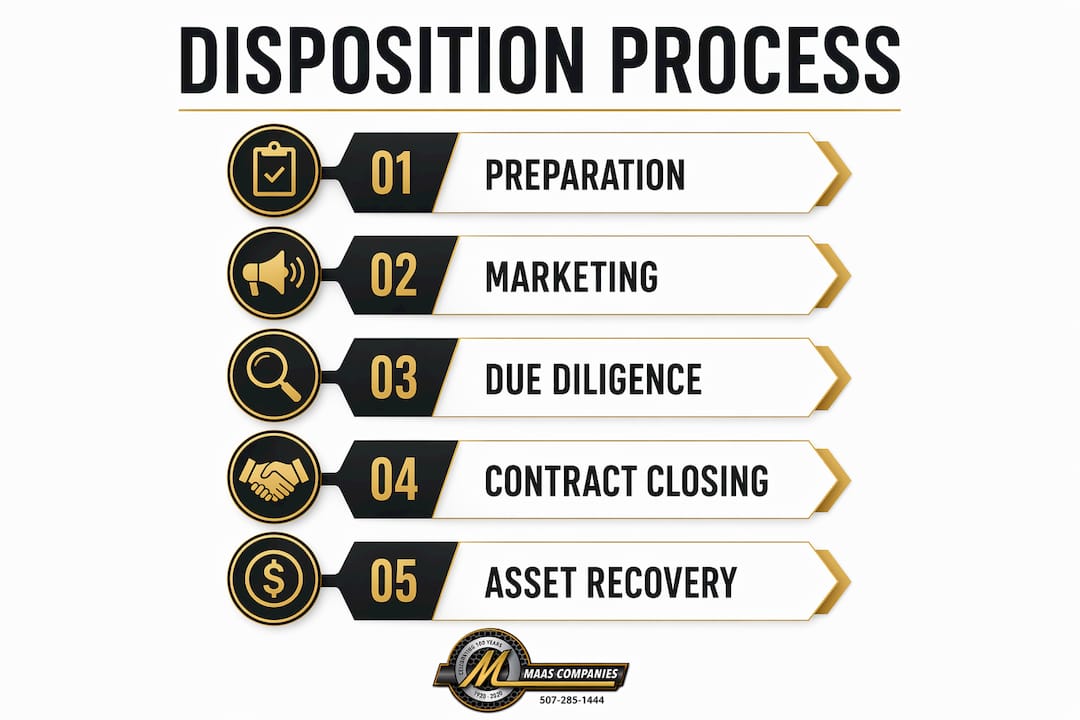
A disciplined sequence protects both recovery and operations. The four-phase liquidation workflow — initiate, inventory and value, execute sale, settle and reconcile — provides the structural backbone; the steps below adapt it to industrial real estate.
Phase 1: Pre-sale preparation
- Pull all title documents, surveys, easements, and recorded liens. Confirm chain of title and identify any encumbrances that require resolution before closing.
- Request payoff letters with per-diem figures and release conditions from every lender in the debt stack, including equipment finance creditors. Release terms, not just payoff amounts, determine closing timing.
- Order a Phase I Environmental Site Assessment if site history is unknown or if prior industrial use suggests contamination. Phase II testing follows if Phase I identifies recognized environmental conditions.
- Compile an equipment encumbrance list: identify which equipment is owned free and clear, which is financed (UCC filings), and which is leased. This list drives the asset removal and lien payoff sequence.
- Obtain tenant estoppels and confirm lease terms, options, and any co-tenancy provisions that affect marketability.
- Conduct an internal broker opinion of value (BOV) or formal appraisal to anchor pricing expectations.
Phase 2: Marketing and buyer outreach
- Build the Offering Memorandum: property description, infrastructure summary, environmental status, zoning, financial summary, and sale process timeline.
- Establish tiered NDA and data-room access. Tier 1 (NDA only) receives the Offering Memorandum and introductory diligence. Tier 2 (qualified buyers) receives full data-room access.
- Execute targeted buyer outreach. Simple, well-located assets benefit from broad marketing; complex or brownfield sites require a pre-qualified buyer list to avoid wasting diligence resources on unqualified parties.
Phase 3: Buyer qualification and LOI
- Collect Letters of Intent. Key LOI terms to require: proposed price, earnest money amount and timing, inspection period length, financing contingency (or proof of funds for cash buyers), proposed closing date, and holdover rate if the seller needs post-closing occupancy.
- Score offers using a weighted matrix: price, timing certainty, financing certainty, technical capability for complex sites, and conditionality. The highest nominal offer is not always the strongest.
Phase 4: Due diligence, contract, and closing
- Open the full data room for qualified buyers. Staged diligence periods with clear milestones reduce the risk of indefinite extensions.
- Execute the Purchase and Sale Agreement with possession schedule, holdover license terms, escrow triggers, and phased funding mechanics tied to the seller’s move schedule.
- Sequence recording, lien releases, and proceeds distribution at closing. Confirm that each lender’s release is filed simultaneously with or before the deed records.
- Manage post-closing asset removal: confirm removal windows, rigging and trucking logistics, and site restoration obligations per contract.
| Phase | Key deliverable | Typical duration |
|---|---|---|
| Pre-sale preparation | Title package, payoff letters, Phase I, equipment list | 4–8 weeks |
| Marketing and outreach | Offering Memorandum, NDA, data room, buyer list | 3–6 weeks |
| Buyer qualification and LOI | Scored LOI matrix, selected buyer | 2–4 weeks |
| Due diligence and contract | Executed PSA, staged diligence complete | 4–8 weeks |
| Closing and post-closing | Recording, lien releases, removal logistics | 1–4 weeks |
Industrial-specific issues that can derail your sale
Industrial dispositions carry operational dependencies that standard commercial real estate transactions do not. Missing any of them late in the process can stall closing or reduce net recovery.

Operational dependencies. Map every critical dependency before marketing: production equipment tied to the building’s utilities or structural systems, rail access and easements, overhead crane runways, compressed air and electrical infrastructure, and inventory that must be relocated before possession. Treating an industrial property like a commodity — without aligning sale timing to equipment removal, line decommissioning, and personnel relocation — is the most common source of value erosion.
Environmental and legacy issues. Known conditions should be disclosed early and calibrated to the buyer pool. Brownfield sites attract a smaller, more specialized buyer pool; attempting to market them broadly without environmental disclosure wastes time and signals inexperience to qualified buyers. Coordinate with environmental counsel on remediation responsibilities and whether any state voluntary cleanup programs apply.
Pro Tip: Build a possession and move sequencing plan before you sign the Purchase and Sale Agreement. Specify holdover license terms, daily rates, insurance obligations during overlap, and the exact sequence of signing, funding, recording, and physical possession. This single document prevents the most common operational disruptions in owner-occupier industrial sales.
Permitting, zoning, and special infrastructure. Identify conditional use permits, stormwater permits, rail easements, and any permits that transfer with the property versus those that require new applications by the buyer. Permit timing risks should be disclosed in the Offering Memorandum and addressed in the contract’s closing conditions.
Equipment handling checklist:
| Item | Action required | Timing |
|---|---|---|
| Equipment titles | Confirm ownership; pull certificates of title and trace materials | Pre-marketing |
| UCC filings | Search and list all active UCC-1 financing statements | Pre-marketing |
| Equipment loan payoffs | Request payoff letters and release conditions | Pre-marketing |
| Removal windows | Define in PSA; coordinate with buyer | Contract stage |
| Rigging and logistics | Engage riggers; confirm crane and trucking access | 30–60 days pre-possession |
| Site restoration | Confirm contractual obligations; document pre-removal condition | Pre-removal |
For detailed guidance on equipment lotting and removal logistics, Maascompanies publishes a pre-auction checklist that covers UCC sequencing and removal window planning.
What are the tax and cost implications of selling industrial property?
1031 exchange mechanics. A Section 1031 exchange defers capital gains tax on the sale of investment or business-use real property when proceeds are reinvested in like-kind replacement property. Two deadlines are absolute: the replacement property must be identified within 45 days of closing, and the exchange must close within 180 days. Owner-occupiers pursuing a 1031 exchange must sequence their closing date carefully — the operational move schedule cannot push the closing past a date that jeopardizes the identification window. Consult a qualified intermediary (QI) and a CPA before executing; state tax treatment of 1031 exchanges varies.
Depreciation recapture. When an industrial property has been depreciated, the IRS requires recapture of that depreciation at ordinary income rates (up to 25% for Section 1250 property under current federal rules) upon sale, separate from capital gains. A CPA familiar with commercial real estate is required to model the net proceeds accurately. Refer to IRS Publication 544 for the governing federal rules; state impact requires separate analysis.
Tax note: Verify 1031 exchange compliance with a qualified intermediary before signing the Purchase and Sale Agreement. The 45-day identification clock starts at closing — not at contract execution — and cannot be extended.
Typical transaction cost categories:
| Cost category | Typical range / notes |
|---|---|
| Broker commission | A few percent of sale price (negotiated; varies by asset size and complexity) |
| Environmental remediation reserve | Varies; set based on Phase II findings and regulatory requirements |
| Moving, rigging, and trucking | Varies widely; budget separately from real estate closing costs |
| Escrow holdbacks | Negotiated; common for environmental or remediation contingencies |
Timeline expectations by channel: private treaty or brokered sale typically runs 3–6 months from engagement to closing. An auction can be organized and executed in 4–8 weeks from engagement to the sale event, with removal and settlement following. Lender-led and receiver-driven sales vary widely depending on court involvement and secured creditor priorities.
How do you vet buyers and structure deals to protect closing?
Selecting the right buyer matters more than extracting the last dollar from the highest bid. A buyer who cannot close, or who lacks the technical capability to manage a complex industrial site, costs more in time and carrying costs than a marginally lower offer from a qualified party.
Buyer vetting checklist:
- Proof of funds or a committed financing letter from a named lender (not a pre-qualification letter)
- Financing source and structure: equity, debt, or a combination; confirm the lender’s familiarity with industrial assets
- Track record with comparable assets: brownfields, permitted industrial sites, or infrastructure-heavy properties
- Technical capability: does the buyer’s team include environmental, engineering, or operational expertise appropriate for the site?
- References from prior industrial acquisitions, particularly complex or permitted sites
- Escrow readiness: confirm the buyer can deposit earnest money within the LOI timeline
Deal-structuring clauses that reduce fall-out:
- Binding, non-refundable earnest money after the inspection period expires
- Staged diligence with defined milestones and a clear “go/no-go” date
- Seller-favorable escrow triggers: funding released to seller only upon recording and lien releases
- Holdbacks for known remediation obligations, with defined release conditions
- Phased possession tied to the seller’s move schedule, not the buyer’s preference
Red flags in offers:
- Vague or unverified funding sources
- Aggressive break clauses paired with short inspection windows
- Buyers unwilling to execute an NDA before receiving detailed site information
- Requests to delay lien releases or defer recording
Pro Tip: Score every offer on a weighted matrix before selecting a finalist. Assign weights to price (30%), financing certainty (25%), timing (20%), technical capability (15%), and conditionality (10%). A buyer who scores 85 on this matrix with a firm financing commitment is more valuable than a 95-point bidder carrying a financing contingency on a complex site.
How do lender-led dispositions differ from owner-led sales?
When a secured lender appoints a receiver, the disposition timeline and negotiating dynamics shift materially. Secured lenders can sell a charged property quickly through LPA receivership, often outside normal liquidation timetables, which compresses the owner’s window to influence the process or protect surplus recovery.
In a lender-led disposal, secured creditors prioritize speed and certainty of proceeds. Owners who have not documented their encumbrance stack, preserved title records, and established communication with lender counsel before a receiver is appointed are at a significant disadvantage when asserting any surplus claim.
The key distinction is charge type. Fixed charges give the lender direct control over specific assets; floating charges crystallize on appointment of a receiver and cover the general asset pool. Understanding which assets are subject to which charge type determines what the owner can negotiate and what the receiver controls outright.
Owner checklist for lender-led scenarios:
- Verify charge types (fixed vs. floating) against the original security documents
- Obtain current payoff figures and confirm cross-collateralization across any related entities
- Document all assets not subject to the lender’s charge (owned equipment, inventory, IP)
- Preserve all title documents, survey records, and environmental reports
- Establish direct communication with receiver or lender counsel early
- Be prepared to assert surplus claims with documented proof of asset values and encumbrance amounts
For lender-focused disposition scenarios, Maascompanies publishes detailed guidance on industrial plant liquidation for lenders and special asset managers.
How Maascompanies executes industrial property dispositions
Maascompanies approaches each industrial disposition as a structured asset-recovery engagement, not a listing assignment. The methodology covers targeted buyer qualification, NDA-protected Offering Memoranda, staged diligence management, contract sequencing for operational continuity, and transparent proceeds reconciliation.

Standard deliverables owners receive:
| Deliverable | Purpose |
|---|---|
| Project timeline | Aligns sale milestones with operational move schedule |
| Buyer short-list | Pre-qualified buyers matched to asset profile and complexity |
| Offering Memorandum | NDA-protected; tiered data-room access for qualified parties |
| LOI comparison matrix | Weighted scoring of price, timing, financing, and conditionality |
| Payoff and lien sequencing plan | Coordinates lender releases with recording and funding |
| Final reconciliation report | Documents proceeds distribution and post-closing obligations |
The firm’s experience spans manufacturing, energy, hospitality, healthcare, education, agriculture, and contractor inventory, including court-ordered, lender-ordered, and government foreclosure asset liquidations. That breadth matters for complex industrial sites where the buyer pool is narrow and the diligence requirements are specialized.
Pro Tip: Ask any disposition partner to show you a sample LOI comparison matrix and a payoff sequencing plan from a prior engagement before you sign an engagement agreement. These two documents reveal whether the firm manages the transaction operationally or simply facilitates introductions.
For procedural templates and industrial asset sale process guidance, Maascompanies maintains a library of practical resources covering auction strategy, equipment lotting, and facility transition planning.
Key Takeaways
A buyer-qualified, timeline-aligned disposition that sequences contract mechanics to the seller’s operational move schedule produces the strongest recovery for industrial properties.
| Point | Details |
|---|---|
| Secure records first | Pull title, lien documents, and payoff letters with release conditions before engaging any buyer. |
| Match strategy to asset complexity | Brownfield and infrastructure-heavy sites require targeted pre-qualification; broad marketing suits clean, well-located assets. |
| Sequence contract to operations | Build possession schedule, holdover terms, and phased funding into the PSA before signing. |
| Qualify buyers beyond price | Score offers on financing certainty, technical capability, and conditionality — not price alone. |
| Maascompanies as strategic partner | Maascompanies provides targeted marketing, buyer vetting, lien sequencing, and post-sale reconciliation for complex industrial dispositions. |
What owners consistently underestimate about industrial dispositions
The most persistent mistake in industrial dispositions is treating the real estate closing as the primary project and the operational relocation as secondary. Every experienced practitioner has seen the same scenario: a seller accepts the highest offer, signs a contract with a standard 60-day closing, and then discovers that equipment removal, utility disconnection, and personnel relocation cannot be completed in that window. The result is either a closing delay that gives the buyer leverage to renegotiate, or a possession handover that strands critical operations.
The second recurring error is prioritizing nominal price over buyer certainty. A buyer carrying a financing contingency on a complex industrial site is not a committed buyer; the contingency is an option, not a commitment. The offers worth pursuing are those where the buyer has demonstrated financing certainty, technical understanding of the site, and a realistic timeline. A marginally lower offer from that buyer closes. The higher offer with vague funding sources frequently does not.
Contract mechanics are where recoveries are protected or lost. Holdover license rates, phased funding triggers, escrow release conditions, and lien payoff sequencing are not boilerplate provisions. They are the operational infrastructure of the transaction. Owners who treat them as standard language and defer to the buyer’s counsel on drafting consistently leave value on the table.
Maascompanies offers a structured path to maximum recovery
When the asset is industrial, the stakes of a poorly managed disposition extend beyond the sale price. Carrying costs accumulate, operations are disrupted, and lender relationships are strained when the process lacks structure. Maascompanies provides a disciplined, results-oriented engagement that covers every phase: strategic marketing, pre-qualified buyer outreach, auction and private treaty execution, lien and payoff sequencing, environmental coordination, and post-sale reconciliation.
Owners evaluating Maascompanies as a disposition partner should expect a clear project scope, a defined timeline aligned to their operational schedule, a named buyer short-list, and a fee structure tied to results. The firm’s experience with court-ordered, lender-ordered, and government foreclosure liquidations means it operates effectively under time pressure and in complex creditor environments.
To request a project assessment and review Maascompanies’ full services portfolio, contact the team directly. Owners planning a combined real estate and equipment sale can also review the dedicated seller services page for scope and engagement details.
This article provides general informational guidance on industrial property disposition. It is not legal, tax, or financial advice. Owners should confirm current IRS rules, environmental requirements, and applicable state regulations with qualified legal, tax, and environmental professionals for their specific situation.
Authoritative resources for further reference
| Resource | Authority | Relevant to |
|---|---|---|
| EPA Brownfields Program | U.S. Environmental Protection Agency | Phase I/II screening, brownfield disclosure, remediation funding |
| IRS Section 1031 Exchange Guidance | Internal Revenue Service | Like-kind exchange rules, identification and closing deadlines |
| IRS Publication 544: Sales and Other Dispositions of Assets | Internal Revenue Service | Depreciation recapture, capital gains, installment sales |
| Industrial Asset Sale Process Guide | Maascompanies | Process templates, marketing methodology, recovery checklists |
| Industrial Plant Sale Checklist | Maascompanies | Owner-occupier sequencing, pre-sale document checklist |
| Types of Industrial Asset Disposition | Maascompanies | Strategy selection by asset profile and owner objectives |
| Facility Liquidation and Transition Planning | Maascompanies | Operational migration planning and transition sequencing |
Recommended
- What Is Property Disposition? A Practical Guide | Blog | Insights on Asset Liquidation and Auction Trends
- Types of Industrial Asset Disposition: A Strategy Guide | Blog | Insights on Asset Liquidation and Auction Trends
- Industrial Property Sales Explained for Investors in 2026 | Blog | Insights on Asset Liquidation and Auction Trends
- Industrial Asset Sale Process: Maximize Recovery in 2026 | Blog | Insights on Asset Liquidation and Auction Trends