

Blog
What Is Surplus Inventory? A Guide for CFOs and Operations Managers

TL;DR:
- Surplus inventory exceeds the quantity needed to meet demand plus safety stock, becoming a financial liability over time. Proper classification and timely liquidation are essential to limit carrying costs, obsolescence, and markdown risks, thereby maximizing recovery value. Effective management requires structured governance, precise accounting, and early action to prevent surplus from eroding profitability.
Surplus inventory is defined as stock held beyond what a business needs to satisfy current and forecasted demand plus its designated safety stock buffer. For CFOs and operations managers, this excess represents tied-up working capital, mounting carrying costs, and growing exposure to obsolescence write-downs. Excess inventory is the portion of stock above projected demand plus safety buffer, and it creates an economic problem where storage and holding costs begin to outweigh any recoverable value. Understanding the surplus stock definition precisely, and acting on it with discipline, separates organizations that recover value from those that absorb losses.
What is surplus inventory and how is it measured?
Surplus inventory is calculated by comparing on-hand stock against the sum of forecasted demand and safety stock for a defined period. Any quantity above that threshold qualifies as surplus. The formula is straightforward: Surplus Quantity = On-Hand Stock minus (Forecasted Demand plus Safety Stock). If a facility holds 5,000 units of a component, forecasted demand is 3,500 units, and safety stock is 400 units, the surplus is 1,100 units.

Safety stock is distinct from surplus because it serves a deliberate protective function against demand variability and supply disruptions. Treating safety stock as surplus leads to false positives and unnecessary liquidation decisions. Obsolete inventory, by contrast, refers to stock with no foreseeable demand at all. Surplus inventory sits between these two categories: it has potential value but no near-term consumption path.
The economic test for classification goes beyond quantity. Carrying costs outweigh incremental recoverable value when potential sales revenue minus expected storage costs turns negative. At that point, the inventory crosses from a holding asset into a financial liability. Operations managers should apply this economic test quarterly, not just at year-end.
- Calculate net surplus quantity using the formula above, segmented by SKU or product category.
- Apply the economic test by comparing net realizable value (NRV) against annualized carrying costs for each surplus SKU.
- Classify by risk tier as slow-moving, at-risk, or critically surplus, based on demand trend and NRV trajectory.
- Document the classification with supporting demand data and cost records for accounting and governance purposes.
Pro Tip: Run surplus identification at the SKU level, not the category level. Aggregating across product lines masks individual items where carrying costs have already exceeded recoverable value, delaying decisions that cost real money.
What are the operational and financial impacts of holding surplus inventory?
Holding surplus inventory creates compounding financial pressure that extends well beyond the balance sheet line item. Working capital locked in unsellable or slow-moving stock cannot be redeployed to fund operations, capital expenditures, or debt service. For asset-intensive businesses, this constraint directly limits strategic flexibility.
The operational and financial consequences include:
- Carrying cost accumulation: Storage, insurance, handling, and capital cost of inventory typically range from 20% to 30% of inventory value annually, meaning a $2 million surplus position costs $400,000 to $600,000 per year to hold.
- Obsolescence and markdown risk: Delaying action on surplus accelerates obsolescence and forces deeper discounts, reducing the final recoverable value.
- Write-down exposure: Over 40% of companies risk more than 10% of inventory becoming unsellable, with 54% writing off stock at least quarterly. Each write-down reduces gross margin and net income directly.
- Operational disruption: Surplus stock occupies warehouse space, complicates cycle counts, and diverts labor from productive inventory management tasks.
- Reporting credibility: Persistent surplus inventory on the balance sheet raises questions from auditors, lenders, and investors about demand forecasting accuracy and management discipline.
“The financial focus for surplus inventory management should balance carrying costs against expected recoverable value, not just quantities. A unit-count approach misses the economic reality of what holding that stock actually costs the business.”
The timing dimension is critical. Every quarter a surplus position is left unaddressed, the range of viable recovery options narrows. Auction markets, secondary buyers, and liquidation channels all apply steeper discounts to aging stock. The decision to act is itself a financial decision with a measurable cost of delay.
Accounting and reporting considerations for surplus inventory
US GAAP requires that inventory be carried at the lower of cost or net realizable value (NRV). When surplus inventory’s NRV falls below its recorded cost, write-downs reduce inventory to NRV and recognize the impairment as a loss in the income statement. This is not discretionary. Once the evidence of impairment exists, the write-down is mandatory under ASC 330.
IFRS (specifically IAS 2) follows the same lower of cost or NRV principle, but with one significant difference: IFRS allows write-down reversals if NRV subsequently recovers, while US GAAP generally prohibits reversals. This distinction matters for multinational organizations that consolidate under both frameworks, since the timing and magnitude of reported losses can differ materially.
| Accounting Framework | Write-Down Trigger | Reversal Permitted | Key Standard |
|---|---|---|---|
| US GAAP | NRV below cost | No | ASC 330 |
| IFRS | NRV below cost | Yes, up to original cost | IAS 2 |
| Both | Credible evidence required | Varies | Documentation critical |
Inventory write-offs require credible evidence of recoverability or loss, and accounting transparency is non-negotiable. Controllers and CFOs should maintain allowance accounts for surplus and obsolete inventory, updated at each reporting period, rather than taking large one-time charges that signal poor monitoring to auditors and analysts.
The documentation standard is equally important. Write-down entries must be supported by demand analysis, NRV calculations, and evidence of management’s intent to dispose. Undocumented write-downs invite audit scrutiny and can result in restatements.
Pro Tip: Establish a formal allowance for inventory obsolescence as a percentage of surplus stock value, reviewed quarterly. This smooths the income statement impact and signals to auditors that management has a disciplined process, not a reactive one.
What causes surplus inventory to accumulate?
Surplus inventory rarely appears suddenly. It builds through a combination of operational failures and market shifts that go unaddressed over successive planning cycles. Identifying root causes is the prerequisite for prevention.
The most common causes include:
- Inaccurate demand forecasting: Over-reliance on historical sales data without adjusting for market trends, seasonality shifts, or product lifecycle stage produces systematic over-ordering. Poor forecasting and demand shifts are among the most cited drivers of excess stock accumulation.
- Supply chain over-ordering: Minimum order quantities from suppliers, bulk purchase incentives, and lead time buffers all encourage ordering beyond near-term demand. Without a disciplined review process, these quantities compound into surplus.
- Market demand changes: Product obsolescence driven by technology shifts, regulatory changes, or competitor introductions can render previously fast-moving inventory surplus almost overnight.
- Promotional and launch failures: New product introductions that underperform projections, or promotions that do not generate expected sell-through, leave residual inventory with no clear consumption path.
- Lack of inventory governance: Without formal escalation procedures, SKU rationalization reviews, and cross-functional accountability, surplus positions accumulate silently until they reach a scale that forces reactive action.
The governance gap is particularly consequential. Organizations that lack a structured obsolescence review process tend to discover surplus inventory problems during annual audits rather than during the planning cycle when intervention is still cost-effective.
How to manage and liquidate surplus inventory effectively
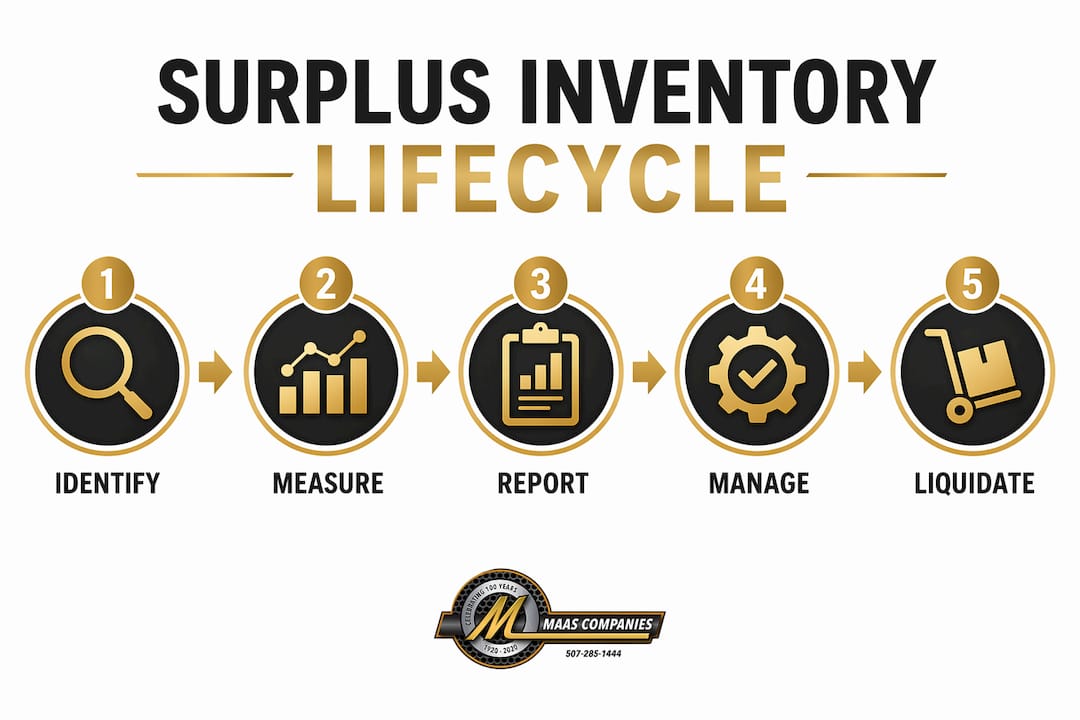
Effective surplus inventory management follows a structured sequence that prioritizes value recovery at each stage before moving to more aggressive disposal. Reutilization before disposal is the governing principle, consistent with both financial best practices and regulatory guidance from bodies like the FTC.
- Establish an obsolescence review board. A cross-functional team including finance, operations, and supply chain should meet quarterly to review surplus positions, classify SKUs by risk tier, and authorize disposition actions. Governance mechanisms like review boards improve decision quality and align accounting treatment with operational reality.
- Pursue internal reutilization first. Before any external disposition, assess whether surplus stock can be transferred to other facilities, repurposed in production, or substituted for planned purchases. This recovers full cost value with no transaction friction.
- Execute secondary market and channel options. Discounted sales to existing customers, bundling with active product lines, and return-to-vendor negotiations can recover 60% to 80% of cost value when executed promptly.
- Engage liquidation and auction channels. For surplus that cannot be absorbed internally or sold through normal channels, industrial equipment auctions and specialized liquidators provide market-clearing mechanisms. Recovery rates vary by asset type, condition, and timing.
- Document and close out residual positions. Remaining stock with no viable recovery path should be written off with full documentation, disposed of in compliance with environmental and regulatory requirements, and removed from the balance sheet promptly.
Timing governs recovery rates at every stage. A surplus equipment sale executed within the first 90 days of classification typically recovers significantly more value than one initiated after six months of continued holding. The decision framework should be time-bound, not open-ended.
Key takeaways
Surplus inventory is a financial liability that compounds over time, and the organizations that recover the most value are those that identify, classify, and act on it within a structured governance framework.
| Point | Details |
|---|---|
| Precise definition matters | Surplus is stock above forecasted demand plus safety stock, not simply slow-moving inventory. |
| Economic test drives decisions | Compare NRV against carrying costs quarterly to determine when holding becomes a net loss. |
| Accounting treatment is mandatory | US GAAP requires write-downs to NRV with no reversal; IFRS permits reversals under IAS 2. |
| Root causes must be addressed | Forecasting failures, over-ordering, and governance gaps are the primary drivers of accumulation. |
| Act early to maximize recovery | Delaying disposition consistently reduces recoverable value through obsolescence and markdown pressure. |
The governance gap no one talks about
Most surplus inventory problems are not forecasting problems. They are governance problems. The forecasting errors that produce surplus are often visible in the data weeks or months before anyone acts on them, but without a formal review structure and clear decision authority, the surplus simply ages.
What I have observed across industrial and manufacturing asset recovery engagements is that organizations treating surplus as a portfolio of SKU risk tiers, rather than a single inventory category, consistently outperform those applying uniform liquidation policies. A component with a 60% NRV recovery potential and a six-month window requires a completely different response than a commodity item losing 5% of value per month. Applying the same discount rate or the same auction timeline to both destroys value in one case and leaves money on the table in the other.
The second pattern worth noting is the cost of delayed communication between finance and operations. Finance teams often recognize the accounting impairment trigger before operations has formally classified the inventory as surplus. Operations teams often know a product line is being discontinued before finance has adjusted the carrying value. Neither team acts until the other does. That coordination gap, measured in quarters, translates directly into reduced recovery rates.
The organizations that manage surplus inventory well treat it as a standing agenda item with cross-functional ownership, not a periodic cleanup exercise. The difference in financial outcomes is not marginal.
— Vector
How Maascompanies supports surplus inventory liquidation

When surplus inventory reaches the scale where internal reutilization and standard channel options are exhausted, the quality of your liquidation partner determines how much value you recover. Maascompanies brings decades of experience in marketing industrial plants, equipment, and surplus assets to buyers worldwide, with a track record across plant closures, restructuring events, and large-scale surplus dispositions.
Maascompanies develops customized marketing and auction strategies tailored to the asset type, timeline, and recovery objectives of each engagement. Whether you are managing a single surplus equipment lot or a complex multi-facility disposition, the asset recovery services at Maascompanies are structured to maximize competitive bidding and final recovery value. To discuss your surplus inventory position and recovery options, visit the sell industrial equipment page to connect with the Maascompanies team directly.
FAQ
What is the surplus inventory definition in accounting?
Surplus inventory is stock held above the quantity needed to meet forecasted demand plus safety stock, carried on the balance sheet at the lower of cost or net realizable value under both US GAAP (ASC 330) and IFRS (IAS 2).
How does surplus inventory differ from obsolete inventory?
Surplus inventory has potential recoverable value but no near-term consumption path, while obsolete inventory has no foreseeable demand at any price. The distinction determines the appropriate accounting treatment and disposition strategy.
What causes surplus inventory to accumulate most often?
The primary causes are inaccurate demand forecasting, supplier minimum order quantities that exceed near-term needs, unexpected market demand shifts, and the absence of formal inventory governance and escalation procedures.
How should CFOs account for surplus inventory write-downs?
Under US GAAP, write-downs to NRV are mandatory when impairment evidence exists and are not reversible. CFOs should maintain a quarterly-updated allowance account for surplus and obsolete inventory rather than taking large one-time charges, which signals poor monitoring to auditors and lenders.
When is the right time to liquidate surplus inventory?
The optimal window for liquidation is within the first 90 days of formal surplus classification. Waiting beyond that point accelerates obsolescence, narrows buyer options, and forces deeper discounts that reduce final recovery value materially.
Recommended
- Why buy surplus equipment? Cut costs, preserve cash, boost ESG | Blog | Insights on Asset Liquidation and Auction Trends
- Surplus equipment sale guide: maximize asset recovery fast | Blog | Insights on Asset Liquidation and Auction Trends
- Equipment liquidation explained: maximizing asset recovery | Blog | Insights on Asset Liquidation and Auction Trends
- How Auctions Help Speed Up Industrial Asset Disposition | Blog | Insights on Asset Liquidation and Auction Trends