
Blog
Top Distressed Asset Liquidation Tools for Institutional Sellers

TL;DR:
- Engaging a qualified advisory partner within 30 days of asset acquisition protects recovery value and regulatory standing.
- A documented stabilization plan, decision logs, and proper execution are critical for successful distressed asset liquidation.
The top distressed asset liquidation tools — in order of deployment — are managed auction, negotiated private sale, targeted buyer outreach and auction catalog marketing, valuation and appraisal services, inventory cataloging and data room preparation, logistics and decommissioning coordination, title and foreclosure management, and court-ordered liquidation services. The single most consequential action any lender, fiduciary, or PE sponsor can take is to engage a qualified advisory partner within 30 days of taking title. Delay converts a recoverable asset into a carrying-cost liability.
Highest-priority first steps to authorize today:
- Commission a physical condition assessment and preliminary valuation
- Confirm title, insurance coverage, and any outstanding liens
- Identify environmental liabilities and remediation obligations
- Authorize an immediate hold-vs-sell NPV analysis
- Retain insured logistics and rigging partners before marketing begins
Pro Tip: Document every decision made in the first 30 days in a dated, auditable log. Examiners and fiduciaries will scrutinize those early choices; a clean decision trail protects both recovery value and regulatory standing.
Table of Contents
- Why the 30-day stabilization rule determines your recovery outcome
- What are the core liquidation tools and when should you use each?
- How do you choose the right mix of tools for your asset?
- What timeline and costs should you plan for?
- A practical step-by-step workflow from intake to settlement
- Key Takeaways
- What most distressed liquidations get wrong
- Maascompanies: a qualified partner for institutional asset liquidation
- Useful sources and further reading
Why the 30-day stabilization rule determines your recovery outcome
Advisors consistently recommend engaging a qualified advisory partner within 30 days of taking title. That window is not arbitrary. An unmanaged asset deteriorates physically, loses market relevance, and accumulates carrying costs that erode net recovery before a single bid is placed.
For regulated lenders, the stakes are higher still. OCC and FDIC guidance requires banks to carry OREO assets at the lower of cost or fair value less estimated selling costs, with an expectation of disposition within five years. A documented stabilization plan directly affects how examiners classify carrying value and whether extension requests receive favorable treatment. Without one, the institution is exposed on two fronts: regulatory criticism and a lower net realization.
A defensible stabilization plan must include:
- Physical condition assessment with photographic documentation
- Title search, lien review, and insurance confirmation
- Environmental and liability identification (Phase I ESA at minimum)
- Preliminary valuation by a qualified appraiser
- Hold-vs-sell NPV model in examiner-ready format
- Initial budget and NOI target for the holding period
- Named advisory partner with defined scope and reporting cadence
Days 1–30 action window: Secure the site, confirm utilities and insurance, complete the condition assessment, retain counsel for title review, and deliver a written stabilization plan to the asset committee.
Pro Tip: Maintain a decision log from day one, with timestamps, attendees, and rationale for every material choice. That log is your primary defense in an examiner review or fiduciary challenge.

What are the core liquidation tools and when should you use each?
The structured liquidation toolkit covers eight distinct service categories. Each has a different recovery profile, timeline, and cost structure.
Managed auction delivers broad market exposure in a compressed window, typically 45–90 days from engagement to settlement. It suits assets with wide buyer pools — general manufacturing equipment, commercial vehicles, and mid-market real estate. Fees are commission-based, and recovery depends heavily on catalog quality and bidder outreach.
Negotiated private sale (private treaty) targets a defined universe of qualified buyers and typically runs 90–180+ days. It is the preferred channel for high-value or highly specialized assets where a handful of strategic buyers will pay a significant premium over auction floor prices.
Targeted buyer outreach and auction catalog marketing is not a standalone channel but a multiplier for both auction and private sale. High-quality auction catalogs and organized data rooms increase buyer confidence, reduce due-diligence delays, and often improve net recovery more than incremental increases in marketing spend.
Valuation and appraisal services establish the defensible floor for every disposition decision. Orderly liquidation value (OLV) and forced liquidation value (FLV) appraisals serve different purposes: OLV supports hold-vs-sell modeling; FLV sets auction reserves.
Inventory cataloging and data room preparation is frequently the single biggest determinant of sale speed and net recovery for plant liquidations. Lotting strategy — how equipment is bundled — must balance buyer economics (operation-ready lots) with transport and logistics constraints.
Logistics, decommissioning, and remediation coordination are cost drivers and risk mitigants. Engaging insured rigging and transport partners before marketing begins prevents sale delays caused by unresolved removal scopes or environmental holds.
Title and foreclosure management covers the legal infrastructure: clearing title defects, managing UCC filings, coordinating with counsel on judicial or non-judicial foreclosure timelines, and preparing deed-in-lieu documentation.
Court-ordered liquidation services apply when a receiver, bankruptcy trustee, or government agency holds title. The advisory partner must be experienced with court reporting requirements, bid procedures, and fiduciary standards.
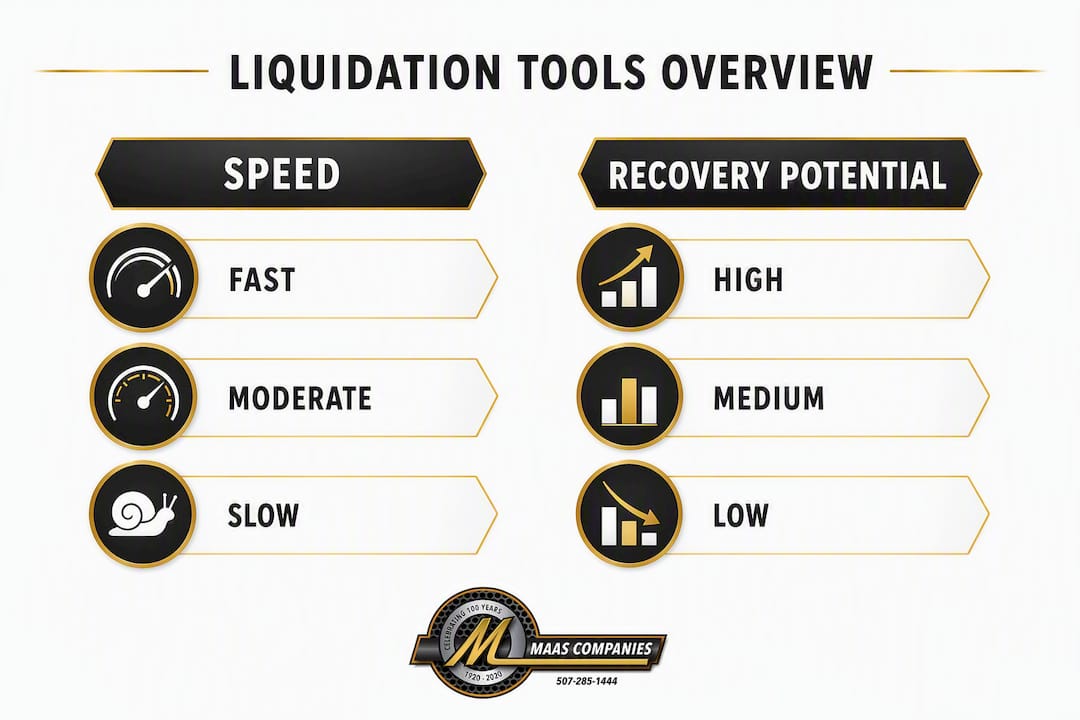
| Tool/Service | Speed | Recovery Potential | Seller Control | Primary Cost Driver |
|---|---|---|---|---|
| Managed auction | High | Moderate to high | Moderate | Commission + marketing |
| Negotiated private sale | Low | High | High | Broker fee + time |
| Scrap/salvage | Very high | Low | Low | Logistics/removal |
| Catalog + data room | N/A (multiplier) | High (additive) | High | Prep labor + photography |
| Logistics/decommissioning | N/A (enabler) | Protects value | Moderate | Rigging + transport |
How do you choose the right mix of tools for your asset?
Selection follows a straightforward matrix: value band × time pressure × buyer specificity. Apply it before issuing any RFP.
Asset and situation checklist:
- Asset value: higher-value assets and time allows → private sale or broker-led negotiation; urgent timeline → managed auction; poor condition with limited demand → scrap or salvage
- Condition and obsolescence: heavily worn or obsolete assets rarely justify private-sale timelines
- Regulatory constraints: court-ordered or lender-ordered dispositions may require competitive bid procedures
- Environmental and remediation needs: unresolved Phase II findings will delay any sale channel
- Buyer pool specificity: highly specialized process equipment demands targeted outreach to industry buyers, not a general auction
Questions to require in any vendor proposal:
- What is your documented recovery benchmark for comparable assets in the past 24 months?
- Which buyer databases and industry networks do you actively maintain?
- Who manages logistics, rigging, and removal, and are those contractors insured and bonded?
- What is your reporting cadence, and in what format are disposition reports delivered?
- Can you provide references from lender-ordered or court-ordered liquidations of similar scale?
Red flags to reject immediately: no auditable fee structure, vague buyer network claims with no named channels, no logistics capability or uninsured subcontractors, and reporting that cannot be formatted for examiner review.
What timeline and costs should you plan for?
Practitioner guidance maps disposition into four phases with distinct calendar windows and cost profiles.
| Phase | Duration | Primary Activities | Key Cost Categories |
|---|---|---|---|
| Immediate triage | Days 1–30 | Condition assessment, title, insurance, stabilization plan | Advisory retainer, appraisal, legal |
| Stabilization | Days 30–60 | Secure site, remediation scoping, valuation, hold-vs-sell model | Environmental, security, holding costs |
| Operational governance | Months 2–6 | Cataloging, marketing, buyer outreach, logistics planning | Marketing, catalog prep, storage |
| Disposition and settlement | Month 6 onward | Auction/sale execution, removal, final reporting | Commission, rigging, transport, title |
Recovery heuristics by channel: auction typically closes within a couple of months; private sale often requires a longer timeframe; scrap or salvage closes most quickly. Speed and recovery move in opposite directions. Faster channels compress the buyer pool and reduce competitive tension; slower channels allow targeted outreach to strategic buyers willing to pay above floor.
Primary cost drivers to budget: advisory/broker commission (typically percentage of gross proceeds), marketing and catalog production, logistics and rigging, environmental remediation, appraisal and legal fees, storage and holding costs, and a contingency reserve for title defects or removal complications.
A practical step-by-step workflow from intake to settlement
A documented intake-to-settlement workflow is standard practice for institutional liquidations. The steps below assign clear ownership and minimum deliverables at each stage.
- Intake and documentation — Asset manager: title report, insurance confirmation, initial inventory list, site access log
- Triage and stabilization — Advisory partner: condition assessment, liability register, preliminary valuation, written stabilization plan
- Valuation and hold-vs-sell decision — Appraiser + legal counsel: OLV/FLV appraisal, NPV model, asset committee sign-off
- Cataloging and data room — Sales/marketing lead: lot descriptions, photography, condition reports, data room population
- Channel selection and marketing — Advisory partner + sales lead: buyer outreach, auction portal listings, broker network activation
- Sale or auction execution — Advisory partner: bid management, reserve confirmation, buyer qualification
- Settlement and removal — Logistics/rigging + legal: payment confirmation, title transfer, removal coordination, site clearance
- Final reporting — Advisory partner: net recovery summary, decision log, examiner-ready disposition report
| Stage | Accountable Party | Minimum Deliverable |
|---|---|---|
| Intake | Lender asset manager | Title report, insurance confirmation |
| Stabilization | Advisory partner | Written stabilization plan |
| Valuation | Appraiser | OLV/FLV appraisal report |
| Cataloging | Sales/marketing lead | Lot descriptions, data room |
| Execution | Advisory partner | Signed purchase agreements |
| Removal | Logistics contractor | Site clearance certificate |
| Reporting | Advisory partner | Examiner-ready disposition report |
KPIs to monitor throughout: days-to-listing, bid coverage ratio, net recovery vs. appraised reserve, and total disposition cycle time.
Key Takeaways
Engaging a qualified advisory partner within 30 days of taking title, combined with a documented stabilization plan and auditable decision logs, is the single most reliable way to protect recovery value and regulatory standing in a distressed asset disposition.
| Point | Details |
|---|---|
| Engage within 30 days | Retain a qualified advisory partner immediately to prevent value erosion and satisfy OCC/FDIC examiner expectations. |
| Stabilization plan is non-optional | Document condition, title, liabilities, and hold-vs-sell NPV before any marketing begins. |
| Execution infrastructure wins | Auditable decision logs, vendor SLAs, and cadenced reporting determine regulatory defensibility more than strategy alone. |
| Match channel to asset profile | Auction suits urgent or broad-market assets (45–90 days); private sale fits high-value specialist equipment (90–180+ days); scrap closes fastest but at lowest recovery. |
| Maascompanies as strategic partner | Maascompanies manages auction and negotiated sale services for industrial plants, equipment, and commercial property, with documented workflows for lender-ordered and court-ordered liquidations. |
What most distressed liquidations get wrong
The failure mode I see most often is not a bad strategy. It is a gap between strategy and execution. A lender or sponsor will retain a capable advisor, approve a reasonable disposition plan, and then allow the process to stall for 60 or 90 days while internal approvals, title complications, or logistics gaps accumulate. By the time the asset reaches market, carrying costs have consumed a meaningful share of the projected recovery, and the buyer pool has moved on to other opportunities.
The second failure is documentation. Fiduciaries who cannot produce a dated decision log, a written hold-vs-sell analysis, or a vendor selection rationale are exposed in examiner reviews and, in contested dispositions, in court. The paperwork is not administrative overhead. It is the evidence that the institution acted prudently and in good faith.
Catalog quality is the third underestimated variable. A well-lotted, photographed, and described asset set consistently attracts more qualified bidders and reduces the due-diligence friction that kills deals at the finish line. Maascompanies has built its practice around exactly this combination: fast operational tempo, documented governance, and marketing that reaches the right buyers before the asset loses value.
Maascompanies: a qualified partner for institutional asset liquidation
When a plant closure, foreclosure, or restructuring puts industrial assets into your portfolio, the difference between a defensible recovery and a regulatory problem is often the quality of the partner you engage in the first 30 days.
Maascompanies manages auction and orderly negotiated sale services for industrial plants, equipment, real estate, and commercial properties across the United States and internationally. The firm’s experience spans court-ordered and lender-ordered liquidations, government foreclosure dispositions, and surplus asset marketing across manufacturing, energy, hospitality, healthcare, and agriculture. Every engagement includes a documented stabilization plan, PMO-style controls, insured logistics coordination, and audit-ready reporting formatted for examiner and fiduciary review.
If you are evaluating disposition options for a distressed industrial or commercial asset, submit your project details to receive a recovery assessment and a proposal tailored to your asset type, timeline, and regulatory requirements.
Useful sources and further reading
- Equipment Liquidation: How to Maximize ROI — Invrecovery: Equipment liquidation methods, timeline heuristics, and recovery benchmarks by disposition channel
- Managing Risk in the Civil and Construction Industries — Truck & Plant On-Demand™ Insurance: Logistics, rigging, and insurance coordination for heavy equipment and plant decommissioning
- Equipment Liquidation Workflow: Maximize Asset Recovery — Maascompanies: Intake-to-settlement workflow with roles, deliverables, and governance checkpoints
- Structured Liquidation Guide — Maascompanies: Operational checklists and structured disposition playbooks for manufacturing asset recovery
This article provides general informational guidance on distressed asset liquidation practices in the United States. It is not legal, financial, or regulatory advice. Confirm current OCC, FDIC, and applicable state requirements with qualified legal and financial professionals before making disposition decisions.
Recommended
- How Industrial Plant Liquidation Maximizes Recovery Value for Lenders | Blog | Insights on Asset Liquidation and Auction Trends
- Auction catalogs: The key to distressed asset liquidation | Blog | Insights on Asset Liquidation and Auction Trends
- Liquidation strategies to maximize distressed asset recovery | Blog | Insights on Asset Liquidation and Auction Trends
- Maximize Asset Recovery: Top Real Estate Liquidation Methods | Blog | Insights on Asset Liquidation and Auction Trends