

Blog
What Is a Negotiated Sale? A Guide for Asset Managers

TL;DR:
- A negotiated sale involves direct negotiation with a limited buyer or small group instead of an open auction. It prioritizes confidentiality, speed, and certainty, making it suitable for complex or time-sensitive assets. Proper preparation and process discipline help sellers maintain leverage and achieve better net outcomes.
A negotiated sale is defined as a method of asset disposition conducted through direct negotiation with a targeted buyer or a limited buyer universe, rather than through open competitive bidding. Unlike an auction, this process prioritizes confidentiality, execution speed, and certainty of close. Asset managers handling specialized industrial equipment, surplus government property, or time-sensitive plant closures rely on negotiated sales when a controlled transaction serves their recovery goals better than broad price discovery. The GSA’s 2026 guidelines recognize negotiated sales as a valid disposal method for unique or limited-interest assets where auctions are less effective.
What is a negotiated sale and how does it differ from an auction?
A negotiated sale, also called a bilateral negotiation or direct sale, is a transaction where the seller engages one buyer or a small group of pre-selected buyers to agree on price, terms, and structure through private dialogue. The seller controls who participates, what information is shared, and at what pace the deal moves. This stands in direct contrast to an auction, where the process is open, competitive, and driven by the highest bid at a fixed point in time.
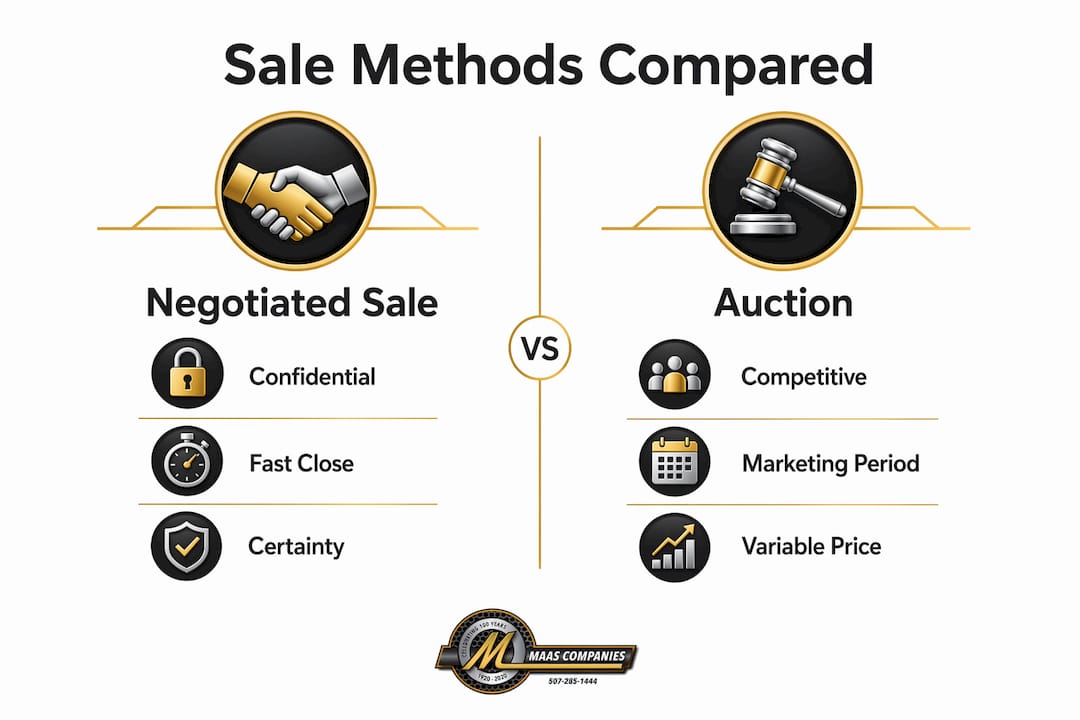
The core distinction is not just price mechanics. Negotiated sales prioritize confidentiality, execution speed, and certainty over the broad price discovery achieved in auctions. That priority shift changes everything about how a deal is structured, who is involved, and what the seller must prepare.
Auctions generate competitive tension that can push headline prices higher. Negotiated sales trade that tension for control. The seller chooses a buyer with the right strategic fit, operational capacity, or financing ability, and works toward a deal that closes reliably. For assets with a narrow buyer universe, such as a 3-MGY biodiesel equipment package or surplus switchgear, an auction may attract too few qualified bidders to generate meaningful competition anyway.
The decision between auction and negotiated sale should focus on financing needs, diligence complexity, confidentiality, and timing rather than solely headline valuation. That principle guides every serious asset manager’s process selection.
How does the negotiated sale process work?
The negotiated sale process follows a defined sequence, even though it lacks the formal structure of an auction timeline. Each stage requires deliberate preparation and clear communication between seller and buyer.
- Buyer identification. The seller, often working with an experienced marketing firm like Maascompanies, identifies buyers with a genuine strategic fit. This means buyers who can absorb the asset, finance the purchase, and close without extended contingencies.
- Confidential outreach. The seller approaches targeted buyers under a non-disclosure agreement. This protects sensitive operational data, customer relationships, and employee information from premature exposure.
- Preliminary offer and valuation. The buyer submits an indicative offer based on internal valuation. Because no competitive benchmark exists, sellers must offer clear rationale and defend asset value to justify pricing absent competitive pressure.
- Due diligence. The seller grants the buyer access to documentation, site visits, and technical data. The scope and timeline of diligence is negotiated, not dictated by a process calendar.
- Negotiation of terms. Price, payment structure, warranties, and transition arrangements are negotiated directly. This stage can include bespoke provisions such as management continuity, phased payments, or seller financing.
- Exclusivity and documentation. Once terms are agreed in principle, the seller may grant a short exclusivity period for final documentation. The negotiated sale agreement is then executed and the transaction closes.
Pro Tip: Keep the exclusivity period as short as operationally feasible. Extended exclusivity removes your ability to re-engage other buyers if the primary deal stalls, which shifts leverage to the buyer at the most critical stage.
The process is faster than a formal auction when both parties are prepared. It is also more flexible, allowing deal structures that a standard auction format cannot accommodate, such as tailored financing packages or equipment removal schedules tied to production cycles.

What are the benefits of negotiated sales versus auctions?
The primary benefits of negotiated sales center on confidentiality, speed, and certainty of close. Each benefit carries direct financial implications for the seller.
Confidentiality limits operational disruption
When a plant closure or equipment sale becomes public knowledge, the consequences are immediate. Employees begin looking for other jobs. Customers start qualifying alternative suppliers. Competitors use the information to poach accounts. Confidentiality in negotiated sales protects sensitive information and reduces operational distractions during critical asset sales. A controlled process keeps the business running at full capacity until the transaction closes.
Speed reduces carrying costs
Auction timelines are fixed and often lengthy. Marketing periods, bidder qualification, and post-auction closing procedures add weeks or months to a disposition. A negotiated sale can close in a fraction of that time when the seller is prepared and the buyer is motivated. Reduced carrying costs, including insurance, security, utilities, and property taxes, directly improve net recovery.
Certainty of close reduces execution risk
Negotiated sales increase closing certainty and reduce leakage, which can sometimes result in better net proceeds than auctions despite lower headline offers. Price tension creates headline spikes in auctions, but leakage and execution issues reduce net recovery. A negotiated sale balances these factors by securing a committed buyer before the process becomes public.
Trade-offs to acknowledge
Negotiated sales are not the right tool for every situation. The key trade-offs include:
- No competitive price tension. A single buyer knows there is no competing bid. That knowledge affects their opening offer and their willingness to move on price.
- Valuation risk. Without market-tested pricing, the seller must rely on internal analysis and advisor expertise to defend value.
- Buyer leverage in diligence. A motivated buyer in a one-on-one process may use the diligence stage to renegotiate price downward based on findings.
The choice of sale process is a strategic lever that directly impacts price, leverage, timing, and deal certainty. Treating it as a default rather than a deliberate decision is the most common mistake asset managers make.
What are the key risks and how do sellers maintain leverage?
The biggest risk in a negotiated sale is losing competitive pressure. Buyers in a one-on-one process may demand excessive diligence access or use findings to push for price reductions that would not survive in a competitive process. Managing this risk requires preparation before the first conversation with a buyer.
Key practices to maintain seller leverage include:
- Complete pre-deal diligence internally. Clean data, accurate asset inventories, and resolved title issues prevent buyers from using diligence findings as a renegotiation tool.
- Prepare a credible fallback. Maintaining credible fallback options preserves seller leverage even when only one buyer is involved. The fallback does not need to be a formal auction. It needs to be believable.
- Shift leverage to information advantage. Understanding the buyer’s synergies, financing constraints, and internal approval timelines gives the seller negotiating power that replaces competitive price tension.
- Control the diligence scope. Define what information the buyer receives and when. Staged disclosure tied to deal milestones prevents the buyer from accumulating information without advancing toward close.
- Limit exclusivity duration. Short exclusivity windows preserve the seller’s ability to re-engage alternative buyers if the primary deal stalls.
Pro Tip: Before entering exclusivity, confirm the buyer has internal approval authority and financing in place. A buyer who needs three more sign-offs after exclusivity begins will use that time to renegotiate, not to close.
Successful negotiated sales require sufficient pre-deal diligence, credible fallback options, and process discipline to avoid buyer dominance. Preparation is the seller’s primary source of leverage in a bilateral process.
When is a negotiated sale the preferred method for asset disposition?
Certain asset profiles and transaction circumstances make a negotiated sale the clear choice over an auction. The following scenarios consistently favor direct negotiation:
- Specialized or niche assets. Equipment with a limited buyer universe, such as ethanol distillation equipment or surplus GE switchgear, may attract only two or three qualified buyers globally. An auction with three bidders generates minimal competitive tension and may not justify the marketing cost.
- Confidentiality requirements. Transactions involving active facilities, sensitive customer data, or regulated assets require controlled information flow that an open auction cannot provide.
- Complex deal structures. Negotiated sales excel for assets needing complex underwriting, bespoke diligence, and structural solutions over price discovery. Management continuity arrangements and tailored financing packages are examples that auctions cannot accommodate.
- Time-sensitive dispositions. Plant closures with fixed lease termination dates, bankruptcy proceedings with court-imposed timelines, or restructuring events with lender deadlines all favor the faster execution of a negotiated process.
- Government surplus property. GSA guidelines recognize negotiated sales as valid for disposing of specialized or surplus government assets where auctions are less effective. Direct negotiation allows price setting between the disposing authority and an interested party, particularly for unique assets.
The process choice between auction and negotiated sale depends on company readiness and buyer universe, not a one-size-fits-all rule. Auctions suit multiple buyers and maximum price tension. Negotiated sales fit when confidentiality and buyer fit are the priorities.
Key Takeaways
A negotiated sale delivers superior net outcomes when confidentiality, speed, and deal certainty matter more than generating competitive price tension through an open auction process.
| Point | Details |
|---|---|
| Negotiated sale definition | A direct transaction with one or few buyers that prioritizes confidentiality, speed, and certainty over open bidding. |
| Best use cases | Specialized assets, niche buyer universes, time-sensitive closures, and transactions requiring bespoke deal structures. |
| Net outcome advantage | Reduced carrying costs and deal leakage can produce better net recovery than a higher auction headline price. |
| Seller leverage | Pre-deal diligence, credible fallback options, and controlled exclusivity protect the seller in a one-on-one process. |
| Process discipline | Defining diligence scope and limiting exclusivity duration are the two most effective tools for maintaining deal momentum. |
Why I think most asset managers underestimate the negotiated sale
After working through dozens of complex industrial dispositions, the pattern I see most often is this: sellers default to auctions because auctions feel objective. There is a date, a room, and a number. The process appears to remove subjectivity from the outcome. That comfort is real, but it is not always rational.
The assets that generate the best net recovery through negotiated sales are almost always the ones where the buyer’s internal valuation far exceeds the market clearing price. A buyer who needs a specific piece of equipment to complete a production line will pay more than the market average, but only if you find them before they know you are selling. An auction announcement tells every potential buyer that you are motivated, and it tells them exactly when your leverage expires.
What I have found is that the sellers who achieve the best outcomes in negotiated processes are not the ones with the most sophisticated legal teams. They are the ones who did their homework before the first call. They know their asset’s replacement cost, its operating history, and the two or three buyers for whom it creates the most value. That preparation is what replaces competitive price tension in a bilateral process.
The uncomfortable truth is that a negotiated sale rewards sellers who treat disposition as a sales process, not an administrative task. Reviewing your industrial plant sale checklist before engaging any buyer is not optional. It is the difference between a controlled transaction and an expensive lesson in buyer leverage.
— Vector
How Maascompanies manages negotiated sales for complex assets
Maascompanies brings decades of experience to negotiated asset dispositions across industrial plants, specialized manufacturing equipment, and commercial real estate. The firm’s process combines targeted buyer identification, confidential outreach, and disciplined deal management to protect seller leverage from first contact through closing.

For asset managers handling time-sensitive or technically complex dispositions, Maascompanies provides the marketing reach and transaction expertise to execute a negotiated sale without sacrificing net recovery. Past projects include orderly negotiated sales of biodiesel equipment packages and surplus industrial assets across multiple sectors. To discuss your current disposition requirements or review active projects, visit the sell industrial equipment page or explore current listings directly.
FAQ
What is the negotiated sale definition in asset management?
A negotiated sale is a disposition method where the seller engages one or a limited number of pre-selected buyers through direct negotiation rather than open competitive bidding. The process prioritizes confidentiality, speed, and certainty of close over maximum price discovery.
How does a negotiated sale differ from an auction?
An auction generates competitive price tension through open bidding among multiple qualified buyers, while a negotiated sale involves direct dialogue with a targeted buyer or small buyer group. Auctions maximize headline price potential; negotiated sales maximize control, speed, and closing certainty.
What does a negotiated sale agreement typically include?
A negotiated sale agreement covers purchase price, payment terms, asset warranties, diligence conditions, exclusivity provisions, and transition arrangements. Bespoke terms such as seller financing or management continuity clauses are common in complex industrial transactions.
When should an asset manager choose a negotiated sale over an auction?
A negotiated sale is the preferred method when the asset has a narrow buyer universe, requires confidentiality, involves complex deal structuring, or must close within a compressed timeline. GSA guidelines also recognize negotiated sales for specialized or surplus government property where auctions are less effective.
What is the biggest risk in a negotiated sale process?
The biggest risk is losing competitive pressure, which can empower the buyer to demand excessive diligence access or push for price reductions. Sellers mitigate this risk through pre-deal preparation, credible fallback options, and disciplined control of exclusivity and information disclosure.
Recommended
- What Is Forced Sale? A Guide for Asset Managers | Blog | Insights on Asset Liquidation and Auction Trends
- Auction Versus Private Treaty Explained for Asset Sellers | Blog | Insights on Asset Liquidation and Auction Trends
- Asset Sale Benefits 2026: A Strategic Guide for Sellers | Blog | Insights on Asset Liquidation and Auction Trends
- Step-by-step asset auction guide for maximizing recovery | Blog | Insights on Asset Liquidation and Auction Trends