

Blog
What Is an Auction Reserve? A Guide for Investors

TL;DR:
- An auction reserve is a confidential minimum price that a seller requires before an item can be sold, protecting against below-floor bids. Bidders should differentiate between the public starting bid and the hidden reserve, which influences their bidding strategy and maximum bid calculations. Transparent reserve communication enhances bidder trust and market efficiency, while strategic reserve setting maximizes seller value.
An auction reserve is the confidential minimum price a seller agrees to accept before an item can sell at auction. Known formally as the reserve price, it functions as a behind-the-scenes safeguard that protects sellers from accepting bids below an acceptable floor value. Reserve pricing applies across industrial equipment liquidations, real estate dispositions, and collectibles auctions alike. Understanding what is an auction reserve, how it differs from starting bids and guide prices, and how it shapes bidding behavior is critical knowledge for any investor or buyer participating in competitive auction markets.
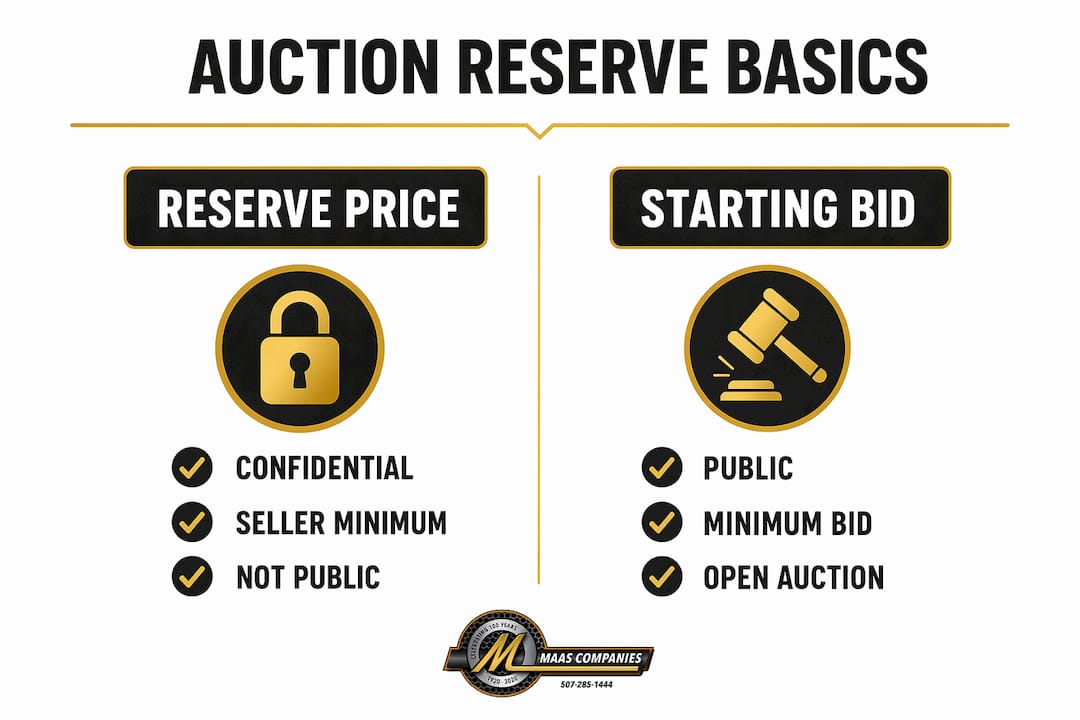
What is an auction reserve and how does it differ from a starting bid?
An auction reserve and a starting bid are two distinct parameters that serve different purposes in the auction process. Reserve and starting bid are separate auction parameters, and confusing them leads to miscalculated bids and missed opportunities.

The starting bid is the public minimum amount required to open bidding on a lot. Auctioneers often set it well below the reserve to generate early participation and build momentum in the room or online. The reserve price, by contrast, is the confidential threshold that must be met before the seller is obligated to complete the sale. If bidding closes below the reserve, the seller is not obligated to transfer the asset, and the lot may be withdrawn unsold.
A third figure, the guide price or estimate, is a public marketing figure published to indicate the expected sale range. The table below clarifies how these four price points relate to one another:
| Price point | Definition | Visible to bidders? |
|---|---|---|
| Starting bid | Minimum bid to open the auction | Yes |
| Guide price / estimate | Published marketing range | Yes |
| Reserve price | Confidential minimum for sale | No |
| Hammer price | Final accepted bid | Yes (at close) |
The practical implication for investors is clear: the starting bid tells you where bidding begins, not where it needs to go. The guide price vs reserve price distinction matters most when calculating a maximum bid, because reserves can be set above the low end of the published estimate range.
Why sellers set reserve prices and the strategic considerations involved
Sellers set reserve prices to manage downside risk in an inherently uncertain price discovery process. Without a reserve, a seller of a $2 million processing plant could theoretically be bound to accept a $400,000 bid if no other offers materialize. The reserve eliminates that exposure.
Confidentiality is a deliberate design choice. Publishing the reserve would anchor bidder expectations at that number, suppressing competitive bidding above it. By keeping the reserve private, sellers allow the market to bid freely, which can produce outcomes above the floor. This dynamic is particularly relevant in industrial asset auctions, where equipment valuations depend on condition, market timing, and buyer-specific utility.
Key strategic considerations when setting a reserve include:
- Valuation accuracy. Reserves set too high relative to market conditions result in passed lots and carrying costs that erode net recovery.
- Market timing. Reserves should reflect current demand, not historical book value or replacement cost.
- Auction format. Online timed auctions, live events, and sealed-bid formats each carry different bidder pools and reserve dynamics.
- Asset class. Industrial equipment, real estate, and specialty assets each have distinct valuation methodologies that should inform reserve levels.
Pro Tip: When setting a reserve for industrial equipment, base it on recent comparable sales data rather than depreciated book value. Book value rarely reflects what an active buyer pool will pay in a competitive liquidation.
A reserve that is calibrated too aggressively can damage auction outcomes. Bidders who sense a reserve is unreachable often disengage entirely, reducing competitive pressure and final sale prices.
How auction reserves impact bidder behavior and bidding strategies
Auction reserves influence bidder behavior by creating deliberate uncertainty. Bidders know a reserve exists but do not know its level, which forces them to make probabilistic judgments about where the threshold sits relative to their own valuation.
This uncertainty produces two distinct bidding patterns. In the first, bidders probe aggressively early to test whether the reserve is within reach, hoping to trigger a “reserve met” signal from the auctioneer. In the second, bidders hold back, waiting to see whether others push bids high enough to confirm the lot is actually for sale. Both behaviors affect price discovery and final outcomes.
No-reserve auctions operate differently. No-reserve lots create more buzz and competitive bidding because every participant knows the item will sell regardless of price. This certainty removes hesitation and often produces faster, more aggressive bidding sequences. For sellers, the tradeoff is accepting full market risk with no floor protection.
Bidding dynamics around the reserve create psychological effects that cause bids to either surge rapidly near the threshold or stall below it, with no obligation for sale if the reserve is unmet. Investors who understand this pattern can use it tactically.
Pro Tip: Watch for the auctioneer’s language during a live event. Phrases like “we’re getting closer” or “the seller is considering” often signal that bidding is approaching but has not yet met the reserve. This is the moment to assess whether your maximum bid is still competitive.
Practical bidder strategies for reserve auctions include:
- Treat the low guide estimate as a floor, not a ceiling, when calculating your maximum bid.
- Factor in the possibility that the reserve sits above the published estimate range.
- Monitor bidding pace. A sudden slowdown often indicates bids have stalled below the reserve.
- Communicate with the auction house before the event when permitted. Some houses will confirm whether a reserve is “in the room” without disclosing the exact figure.
- Use absentee bidding strategies to set a maximum that accounts for reserve uncertainty without overexposing your position.
What are regional or industry-specific rules affecting auction reserves?
Reserve pricing is not uniformly regulated across jurisdictions or asset classes, and the rules that do exist vary significantly in their scope and enforcement. Investors operating across multiple markets need to understand the regulatory framework that applies to each auction context.
The most cited example is the UK’s Royal Institution of Chartered Surveyors (RICS) guidance for property auctions. RICS rules require reserves to be set within 10% above the published guide price or within the published guide range. The purpose is consumer protection: buyers should not be drawn to an auction by a low guide price only to find the reserve is set far above it. This rule provides bidders with a predictable parameter for estimating where the reserve sits.
In Australia, a proposed shift toward disclosed reserve prices in Victoria generated significant debate. Auctioneers reported that disclosed reserves change sales outcomes by anchoring bidder expectations, leading to more passed lots and lower competitive pressure in some cases. The experience illustrates that transparency in reserve pricing is not automatically beneficial to either party.
In the United States, reserve auction rules are largely governed by individual auction house policies and state-level regulations rather than a single national standard. Industrial and equipment auctions conducted by firms like Maascompanies operate under their own disclosed terms, which buyers should review before participating. GSA Auctions for government surplus assets follow federal procurement rules that may include specific reserve or minimum bid requirements distinct from private sector practice.
The practical takeaway for investors is to review the specific auction terms and conditions for each event, confirm whether the reserve is disclosed or confidential, and understand the regulatory framework governing the jurisdiction and asset class before placing any bid.
How investors should approach reserve auctions strategically
Effective reserve auction strategy begins with separating the guide estimate from the reserve price in your pre-auction analysis. Reserves can be set above estimates and directly impact bidding strategy, so investors who treat the low estimate as the reserve will consistently underbid and miss acquisitions.
A structured approach to reserve auction participation includes the following steps:
- Research comparable sales. Identify recent transaction prices for similar assets in similar condition. This gives you an independent valuation anchor separate from the published estimate.
- Set a maximum bid before the auction. Decide your ceiling based on your own valuation, not on competitive pressure during the event. Emotional bidding above your ceiling rarely produces good outcomes.
- Account for reserve uncertainty. Build a buffer above the low estimate into your maximum bid calculation. In property auctions governed by RICS rules, the reserve will be no more than 10% above the guide price, giving you a calculable upper bound.
- Monitor reserve signals during the auction. Auctioneers typically signal when the reserve has been met. Until that signal, the lot is not confirmed for sale and bidding is exploratory.
- Evaluate the no-sale scenario. If the reserve is not met, some auction houses allow post-auction negotiation with the seller. Knowing this option exists changes how aggressively you bid during the live event.
- Review auction terms in advance. Confirm whether the reserve is disclosed, whether the auction house charges a buyer’s premium, and what the payment and removal timeline requires. Understanding how to choose the right auction format for your acquisition goals reduces surprises on auction day.
Pro Tip: For industrial asset auctions, request an equipment inspection before the event. Your maximum bid should reflect actual condition, not the catalog description. A reserve that looks aggressive on paper may be reasonable for an asset in exceptional operating condition.
Reserve prices remain confidential throughout the sale, meaning bidders rely on published estimates and bidding activity to gauge proximity to the threshold. Investors who develop a disciplined pre-auction research process are consistently better positioned than those who rely on in-room signals alone.
Key takeaways
An auction reserve is the confidential minimum price a seller must receive before a lot transfers, and understanding its mechanics is the single most important factor in developing an effective bidding strategy.
| Point | Details |
|---|---|
| Reserve vs. starting bid | The starting bid opens bidding; the reserve is the confidential threshold that must be met for a sale to complete. |
| Seller risk management | Reserves protect sellers from below-floor outcomes, particularly in industrial and real estate liquidations where asset values are significant. |
| Bidder strategy | Plan your maximum bid above the low guide estimate, accounting for the possibility that the reserve exceeds the published range. |
| Regulatory variation | Rules like RICS guidance in the UK cap reserves at 10% above guide price; U.S. industrial auctions follow house-specific terms. |
| Reserve signals | Monitor auctioneer language and bidding pace during live events to gauge proximity to the reserve threshold. |
Why reserve transparency matters more than most bidders realize
After years of working across industrial liquidations and equipment dispositions, the pattern that stands out most is not the complexity of reserve mechanics. It is how often experienced investors still conflate guide prices with reserves and then express frustration when lots pass unsold or when they lose acquisitions they believed were within reach.
Transparent communication about reserve presence without disclosing the amount fosters bidder trust and healthier auction environments. Auction houses that clearly communicate that a reserve exists, even without stating the figure, give bidders the confidence to participate fully rather than holding back out of uncertainty about whether the lot is genuinely available.
The no-reserve versus reserve debate is often framed as a binary choice, but the reality is more nuanced. No-reserve auctions generate excitement and certainty of sale, which is valuable when speed of disposition matters more than price maximization. Reserve auctions protect seller value, which is the priority when assets carry significant carrying costs or when the seller has a defined recovery target tied to debt obligations or restructuring requirements.
The future of reserve pricing in industrial and commercial auctions will likely move toward greater transparency, not less. Bidder education reduces friction, increases participation, and ultimately produces better price discovery for both parties. Sellers who work with experienced auction partners to calibrate reserves accurately, rather than setting aspirational floors, consistently achieve better recovery outcomes than those who treat the reserve as a negotiating position rather than a market-informed floor.
— Vector
Work with Maascompanies on your next asset disposition
Maascompanies brings decades of experience managing reserve-based auctions for industrial plants, processing facilities, and commercial real estate across North America and internationally. The firm’s approach to reserve setting is grounded in current market data, comparable transaction analysis, and a deep understanding of the bidder pools that drive competitive outcomes in each asset class.

Whether you are liquidating surplus equipment, closing a facility, or managing a structured asset recovery, Maascompanies designs auction programs that protect seller value while maximizing bidder engagement. Current projects include an active biodiesel plant auction and a zein extraction process auction in Illinois, both structured with strategic reserve pricing to drive maximum recovery. If you are ready to discuss your asset disposition goals, visit the sell industrial equipment page to connect with the Maascompanies team directly.
FAQ
What is an auction reserve in simple terms?
An auction reserve is the minimum price a seller agrees to accept before an item can sell. If bidding does not reach this confidential threshold, the seller is not obligated to complete the sale.
What is the difference between reserve and no-reserve auctions?
A reserve auction requires bids to meet a confidential minimum before the sale is confirmed. A no-reserve auction guarantees the item sells to the highest bidder regardless of the final price, which typically generates more aggressive bidding.
Is the reserve price the same as the starting bid?
No. The starting bid is the public minimum required to open bidding, often set below the reserve to stimulate participation. The reserve is a separate, confidential figure that must be met for the sale to complete.
Can a seller change the reserve price before the auction?
Some auction houses allow reserve adjustments before the event based on updated market conditions or seller instructions. Buyers should review the specific auction terms and conditions to understand the policies that apply.
How can bidders estimate where the reserve is set?
Bidders can use the published guide price as a reference point. Under RICS guidelines in the UK, reserves must be within 10% above the guide price, giving bidders a calculable upper bound. In other jurisdictions, monitoring bidding pace and auctioneer signals during the event provides the most reliable indication of proximity to the reserve.
Recommended
- Auction absentee bidding: strategies for industrial equipment | Blog | Insights on Asset Liquidation and Auction Trends
- Real estate auctions: Fast liquidation for industrial assets | Blog | Insights on Asset Liquidation and Auction Trends
- Auction strategies for small businesses: Maximize asset recovery | Blog | Insights on Asset Liquidation and Auction Trends
- Top reasons to buy at auction: maximize value & cut risk | Blog | Insights on Asset Liquidation and Auction Trends