

Blog
What Is Compliance in Liquidation: A 2026 Guide

TL;DR:
- Compliance in liquidation involves strict adherence to legal, financial, and procedural obligations that ensure proper asset sales and debt settlement.
- Failing to meet deadlines or maintaining proper records can lead to personal liability, criminal charges, or disqualification for directors.
Compliance in liquidation is the strict adherence to all legal, financial, and procedural obligations that govern how a company’s assets are sold, debts are settled, and the entity is formally wound down. The term used across insolvency practice is liquidation legal compliance, and it covers everything from statutory filing deadlines to fiduciary duties owed to creditors and regulators. For investors, business owners, and financial professionals, understanding these obligations is not optional. Failures trigger personal liability, criminal charges, and prolonged tax complications that outlast the company itself. Frameworks such as the U.S. Internal Revenue Code, the UK Insolvency Act 1986, India’s IBBI regulations, and Australia’s Corporations Act each impose distinct but parallel obligations on directors, liquidators, and stakeholders.
What are the key compliance requirements during liquidation?
Liquidation compliance process begins the moment a dissolution plan is adopted, and the deadlines are unforgiving. In the United States, corporations must file IRS Form 966 within 30 days of adopting a plan of dissolution or liquidation. Missing that window does not simply result in a fine. The IRS continues to expect annual tax returns from the corporation, creating an open-ended tax obligation that can persist for years.
In the United Kingdom, the obligations are equally time-sensitive. Directors in a Creditors’ Voluntary Liquidation must deliver a verified Statement of Affairs within 14 days, and in compulsory liquidation within 21 days. Failure to meet either deadline is a criminal offense, not a civil penalty. The Statement of Affairs is a sworn, legally binding document, and inaccuracies carry their own criminal exposure for directors who sign it.
Key compliance requirements across most jurisdictions include:
- Statutory filings: Submit dissolution plans, statements of affairs, and tax forms within prescribed deadlines.
- Creditor notifications: Formally notify all known creditors of the liquidation, including the method and timeline for submitting claims.
- Regulatory reporting: File required reports with bodies such as the IRS, Companies House in the UK, or the IBBI in India.
- Priority payment order: Distribute assets to creditors in the legally mandated sequence. Improper payments create personal liability for directors and liquidators.
- Liquidator fee approval: Liquidator fees require approval from creditors or the court, and excessive fees can be challenged and reduced.
Pro Tip: Retain a licensed insolvency practitioner before the dissolution plan is formally adopted. Engaging qualified counsel at that stage preserves the 30-day IRS Form 966 window and prevents the most common filing failures.
How do fiduciary duties and director obligations relate to liquidation compliance?
Directors do not shed their legal responsibilities the moment a liquidator is appointed. Under Section 235 of the UK Insolvency Act 1986, directors retain statutory duties to cooperate with the liquidator, produce documents, and attend interviews when required. Non-cooperation is a criminal offense. This obligation extends to former directors and any person who has been involved in the company’s management.
The practical implications are significant. Directors must:
- Deliver all company records to the liquidator promptly, including financial statements, contracts, and correspondence.
- Attend interviews when summoned by the liquidator to explain transactions or decisions made before insolvency.
- Preserve board meeting minutes as primary evidence of fiduciary compliance. Board minutes serve as critical proof in legal challenges and disqualification proceedings.
- Avoid preferential payments to connected parties in the period before liquidation, as these are subject to reversal.
- Cooperate with conduct investigations without obstruction. Liquidators have the authority to investigate wrongful trading and report misconduct to the Insolvency Service under the Company Directors Disqualification Act.
A liquidator must file a conduct report on directors’ actions post-liquidation. That conduct report forms the direct basis for potential disqualification proceedings, which can bar a director from managing any company for up to 15 years in the UK.
Pro Tip: Directors should treat every communication with the liquidator as a formal legal interaction. Verbal assurances carry no weight. Confirm all disclosures and document submissions in writing.
What are the common compliance challenges and risks in liquidation?
The most frequent compliance failures in liquidation are not deliberate. They stem from poor record-keeping, missed deadlines, and underestimating the scope of obligations. Each carries consequences that extend well beyond the company itself.
Common risks include:
- Missing critical filing deadlines: A missed IRS Form 966 filing means the IRS continues to expect annual returns from a dissolved corporation, creating ongoing tax exposure with no automatic resolution.
- Incomplete or inaccurate statements of affairs: Errors in this sworn document expose directors to criminal liability. Liquidators treat inaccuracies as evidence of misconduct, not administrative error.
- Inadequate creditor claim validation: Accepting inflated or fraudulent creditor claims reduces distributions to legitimate creditors and can expose the liquidator to personal liability.
- Missing or incomplete corporate records: Record-keeping failures are treated as conduct issues and can trigger director disqualification regardless of whether fraud occurred. The absence of records is itself evidence of mismanagement.
- Breaching the priority payment order: Paying shareholders before all creditor classes are satisfied is a direct compliance breach. Liquidators who permit this face personal liability.
- Non-cooperation triggering disqualification: Refusal to provide documents or attend liquidator interviews is broadly criminalized and accelerates disqualification proceedings.
The cumulative effect of these failures is severe. A director facing disqualification loses the ability to serve as a director or take part in company management across all entities, not just the one in liquidation.
How does compliance in liquidation vary internationally?
Liquidation and regulatory compliance frameworks share common principles but differ significantly in procedure, timelines, and enforcement mechanisms across jurisdictions.
| Jurisdiction | Governing Framework | Key Compliance Obligation | Penalty for Non-Compliance |
|---|---|---|---|
| United States | Internal Revenue Code | File IRS Form 966 within 30 days of dissolution plan | Ongoing tax obligations; IRS penalties |
| United Kingdom | Insolvency Act 1986 | Statement of Affairs within 14–21 days; director cooperation | Criminal offense; director disqualification |
| India | IBBI Liquidation Regulations | File forms LIQ-1 to LIQ-4 electronically | 500 rupees per form per month delay |
| Australia | Corporations Act 2001 | Simplified liquidation with creditor approval thresholds | Full liquidation required if 25% of creditors object |
The UK framework places the heaviest burden on directors personally, with criminal liability for non-cooperation codified directly in statute. The U.S. framework centers on tax compliance, where the IRS Form 966 filing is the critical trigger. India’s IBBI system uses electronic filing with per-form monthly penalties, creating a recurring cost for delays rather than a single enforcement action. Australia’s simplified liquidation process reduces compliance burdens for smaller insolvencies, but that pathway closes if creditors holding more than 25% of the debt object to it.
For companies with operations in multiple countries, each jurisdiction’s requirements apply independently. A U.S. parent company liquidating a UK subsidiary must satisfy both IRS obligations and UK Insolvency Act requirements simultaneously. Engaging practitioners licensed in each relevant jurisdiction is not a precaution. It is a requirement.
What practical steps should stakeholders take to ensure smooth compliance?
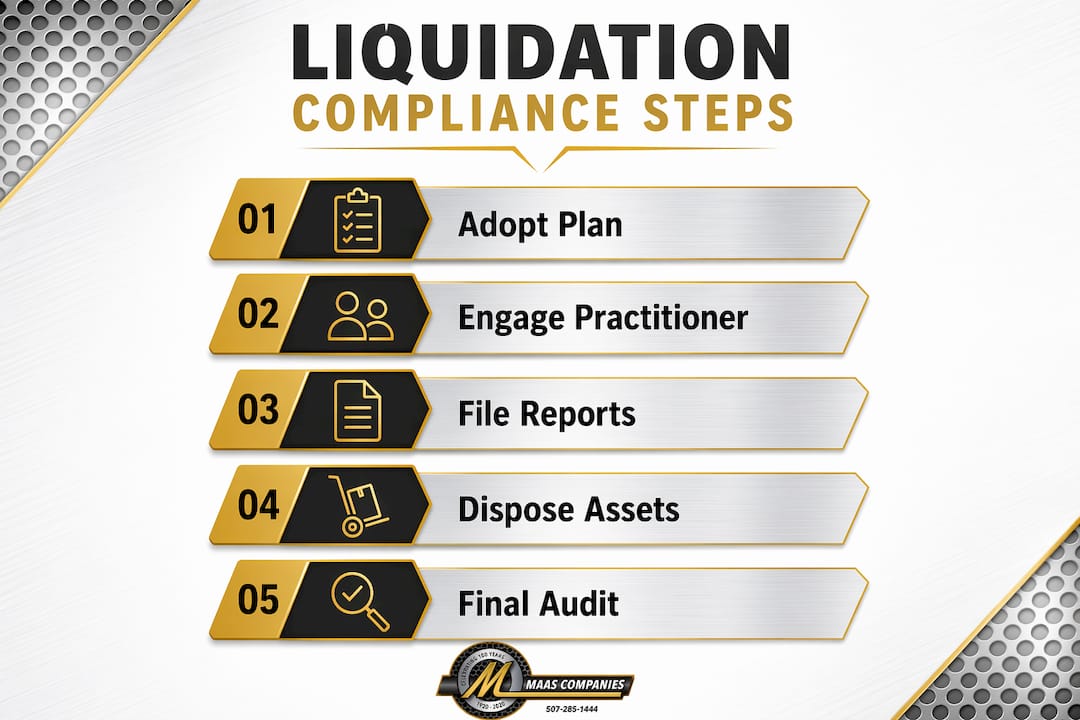
Ensuring compliance in liquidation requires deliberate preparation, not reactive management. The following steps apply to investors, business owners, and financial professionals managing or overseeing a wind-down.
- Engage a licensed insolvency practitioner early. Qualified practitioners understand jurisdiction-specific deadlines and filing requirements. They also serve as the statutory interface between the company, creditors, and regulators.
- Centralize all corporate records immediately. Gather financial statements, board minutes, contracts, tax filings, and asset registers before the liquidation formally begins. Gaps discovered after appointment are harder to explain and more damaging to compliance standing.
- Communicate proactively with creditors. Regular, documented communication reduces the risk of creditor disputes and demonstrates good faith. Creditors who feel informed are less likely to challenge distributions or file objections.
- File all statutory documents on time. Build a compliance calendar that maps every filing deadline from the date the dissolution plan is adopted. Assign responsibility for each submission to a named individual.
- Prepare for liquidator inquiries and audits. Directors should expect detailed questions about pre-insolvency transactions, related-party dealings, and asset valuations. Preparation reduces the risk of answers that inadvertently suggest misconduct.
- Use professional asset disposal services. Compliant asset recovery processes require transparent valuation, documented sale procedures, and proper distribution of proceeds. Professional auction and asset sale services provide the paper trail that regulators and creditors require.
Pro Tip: Build your compliance calendar backward from the dissolution date. Map every deadline, assign ownership, and set internal review checkpoints two weeks before each filing is due.
Key Takeaways

Compliance in liquidation is a legal obligation with direct personal consequences for directors and liquidators, not an administrative formality that can be managed after the fact.
| Point | Details |
|---|---|
| Filing deadlines are firm | IRS Form 966 is due within 30 days; UK Statement of Affairs within 14–21 days; missing either triggers penalties or criminal liability. |
| Directors retain duties post-appointment | Non-cooperation with a liquidator is a criminal offense under UK law and accelerates disqualification proceedings. |
| Record-keeping gaps carry independent risk | Missing corporate records are treated as conduct failures and can trigger disqualification regardless of fraud. |
| International frameworks differ significantly | Each jurisdiction applies its own deadlines, forms, and penalties; multi-jurisdiction liquidations require practitioners in each country. |
| Professional asset disposal supports compliance | Documented, transparent sale processes provide the audit trail creditors and regulators require for fair distribution. |
Why compliance in liquidation deserves more attention than it gets
Most business owners treat liquidation compliance as a checklist to hand off to an attorney. That instinct is understandable, but it misreads where the real risk sits. The legal exposure in a liquidation does not fall primarily on the insolvency practitioner. It falls on the directors, and it follows them personally long after the company ceases to exist.
The cases I find most instructive are not the fraud cases. They are the cases where directors acted in good faith, cooperated reasonably, but failed to maintain adequate records. Courts and regulators do not distinguish easily between negligence and misconduct when the documentation is absent. A director who cannot produce board minutes, cannot explain a pre-insolvency asset transfer, or cannot account for a creditor payment is in a difficult position regardless of intent.
The other misconception I encounter regularly is that simplified liquidation pathways eliminate compliance obligations. They reduce them in scope, but the threshold for accessing those pathways is strict. In Australia, a single creditor group holding 25% of the debt can force a full liquidation with the complete compliance burden attached. Assuming the simplified route is available before confirming creditor positions is a planning failure.
Technology has improved compliance tracking materially. Electronic filing systems in jurisdictions like India’s IBBI framework create automatic timestamps and penalty calculations, which removes ambiguity about whether a filing was late. That is genuinely useful. But technology does not replace the judgment required to identify which transactions need to be disclosed, which creditor claims need to be challenged, and which asset valuations will withstand scrutiny. That judgment comes from experienced practitioners, not software.
— Vector
How Maascompanies supports compliant asset liquidation
Liquidation compliance does not end with legal filings. The asset disposal process itself must be transparent, documented, and defensible to creditors and regulators. Maascompanies works with business owners, lenders, and financial professionals to manage the sale of industrial plants, equipment, and commercial properties through structured auction and negotiated sale processes that meet the evidentiary standards regulators require.

From biodiesel plants to manufacturing facilities, Maascompanies brings the marketing reach and procedural discipline that complex liquidations demand. Current projects, including a 3-MGY Biodiesel Plant auction and a former INEOS biorefinery sale, demonstrate the scale and compliance discipline Maascompanies applies to every engagement. Contact Maascompanies to discuss how structured asset disposal supports your liquidation compliance obligations.
FAQ
What does compliance mean in liquidation?
Compliance in liquidation means adhering to all legal, financial, and procedural obligations required to lawfully wind down a company, including statutory filings, creditor notifications, and asset distribution in the correct priority order.
What is IRS Form 966 and when must it be filed?
IRS Form 966 is the U.S. corporate dissolution filing that must be submitted within 30 days of adopting a plan of liquidation. Failure to file causes the IRS to continue expecting annual tax returns from the dissolved corporation.
Can a director be personally liable for compliance failures in liquidation?
Yes. Directors can face criminal charges for non-cooperation with a liquidator, personal liability for improper asset distributions, and disqualification from serving as a director for up to 15 years under UK law.
How do compliance requirements differ between voluntary and compulsory liquidation?
In the UK, directors in a Creditors’ Voluntary Liquidation must file a Statement of Affairs within 14 days, while compulsory liquidation allows 21 days. Both deadlines carry criminal penalties for non-compliance.
How does professional asset disposal support liquidation compliance?
Professional auction and asset sale services provide documented valuation, transparent sale procedures, and a clear audit trail for proceeds distribution, all of which satisfy the evidentiary standards that creditors and regulators require during a liquidation review.
Recommended
- Liquidation sales explained: Maximize asset recovery | Blog | Insights on Asset Liquidation and Auction Trends
- Plant liquidation strategies: maximize recovery in 2026 | Blog | Insights on Asset Liquidation and Auction Trends
- Equipment liquidation explained: maximizing asset recovery | Blog | Insights on Asset Liquidation and Auction Trends
- How to Plan Government Asset Sales for Spring 2026 | Blog | Insights on Asset Liquidation and Auction Trends